

The crypto market has been in the doldrums for the past two weeks. With the exception of a few minor cryptocurrencies that made a brief breakout, most of the major currencies continued to decline under the influence of political instability and macro uncertainty, and the market sentiment has clearly weakened. Fear and greed indices have also dropped from greed to fear, reflecting a renewed contraction in capital risk appetite. Looking at the data on the chain, profits have risen sharply in a short period of time, indicating that the market is still in a stage of deleveraging and restructuring, and the currency may still need time to absorb the pressure. However, when the camera turns to the other end of the market, the drama is completely opposite. U.S. stocks and precious metals have continued to strengthen, with gold once exceeding US$5,500 per ounce and silver surging to a record high of US$120 per ounce. But in a dramatic turn of events, gold and silver have both retreated to historic levels before press time, with prices now back down to around US$4,800 and US$85 respectively. In an era when even gold, traditionally a safe-haven asset, can be highly volatile, the order of markets is being redefined. In this issue of the Alpha Report, we unpack the structural signals behind this cross-market turmoil and look at how capital should be deployed in a highly uncertain environment.

ETF Funding Takes a Turn for the Worse: The Return of Calm After the Frenzy
According to the chart of SoSoValue, the Bitcoin spot ETF showed a clear reversal of fund flows over the past week, with strong and then weak flows. At the beginning of the month, the market sentiment was rapidly heating up, with net inflows of over US$700 million and US$800 million on January 13th and 14th respectively, pushing the total assets of the ETF above US$128B at one point, and the price of Bitcoin surged to nearly US$90,000 at the same time. However, the momentum was not sustained, as funds withdrew significantly after January 16, with net outflows of more than US$500 million on January 20 and 21, and then US$103.57 million on January 23, pushing total assets back to around US$115.88B and the price of Bitcoin back to the US$86,000 range. This reflects that ETF funds are more like short-term allocations at sentiment highs rather than long-term trend positions. Even as the geopolitical conflict persisted, the market chose to ignore the risks at the beginning of the month, and risk sentiment quickly rose from fear to neutral greed, leading to a general rally. However, with the lack of new catalysts after the price surge, capital quickly returned to the defense, and ETFs became the main outlet for de-risking. This contrasts with the continued strength in rare metals, suggesting that asset rotation has yet to fully kick in. The current pullback is more like reserving space for the next round of allocation. After prices return to the lower edge of the range, it is more efficient to make disciplined batch layouts rather than chasing sentiment highs, paving the way for the return of capital to the crypto market in advance.

Long orders were systematically purged, the rebound market officially cooled down.
According to the CoinGlass chart, the city's market liquidation amounted to $652.43M in the past 24 hours, with the structure showing an extreme bias in favor of long positions. Long orders were liquidated for $600.66M, while short orders were only $51.76M, indicating that the price retreat was mainly focused on clearing high leverage positions. A total of 209,743 traders were liquidated, increasing the concentration of risk significantly. Looking at the distribution of the underlying currencies, ETH was the centerpiece of the liquidation, with a liquidation amount of $204.30M, followed by BTC with $180.05M, SOL with $61.06M, and other tokens with $63.82M. The largest single liquidation took place in BTC, with a liquidation amount of $180.05, SOL with $61.06, and other tokens with $63.82. The largest single liquidation occurred in Binance's ETH USDT pair, with an amount of $15.22M, reflecting the market's focus on correcting the long consensus at a high level.
The structure of this significant long order washout is a clear indication that the optimistic leverage built up over the previous two weeks of full-blown gains is retreating. Even though the geopolitical conflict did not have an immediate impact on the market, and sentiment quickly shifted from fear to neutrality or even greed, prices were unable to take on the highly leveraged positions, and ultimately cooled off through liquidation. Bitcoin's pullback to around $76,000 is a direct result of this correction in sentiment. The current market is closer to a healthy deleveraging phase than to the start of a trend reversal. As rare metals continue to attract safe-haven capital, the market is waiting for the conditions to trigger the next asset rotation. Against this backdrop, it is more in line with the upcoming rhythm of capital flows to spread out rather than chase a rebound.
Most Popular Cryptocurrency Trading Platforms
Hong Kong People's Top Choice for Bitcoin and Ether Trading 》 【2025 Introduction】OSL Registration Benefits, Security, Deposit and Withdrawal, Special Features
Suitable for traditional Hong Kong investors to buy and sell stocks and currencies at the same time. [2025 Introduction] What is Victory Securities? Security, Deposit and Withdrawal, Features
More choices of contract currencies, suitable for buying fake coins in cash. Trade on MEXC and enjoy 500x leverage and many other benefits!
Related Post:
Best Cryptocurrency Trading Platform for Hong Kong Users?2025 Latest Bitcoin Tips for Beginners
2025 Coin Ring Newbie Guide Lazybones|Chained Ecology Entry Guide
2025 Must Read for Newbies! Use these six data indicators to learn how to judge buying opportunities.

Emotions ebb fast, fear returns to reveal market slowdowns
According to the CMC Fear and Greed Index, there has been a clear pattern of rising and then falling sentiment over the past month. The index pushed up quickly in the middle of the month in response to the price spike, approaching the greed zone for a while, but failed to stabilize and recently fell back into the extreme fear range with the latest reading of 14. Historical data shows that sentiment remained at a neutral level of 49 last week, compared to a fear level of 28 last month, suggesting that the recovery was only a short-lived rebound. During the same period, Bitcoin price fell back to around USD76,000 after two weeks of rapid upward movement at the beginning of the month, with a concurrent drop in trading momentum, reflecting that price-chasing funds chose to exit at the high level, and that confidence in the market could not be sustained.
This sentiment trend is highly overlapping with the current macro and geopolitical uncertainties. Regional conflicts and policy noise have amplified divisions and fears in the community, pulling sentiment back to defensive territory. Even with all major currencies rising in tandem over the previous period, the market's tolerance for risk remained limited, and any pullback in prices quickly suppressed sentiment. Meanwhile, rare metals such as gold and silver remained strong, attracting safe-haven capital to park, leaving the crypto market relatively unfocused. When fear indices fall from neutral but do not return to extreme fear, it often means that the market is digesting the news rather than collapsing. This type of phase is closer to a transition period in preparation for the next asset rotation, and for the medium to long term, the back-and-forth sentiment provides a more disciplined DCA rhythm.
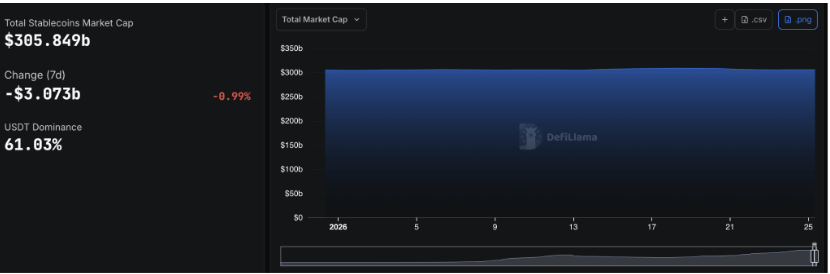
Stabilized Currency Liquidity Retreats, Quiet Period of Funding Before Risk Sentiment Ebbs
Over the past week, the total market capitalization of stablecoin has fallen back to ~USD305.8B, with a net outflow of ~USD3.07B on the 7th day, a weekly decrease of 0.99%. Against the backdrop of a generalized crypto rally during the first two weeks of the month, stablecoin has seen a significant shrinkage, reflecting the short-term shift of funds into risky assets in order to chase the rally. This indicates that during market highs and shocks, capital flows are more concentrated in the stablecoin system, which has the highest level of liquidity and trust, rather than a full-scale expansion of the stablecoin. This structure suggests that the market is not going on the defensive, but rather shifting from an offensive stance to a more focused and conservative allocation. In terms of behavior and tempo, this stabilization was more like a natural cooling of the market after the release of risk. The geopolitical conflict did not cause any real disruption to the market, and sentiment indicators quickly recovered from fear to neutral or even greed, driving Bitcoin and most assets to a sharp rise in the early part of the month. However, as Bitcoin fell back to the ~$86k range, profit-taking and wait-and-see sentiment emerged, and stable money began to regroup in preparation for the next phase. After rare metals strengthened first, the asset rotation logic is gradually taking shape, and the crypto market may become the next focus. The current contraction in stablecoin size is not the end, but more like a necessary precipitation period before the DCA re-launch.

Bitcoin Dominance Rate Recovery Stuck Again, Structural Signals of Cooling Risk Appetite
Over the past week, Bitcoin's market capitalization dominance rate rebounded to 59.85%, with a one-day change of +0.15%, and a weekly cumulative increase of about 0.52%, approaching the 60% threshold again, but failing to stabilize effectively. The chart shows that the dominant rate recovered quickly after a dip at the beginning of the month, reflecting that during the generalized market rally in the first two weeks, capital did not flow to cottage assets across the board, but rather returned to the Bitcoin system after the rally. Even though most currencies have risen significantly, capital allocations are still skewed towards the conservative core, suggesting that the expansion of market risk appetite is limited, and that structurally it is more of a rebound than a full-blown reboot of risk appetite. This dominant but stymied recovery is highly consistent with the rapid cooling of sentiment from fear to neutral greed. The lack of a material impact on asset prices from the geopolitical conflict has fueled short-term optimism, but as Bitcoin has fallen back to the ~$86k area, capital has begun to reassess the risk of price chasing. The failure of the dominant rate to break out means that the market has yet to enter a clear risk aversion mode, and also represents a lack of sustained traction in the cottage market. With rare metals rising first, the logic of asset rotation is gradually emerging and the crypto market is more likely to enter a waiting zone. For investors, the current dominance structure suggests a slower pace rather than a clear direction, which is a critical window for re-planning DCA and risk allocations.

Collective Cooling After Early Rally: Sector Prices Enter High Plateau Period
Over the past 7 days, the price movements of most of the ecological sectors showed a consistent high oscillator structure. The chart shows that after a rapid and synchronized rally in early January, the panels topped out between January 7 and January 10, generally registering a periodical increase of around +8% to +15%, with some ecosystems, such as Cardano, Cosmos, and Hyperliquid Ecosystem, once touching +20% or more. However, in the middle of the month, the upward momentum was obviously weakened, and the prices fell back and consolidated sideways, and most of the boards retreated to around 0% around January 20, and some of them, such as Polkadot, Avalanche and Arbitrum Ecosystem, even turned to around -5% to -8%. The overall structure shows that the resonance rally at the beginning of the month has come to an end and the market has entered a stagnation zone where the trend cannot continue. This plateau is not the result of the weakening of a single sector, but rather the lack of new impetus at the capital level. The early rally was more of a sentiment recovery and a rebound from the lows, with selling pressure naturally surfacing as prices quickly returned to pre-dense trading zones in the USD framework, leading to a dissipation of momentum. mindshare did not clearly focus on any single sector during this period, resulting in a synchronized cooling of sectors rather than a rotation of baton pickups. This structure implies that the market is not yet ready for a new trend, and is more likely to keep oscillating back and forth with slow downward movement in the short term, waiting for new macro variables or narrative catalysts to rebalance the market. Until then, the early-month rally should be viewed more as the completion of a rebound rather than the start of a longer-term uptrend.
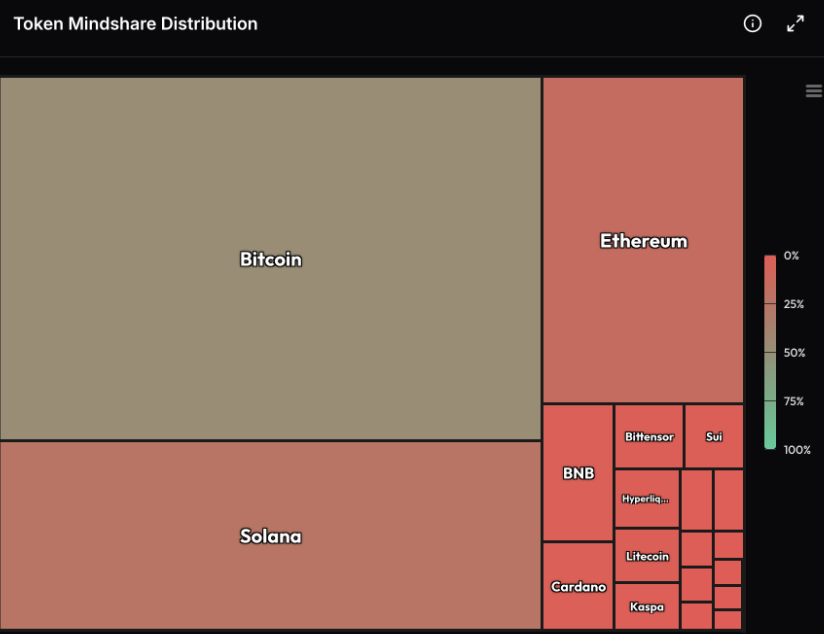
The Attention Vacuum Continues to Expand: Shrinking Attention Becomes an Indicator of Emotional Reversal
Over the past 7 days, the token mindshare structure continued the concentration and contraction trend of the previous weeks. The chart shows that Bitcoin still occupies the largest area in the 50%-70% mindshare, and is the center of attention in the market, while Ether is the second largest, but its share is significantly smaller than that of BTC, and Solana still retains a visible area, but it has been shrinking significantly compared to its peak. The rest of the mainstream tokens, such as BNB and Cardano, accounted for a very small percentage of the total, and the overall picture was highly fragmented and dark red, reflecting the fact that the mindshare of most assets continued to decline over the week. There was little new narrative to amplify the overall picture, suggesting that the market is pulling its attention away from crypto assets altogether. This loss of mindshare is not a single point in time, but the result of a cross-market shift in risk appetite. Against a backdrop of persistently high macro uncertainty, capital and buzz has been directed towards rare metals such as gold and silver, in stark contrast to the crypto market. When crypto is still being discussed with only BTC and a few high consensus assets, and the rest of the market is completely silent, it often means that sentiment is approaching a low point. Historically, when the mindshare is significantly lower than the fundamentals and long term story, it is a negative signal at the valuation level. When the market chooses to ignore the entire asset class rather than just individual tokens, it means that sentiment is overly pessimistic, leaving room for risky assets to regain traction down the road.
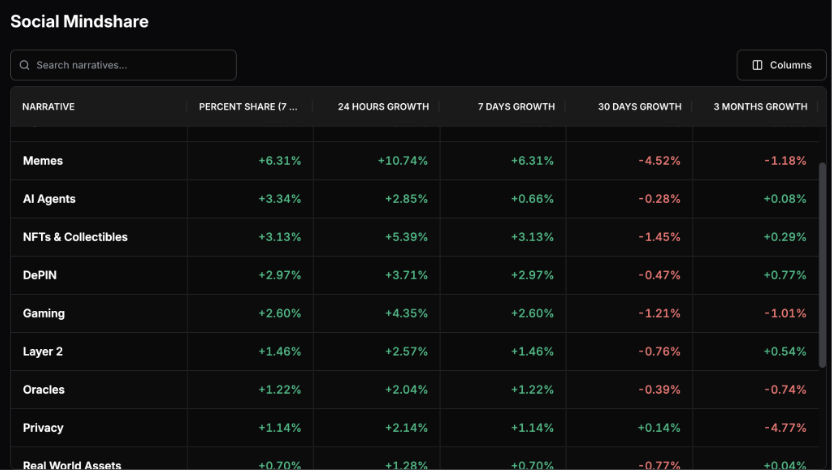
Sentiment polarization returns, short-term risk appetite seesaw intensifies
Over the past 7 days, there was a clear narrative split in the social mindshare structure, with Memes topping the list with 6.31% of 7D mindshare, and recording +10.74% of 24H growth and +6.31% of 7D growth, making it by far the most talked about board. In comparison, AI Agents only accounted for 3.34%, 7D growth +0.66%, NFTs and Collectibles 3.13%, DePIN 2.97%, Gaming 2.60%, and the rest, such as Layer 2 and Oracles, were below 1.50%. It's worth noting that most sectors are still negative in the 30D dimension, such as Memes at -4.52% and Gaming at -1.21%, suggesting that the recent heat is more in favor of short-term outbreaks rather than medium-term narrative returns. This mindshare structure, led by Memes, reflects a highly emotional and 'all or nothing' discussion. Against the backdrop of a lack of liquidity and a lack of trend in mainstream asset prices, investors are more inclined to turn their attention to high volatility, low threshold, and immediate feedback narratives in exchange for short-term excitement and gaming opportunities. the uptick in the Memes' mindshare is not a full-blown rebound in risk appetite, but rather an alternative way to vent capital and attention in the face of a lack of direction. Historical experience shows that when the social mindshare is dominated by emotional rather than fundamental narratives, price volatility tends to be amplified and weakly sustained, creating both opportunities and risks for short-term traders, while medium- and long-term allocations need to be more rhythmic and disciplined.
Chain Data

Long-Term Chips to the Top: Upper Pressure Dominates the Consolidation Rhythm
The heat map of the cost distribution of long term holders shows a highly concentrated block above the current price, with a large amount of supply concentrated above previous buying costs, creating a significant pool of potential selling pressure. As the chart shows, these long-term holders tend to have a stronger incentive to liquidate when prices are close to their cost zones, causing the rally to sell off in the short to medium term. This structure means that even if prices try to move up, they will have to repeatedly test multiple layers of resistance, and until new demand strengthens significantly, the room to move up will continue to be limited, making it difficult for the market to develop continuous upward momentum. With long-term chips not yet effectively absorbed above, the market is more likely to enter a time-for-space consolidation phase. The fact that prices are falling back after testing resistance during the rebound essentially reflects a gradual release of potential selling pressure from long-term holders, rather than a failure of a trend reversal. This back-and-forth structure is helping to gradually weaken the upper supply density, paving the way for a healthier uptrend. Therefore, the multiple pressure tests and pullbacks in the short term are not negative in themselves, but rather a natural part of the consolidation cycle, as the market waits for new demand to build up enough absorption capacity before it can truly break out of the long-term cost zone and start a new trend.

Spot momentum reversed: short-term structure reshaped from dumping to sucking.
After the recent pullback, there are clear signs of improvement in spot market behavior. The chart shows that the cumulative volume differential between Binance and the market-wide exchanges has moved from persistent net selling to a predominantly buying zone, implying a shift from daily net selling to daily net buying. The one-way selling pressure from previous consolidation periods is subsiding, and the strength of net selling in Coinbase, once the primary source of selling, has slowed significantly, reducing overall spot supply pressure. This change reflects the fact that spot participants are beginning to take ownership of the supply rather than continuing to allocate chips in the rally, providing initial support for prices. Although spot buying has yet to reach the strength required for a full trend expansion phase, the shift from seller-led to buyer-led is a key structural turnaround in itself. As the selling pressure on the Coinbase side subsides, overhead supply is gradually being absorbed, allowing prices to stabilize in a lower resistance environment. This spot-driven absorption process will help improve the overall distribution of chips and reduce the risk of rapid selling on future rebounds. If net buying continues to expand, it will establish a healthier foundation for the market to build on, so that the subsequent upward movement is no longer driven by derivatives alone, but by real demand, opening up further room for medium-term development.
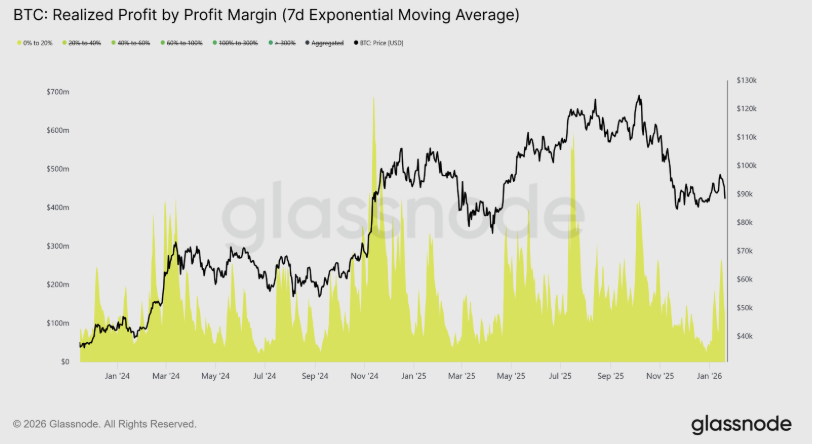
Low Risk Appetite Leads: Liquidity Repair Pace Destined to Be Slow
The chart shows a clear increase in the proportion of realized profits coming from the 0% to 20% profit range, which has been the main source of supply during the recent price strength. This represents a large amount of capital choosing to close quickly close to cost basis rather than take on the uncertainty of trend continuation. This type of behavior is dominated by capital-recovery sellers and short-term traders, reflecting the fact that market participants are more interested in capital preservation than in profit magnification at this stage of the market. Structurally, thin supply is released every time prices rebound and continues to limit the upward slope, suggesting that liquidity has not really shifted to risk-taking and remains in a defensive mode. In an environment dominated by low profit settlements, the market's overall risk tolerance is obviously low, meaning that it is difficult for new liquidity to enter the market on a large scale within a short period of time. Even if prices rebound at this stage, the nature of the rebound is closer to a structural repair than a full-blown trend reversal, and a hasty repositioning or one-off investment will magnify the risk of retracement. This pattern suggests that investment strategies need to trade time for structural improvement, and deal with long-term consolidation through batch allocation and strict position management. The market is still a long way from a full recovery in sentiment, and patience and tempo control will be more critical than directional judgment. Only by waiting for risk appetite to rebound in real terms can liquidity conditions support a more sustained uptrend.
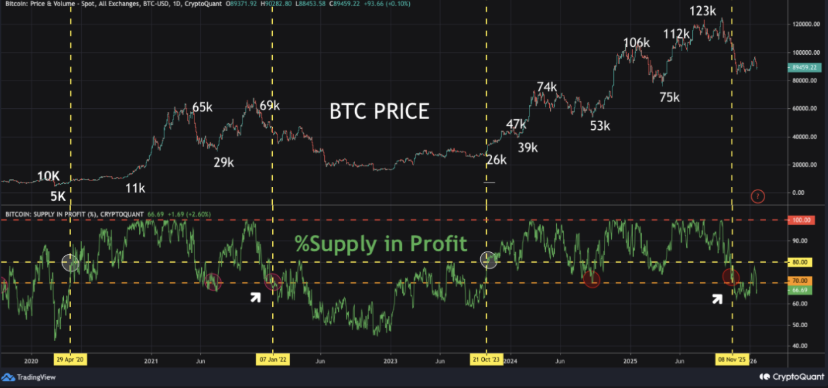
Earnings Supply Falls Below Warning Line: Bear Market Risks Renewed
Once the percentage of Bitcoin supply in profitability falls below 70% and fails to quickly rise above 80%, it has been an important precursor to further market downturns many times in the past. The chart shows that when the profitability supply ratio falls below this threshold, a deterioration in confidence is often accompanied by a proliferation of selling behavior, ultimately confirming a bear market structure. This indicator not only reflects the retreat at the price level, but also reveals a synchronized decline in risk tolerance as the majority of holders move from profits to losses, making the supply side significantly less tolerant of a rebound. The market remains exposed to the structural risk of a prolonged downturn until the earnings supply ratio gets back to 80%. Chasing a rebound too much at this stage is vulnerable to asymmetric pullbacks when sentiment weakens again. In contrast, maintaining adequate liquidity reserves, such as USDT, is tantamount to reserving room to maneuver for a potentially deeper correction. History has shown that truly attractive allocation opportunities tend to arise when sentiment is extremely conservative, rather than when risk first emerges. The current environment is better suited to a defensive focus, preparing for worst-case scenarios and waiting for structural and metrics to recover in tandem before gradually increasing risk exposure.
Related Post:
Best Cryptocurrency Trading Platform for Hong Kong Users?2025 Latest Bitcoin Tips for Beginners
2025 Coin Ring Newbie Guide Lazybones|Chained Ecology Entry Guide
2025 Must Read for Newbies! Use these six data indicators to learn how to judge buying opportunities.
Selected tokens:

Perpetual Contract Market Leader: Hyperliquid Leads Perp DEX to a High-Yield Future
Hyperliquid is a decentralized perpetual contract trading protocol focused on providing an efficient, low-slippage perpetual contract trading experience, with particular strength in the shorting market. At its core, it allows traders to short based on fundamentals, combining deep liquidity and high leverage, positioning it as a Perp DEX for high income generation. according to the chart, Hyperliquid's price has risen from ~25.77 USD to 30.35 USD in the past month, with a cumulative increase of ~18.17%, and a market capitalization of ~9.16 billion USD, indicating strong capital inflow and a strong presence in the Perp DEX market. This shows a strong capital inflow and a high trading volume and market interest in the Perp DEX space.
Analyzing from a business model perspective, Hyperliquid relies on its high liquidity to provide a deep market that enables traders to short when the fundamentals make sense, which not only attracts professional traders, but also generates ongoing trading fee income for the agreement. The platform reduces credit risk by automating the clearing of smart contracts and utilizes an internal margining mechanism within the protocol to generate continuous cash flow. In addition, Hyperliquid's token repurchase of over 95% is a favorite among investors. Hyperliquid's ability to generate high yields when market sentiment picks up, especially during periods of heightened volatility, and its shorting feature provides a hedge against volatility, reinforcing its leading position in the Perp DEX. As such, Hyperliquid has medium to long term growth potential based on its solid revenue model and market demand, and is worth keeping a close eye on.

AI Agents Connect with the Physical World: Virtuals at the Start of the Next Round of Mechanism Expansion
Virtuals Protocol is a protocol layer centered on AI agents, with the goal of enabling intelligent agents to be deployed, collaborated on, and extended to real-world applications, including robotics, x402, and composable agent mechanisms. The current round of price action shows that VIRTUAL once reached ~1.2 USD at the beginning of the month, and then retreated to ~0.69 USD recently as market sentiment dropped, still registering a 1-month gain of ~+7.03%. The market capitalization is about USD 458 million, FDV is about USD 698 million, circulating supply is about 656 million coins, and holding address is more than 1.04M, which shows that it is not a niche experimental asset, but a medium-sized agreement that has built up a wide base of users and community. The drop in trading volume and price correction are synchronized, reflecting a short-term capital retreat rather than a collapse of the narrative. In terms of business model and medium-term logic, the core value of Virtuals is that it is one of the few protocol layers with cross-virtual and real-world extensibility, as it can host AI agents, robots, and off-chain services simultaneously. x402 and other new mechanisms provide agents with a sustainable operation and a path to value capture, so that protocols do not only rely on sentiment-driven, but also progressively shift towards functionality and scenario-based expansion. The current pullback is more of a healthy repricing from the highs, and corresponds to a decline in market risk appetite rather than a deterioration in fundamentals. Against the backdrop of a deepening AI narrative, Virtuals has the potential to become the underlying infrastructure. Short-term volatility, on the contrary, provides a reasonable entry point for medium- to long-term time-for-space DCA strategies, making it a structural growth target worth tracking.
Conclusion
Most Popular Cryptocurrency Trading Platforms
Hong Kong People's Top Choice for Bitcoin and Ether Trading 》 【2025 Introduction】OSL Registration Benefits, Security, Deposit and Withdrawal, Special Features
Suitable for traditional Hong Kong investors to buy and sell stocks and currencies at the same time. [2025 Introduction] What is Victory Securities? Security, Deposit and Withdrawal, Features
More choices of contract currencies, suitable for buying fake coins in cash. Trade on MEXC and enjoy 500x leverage and many other benefits!
Related Post:
Best Cryptocurrency Trading Platform for Hong Kong Users?2025 Latest Bitcoin Tips for Beginners
2025 Coin Ring Newbie Guide Lazybones|Chained Ecology Entry Guide
2025 Must Read for Newbies! Use these six data indicators to learn how to judge buying opportunities.

Disclaimer
The content of this article is for reference only, investors should exercise independent judgment, invest prudently and at their own risk, this article does not provide or attempt to persuade the audience to do trading or investment basis, the content is for sharing purposes only, and should not be regarded as investment advice.It does not represent the views and position of Monsterblockhk.All information and opinions are current as of the date of the judgment. In addition, if a judgment is rendered on aIn this siteAny content related to virtual asset trading platforms that have not yet obtained a license to operate virtual asset trading platforms in Hong Kong, including but not limited to text introductions, pictures, offers, events, etc., are only available to users outside the Hong Kong Special Administrative Region.
According to the Hong Kong Anti-Money Laundering and Counter-Terrorist Financing (Amendment) Ordinance 2022, after June 1, 2023, all centralized virtual asset trading platforms operating in Hong Kong or actively promoting their services to Hong Kong investors will be licensed and regulated by the SFC, and any related unlicensed activities will be a criminal offence. For more information and details of the legislation, users may refer to the SFC website.