

Every time you complete a transaction on a DeFi protocol - exchanging coins at Uniswap, pegging NFTs at OpenSea, depositing assets at Aave, etc. - you need to give that protocol an "authorization" to use a specific token on your behalf, but the problem is, that authorization doesn't just disappear when you're done with that transaction. It just sits there on the chain, waiting to be used - either by a protocol you trust, or by a hacker who takes advantage of it after it's been compromised.
Revoke.cash is the tool to solve this problem. It gives you a complete view of all your licensed contracts, and one by one, you can revoke licenses that you no longer need and close doors that have been left open.
This article is a complete guide to Revoke.cash, from basic concepts to operational details.
What is Token Approval and why is it a security risk?
The way DeFi works requires authorization
In traditional finance, you transfer money to a bank and the bank executes it directly. But in Ethernet and EVM-compatible chains, the situation is different. Each token (ERC-20 token) has its own smart contract, and other contracts (e.g., Uniswap's transaction router) can't access the tokens in your wallet without your permission.
This is where Token Approval comes in. The first time you exchange USDC for ETH at Uniswap, Uniswap will ask you to sign an authorization transaction so that Uniswap's contract can use USDC on your behalf, and only after this authorization is complete can the actual exchange take place.
This mechanism makes DeFi operations possible, but it comes with a side issue: once a license is given, it is permanent until you revoke it on your own initiative.
What does the authorization to stay on the chain mean?
This means that even if you have completed that Uniswap transaction, and even if you have disconnected MetaMask from the Uniswap website, Uniswap's contract still holds the rights you granted it to move USDC.
Most well-known agreements will not abuse this license because of their reputation and legal liabilities. But the risk of the problem lies elsewhere:
First, the protocol itself can be hacked. When a DeFi protocol is compromised, an attacker will first look for the addresses of all users with existing authorizations and use those authorizations to extract tokens. you don't need to have done anything at the time of the attack, you just need to have authorized the protocol, and your assets could be at risk.
Second, the license amount is often "Unlimited". Many protocols require "unlimited authorization" by default for the convenience of the user - meaning that it is authorized to use the entire amount of the specified token in your wallet, not just the amount required for that transaction. This design allows for a much larger loss in the event of an attack than if only the exact amount was authorized.
Third, anyone with your address can view your list of licenses. Your license history is publicly linked data that can be scanned in bulk by an attacker to find addresses that hold high-value licenses to target.
Revoke.cash is the tool that allows you to systematically audit and clean up these licenses.
Recent Recent Posts:
2026 Latest 6 Free Coin Ring Tools Inventory|Where to find the data on the chain?
2025 Latest OKX Web3 Wallet Tutorial: Does it work? How to create it? A Guide to Safe Operation, Multi-Link Support, and Time-Limited Airdrops
2026 Latest Polymarket Tutorial|How to find out the insiders and realize the high win rate!
2025 New DeFi Beginner's Guide|Teaching you to earn stable money passive income! Introducing 3 popular programs, DeFiLlama tool tutorial!
What is Revoke.cash? What can it do and what can't it do?
What it can do.
Revoke.cash is currently the most widely supported Token Approval management tool, covering over 100 EVM-compatible networks, including major chains such as Ether, Arbitrum, Base, Optimism, BNB Chain, Polygon, Avalanche, and dozens of smaller L2 and side chains.
Its core features include:
A complete list of all existing authorizations for your wallet on the specified network, showing the name of the token approved, which contract (Spender) it was approved for, the amount of the authorization (limited or unlimited), and when it was granted.
Allows you to revoke any license directly from the interface. A revocation operation is a standard on-chain transaction with a small Gas fee and is the same in nature as any other blockchain transaction.
Batch Revoke is available - you can select multiple licenses to revoke at once, saving you the cost of revoking them one by one for Gas. When using the batch feature, Revoke.cash charges a $1.50 service fee to support ongoing development, with some of the costs on the network covered by the sponsor.
Provides an "Exploit Checker" feature that allows you to check if your wallet has been exposed to a known DeFi attack as an additional layer of risk identification.
What it can't do.
There are a few points that need to be made clear to avoid false expectations of this tool.
Revoke.cash has no way of recovering stolen assets. If an authorization has been exploited and funds have been diverted, no tool can reverse the process. Its purpose is prevention, not remediation.
Revoke.cash cannot block new licenses that you subsequently sign. If you sign another license transaction on a malicious website after revocation, the new license will also take effect and Revoke.cash will not be able to block it beforehand. That's why Revoke.cash also provides a browser extension that pops up a real-time warning when you are about to sign a suspicious license.
Revoke.cash cannot protect your private key. If your auxiliary or private key has been compromised, an attacker can take direct control of your entire wallet, and revocation of authorization is completely ineffective in this case. You need to transfer your funds to a brand new wallet immediately.
Hardware wallets are also not protected against authorization attacks. Many people think that using Ledger or Trezor is safe enough. This is true at the private key protection level, but an authorization attack doesn't need to have access to your private key - as long as you've signed an authorization, an attacker can use the contractual mechanism to extract the specified token, and hardware wallets offer no additional protection.
III. 2026 Update: List of Existing Features of Revoke.cash
Browser Extensions
Revoke.cash's browser extension is one of the most useful additions in recent years. Once installed, whenever you are about to sign a Token Approval transaction on any website, the extension automatically analyzes the risk level of the authorization and pops up a reminder before you confirm it, giving you a chance to confirm it twice.This feature is especially good for phishing sites - even if you mistakenly enter a fake site that spoofs a well-known deal, the extension may recognize the anomaly and warn you before you press OK.
Exploit Checker
The Exploit Checker allows you to check if a specific wallet address has been exposed to a recorded DeFi attack. Once the address is entered, the system compares a list of addresses affected by known attacks and tells you if the wallet has been authorized for the protocol that was attacked.This is particularly useful for determining the risk status of your old wallet, especially after a large DeFi attack event (such as the Kelp DAO event) to quickly confirm whether you are within the affected area.
Account Abstraction wallet free Gas revocation
For smart wallets that support EIP-4337 (Account Abstraction), such as Ambire and Coinbase Smart Wallet, Revoke.cash offers a weekly Gas-free bulk revocation - at the cost of the third-party sponsors. This means that users with these wallets can perform a regular weekly license cleanup without paying any gas fees. The availability of this feature will continue to grow as Account Abstraction wallets become more popular.
Revoke.cash complete use of teaching: step-by-step guide to operating
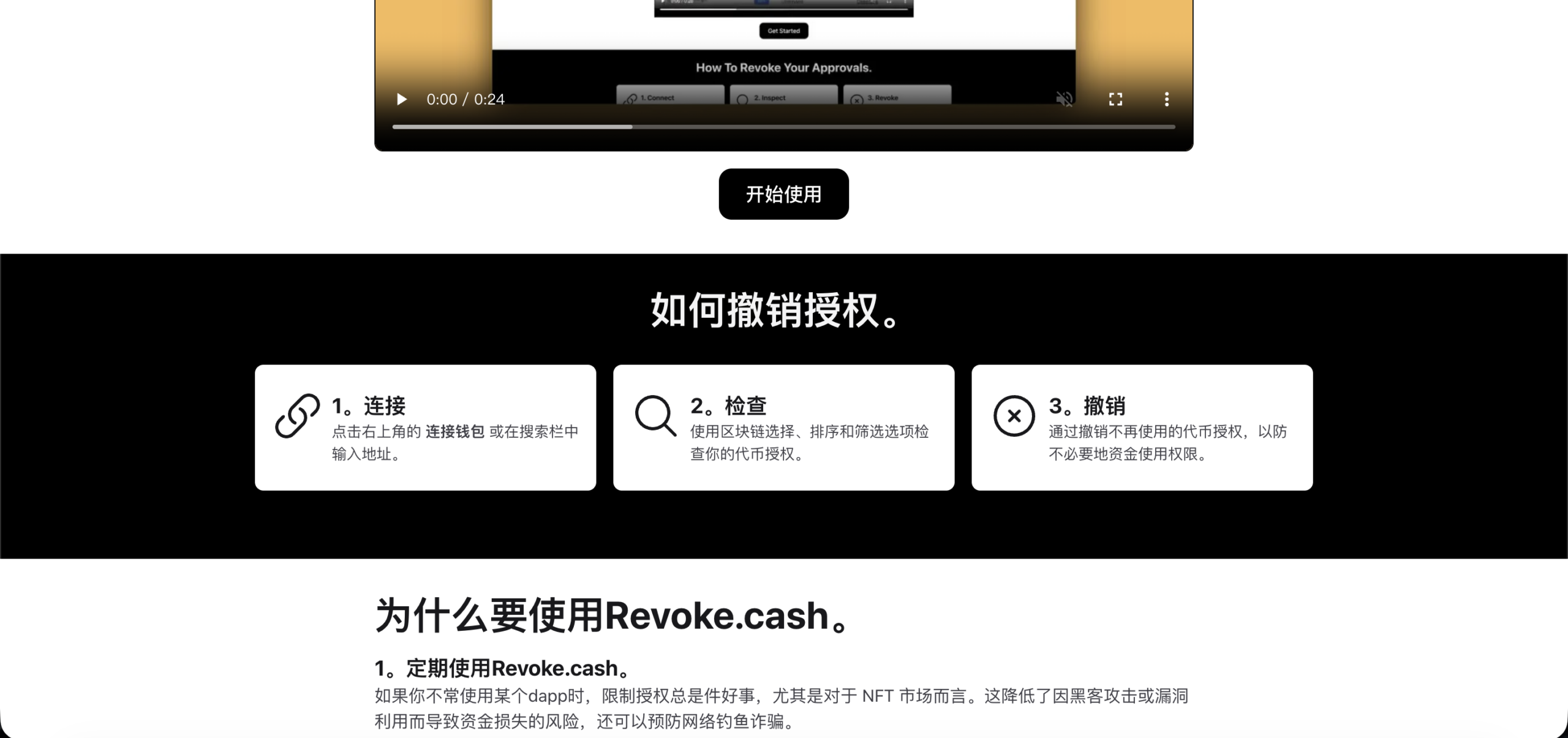
Step 1: Go to the website and connect your wallet
Go to revoke.cash. You'll see the "Connect Wallet" button in the upper right corner of the page, which supports MetaMask, WalletConnect-compatible wallets, Coinbase Wallet, and other popular options. Connecting to a wallet is just a read operation, Revoke.cash will not ask you to sign any transaction and will not use your assets. If you don't want to connect to a wallet, you can enter any wallet address (including the ENS name) directly into the search box and the results will be complete.
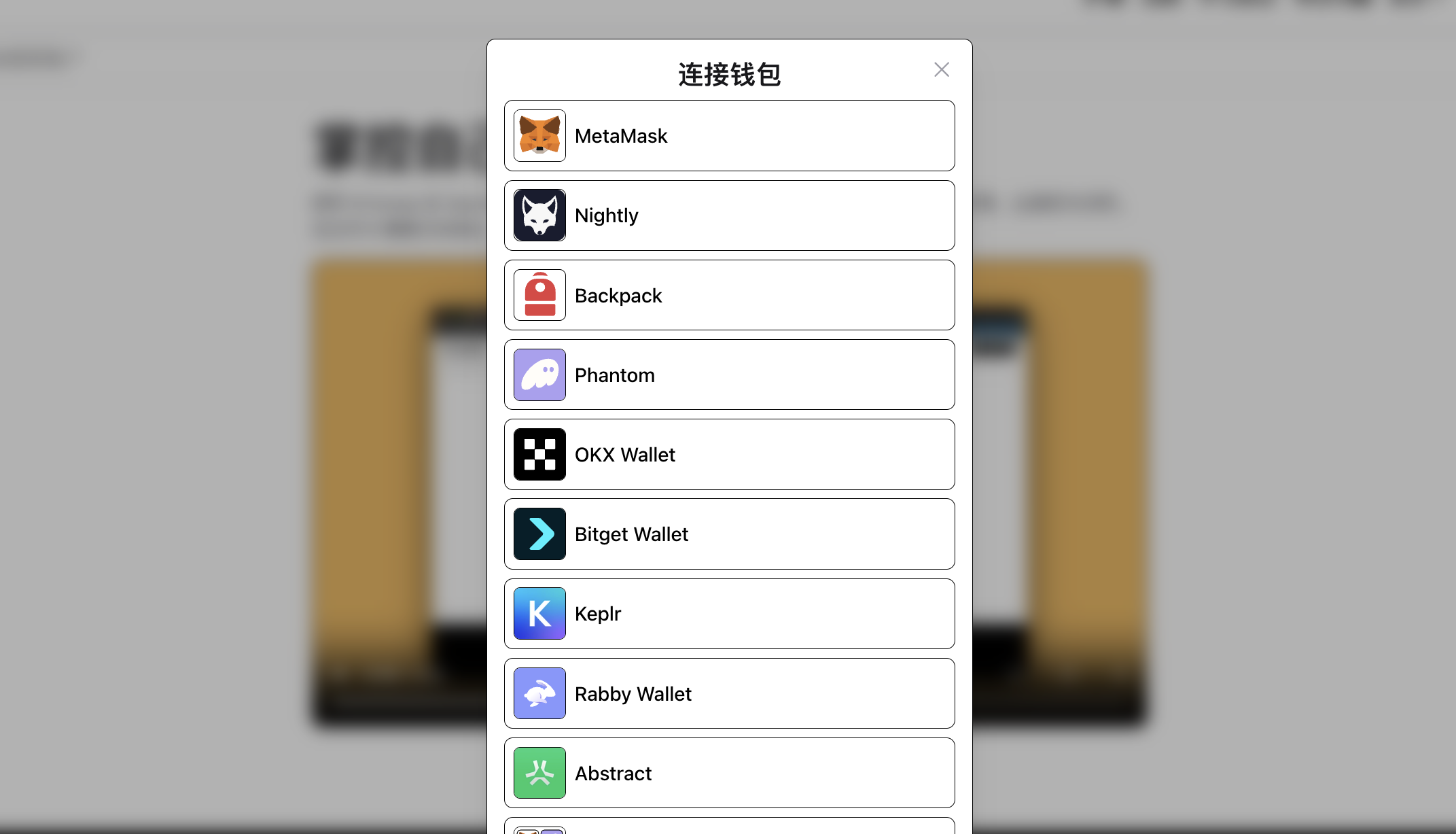
Step 2: Select the network you want to inquire about
Once connected, use the network selector on the page to select the blockchain you want to query. If you have assets on multiple chains, you'll need to query and manipulate each chain separately - each chain's licenses are managed independently, and it's not possible to query across chains in bulk. It is recommended that you prioritize the chain you use most often, usually the Ethernet Master Chain and the L2 you actively use, such as Arbitrum or Base.
Step 3: Audit the authorization list
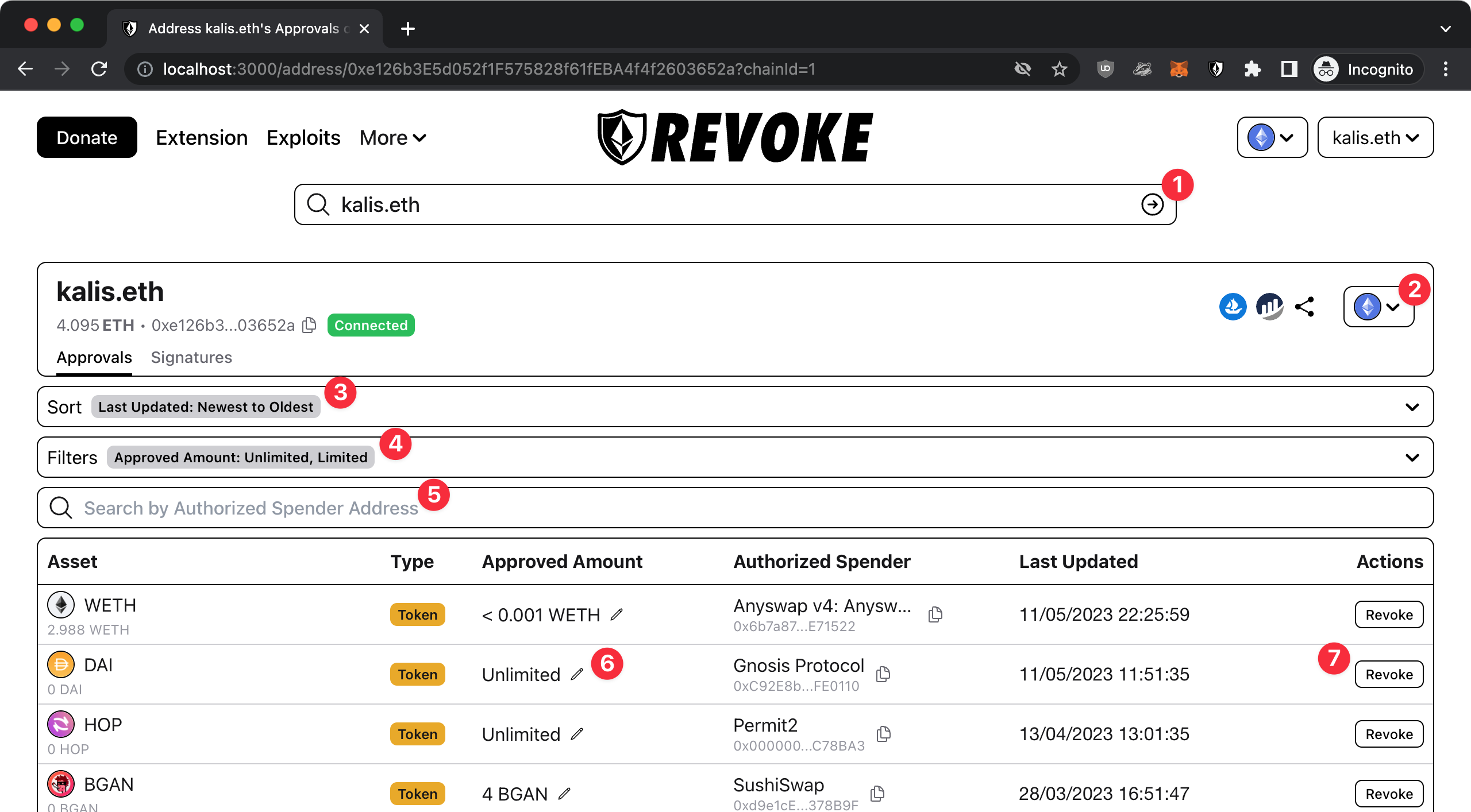
After selecting a network, the system loads all of your existing authorizations on this chain. Each license record usually displays the following information:
Authorized token name and contract address (e.g., "USDC"), authorized contract (Spender, e.g., "Uniswap V3"), authorized amount ("Unlimited" means unlimited), and authorized time.
When viewing, it's recommended to first sort by "newest to oldest" and prioritize reviewing the most recent authorizations first - this is the fastest way to find your target if you suspect a suspicious authorization may have just been signed.Licenses that require special attention include licenses with "Unlimited" amounts, licenses approved to contract addresses you don't know, old licenses that haven't been used in a long time, and licenses approved to agreements that have been attacked or are no longer in operation.
Step 4: Execute the Undo
Once you have found the license you wish to revoke, click the "Revoke" button to the right of the license. A transaction confirmation request will pop up in your wallet showing the Gas fee for this revocation. Once confirmed, the revocation transaction will be uploaded and the license will officially expire.If you want to revoke multiple licenses at the same time, you can check multiple items and then use the "Batch Revoke" function to process them all at once, which can effectively save the time and cost of multiple confirmations and Gas (Note: there is a $1.5 service fee for batch operation).
Step 5: Install Browser Extensions
After completing the license cleanup, it is highly recommended to install the Revoke.cash browser extension. It works on Chrome, Firefox, and Brave browsers, requires no setup, and automatically monitors your upcoming license transactions in the background.
V. Things to note when using Revoke.cash
Regular Cleaning Frequency Recommendations
Revoke.cash is a preventative tool whose value lies in its regular use, not in remembering it after an incident.
For light DeFi users (participating in several transactions per month), a full audit is recommended quarterly. For moderate users (using multiple transactions per week), a monthly cleanup is recommended. For active DeFi participants or mobility providers, it is recommended that all licenses associated with them be revoked immediately after each completion of a phase of activity (e.g., after exiting a particular mining program).
Which authorizations can be retained and which should be revoked
Not all licenses need to be revoked. The official advice from Revoke.cash is that license management is a balance between security and convenience, not a requirement that you empty all licenses.
For well-known protocols that you are still actively using (such as Uniswap, which is actively used, or Aave, in which you are holding a position), it makes sense to keep the license - revoking it would require a new license, and instead increase the number of unnecessary trades and Gas fees. Note, however, that if you have an active NFT pending order with OpenSea, revoking the OpenSea license will cause the pending order to lapse.
Priority revocations include: licenses for agreements that are no longer in use, uncapped licenses (consider changing to a precise dollar amount), licenses for unknown or suspect contracts, and licenses for agreements that have been attacked or shut down.
The best time to pay for gas
There is a Gas fee for each revocation. On the EtherChannel mainchain, the Gas fee can be significant during busy times. It is recommended to use Etherscan's Gas Tracker or GasHawk tools to save money by finding times when network activity is relatively low and performing revocations. On L2 networks (e.g. Arbitrum or Base), Gas fees are usually much lower and you can be less concerned about timing.
In DeFi's world, security is never something you set up to work forever, it's a habit that needs to be maintained on an ongoing basis, and Revoke.cash provides the tools to make that habit easy to implement.
Regularly cleaning up your authorization list is like regularly backing up your aids - not because you expect problems to happen, but because preparing for them before they do is much less costly than fixing them after the fact.
Join Monsterblockhk's Telegram CommunityGet the latest guide to using DeFi's security tools, as well as an in-depth analysis of the encryption market!
Disclaimer
The content of this article is for reference only, investors should exercise independent judgment, invest with caution and at their own risk, this article does not provide or attempt to persuade viewers to trade or invest on the basis of the content of this article is for sharing purposes only, and should not be regarded as investment advice, and does not represent the Monsterblockhk viewpoints and positions, all information and views of the specific date of the judgment of the time-limited nature. In addition, if any content in this website involves virtual asset trading platforms that have not yet obtained a license to operate virtual asset trading platforms in Hong Kong, including but not limited to text introductions, pictures, promotions, events, etc., they are only available to users outside of the Hong Kong Special Administrative Region.
According to the Hong Kong Anti-Money Laundering and Counter-Terrorist Financing (Amendment) Ordinance 2022, after June 1, 2023, all centralized virtual asset trading platforms operating in Hong Kong or actively promoting their services to Hong Kong investors will be licensed and regulated by the SFC, and any related unlicensed activities will be a criminal offence. For more information and details of the legislation, users may refer to the SFC website.