

Efficient funding allocation has always been a difficult problem in the blockchain and open source space. Now, an innovative project called DeepFunding is attempting to solve this problem using artificial intelligence (AI) and a decentralized review mechanism. The project was initially funded with a $250,000 grant from Ether founder Vitalik Buterin to improve the current state of resource allocation for public goods in the Ether ecosystem.
DeepFunding not only aims to solve the current problem of inefficient resource allocation in the Ethernet ecosystem, but also hopes to establish a new model for funding public goods in the future.
The Dilemma of Public Goods Funding in Ethernet
Traditional methods of funding public goods, such as Gitcoin's donation or secondary funding mechanisms, have some obvious limitations. First, human decision-making is often irrational in the face of large and complex information. For example, in the ethereum ecosystem, funders tend to support ostensibly high-profile projects while ignoring the hidden, but critical, technological dependencies and foundational contributions.
The current funding mechanism, which relies on either a large number of public assessments (resulting in marketing competitions to gain attention for projects) or a few expert decisions (which may result in private solicitations), is difficult to scale up given the large number of projects. The result is that there is insufficient support for some of the basic tools and 'invisible' infrastructure that are critical to ecological development, and resources may be wasted on projects that appear popular in the short term but have limited value in the long term.
In the case of open source software, for example, contributors to projects that rely on the core don't get the rewards they deserve, according to Vitalik Buterin, who points out that today's secondary fundraisers, Retro funding, and so on, favor highly visible, easy-to-publicize projects while ignoring the low-profile, but equally critical, contributors.
An oft-cited example is the core-js library for JavaScript: it powers countless large-scale applications, but is so obscure that its maintainers live off of sporadic donations. This kind of phenomenon suggests that the current model of public infrastructure economics is unhealthy, and that we urgently need a fairer, more sustainable funding model to address these blind spots.
Recent Articles:
Web3 is no longer just a lab product, but an infrastructure for an era of de-trust.
2025 Beginner's Guide|How to transfer USDT? From bank deposit to wallet receipt of coins complete instruction
Best Cryptocurrency Trading Platform for Hong Kong Users?2025 Latest Bitcoin Tips for Beginners
2025 Coin Ring Newbie Guide Lazybones|Chained Ecology Entry Guide
DeepFunding's Vision and Innovation
What is DeepFunding? In short, DeepFunding is a new attempt to redistribute public resources using AI and community intelligence.
Its core vision is to create a fair, transparent, and efficient funding distribution system that ensures long-term sustainable support for Ethernet and its key open source projects. Unlike the traditional model, which requires projects to apply for funding, DeepFunding takes a proactive approach: it proactively identifies dependencies that contribute to the ecosystem and rewards them.
Vitalik calls the idea behind it Distilled Human Judgment (DHJ). The idea is to use AI to capture the value consensus of the human community, so that funds can be distributed deeply along the contribution chain, and all contributors behind the entire output get their due.
How does DeepFunding work? Its solution can be summarized as"AI Engine + Human Steering Wheel."The model.
The entire technical framework consists of the following components:
How Deep Funding Works
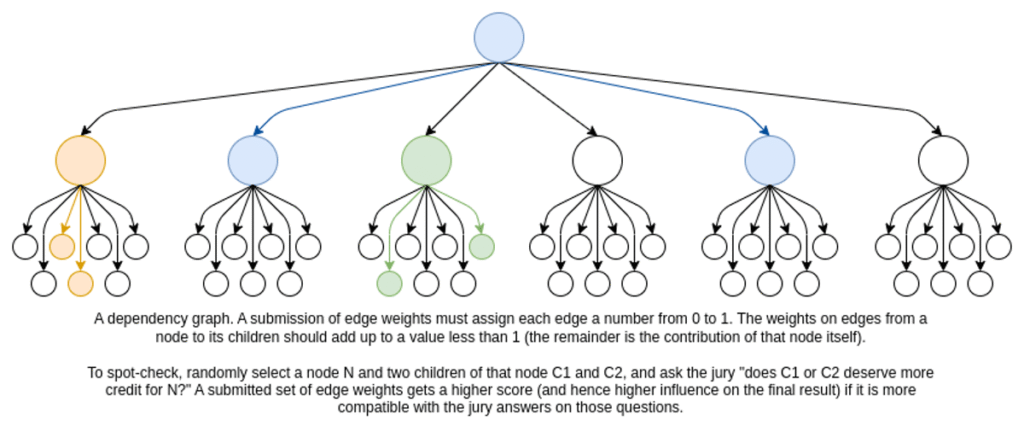
Deep Graph Dynamic Dependency Graph: DeepFunding begins by constructing a comprehensive project dependency graph (Deep Graph).
This map presents the dependencies between projects and components in the ecosystem in the form of nodes and links, and assigns a certain weight to each dependency.
With Deep Graph, we can visualize the actual value contribution of each project - the "invisible contribution" that used to be difficult to measure is now presented in an intuitive way.
For example, if an Ethernet decentralized application relies on a certain cryptographic library, then the Deep Graph will allow us to see that reliance and give us a percentage of its importance to the end result.
AI Model Weighting and EvaluationThe next step is to determine the contribution weight of each node (project) once the dependency graph is in place. To solve the problem of manually evaluating a large number of projects, DeepFunding introduces artificial intelligence models to accomplish this task.
The model takes as input a variety of objective data about the open source project (e.g., GitHub stars, contributor activity, last update time, etc.) and, based on this information and an understanding of the project's value, automatically calculates the weight that should be assigned to each dependency. In other words, the AI model answers the question, "How much of the credit for Project A's success should go to Project B, on which it relies?
Since there may be thousands of dependencies to be evaluated, participants are encouraged to use AI for batch calculations to solve the difficulty of scaling manually. With the help of AI, we can dynamically adjust the allocation of funds to reflect the actual contribution of each project to the overall ecosystem as much as possible.
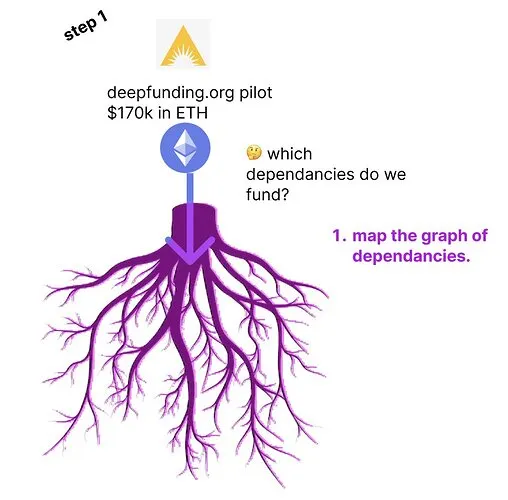
Jury Mechanism: While AI can process large amounts of information at scale and speed, at the end of the day we want to make sure that the results are distributed in a way that is consistent with the values and common sense of the human community. That's why DeepFunding has introduced a decentralized panel of experts to spot-check and calibrate AI model results.
Specifically, a panel of experienced experts in the community will randomly select some of the projects and compare their dependencies, answering questions such as "Which one is more important to the overall ecology, Project A or Project B? These questions are answered by a panel of judges. This form of pairwise comparison is relatively simple for human beings and can produce a clear basis for judgment.
Through these manual sampling points, the system can evaluate which AI model's weighted results most closely match the preferences of human experts. In the end, DeepFunding selects the winning models that most closely align with the human consensus to make the actual funding decisions. It can be said that human experts are responsible for guiding direction and value judgment, while AI is responsible for large-scale data analysis and prediction on this basis, and the two complement each other.
Funding and Incentives: Once the weighting calculation and model evaluation are complete, the funds are allocated according to the finalized weights. Simply put, the greater the contribution of a project to the whole, the more funding it receives. In addition, in order to encourage people to participate in building excellent models, DeepFunding will also set aside a portion of the prize money to reward the best model submitters. Overall, this mechanism ensures that the funding not only takes care of the key fundamental projects, but also rewards the participants for their wisdom, forming a virtuous cycle.
Why is DeepFunding fairer and more sustainable?
Under the traditional approach, capital tends to flow to projects with high visibility or marketing, leading to an imbalance of "many people pursuing new applications and no one maintaining old infrastructure".
DeepFunding willExpanding the perspective from a single project to the entire contribution chainIt also ensures that the heroes in the background (e.g., library authors, developers of underlying protocols) are also rewarded. It's not only fairer, it's also a stronger foundation for the entire ecosystem.
More importantly, with the help of AI, DeepFunding's decision-making mechanism can be dynamically adjusted as projects and dependencies evolve, unlike traditional funding which is one-off and static. This means that as the ecology changes and new key technologies emerge, funding allocations can be adjusted accordingly to maintain long-term effectiveness.
In addition, because AI can handle massive amounts of data and shorten decision-making time, DeepFunding can expand as the ecosystem grows and will not be constrained by the bottleneck of human evaluation.
Overall, DeepFunding provides a way to subsidize public goods.A path of greater breadth and depth: Covering more hidden contributors in terms of breadth and emphasizing long-term impact and sustainability in terms of depth.
The whole process embodies the concept of "human-machine collaboration":AI Provides Scaled Analytics EngineWe, as human beings, ensure that value judgments are made in the right direction.
Vitalik describes this as "AI as the engine, humans at the wheel," and DeepFunding is the realization of this philosophy in the area of resource allocation.
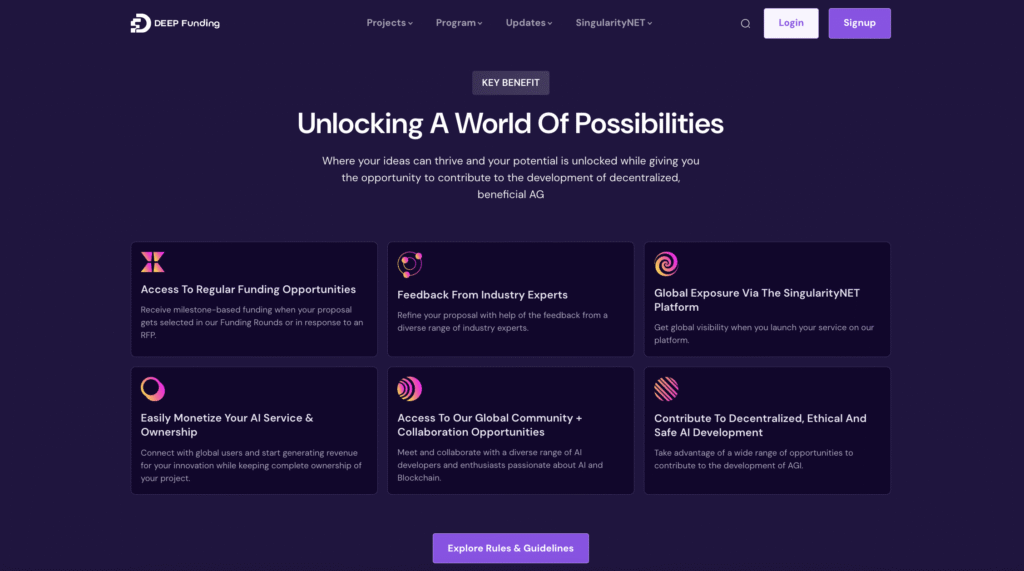
How do I get involved with DeepFunding?
By now, you're probably excited about DeepFunding. Whether you're a developer, a researcher, or simply interested in funding public resources, there are opportunities for you to get involved!The proposal process is not just a formality for innovators who want to compete for funding. For innovators seeking funding, submitting a proposal is more than just filling out a form; it's a complete process of planning, presentation, and community interaction. Here are the steps from preparation to funding:
1. Prepare a complete proposal
Before submitting, you need to put together a specific and compelling proposal document. The content should include:
- Project Profile and Objectives: Clearly describe the problem you're trying to solve, the core value of your AI solution, and how you're facilitating the development of decentralized AI.
- Team Background: Introduce the core members' experience, technical skills, and past project examples to convince the judges and the community of your ability to execute.
- Technical Solutions and Feasibility: Describe the design logic of the AI model or service, how it operates, and the integration plan with the SingularityNET platform.
- Milestone Design: Divide the project into multiple phases, with each phase listing clear deliverables (demos, APIs, documentation, etc.) and setting standards for achievement.
- Budget Planning: List the funding required for each milestone and explain the use of the funds to ensure that the funders can monitor the flow of funds.
- Social or Platform Impact: If your project has a positive social impact (e.g., public service application, accessible technology, educational tool) or increases user adoption of the SingularityNET platform, it should be emphasized here.
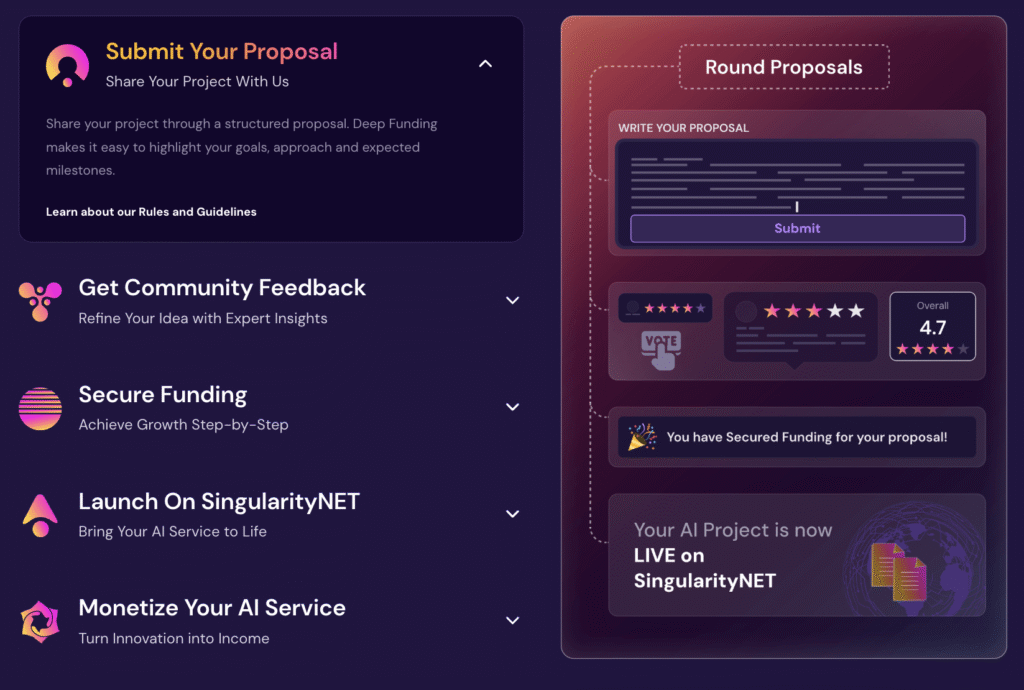
2. Select Application Type
DeepFunding offers two main application channels:
- Funding Round: Any idea can be submitted and competition is fierce.
Small grants: up to US$40,000; large grants: up to US$150,000 (in some cases subject to sharing of future revenues with the platform) - RFP (Request for Proposal): Officials or the community make explicit requests (e.g., specific AI tools, platform extensions), and you can submit a solution for these topics.
3. Submit a proposal on the official DeepFunding website
- Registering and logging in DeepFunding.ai Platform.
- Fill out an online form with project summary, technical details, milestones, budget, and team information.
- Upload relevant attachments, such as Pitch Deck, technical documents, preliminary demos or designs.
DeepFunding is a cutting-edge experiment, and it is worthwhile to keep track of the subsequent developments. Readers are advised to subscribe to relevant news channels, follow the DeepFunding Official Websiteand social media (e.g. Twitter, etc.) to keep abreast of the latest developments.
If there are offline seminars, hackathons, or community discussions, you can also participate and meet like-minded developers and researchers. As the DeepFunding mechanism matures, there is reason to be optimistic about the future of public goods funding: a more equitable, transparent, and sustainable funding era is on its way!
Recent Articles:
Web3 is no longer just a lab product, but an infrastructure for an era of de-trust.
2025 Beginner's Guide|How to transfer USDT? From bank deposit to wallet receipt of coins complete instruction
Best Cryptocurrency Trading Platform for Hong Kong Users?2025 Latest Bitcoin Tips for Beginners
2025 Coin Ring Newbie Guide Lazybones|Chained Ecology Entry Guide

Disclaimer
The content of this article is for reference only, investors should exercise independent judgment, invest prudently and at their own risk, this article does not provide or attempt to persuade the audience to do trading or investment basis, the content is for sharing purposes only, and should not be regarded as investment advice.It does not represent the views and position of Monsterblockhk.All information and opinions are current as of the date of the judgment. In addition, if a judgment is rendered on aIn this siteAny content related to virtual asset trading platforms that have not yet obtained a license to operate virtual asset trading platforms in Hong Kong, including but not limited to text introductions, pictures, offers, events, etc., are only available to users outside the Hong Kong Special Administrative Region.
According to the Hong Kong Anti-Money Laundering and Counter-Terrorist Financing (Amendment) Ordinance 2022, after June 1, 2023, all centralized virtual asset trading platforms operating in Hong Kong or actively promoting their services to Hong Kong investors will be licensed and regulated by the SFC, and any related unlicensed activities will be a criminal offence. For more information and details of the legislation, users may refer to the SFC website.