
What Is a Stablecoin Freeze? Binance Froze Over $2.3 Billion Within Hours of the Hack
On October 29, 2026 (UTC), Binance’s hot wallet was compromised; officials estimate the total loss at approximately $6.3 billion. Less than two hours after the funds were transferred, several stablecoin issuers had already frozen the tokens in the attacker’s address on-chain:
- Tether: CEO Paolo Ardoino said that more than 1.567 billion USDT has been frozen
- Circle: CEO Jeremy Allaire said the company has cooperated with law enforcement agencies to freeze more than 800 million USDC
- World Liberty Financial: Frozen 27 million USD1
- Ripple: It also froze the relevant RLUSD, but did not disclose specific figures
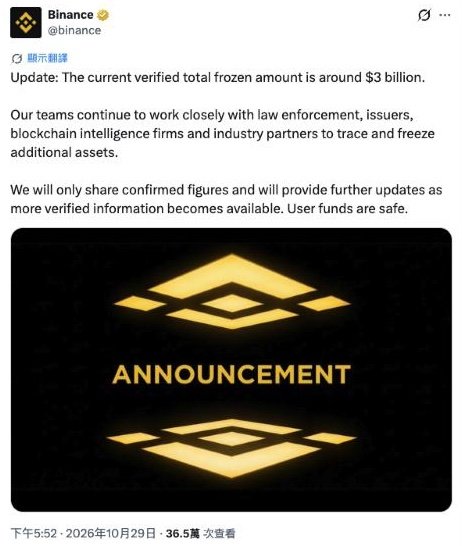
Tether and Circle alone account for more than $2.3 billion. Binance later stated that, with the assistance of other project teams, it had verified that the total amount frozen was approximately $3 billion.
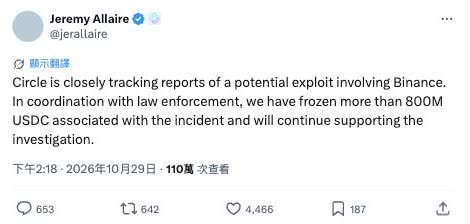
The term “freeze” refers to a stablecoin issuer adding a specific wallet address to the token contract’s blacklist. Once an address is added to the blacklist, the USDT or USDC held in that wallet can no longer be transferred out, and the holder cannot access the funds even if they possess the private key.
For the average user, this means:Stablecoins are not like Bitcoin, where “as long as you have the private key, no one can touch it.”. As long as a stablecoin is issued by a company, the issuer retains the ability to freeze it, regardless of whether the tokens are held on an exchange or in your own wallet.
What Regular Users Should Do: Check Whether Their Address Is on the Blacklist
The vast majority of frozen addresses are associated with hackers, scammers, or sanctioned entities, so it is highly unlikely that ordinary users would encounter them during normal use. However, if you frequently receive USDT through over-the-counter (OTC) or peer-to-peer (P2P) transactions, or if the sender’s address is of unknown origin, you should first check whether that address has been blacklisted by Tether.
Take USDT on Ethereum as an example:
- Open the USDT futures page: Go to Etherscan in your browser at USDT Futures Page, with the contract address 0xdAC17F958D2ee523a2206206994597C13D831ec7.
- To access the read function: Click the "Contract" tab on the page, then click "Read Contract." This step does not require connecting a wallet.
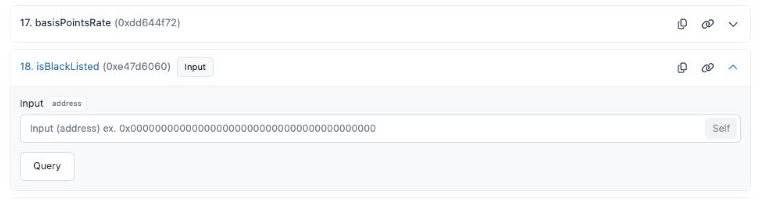
- Find the blacklist function: Scroll down to the "isBlackListed" entry; when you click it, an address input field will appear.
- Enter an address and search: Paste the wallet address you want to check, then click "Query." A result of "true" means the address has been blacklisted; "false" means it has not.
The contract address for USDT (TRC20) on the Tron chain is TR7NHqjeKQxGTCi8q8ZY4pL8otSzgjLj6t. You can view it in the same way on the Tronscan contract page; the function names are subject to the page's display.
Search results only reflect the "current" status. Just because a recipient's address is not currently on a blacklist does not mean the source of the funds is necessarily legitimate, so a more practical approach is to minimize receiving coins from unknown sources:
- Prioritize purchasing cryptocurrency through licensed platforms: Many jurisdictions have licensing requirements for cryptocurrency platforms; for example, the Hong Kong Securities and Futures Commission requires virtual asset trading platforms to be licensed. Before buying cryptocurrency, check whether the platform is licensed in your jurisdiction.
- Records of Large Transactions: When conducting OTC or P2P transactions, keep records of the other party’s identity, conversations, and transfer history. In the event of any issues with the funds, these records will serve as evidence that you acquired them in good faith.
- Don't put all your funds into a single stablecoin.: Freezing and decoupling are both risks at the issuer level; diversifying holdings can mitigate the impact of a single event.
If you want to buy and sell cryptocurrency through a licensed brokerage firm,Futuhui SecuritiesThis is a brokerage firm licensed by the Hong Kong Securities and Futures Commission (SFC). Account opening eligibility and tradable cryptocurrencies are subject to the information displayed on the platform. Please note that retail investors in some regions cannot purchase USDT directly on licensed platforms; for example, in Hong Kong, this is currently limited to professional investors. For the account opening process, please refer to Futuhui Account Opening Guide。
How USDT and USDC Are Frozen: The Blacklist Is Embedded in the Token Contracts
Stablecoins can be frozen because, when issuing the tokens, the issuer has already programmed management functions into the smart contract that only they can invoke.
USDT: Blacklist, and if necessary, burn and reissue
Tether's USDT contracts (Ethereum and Tron versions) have three governance functions related to freezing:
- addBlackList: Add the address to the blacklist; USDT from that address can no longer be transferred out.
- removeBlackList: Remove the address from the blacklist to unfreeze it
- destroyBlackFunds: Destroy the USDT balance in blacklisted addresses
Blacklisted addresses can still receive USDT, but they will be unable to transfer it out after receiving it. As for `destroyBlackFunds`, this is the key to recovering funds: the issuer first destroys the frozen tokens and then reissues an equivalent amount of USDT to the rightful owners.
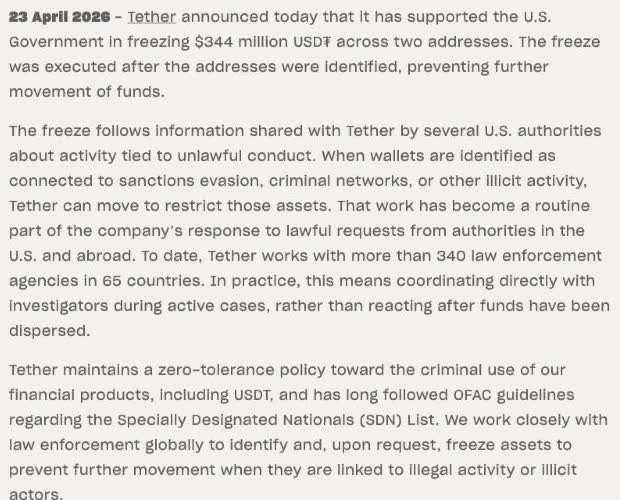
In an official announcement on April 23, 2026, Tether stated that the company has collaborated with more than 340 law enforcement agencies across 65 countries, assisted in over 2,300 cases, frozen more than $4.4 billion in assets, and will freeze addresses related to sanctions, criminal networks, or other illegal activities upon request from law enforcement agencies.
According to statistics from the blockchain security firm BlockSec, as of July 26, 2026, Tether had blacklisted a total of 9,597 addresses, freezing assets worth approximately $5.69 billion, of which about $3.71 billion was on the Tron chain. Tron is a network frequently used by many people to receive and send USDT via OTC transactions, which is why we recommended checking the address in the previous section.
USDC: Blacklisted addresses cannot send or receive funds
Circle’s USDC contract includes a “Blacklister” role. Once an address is blacklisted, it cannot send, receive, mint, or burn USDC—restrictions that are stricter than those for USDT.
In April 2026, Allaire stated that Circle would only freeze USDC upon instruction from law enforcement or a court. A notable historical example occurred in August 2022, when, on the same day the U.S. Treasury Department imposed sanctions on the mixing service Tornado Cash, Circle immediately froze approximately 75,000 USDC in related addresses—even preventing users who had simply deposited funds into the protocol and were not connected to the sanctions from withdrawing their funds.
Regulators have made freezing capacity a mandatory requirement.
The GENIUS Act, signed by the United States in July 2025, requires that eligible payment-type stablecoin issuers possess the technical capability to comply with lawful orders to freeze, seize, or destroy tokens. In other words, “freezability” is not a choice for individual issuers, but rather a prerequisite for issuing stablecoins in major markets.
Freezing Does Not Mean Recovery: Follow-up Procedures for Frozen Funds
Freezing funds merely prevents them from being moved; it does not mean the money has been returned to the victims. The general process consists of four steps:
- Freeze: The issuer blacklists the attacker's address, and the flow of funds is halted.
- Legal Proceedings: Law enforcement agencies are typically required to obtain a court order or a seizure warrant to identify the lawful owner of the funds.
- Destroy: The issuer destroys the tokens held at the addresses on the blacklist.
- Reissue: The issuer issues an equal number of new tokens to the rightful owners.
Irina Heaver, founder of the Dubai-based law firm NEOSLegal, pointed out that the freeze is “only the first step” and that the funds will not automatically be returned to Binance as a result; Max Atallah, managing partner at the Nordic law firm Nordic Law, also stated that the freeze itself does not determine who is entitled to the assets. Researchers at the blockchain analytics firm Chainalysis noted that while the freeze can be completed quickly, there is no standard timeline for the return of assets, which may take several months or even longer.
In its third update, released on the evening of October 31 (UTC+8), Binance stated that it had utilized a portion of the SAFU fund, a portion of the futures insurance fund, and company funds to recover approximately 90 percent of the stolen assets. Among these, ten major tokens—including BTC, ETH, USDT, and USDC have been fully reimbursed, while the remaining 10 percent will continue to be purchased through market and over-the-counter channels. In other words, user compensation does not depend on when these frozen stablecoins are reissued.
Freezing Assets Won't Stop Anything: There Is No Issuer for ETH or BTC That Can Freeze Them
No matter how quickly stablecoins can be frozen, the process can only apply to tokens issued by the company. In this incident, the attacker took several actions both before and after the freeze took effect:
- Withdraw a portion of your USDT early: According to on-chain data, the attackers’ primary receiving addresses collectively received approximately 1.82 billion USDT, of which about 640 million had already been transferred out before the funds were frozen.
- Exchange other tokens for ETH: The attacker used a decentralized exchange to gradually convert tokens other than stablecoins into ETH, then consolidated them into a single address. As of the early hours of October 30 (UTC), that address held more than 190,000 ETH.
- BTC Cannot Be Frozen: According to estimates by an on-chain analytics firm, the attackers also obtained approximately 18,000 BTC. Since Bitcoin has no central issuer, no one can freeze it on-chain; it can only be intercepted by an exchange when funds are transferred to the platform.
This perfectly illustrates the fundamental difference between stablecoins and ETH and BTC: the former have issuers that assume responsibility for reserves and compliance, so they can be frozen; the latter have no issuers, so no one can freeze them—but likewise, no one can help you recover them either.
Controversy Over Freezing Rights: Why Are Some Questioning the Double Standard?
The speed at which this freeze occurred has prompted the industry to revisit the question of when publishers should take action.
The supporting sideThe company believes that the freeze has prevented billions of dollars from flowing into money-laundering channels and has protected the entire industry. Ardoino stated that protecting the industry and its partners is the company’s top priority.
The party raising the objectionThe focus is on whether the standards are consistent. Anton Golub, a former senior executive at an exchange and current head of business operations at Forte Exchange, stated, “There is a double standard here,” noting that when smaller projects are hacked, the industry often emphasizes the need for court orders and legal restrictions. He also cited the April 2026 Drift hack, in which approximately $290 million was stolen, noting that Circle had faced criticism at the time for failing to freeze the stolen USDC.
Another issue worth noting isInnocent Address. The blacklist targets addresses, not individuals. If an address receives funds from a sanctioned or compromised address, there is a chance that those funds will also be frozen. Depositors who were unable to withdraw their funds during the Tornado Cash incident are a case in point.
For the average user, the practical implication of these controversies is this: freezing assets is a centralized power that can both protect you and affect you. Only by understanding this can you decide how much of your funds to allocate to stablecoins and through which channels to receive them.
Risks That Stablecoin Holders Should Be Aware Of
- Issuer Default Risk: Stablecoins issued by the company, such as USDT, USDC, RLUSD, and USD1, can all be frozen. Once an address is blacklisted, the funds cannot be accessed even if you hold the private key.
- Low chance of thawing: According to BlockSec’s statistics, of the USDT addresses blacklisted in 2025, only about 3.6% were unblocked that year. Users whose funds were mistakenly frozen typically need to contact the issuer or law enforcement and prove that the funds came from a legitimate source.
- Decoupling Risk: The value of a stablecoin depends on the issuer’s reserves. When Silicon Valley Bank collapsed in March 2023, Circle had approximately $3.3 billion in reserves held at the bank, and the USDC briefly dropped to about $0.87 before stabilizing several days later. For a comparison of the risks associated with different types of stablecoins, see A Comprehensive Analysis of Stablecoin Risks。
- Regional Regulatory Differences: The pace of stablecoin regulation varies by region. For example, Hong Kong’s “Stablecoin Ordinance” took effect on August 1, 2025, but the Hong Kong Monetary Authority has issued only two stablecoin issuer licenses to date, and neither USDT nor USDC is among them.
Frequently Asked Questions
If I keep stablecoins in my own wallet, could they still be frozen?
Yes. The freeze is enforced at the token contract level and is not dependent on whether the tokens are held on an exchange or in a self-custody wallet. As long as an address is blacklisted by the issuer, the USDT or USDC in that address cannot be transferred out.
Can I check on my own to see if my address has been frozen?
Taking USDT on Ethereum as an example, you can go to the USDT contract page on Etherscan, navigate to “Contract” → “Read Contract,” and use the `isBlackListed` function to query an address. A return value of `true` indicates that the address has been blacklisted.
Can frozen USDT be recovered?
It is possible, but the process is not straightforward. Typically, law enforcement must intervene and obtain a court order; only after the rightful owner has been identified will Tether destroy the frozen tokens and reissue them. According to BlockSec’s statistics, only about 3.6% of the tokens held in frozen addresses in 2025 were unfrozen that same year.
Will Bitcoin and ETH be frozen?
They will not be frozen on-chain. BTC and ETH have no central issuer, so no one can blacklist an address. However, when funds are transferred to an exchange, the platform may block or freeze an account in accordance with its risk control policies.
How many stablecoins were frozen from Binance this time?
Tether reported that over 1.567 billion USDT had been frozen, Circle reported that over 800 million USDC had been frozen, World Liberty Financial had 27 million USD1 frozen, and Ripple also froze a portion of its RLUSD. Binance officials stated that they have verified the total amount frozen to be approximately $3 billion.
Are there any stablecoins that can't be frozen?
For any stablecoin issued by a company and backed by fiat currency reserves, the issuer typically retains the ability to freeze funds; the U.S. “GENIUS Act” even lists this ability as a compliance requirement. When selecting a stablecoin, rather than seeking one that “cannot be frozen,” it is better to first understand the issuer’s reserves, regulatory status, and freeze policies.
The information in this article was verified as of 8:00 a.m. on November 1, 2026, UTC+8 (Hong Kong, Taiwan, Singapore, and Malaysia time) (00:00 UTC on November 1). For the latest updates on the Binance hack, please refer to A Comprehensive Analysis of the Binance Hot Wallet Hack。
Next Step
If you want to reduce the chances of receiving coins from unknown sources, you can start by reading Futuhui Account Opening Guide, trade BTC and ETH through a licensed brokerage firm; if you need to transfer your coins to your own wallet, please refer to Futuhui Deposit and Withdrawal Guide. For tips on daily USDT transactions, please refer to USDT Transfer Guide。
Disclaimer
The content of this article is for reference only, investors should exercise independent judgment, invest with caution and at their own risk, this article does not provide or attempt to persuade viewers to trade or invest on the basis of the content of this article is for sharing purposes only, and should not be regarded as investment advice, and does not represent the Monsterblockhk viewpoints and positions, all information and views of the specific date of the judgment of the time-limited nature. In addition, if any content in this website involves virtual asset trading platforms that have not yet obtained a license to operate virtual asset trading platforms in Hong Kong, including but not limited to text introductions, pictures, promotions, events, etc., they are only available to users outside of the Hong Kong Special Administrative Region.
According to the Hong Kong Anti-Money Laundering and Counter-Terrorist Financing (Amendment) Ordinance 2022, after June 1, 2023, all centralized virtual asset trading platforms operating in Hong Kong or actively promoting their services to Hong Kong investors will be licensed and regulated by the SFC, and any related unlicensed activities will be a criminal offence. For more information and details of the legislation, users may refer to the SFC website.