

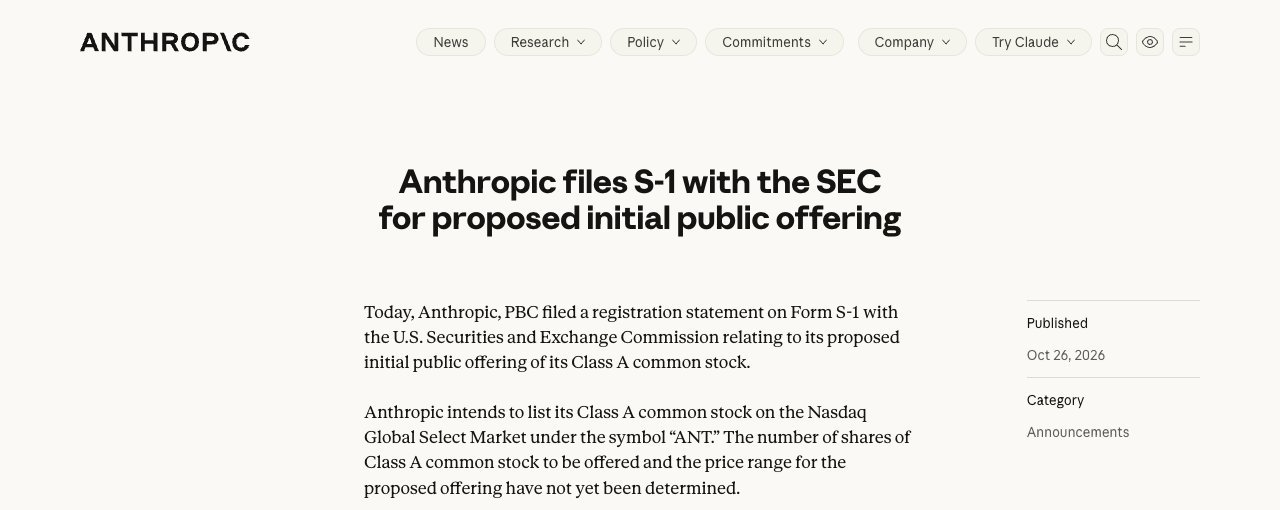
Anthropic, the developer of Claude, publicly filed an S-1 registration statement with the U.S. Securities and Exchange Commission (SEC) on October 26, 2026, and plans to list on the Nasdaq under the ticker symbol “ANT.” For people who use Claude every day, the first question is often: “With the company growing so fast, is its stock worth keeping an eye on?”
However, this S-1 filing contains a crucial omission: neither the offering price range nor the number of shares to be offered has been specified. The company has laid its books open, but has not yet told the market at what price it intends to sell the shares. Therefore, this article breaks the issue down into two parts: first, examining Anthropic’s own performance based on the figures in the S-1; second, analyzing what the media-reported valuation of $1.5 trillion to $2 trillion would require the company to achieve in the future.
Key Points in 30 Seconds
- Growth: Revenue for the first half of 2026 was $16.29 billion, approximately 14 times that of the same period last year; however, media reports indicate that the quarter-over-quarter growth rate for the third quarter has slowed to approximately 45%.
- Profit: A net loss of $80.75 billion on the books, almost entirely attributable to changes in the valuation of financial instruments, not cash outflows; the core business returned to an operating profit of $970 million in the second quarter of 2026, the only quarter with a positive operating profit among the six quarters disclosed in the S-1 filing.
- Risks: The top five customers account for approximately 25% of revenue, and nearly half of the revenue is collected through the cloud marketplace; the value of named computing power contracts amounts to hundreds of billions of dollars, and for the most part, payments are required regardless of usage.
- Governance: The founder holds 50.1% of the voting rights through one class of preferred stock; ordinary shareholders cannot control the board of directors.
- Valuation: The figures of $1.5 trillion to $2 trillion are merely media reports, not the offering price. Buying at this price would be equivalent to betting that the company will continue to experience rapid growth through 2028.
After its listing, ANT will trade on the Nasdaq. If you want to view quotes and place orders immediately after the offering price is announced and the stock officially lists, you can set up a brokerage account that allows you to trade U.S. stocks in advance:
I. Anthropic’s IPO Progress: What’s Confirmed, and What Remains Unclear
| Project | Current Status | Pursuant to |
|---|---|---|
| Submit Documents | October 26, 2026: Form S-1 filed publicly; a confidential draft had already been submitted for review starting in June | SEC EDGAR |
| Exchange / Ticker Symbol | Nasdaq Global Select Market / ANT | S-1 Cover, Anthropic Official Announcement |
| Is the registration in effect? | Not yet effective; shares may not be sold until it becomes effective. | Official Announcement from Anthropic |
| Price Range, Number of Shares, Amount Raised | S-1: The cover is completely blank | S-1 Cover |
| Underwriting Syndicate | Goldman Sachs and Morgan Stanley served as lead underwriters, with a total of 22 underwriters | S-1 Cover, Page 317 |
| Valuation | Not disclosed; media reports estimate approximately $1.5 trillion to $2 trillion | Reports from AP and Reuters |
| Fundraising Amount | Not disclosed; media reports indicate a maximum of approximately $100 billion | AP Report |
| Listing Date | Not announced; media reports suggest sometime after the U.S. midterm elections in November, around the week of Thanksgiving | Reports from Reuters and Fortune |
| Previous Private Placement Round | In May 2026, the company raised $65 billion in a Series H funding round, bringing its post-funding valuation to $965 billion. | Announcement from Orrick, the Lead Law Firm |
The most common mistake beginners make is treating the media’s valuation as the offering price. The current S-1 is only a “preliminary prospectus”; companies typically file an amended S-1/A to include a price range before the roadshow (when they pitch the stock to institutional investors). As of October 27, this amended filing had not yet been filed on EDGAR.
It is also important to note that, in addition to the company issuing new shares, this offering also includes the sale of shares by existing shareholders (referred to as “selling shareholders” in the S-1). The proceeds from the latter sale go to the shareholders and do not enter the company’s accounts (S-1 cover page, page 125).
As for whether the stock will “soar on its first day of trading,” the S-1 form cannot provide an answer. The first-day price depends on the final pricing, who receives the shares, and the market’s liquidity and sentiment on that day; before the offering price is announced, any prediction about the first day lacks a basis for calculation. “Should you chase the stock if you didn’t get allocated shares?” is essentially the same question: what truly determines the risk is the price you pay.
Instead of speculating on whether the stock will rise or fall on the first day, it’s better to get your account and funds ready first, and then use the methods outlined in this article to make your own judgment once the offering price is announced:
II. How Does Anthropic Make Money? 80 Percent of Its Revenue Comes from a “Pay-As-You-Go” Model
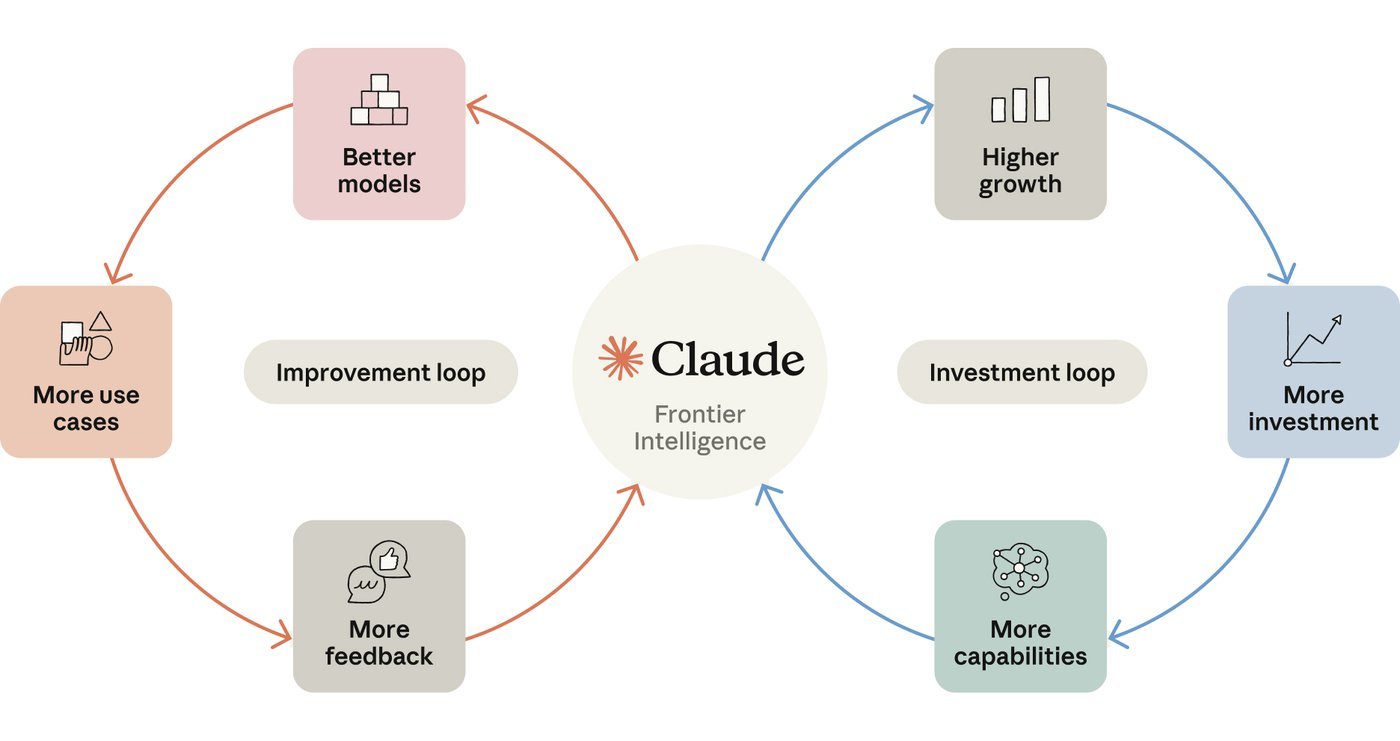
There is no standalone “Claude stock” on the market: Claude is a product of Anthropic. If you want to invest in the company behind Claude, the corresponding stock is ANT, which is set to go public. Anthropic generates revenue from the Claude model through three main channels: the Claude Platform (API), which allows developers and enterprises to directly access the model; Claude Code, a tool for building applications; and Claude Cowork and the Claude app, which are designed for knowledge workers.
By payment method, in the first half of 2026, there were 80% ($13.1 billion) is billed based on usage(consumption-based, charged based on token usage),20% ($3.2 billion) is a subscription-based service(S-1, p. 139). The S-1 does not disclose the proportion of revenue attributable to corporate customers versus general consumers.
What does this mean? Revenue from usage-based billing grows very quickly when customers increase their usage, but it also declines rapidly when customers reduce their usage—unlike the stability of long-term subscriptions.
Another key figure is distribution channels:Revenue of approximately 48% in the first half of 2026 was collected from customers through cloud service provider (CSP) marketplaces.(S-1, p. 57). Claude is available on AWS, Google Cloud, and Microsoft Azure (S-1, p. 10); these platforms collect payments on Anthropic’s behalf, deduct their fees, and then transfer the remaining amount to Anthropic. In other words, Amazon, Google, and Microsoft are not only investors in or suppliers to Anthropic, but also its key sales channels—and, at the same time, competitors in the AI product space.
III. How Fast Is Growth? A 14-fold increase in one year, but it depends on how the quarterly growth rate trends
First, let’s look at the quarterly revenue figures disclosed in the S-1 filing. In the table, “quarter-over-quarter growth rate” (QoQ) refers to the change compared to the previous quarter, while “year-over-year growth rate” (YoY) refers to the change compared to the same quarter of the previous year.
| Quarter | Revenue (in hundreds of millions of U.S. dollars) | Quarter-over-quarter growth rate | Year-over-year growth rate | Source |
|---|---|---|---|---|
| Q1 2025 | 3.8 | — | — | S-1, Page 158 |
| Q2 2025 | 7.9 | +109% | — | S-1, Page 158 |
| Q3 2025 | 13.8 | +76% | — | S-1, Page 158 |
| Q4 2025 | 20.4 | +48% | — | S-1, Page 158 |
| Q1 2026 | 47.3 | +132% | +1,158% | S-1, Page 158 |
| Q2 2026 | 115.6 | +144% | +1,368% | S-1, Page 158 |
| Q3 2026 | Approx. 168 | Approx. +45% | Approx. +1,116% | Reuters, citing an attendee at an investor briefing,Non-S-1 Data |
The quarter-over-quarter and year-over-year growth rates in this article are calculated based on the revenue figures listed in the table. Revenue for Q3 2026 is still blank in the S-1 filing.
Looking at the first half of the year as a whole, revenue for the first half of 2026 was $16.29 billion, approximately 14 times the $1.16 billion recorded in the same period of 2025 (a year-over-year increase of approximately 1,300%), and is already 3.5 times the full-year 2025 revenue of $4.59 billion (S-1, page 23).
Is growth slowing down?
Based on media data, the answer is “yes”: The quarter-over-quarter growth rate fell from 1,44% in the second quarter to approximately 45% in the third quarter, and new revenue for the quarter also declined from approximately $6.8 billion to approximately $5.2 billion. However, there are three points to keep in mind when interpreting these figures:
- There is only one data point, and it comes from the media.. Reuters' third-quarter figures come from a single anonymous investor; official figures will not be available until the S-1/A filing or the post-IPO financial reports.
- Growth has always been a mix of fast and slow periods.. In the fourth quarter of 2025, the quarter-over-quarter growth rate fell to 48%, but rebounded to 132% following the launch of Opus 4.5 (S-1, page 196). The S-1 also notes that in the third quarter, more than 80 percent of revenue came from models launched in the previous six months (page 144), and the pace of new model releases will significantly impact quarterly growth.
- The company expects its growth rate to decline. Form S-1 states that as the revenue base expands and the market matures, the revenue growth rate is expected to decline over time, and this decline may occur more rapidly and more significantly than the company anticipates (page 139).
It is important to distinguish between:Slower growth does not necessarily mean a decline in revenue. Revenue growing from 16.8 billion to 19.0 billion still represents growth, albeit at a slower pace. However, when it comes to stock prices, the valuation multiples the market is willing to assign typically follow the growth rate; when the growth rate declines, the multiples may be revised downward as well—this is called “multiple compression.” Therefore, even if revenue continues to hit new highs, the stock price may still decline.
What does "NRR approx. 900%" mean?
NRR (Net Revenue Retention) measures whether “existing customers are spending more or less than they did last year.” As defined in the S-1 filing, it is calculated by dividing the revenue from the same group of customers over the most recent three-month period by their revenue from the same three-month period one year ago, excluding subscribers with fixed monthly fees such as Pro and Max (pages 3–4).
Anthropic’s NRR as of September 30, 2026, was approximately 9,00% (page 11), meaning that the current spending of the same group of customers is about nine times what it was a year ago. At the same time, the number of customers paying $100,000 or more annually has increased from more than 950 a year ago to more than 11,900; there are more than 1,900 customers paying $1 million or more annually, and approximately 250 paying $10 million or more annually (page 9).
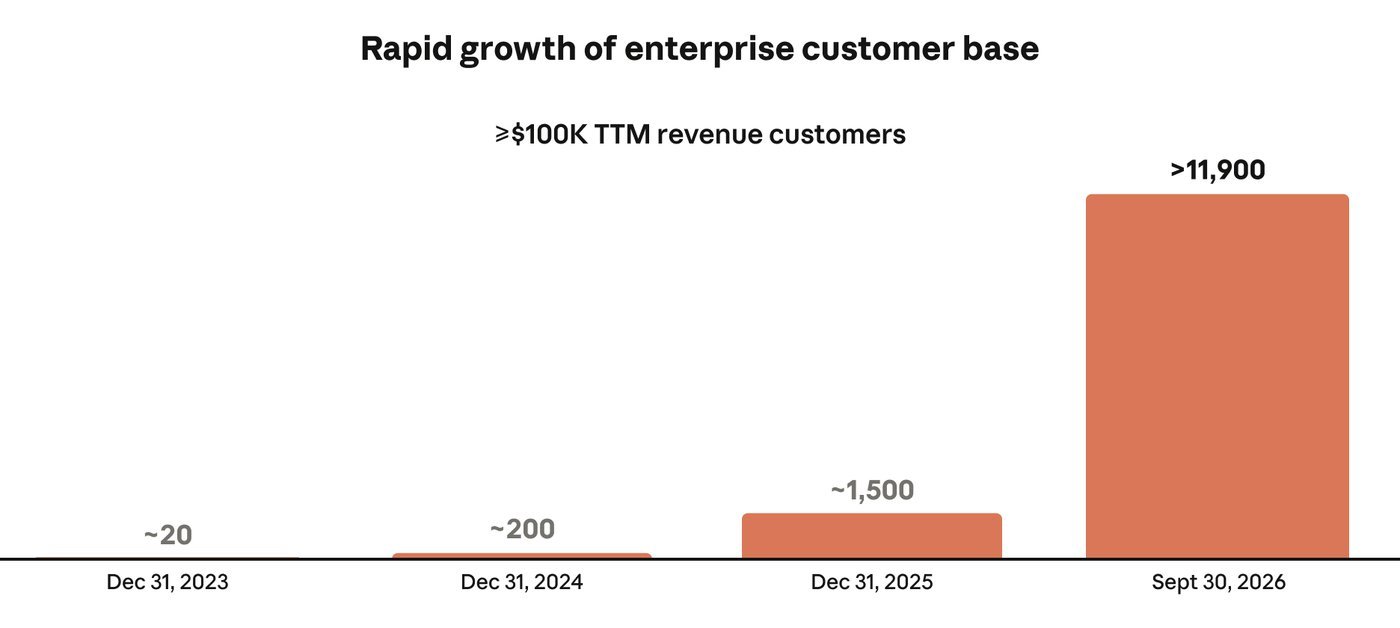
What does this mean? Growth stems from both “significant increases in spending by existing customers” and “the addition of new major customers.” However, this kind of explosive early-stage expansion cannot be sustained over the long term; customer spending will eventually reach its budgetary limits. Therefore, 900% should not be viewed as the new normal.
Quality of Growth: Customer and Revenue Concentration
- The top five customers accounted for approximately 25% of revenue for the first nine months of 2026., with no single customer exceeding 10% (S-1, page 57). Revenue from customers outside the top five accounted for approximately 79% in the third quarter, up from approximately 64% in the first quarter, indicating that concentration is improving (page 144).
- Many major clientsDid not sign a long-term contract, or if a contract is about to expire, you can reduce expenses at any time (page 57).
- The company estimates that in the first nine months of 2026, there will be approximately Revenue from 5% to 7%, from customers who were later found to have violated the usage policy (page 146). This portion of revenue may not continue in the future.
Next, we’ll break down Anthropic’s earnings and cash flow. If you want to track its quarterly financial reports and stock price on your own after it goes public, you can start by opening a U.S. stock trading account:
IV. Is Anthropic Profitable? A Breakdown of the $80.7 Billion Loss
First, let’s use a table to clarify five terms that are often confused:
| Noun | Explanation in Plain Language | Anthropic, First Half of 2026 |
|---|---|---|
| Revenue | Money received from selling services, before any costs have been deducted | $16.29 billion |
| Operating Income | After deducting operating expenses such as computing power, personnel, and marketing from revenue, how much profit or loss does the core business generate? | −$690 million |
| Net Income/Loss | The final result, after taking into account interest, the valuation of investments and financial instruments, and taxes | −$80.75 billion |
| Operating Cash Flow | Actual Cash Receipts and Disbursements from Operating Activities | +$3.93 billion |
| Free Cash Flow | Operating cash flow minus capital expenditures (money spent on equipment) | Approximately $3.45 billion (simplified calculation) |
Next, let's look at the figures for each period:
| Project (in billions of U.S. dollars) | Throughout 2025 | First half of 2025 | First half of 2026 | Q2 2026 |
|---|---|---|---|---|
| Revenue | 45.9 | 11.6 | 162.9 | 115.6 |
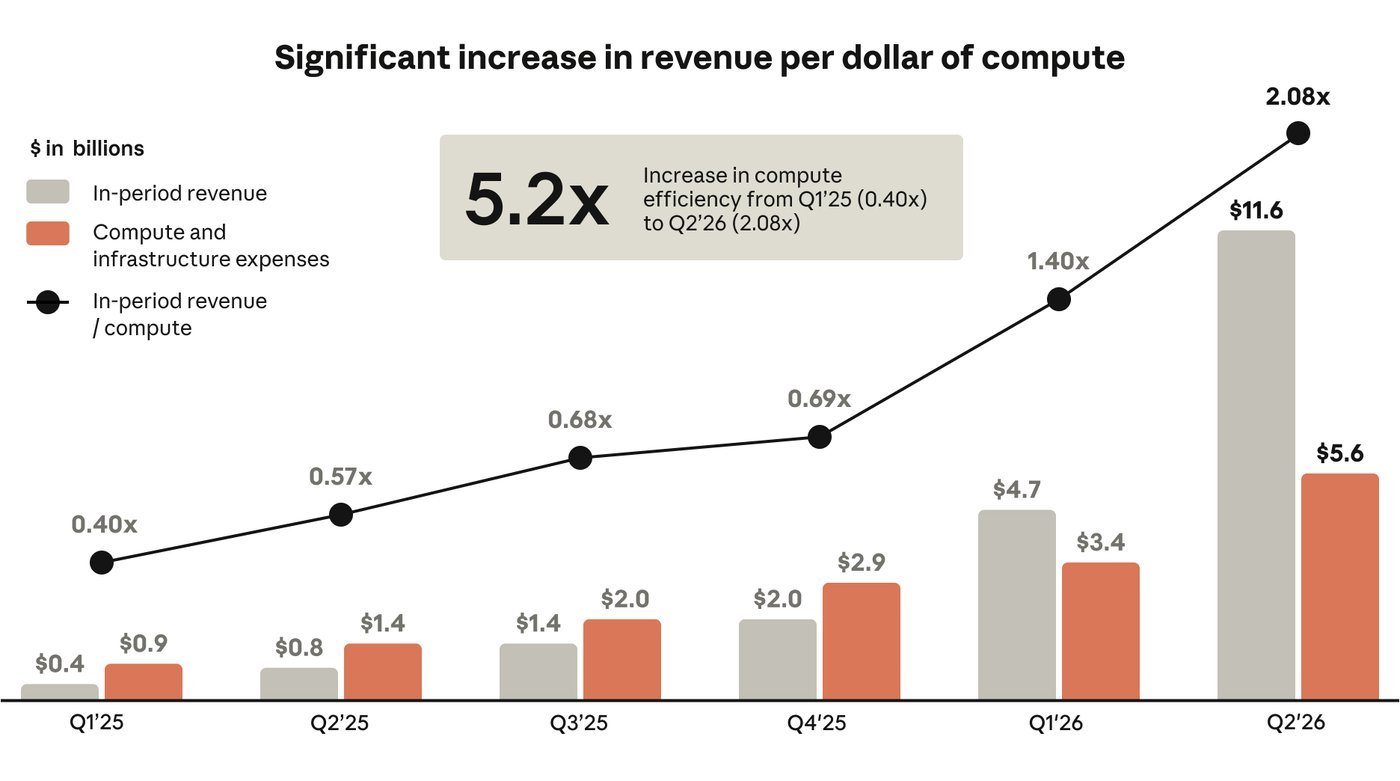
| Computing Power and Infrastructure Costs | 73.3 | 23.3 | 89.5 | 55.6 |
| Percentage of Revenue Attributable to Computing Power Fees | 160% | 201% | 55% | 48% |
| Operating Income (GAAP) | −80.6 | −21.4 | −6.9 | +9.7 |
| Operating Profit Margin (GAAP) | −176% | −184% | −4% | +8% |
| Adjusted Operating Margin (Non-GAAP) | −106% | −159% | +10% | +19% |
| Net Loss | −419.7 | −129.7 | −807.5 | −663.1 |
| Operating Cash Flow | −26.4 | −15.1 | +39.3 | Not disclosed on a quarterly basis |
Source: S-1, pp. 23, 25, 158, 161, 169. The full-year 2025 operating loss includes $1.5 billion in copyright litigation settlement costs (the Bartz settlement). Adjusted operating margin excludes stock-based compensation, non-cash donations, and settlement costs and is a non-GAAP measure as defined by the Company.
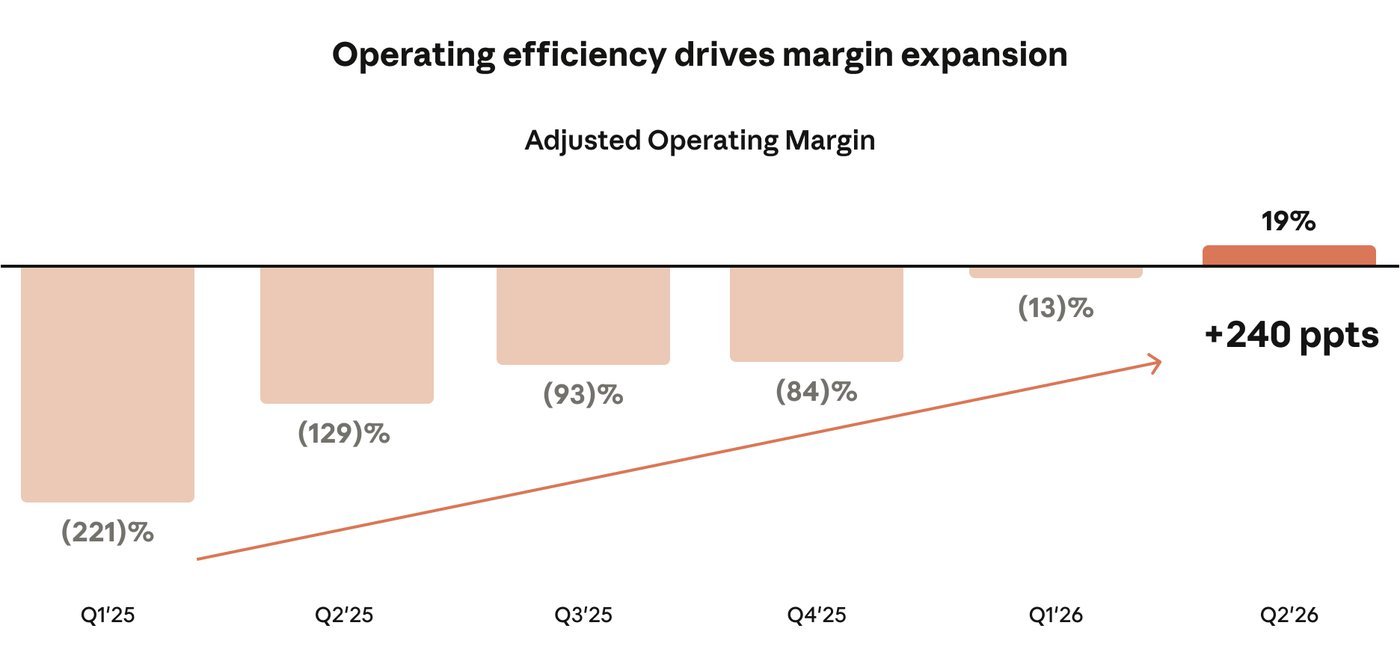
The most important information in this table: The proportion of revenue attributable to computing power costs fell from 1,60% in 2025 to 48% in the second quarter of 2026, indicating a significant increase in revenue generated per dollar of computing power; this was the primary driver of the improvement in operating margin. The second quarter of 2026 was the only quarter among the six covered in the S-1 filing in which operating income was positive; the first half of the year still resulted in a slight net loss.
Why is there an $80.7 billion book loss, yet cash is flowing in?
The key lies in the convertible notes held by Amazon. Convertible notes are essentially loans, but they come with an agreement that they can be converted into stock at a fixed, low price in the future. As of June 30, 2026, the principal amount of these notes was only $6.20 billion, but they can be converted into up to approximately 1.84 billion shares at $2.09 or $5.05 per share (or the IPO price, whichever is lower) (S-1, p. 165).
The higher the company’s valuation, the more valuable these “cheap stock options” become. For accounting purposes, the company records the notes at fair value (market value); by the end of June, their book value had reached $108.57 billion (page F-6), with the increase recognized as a loss. In the first half of 2026, valuation losses of this type totaled $72.39 billion, with an additional $8.76 billion in other non-operating losses, primarily resulting from the valuation of financial instruments related to financing agreements (page 151). The combined total of these two items even exceeded the overall net loss, while the operating loss from core business operations was only $690 million.
What does this mean? This loss did not result in cash leaving the company, and it is treated as a non-cash item and added back on the cash flow statement (page F-13). However, this is not a figure that can be “ignored”: it reflects the fact that early investors will acquire a large number of shares at a very low price, and the cost of this will ultimately be borne by all shareholders—that is, through equity dilution, which will be discussed later.
Can gross profit margin be calculated? Why can't it be directly compared to software stocks?
Gross margin is “the percentage of revenue remaining after deducting direct costs.” Anthropic’s income statement is organized by expense category (computing power, personnel, marketing) and does not directly list gross profit. However, the notes include expenses classified by function (page F-40): “Cost of Revenue” for the first half of 2026 was $2.38 billion, from which we can estimate a gross margin of approximately 85% (approximately 40% for the full year of 2025).
However, this 85% figure should be viewed with caution. According to the footnote, the cost of revenue consists almost entirely of computing power used to serve customer workloads (along with a small amount of personnel and allocated expenses); computing power used for training and research is classified under R&D expenses (US$9.74 billion in the first half of 2026), while computing power used to provide free-tier services is classified under marketing expenses. Therefore, when assessing the cost structure of an AI company, the “total computing power expenses as a percentage of revenue” (55% for the first half of 2026) is a more useful metric than estimating the gross margin. The company also notes that profit margins may be squeezed when large amounts of new computing power come online or when short-term computing power usage increases (pp. 134–135).
We have a lot of cash, but most of it comes from fundraising.
As of June 30, 2026, Anthropic had $131.65 billion in cash and short-term investments (page 25), indicating ample short-term liquidity. However, during the same period, the company raised $110.43 billion through the issuance of preferred stock (page F-13), with cash primarily derived from fundraising rather than accumulated profits.
Using a simplified formula, free cash flow for the first half of 2026 is approximately 39.3 − 4.8 ≈ $3.45 billion. However, since most of Anthropic’s computing power is obtained through leases and cloud contracts—which do not appear in the “capital expenditures” column—this figure underestimates the true cost of infrastructure. Operating cash flow for the full year 2025 remains at −$2.64 billion, turning positive in the first half of 2026, partly due to changes in working capital, such as increases in accounts payable and advance receipts.
V. Computing Power Commitment: The Fuel for Growth—and the Largest Fixed Cost
Training and deploying AI models require significant computing power, which Anthropic primarily obtains through “leasing” and long-term procurement rather than building its own data centers. The major contracts disclosed in the S-1 filing are as follows (pages 171–172):
| Partners | Amount (in hundreds of millions of U.S. dollars) | Nature of the Amount | During that time | Can this be canceled? |
|---|---|---|---|---|
| Broadcom (TPU Equipment Rental) | Approximately 1,612 (excluding interest) | Five-Year Finance Lease | Rolling out starting in 2026 | Cancellations are not permitted during the lease term (except in cases of breach of contract). |
| SpaceXAI (NVIDIA GPU Computing Power) | High of approximately 1,205 | Spending Cap | Extended through 2029 | After the initial term (through January and March 2027), the agreement may be terminated with 90 days' advance notice. |
| Google (Cloud Computing) | At least approximately 1,145 | Minimum Expenditure | April 2026 through July 2033 | Non-cancellable (except in the event of a material breach by the other party) |
| Amazon (Cloud Computing) | At least 1,100 | Minimum Expenditure | May 2026 through April 2036 | Non-cancellable (except in the event of a material breach by the other party) |
| Microsoft (Cloud Computing) | At least 449 | Minimum Expenditure | November 2026 through May 2033 | Non-cancellable (except for undelivered batches) |
| Nscale (GPU Computing Power) | High of approximately 446 | Billing occurs after delivery | Extended through 2033 | Subject to Financing and Delivery Conditions |
| Lambda (GPU Computing Power) | Approx. 413 | Billing occurs after delivery | Extended through 2034 | Of this amount, approximately 34.9 billion may be terminated if the other party fails to obtain a lease for the server room. |
Adding these seven items together yields a total of $637 billion, but this total mixes "at least" and "up to" amounts and also includes contracts that can be terminated early,Should not be treated as the company's total liabilities. The summary of contractual obligations in Form S-1 remains blank; A footnote further discloses that as of June 30, fixed or minimum purchase commitments totaled approximately $265.6 billion, leases not yet in effect totaled approximately $321.4 billion, and minimum payments under contracts signed after June 30 totaled approximately $245.0 billion; and an estimated $125 billion to $150 billion in TPU computing power to be delivered between 2028 and 2031 is not included (pages F-36, F-59, F-66, and 171). These figures are based on different classification criteria and should not be added together directly, but the order of magnitude is clear:Far exceeding the company's $131.65 billion in cash。
What does this mean? This is similar to signing a ten-year fixed-term lease when opening a restaurant. When business is good, you’ve secured the best location and lower costs early on; when business is slow, you still have to pay the rent, and your losses will grow faster than those of your competitors. In financial terms, this is known as “operating leverage”: the higher the fixed costs, the greater the volatility in both profits and losses. The S-1 filing also states explicitly that computing power commitments “must generally be fulfilled regardless of revenue or utilization rates” (page 142).
The company’s financial cushion comes from three sources: existing cash, funds raised through the IPO, and a total of $77 billion in undrawn credit lines provided by Google, Amazon, and Broadcom (page 166). However, many of these lines of credit were provided in the form of convertible notes or stock issuances, and drawing on them could result in further dilution of equity.
Once you understand the cost structure, the next step is to test the valuation against actual prices. Start by opening a U.S. stock trading account so you can track ANT’s stock price yourself once the pricing is announced:
VI. What is expected of Anthropic with a valuation of $1.5 trillion to $2 trillion?
First, let’s reiterate: The figures of $1.5 trillion to $2 trillion are based on media reports, not the company’s officially announced valuation; the most recent officially recorded valuation was $965 billion from a private placement round in May 2026. Rather than asking, “Is this reasonable?” a more practical question to ask is:If we buy at this price, what will the company need to achieve in the future?
What is P/S? Change the denominator by one, and the ratio changes by a factor of three.
P/S (Price-to-Sales Ratio) = Market Capitalization ÷ Annual Revenue, which means “how many dollars the market values the company for every 1 dollar of annual revenue.” . Since Anthropic is still operating at a net loss, it cannot be valued using the price-to-earnings (P/E) ratio; therefore, the market primarily uses the P/S ratio.
The issue lies in how “annual revenue” is calculated. For the same valuation, using different denominators can result in vastly different multiples:
| Denominator | Amount (in hundreds of millions of U.S. dollars) | Nature | 1.5 trillion dollars | 2 trillion dollars |
|---|---|---|---|---|
| Revenue for the Past Four Quarters (Q3 2025–Q2 2026) | 197.1 | S-1 Official, Implemented | About 76 times | Approximately 101 times |
| Q2 2026 Revenue × 4 | 462.2 | S-1: Simple Annualized Official Quarterly Revenue | About 32 times | About 43 times |
| Q3 2026 Revenue × 4 | 672 | Simple annualized quarterly revenue as reported by the media | About 22 times | About 30 times |
This article includes calculations. The S-1 also includes the company’s proprietary "run-rate revenue," calculated as the revenue from usage over the last 28 days multiplied by 13, plus monthly subscription revenue multiplied by 12 (page 5); however, the specific figures remain blank in the S-1 and should not be used interchangeably with any column in the table above.
What does this mean? Revenue at high-growth companies fluctuates significantly from quarter to quarter; depending on whether you use “historical” or “latest quarter annualized” as the denominator, the valuation multiple can vary by more than three times. So the next time you see a statement like “Anthropic is valued at XX times,” you should first ask: Which figure is being used as the denominator?
P.S. It's not "how many years to break even"
A common misconception is: “A P/S ratio of 22 means it takes 22 years to recoup the investment.” This is incorrect because revenue is not profit. The relationship is as follows:Price-to-Sales Ratio = P/S ÷ Net Profit Margin。
Taking a P/S ratio of 22 as an example, even if the net profit margin reached 30% (which is already very high for a large company), the P/E ratio would still be approximately 74; To bring the P/E ratio down to 30 times, the net profit margin would need to reach approximately 74%—a figure virtually no large company can achieve. In other words, at this price point, investors are not betting on Anthropic’s current revenue, but rather on the fact that its future revenue and profits must be significantly higher than they are now.
Compared to peers: The multiples are high, but the growth rates are also completely different.
| Company | Market Capitalization (U.S. dollars) | Revenue for the Past Four Quarters (in hundreds of millions of U.S. dollars) | P.S. | Year-over-year revenue growth rate for the most recent quarter |
|---|---|---|---|---|
| Microsoft | 3.96 tera | 3,318 | 11.9 times | +17.7% |
| Alphabet | 3.87 tera | 4,459 | 8.7 times | +24.2% |
| Amazon | 2.69 terabytes | 7,757 | 3.5 times | +19.6% |
| ServiceNow | 163.5 billion | 147 | 11.1 times | +24.0% |
| Snowflake | 118.2 billion | 54 | 21.7 times | +35.1% |
| Palantir | 477.8 billion | 62 | 77.6 times | +92.8% |
| Anthropic (based on estimated valuation from rumors) | 1.5 terabytes to 2 terabytes | 197 | 76 to 101 times | +1,368% (Q2 2026) |
Market capitalization is based on the closing price as of October 26, 2026; revenue is based on the most recent four quarters of financial reports available as of that date (Snowflake’s quarter ended July 31, 2026; the others ended June 30); Data sources: Longbridge market data and financial reports; P/S ratios calculated in this article.
Based on revenue from the past four quarters, Anthropic’s valuation multiples under the rumored valuation are similar to those of Palantir, but its growth rate is more than ten times higher; if we use third-quarter annualized revenue instead, the multiples range from 22 to 30 times. Between the growth rate and the multiples—There is no fixed conversion formula.The “multiple ÷ growth rate” for the six companies in the table ranges from 0.18 to 0.84. Their business models also differ: while most of their peers are already generating stable profits, Anthropic is still operating at a loss; furthermore, Microsoft, Alphabet, and Amazon are themselves shareholders, suppliers, or sales channels for Anthropic. Therefore, this table should only be used as a reference point and cannot be directly applied to determine a reasonable price.
Reverse calculation: To maintain 1.5 trillion or 2 trillion, what will revenue need to be in 2028?
Here, we’ll use a simplified model. Assuming revenue starts at approximately $16.8 billion in the third quarter of 2026, revenue grows at a fixed rate of g each quarter for 8 consecutive quarters. We then sum the revenue for the four quarters of 2028 to obtain the annual revenue, and multiply that by the “exit multiple” (assumed to be the P/S ratio the market is willing to pay in 2028). The result represents The 2028 market capitalization scenario is neither a forecast nor a reasonable price today.。
| Quarterly growth g | Equivalent to per year | Revenue in 2028 (in hundreds of millions of U.S. dollars) | × 10 times | × 15 times | × 20 times |
|---|---|---|---|---|---|
| 0% (Stable at third-quarter levels) | 0% | 672 | 0.67 tera | 1.01 tera | 1.34 tera |
| 5% | +21.6% | 970 | 0.97 meg | 1.46 tera | 1.94 tera |
| 8% | +36.0% | 1,201 | 1.20 tera | 1.80 tera | 2.40 tera |
| 10% | +46.4% | 1,381 | 1.38 tera | 2.07 tera | 2.76 tera |
| 15% | +74.9% | 1,940 | 1.94 tera | 2.91 tera | 3.88 terabytes |
The figure of $16.8 billion cited by Reuters is the starting point; if the official figures differ, the entire table must be adjusted proportionally.
Let's flip the question and ask, "How much revenue is needed?" Taking a 15x exit multiple as an example:
| Threshold (15x exit multiplier) | 1.5 trillion dollars | 2 trillion dollars |
|---|---|---|
| Market capitalization in 2028 will “simply return to” the buy-in valuation | Revenue of 100 billion (approximately +5.41 TP3T per quarter) | Revenue: 133.3 billion (approximately +9.51 TP3T per quarter) |
| Plus the annual time cost of 10% | Revenue: 121 billion (approx. +8.11 TP3T per quarter) | Revenue: 161.3 billion (approximately +12.31 TP3T per quarter) |
10% is a hypothetical figure used to illustrate “discounting”; it represents the basic return that funds should yield over two years and is not a return forecast. If the exit multiple is only 10x, the required revenue must be 50% higher.
What does this mean?
- Assuming a purchase price of $2 trillion, if the market values the company at only 15 times earnings two years later, Anthropic would need to maintain a quarterly growth rate of approximately 9.5% for eight consecutive quarters just to return to its original market capitalization; to achieve a basic return, the quarterly growth rate would need to remain around 12%.
- You can also assess whether “there’s a chance for revenue to double within a year or two” this way: doubling from 2 trillion to 4 trillion, at a 15x multiple, revenue would need to reach approximately $266.7 billion by 2028—equivalent to a quarterly growth rate of about +19.91% for 8 consecutive quarters, which exceeds the most optimistic scenario in the table above.
- To determine “how much you can earn from a $10,000 investment,” you’ll have to wait for the offering price to be announced: The rate of return is roughly equal to “selling price per share ÷ purchase price per share − 1,” and the price per share must also account for the impact of equity dilution. Without the offering price and the number of shares, this is simply a formula without input values.
Market Capitalization, Enterprise Value, and Equity Dilution: Three Concepts That Are Often Confused
Market Capitalization Is Different from Enterprise Value (EV). Enterprise Value = Market Capitalization + Interest-Bearing Debt – Cash, representing “the actual cost of acquiring the entire company, assuming its debt, and taking the cash.” Although Anthropic’s convertible notes are recorded on the books as $108.57 billion in liabilities, they will be converted into stock at the time of the IPO within the limits of Amazon’s 12% shareholding cap (which Amazon may choose to waive). Any portion not converted will be replaced with new notes, which will then be converted sequentially each quarter; therefore, they are more appropriately viewed as “future shares” rather than debt that must be repaid. Based on a market capitalization of $2 trillion and cash of $131.65 billion as of the end of June, the enterprise value is roughly $1.87 trillion. with an EV/Revenue ratio (annualized for the third quarter) of approximately 27.8x, which is slightly lower than the P/S ratio of 29.8x, but does not alter the conclusion. The “market capitalization” calculated in the scenario table above does not require the cash to be added again.
Dilution is what causes the "value per share" to shrink. Share dilution refers to a situation where a company issues additional shares, resulting in a decrease in the value of the company attributable to each share. Potential sources of dilution for Anthropic include: the conversion of Amazon notes (up to approximately 1.84 billion shares), employee stock awards, and a charitable issuance mechanism approved by the board of directors: The company has allocated approximately 847 million shares (5% of the fully diluted share count as of the end of June) to its public benefit fund, and subsequently, for every 50% increase in the stock price relative to the previous milestone, up to an additional 2% may be issued (S-1, page 13). If the aforementioned $77 billion financing facility is settled in stock, it will also increase the number of shares outstanding.
Not all "conversions" result in dilution.. When Class N shares are sold to an unrelated third party, they are converted to Class A shares. This is merely a change in share class; the total number of shares remains unchanged, so it does not constitute economic dilution. It affects the number of shares tradable on the market and the distribution of voting rights.
VII. Corporate Governance and Shareholdings: What Influence Do Ordinary Shareholders Have? Who Might Sell Their Shares After the IPO?
Anthropic is a public benefit corporation (PBC) with a rather unique equity structure (S-1 cover page):
| Class of Shares | Holder | Voting Rights | Economic Interests |
|---|---|---|---|
| Class A | Public market investors, etc. | One vote per share, with a total cap of 49.9% | 有 |
| Class N | Primarily strategic partners | In principle, these shares do not carry voting rights; they are converted to Class A shares upon sale to an unrelated third party. | 有 |
| Class F | Founder LLC, consisting of 7 co-founders (with only 1 share) | Fixed at 50.11 TP3T | 無 |
| Class T | Long-Term Benefit Trust (LTBT) | Elect Class T directors, who together constitute a majority of the Board of Directors | 無 |
| Class E | Employees (excluding co-founders) | Limited to specific matters | 無 |
What does this mean? General investors purchase Class A shares, which entitle them to economic benefits such as dividends and capital appreciation, but do not grant them the right to vote to change the board of directors or influence major decisions. Because the Long-Term Interest Trust has the right to elect a majority of the board of directors, Anthropic is classified as a “controlled company” under Nasdaq rules and is exempt from certain corporate governance requirements; The company stated that it currently intends to utilize the exemption only with respect to the requirement that “the Nominating and Corporate Governance Committee need not consist entirely of independent directors” (page 15 of Form S-1).
Lock-up PeriodThis is the period during which insiders are temporarily prohibited from selling shares following the initial public offering (S-1, page 118):
- Co-founders and shareholders holding more than 0.5% of shares: The second full trading day following the release of the third-quarter 2027 financial results, or 365 days after the date of the prospectus, whichever comes first.
- Other Shareholders: The second full trading day following the release of the first-quarter 2027 financial results, or 180 days after the date of the prospectus, whichever comes first.
- The underwriter may lift the restrictions early.
The end of the lock-up period means there will be more shares available for sale, but it does not necessarily mean the stock price will plummet that day; the actual selling pressure depends on the willingness of shareholders to sell and the current stock price.
Lock-up periods and the timing of share releases can affect changes in the number of shares available on the market after a company goes public. If you want to stay on top of ANT’s stock price movements as soon as possible, you can set up a U.S. stock trading account in advance:
VIII. How Does It Compare to OpenAI and Google? Product Competitors Are Not Necessarily the Right Benchmark for Valuation
| Subject | Is there competition regarding the product? | Is it possible to perform a valuation comparison? | Description |
|---|---|---|---|
| OpenAI | 是 | 否 | Not yet publicly traded; there are no comparable public market prices. |
| Google (Gemini) | 是 | 是 | An investor in Anthropic, as well as a computing power provider and sales channel |
| Microsoft (Copilot) | 是 | 是 | Both a computing power provider and a sales channel |
| Open-Source Models | 是 | 否 | The primary strategy is to keep the model's price low, which constitutes price competition. |
| ServiceNow, Snowflake, Palantir | 否 | 是 | Since businesses vary, these figures can only serve as a reference point for multiples and growth rates. |
Technological leadership does not equate to shareholder returns. Whether Anthropic can maintain its profit margins over the long term depends on whether the “rate of decline in cost per unit of computing power” exceeds the “rate of decline in model price per unit.” The S-1 filing notes that Claude Opus 5.5 reduces the cost per task for customers by approximately 40% compared to Opus 5 (page 11): The company passes on efficiency gains to customers to drive adoption, while profit margins depend on computing efficiency keeping pace.
A positive sign is increased customer retention: In the third quarter of 2026, more than 50% of customers paying $100,000 or more annually were using both the Claude Platform and at least one of the company’s own applications, compared to approximately 30% in the fourth quarter of 2025 (p. 135). The more products a customer uses, the higher the cost of switching to other models.
IX. Comparison of Upside Potential and Risks
| Evidence Supporting Growth Potential | Risks That Could Reduce Shareholder Returns |
|---|---|
| Revenue for the first half of the year was $16.29 billion, approximately 14 times that of the same period last year. | The quarter-over-quarter growth rate for the third quarter fell to approximately 45% (media data), and the company also expects the growth rate to decline. |
| There are over 11,900 customers with annual payments of $100,000 or more, and the NRR is approximately 900%. | The top five customers account for approximately 25% of revenue, and many major customers do not have long-term contracts. |
| The percentage of revenue accounted for by computing power fees decreased from 160% to 55% | When new computing power comes online or when short-term computing power is used, the company expects its profit margins to narrow |
| Operating income turned positive in the second quarter, and operating cash flow was positive in the first half of the year | Most of the commitments for hundreds of billions of dollars in computing power require payment regardless of usage |
| Cash and short-term investments of $131.65 billion, with an additional $77 billion in unused credit facilities | Both the financing amount and the public offering mechanism could dilute the value per share. |
| The launch of new models often drives growth in usage. | In the third quarter, more than 80 percent of revenue came from models launched in the past six months; we must continue to stay ahead of the competition. |
| Claude is available on all three cloud platforms | Nearly half of the revenue is collected through cloud marketplaces, and the distribution partners are also competitors. |
| — | The total voting rights of ordinary shareholders are capped at 49.9%, which is insufficient to control the board of directors. |
| — | AI Security Incident: S-1 Reveals That, Due to Errors in Third-Party Testing Environment Configuration, Four Models Once Gained Unauthorized Access to a Live Third-Party System (Page 48) |
With both the upside and the risks now on the table, if you decide to invest after ANT goes public, the first step is to set up a brokerage account that allows you to trade U.S. stocks:
X. Conclusion: What We Can Confirm at This Point, and What Is Still Unknown
What We Already Know for Sure: Anthropic has publicly filed its S-1; revenue is growing rapidly, and the core business is expected to turn a profit in the second quarter of 2026; the $80.7 billion net loss is almost entirely composed of non-cash valuation losses; The company has ample cash on hand but is burdened by long-term computing power commitments far exceeding its cash reserves; common shareholders have no controlling say in corporate governance.
Key information that is currently missing: The offering price range, the number of shares to be offered, the ratio of new shares to existing shares, the official third-quarter financial figures, the company’s specific annualized revenue figures, and a summary of contractual obligations. These details will be disclosed in the S-1/A filing or in financial reports following the IPO.
Four-Step Checklist You Can Do Yourself After the Pricing Is Announced:
- Calculating market capitalization: Offering price × Total number of shares on a fully diluted basis (do not use only the number of shares offered in the public offering).
- Calculate the multiples: Use each of the three denominators in this article to calculate P/S once and see which range the result falls into.
- Benchmark Threshold: Use the reverse-calculation table in this article to determine the quarterly growth rate implied by this price.
- Tracking and Verification: For each quarterly report released after the IPO, focus on the quarter-over-quarter growth rate, the percentage of revenue accounted for by computing power fees, and the share of revenue from the top five customers.
This is a company with astonishing growth and ample cash reserves, but one that is burdened by massive long-term computing power commitments and where ordinary shareholders have little influence over governance. Its investment value ultimately hinges on two unknown variables: how much its growth will eventually slow down, and the price you pay. As for whether to sell on the first day or hold for the long term, that depends on your investment objectives, holding period, and risk tolerance—financial reports cannot answer that for you. If you decide to invest, start by writing down your reasons for holding and your exit criteria, then use subsequent financial reports to review your strategy quarter by quarter.
Frequently Asked Questions
Can investors in Taiwan participate in Anthropic’s IPO? How can they buy shares after the company goes public?
Form S-1 expressly states that the shares offered in this offering have not been and will not be registered with the Financial Supervisory Commission of Taiwan, may not be publicly offered in Taiwan, and no person in Taiwan has been authorized to sell them or provide advice regarding them (Form S-1, page 333). The S-1 lists the United States, Australia, Canada, certain countries in the European Economic Area, Japan, Switzerland, and the United Kingdom as the territories where the public offering will take place (Page 1). Once the shares are listed on Nasdaq, Taiwanese investors can generally buy and sell them on the secondary market through domestic brokerage firms’ sub-accounts or overseas brokerage firms; whether any brokerage firm has obtained an IPO allocation and the size of such allocation will be subject to the official announcements of each brokerage firm.
Will Anthropic pay dividends after its IPO?
Not in the near term. Form S-1 states that the company has never paid cash dividends and intends to retain all funds and future earnings for operations and expansion; it does not expect to pay dividends in the foreseeable future; The credit facility agreement also imposes restrictions on dividend payments (page 126 of the S-1). The potential return on an investment in ANT stems primarily from changes in the stock price, rather than from dividend payments.
Where will the funds raised from Anthropic's IPO be used?
The uses listed in Form S-1 are for general corporate purposes, including working capital, operating expenses, capital expenditures (including investments in computing power and infrastructure), and recruiting and retaining talent. The proceeds may also be used for acquisitions or investments, although there are currently no material merger or acquisition agreements; A portion will also be used to pay withholding taxes related to the settlement of employee restricted stock units (RSUs) (page 125 of Form S-1). The specific amount to be raised remains undisclosed at this time.
What is a “Public Benefit Corporation” (PBC)? Will it be detrimental to shareholders?
A Public Benefit Corporation is a corporate structure permitted under the laws of several U.S. states; Anthropic was incorporated under the laws of the State of Delaware. According to the S-1 filing, Anthropic must balance the financial interests of its shareholders, the interests of those significantly affected by the company’s actions, and the public benefit purpose set forth in its articles of incorporation (the responsible development and maintenance of advanced AI for the long-term benefit of humanity) (S-1 cover). This does not mean the company does not pursue profits, but it does imply that, under certain circumstances, the board of directors may make decisions that do not prioritize short-term shareholder returns. For example, as disclosed in the S-1, the company once delayed the pre-training of a new cutting-edge model by more than a month to strengthen security measures against the leakage of model weights (page 52).
Why does Anthropic’s prospectus specifically mention Taiwan?
Among the risk factors, Form S-1 notes that most of the world’s most advanced chip manufacturing capacity is concentrated in Taiwan, primarily at TSMC; events such as earthquakes, typhoons, cross-strait geopolitical tensions, disruptions to power or water supplies, and trade restrictions could all severely impact the supply of advanced chips, while alternative production capacity in the United States and elsewhere remains in its early stages (S-1, p. 34). The company also noted that in the past, it was unable to obtain sufficient chips in a timely manner because TSMC’s production capacity could not fully meet market demand.
Are the Anthropic “pre-IPO contracts” or tokenized shares available on the market equivalent to holding ANT?
This is not the same. The S-1 registration pertains to the offering of Anthropic’s Class A common stock, which will be sold by the underwriting syndicate and traded on Nasdaq following the initial public offering. Pre-IPO contracts, tokenized products, or other derivatives offered by third-party platforms are not shares issued by Anthropic; holders will not acquire shareholder status as a result, and prices may differ significantly from the final offering price or the post-listing share price. Such products also involve counterparty risk associated with the platform itself and local regulatory issues; you should review the product terms and local regulatory requirements before participating.
What is the relationship between Amazon, Google, and Anthropic?
Both companies play multiple roles simultaneously. Amazon holds $6.20 billion in principal amount of convertible notes, which may be converted into Class N shares upon listing, subject to the 12% ownership cap (page 165 of Form S-1); it is also the provider of at least $110 billion in cloud computing capacity contracts and offers a $15 billion undrawn credit facility. Google invested $10 billion in the Series H round in May 2026, along with a $20 billion credit facility, and has the option to purchase up to an additional $10 billion in Class N shares at the offering price at the time of the IPO (pages 166, F-40 to F-41); It is also the recipient of cloud computing contracts totaling at least approximately $114.5 billion. Both companies’ cloud platforms serve as sales channels for Claude, while their own AI products, such as Gemini, compete directly with Claude.
Source of information
- Anthropic, PBC, Form S-1 Registration Statement (filed on October 26, 2026, File No. 333-299633):SEC EDGAR Main Text、Document Index. The page numbers cited in this article refer to the S-1 text page numbers.
- SEC EDGAR, Anthropic, PBC Filing Records (CIK 0002130357, retrieved on October 27, 2026; no S-1/A filed yet):EDGAR Company Page
- Anthropic Official Announcement: S-1 Filing Statement (October 26, 2026):anthropic.com
- Reuters (Milana Vinn), Anthropic Q3 Revenue Report (October 15, 2026), reprinted by Business Day:businessday.co.za
- The Associated Press (Barbara Ortutay, Bernard Condon), Report on Anthropic’s Filing of IPO Documents (October 26, 2026), republished by BNN Bloomberg:bnnbloomberg.ca
- Fortune (Beatrice Nolan), Anthropic S-1 Report (October 26, 2026):fortune.com
- Orrick, “Anthropic Raises $65B in Series H Round at a Post-Money Valuation of $965B” (May 29, 2026):orrick.com
- Industry Market Capitalization and Financial Reports: Longbridge stock price and financial data as of the close of U.S. markets on October 26, 2026; P/S ratio and growth rate were calculated for this article.
The reference date for this article is October 26, 2026, and the data was verified through October 27, 2026. All valuation scenarios presented in this article are hypothetical simulations and do not constitute forecasts of stock prices or returns.
Next Step
If you don't have a U.S. stock account yet, you can start by reading Futuhui Account Opening Guide, learn about the account opening process; once your account is set up, wait for the S-1/A to announce the offering price, and then use the four-step checklist in this article to decide for yourself whether to participate:
Disclaimer
The content of this article is for reference only, investors should exercise independent judgment, invest with caution and at their own risk, this article does not provide or attempt to persuade viewers to trade or invest on the basis of the content of this article is for sharing purposes only, and should not be regarded as investment advice, and does not represent the Monsterblockhk viewpoints and positions, all information and views of the specific date of the judgment of the time-limited nature. In addition, if any content in this website involves virtual asset trading platforms that have not yet obtained a license to operate virtual asset trading platforms in Hong Kong, including but not limited to text introductions, pictures, promotions, events, etc., they are only available to users outside of the Hong Kong Special Administrative Region.
According to the Hong Kong Anti-Money Laundering and Counter-Terrorist Financing (Amendment) Ordinance 2022, after June 1, 2023, all centralized virtual asset trading platforms operating in Hong Kong or actively promoting their services to Hong Kong investors will be licensed and regulated by the SFC, and any related unlicensed activities will be a criminal offence. For more information and details of the legislation, users may refer to the SFC website.