

What is Bitget Wallet? The 2026 version is very different from previous versions.
Bitget Wallet is a self-custodial, multi-chain Web3 wallet. Self-custody means you hold your private keys yourself, and your assets are stored directly on the blockchain rather than on a company’s ledger. This is different from keeping your coins in an exchange account: with an exchange, the exchange holds your assets for you, and you have the right to withdraw them; with a self-custody wallet, you hold your assets yourself, and you own the assets outright.
As of September 2026, the officially reported figures were approximately 100 million users worldwide, support for over 130 public blockchains, and a $300 million user protection fund.
The difference between the two modes is best illustrated by a few real-life scenarios:
| Situation | Listed on an exchange | Store in a self-custody wallet |
|---|---|---|
| I want to participate in a project on a new public blockchain | We'll have to wait for the exchange to list it; it can't be done before then. | Join the network to get started |
| Forgot Password | You can recover it through customer service and identity verification. | If you lose your mnemonic phrase, it cannot be recovered. |
| The platform has been suspended or is experiencing issues | Your withdrawal may be affected | Assets are on-chain and remain unaffected |
| Daily Trading of Major Cryptocurrencies | Good depth, easy to use | You have to find your own liquidity, so slippage is higher. |
| Wrong Address | In some cases, customer service can assist | Cannot be revoked |
The conclusion isn’t that one is better than the other, but rather that they serve different purposes. For most people, the sensible approach is to use both: use an exchange for fiat deposits and withdrawals as well as trading major cryptocurrencies, and use a wallet for on-chain transactions and long-term holding. For a more comprehensive comparison, see Should I Keep Cryptocurrency on an Exchange or in a Wallet?。
First, let's be clear: Bitget Wallet is not the same as the Bitget exchange.
This is the point that beginners most often get confused about. Although they are part of the same ecosystem, they operate completely independently:
- Bitget Wallet It's an on-chain wallet—you hold the private key, and you can use all its features without needing to open an exchange account.
- Bitget Exchange It is a centralized exchange that requires registration and identity verification.
All the steps described in this article are completed within the wallet; there is no need to open an exchange account.
What Has Really Changed in 2026
If you’ve used this wallet a few years ago, your impression of it probably revolves around “coin swaps and airdrop tasks.” The changes over the past two years have been fundamental: the wallet has evolved from a simple asset custody tool into a gateway that allows users to directly buy U.S. stocks, make cross-border payments, and connect to various new public blockchains.
If you arrange the published nodes in chronological order, the direction becomes quite clear:
- November 2024: Launch of a meme coin toolkit, including MemeX and Hot Picks.
- December 2025: Integrate Hyperliquid, a decentralized perpetual contracts platform, to bring on-chain derivatives into wallets.
- May 2026: Upgrade on-chain U.S. stock (RWA) trading by aggregating liquidity from Ondo and xStocks.
- July 2026: Entered into a strategic partnership with Robinhood to fully integrate with the Robinhood Chain mainnet.
- September 2026: Integration completed on the day Circle’s Arc mainnet went live.
Two of the three changes relate to traditional financial assets, and one relates to stablecoin settlement infrastructure. This isn’t about adding features to the existing functionality; rather, it’s about positioning the wallet as an “interface between traditional assets and on-chain funds.” For the average reader, this means you can now use a single app to manage crypto assets, tokenized U.S. stocks, and cross-border stablecoin transfers all at once—without needing three separate tools.
In Section 3 of this article, we’ll break down each of these features one by one to explain how they actually work and whether they’re worth using.
From Hong Kong Dollars to On-Chain: A Complete Guide to Setting Up a Wallet and Depositing Funds
This section is the most practical part of the entire article. First, set up a wallet; then we’ll talk about how to add funds to it.
Step 1: Download and set up a wallet
- Download the App: Jing Bitget Wallet Official Page(Invitation code: mbhkcrypto1) Click here to download. Do not download via links found in search ads or chat groups; fake apps are the most common cause of asset loss for this type of wallet.
- Select a setup method: Click “Create Wallet” on the home page. You can choose between a traditional mnemonic phrase wallet and an MPC (Merkle Tree) wallet that doesn’t require a mnemonic phrase. We recommend that beginners start with MPC to eliminate the risk associated with storing a mnemonic phrase; advanced users can choose the mnemonic phrase version for easier import into other wallets in the future.
- Back up your mnemonic phrase: If you choose the mnemonic phrase option, write down 12 or 24 English words with a pen and paper, recording them in order. Do not take a screenshot, do not save them to the cloud, and do not send them to yourself via messaging apps.
- Complete Verification: The system will ask you to re-enter your mnemonic phrase in the correct order to confirm that you wrote it down correctly.
- Setting Up Passwords and Biometric Authentication: Adding fingerprint or facial recognition will make everyday use much more convenient.
Setting up a wallet is free and does not require any funds.
Step 2: Choose a deposit method
The wallet itself has built-in functionality for full fiat currency deposits and withdrawals, and no exchange account is required at any stage. Hong Kong readers have two practical options:
Option A: Buy cryptocurrency through a licensed brokerage firm and then withdraw it (low cost, takes longer)
Best for those with larger amounts who aren't in a hurry.Futuhui Securities(Invitation code: MBHKFT) is a licensed platform where you can deposit Hong Kong dollars to directly purchase cryptocurrency and then withdraw it to your own wallet:
- Account Opening and Funding: Complete the account opening process and activate cryptocurrency trading, then fund your account with Hong Kong dollars.
- Buy ETH: Retail accounts support BTC and ETH withdrawals, so buy ETH as a vehicle for depositing funds onto the blockchain.
- Add a withdrawal address: In your Futu Crypto account, click "Withdraw," then paste your Bitget Wallet Ethereum address. It takes more than 24 hours for a new address to become active after it has been whitelisted, so we recommend completing this step one day in advance.
- Submit a Withdrawal Request: Deposits are free; a fixed fee of 0.0018 ETH applies to each ETH withdrawal. Requests are typically processed within approximately 3 business days after submission; please allow sufficient time when arranging your funds.
- Confirm Deposit: Check your balance on the Ethereum network in Bitget Wallet.
Futuhui's trading platform charges a fee of 0.081 TP3T, with a minimum of HKD 15 or USD 1.99 per order. For detailed instructions, please refer to Fidelity Cryptocurrency Teaching 與 Futuhui Account Opening Guide。
Option B: Buy directly from your wallet (instant, higher cost)
Ideal for those looking to start with small amounts right away. The "Buy Crypto" feature within the wallet is powered by third-party providers such as Mercuryo and supports over 40 fiat currencies and more than 10 payment methods, including Visa, Mastercard, Apple Pay, and Google Pay.
- To Buy Cryptocurrency: Open the app and tap "Buy Cryptocurrency" on the home screen.
- Select Currency and Amount: Choose the token you want to buy and its network, then enter the amount.
- Select a payment method: You can choose from credit card, Apple Pay, or Google Pay.
- Complete Payment: First-time users must complete the service provider’s identity verification; funds are typically credited within a few minutes.
The exchange rate and fees for this method are higher than those for Route A, but the advantage is that it’s instant. The wallet also supports peer-to-peer (P2P) cryptocurrency purchases, virtual account top-ups, and the basic feature of “receiving payments directly via your wallet address.”
How to Choose Between Two Paths
| Option A: Buy Cryptocurrency on Futu and Withdraw It | Option B: Buy directly from your wallet | |
|---|---|---|
| Time of Credit | Withdrawals take about 3 business days; for the first withdrawal, you'll also need to wait 24 hours for your address to be whitelisted. | Usually a few minutes |
| Major Costs | Platform usage fee: 0.081 TP3T (minimum HKD 15) + Withdrawal fee: 0.0018 ETH | Price differentials and fees charged by third-party service providers are generally higher than those for Option A. |
| I need to open an account | Open a securities account and activate cryptocurrency trading | No, but you'll need to pass the service provider's verification when purchasing cryptocurrency for the first time. |
| Suitable for | Larger amounts, not in a hurry | Small amount; want to start today |
The real distinction lies in whether fixed costs can be spread out. With Option A, the withdrawal fee is a fixed 0.0018 ETH, regardless of the amount you withdraw, so the larger the amount, the more cost-effective it is; however, if your principal is only a few hundred Hong Kong dollars, the withdrawal fee and Ethereum gas fees alone could eat up a significant portion of it, so in this case, Option B is actually the more reasonable choice.
Another practical consideration is time. With Option A, you first have to wait 24 hours to be added to the whitelist, then wait about 3 business days for the coins to be withdrawn; the entire process can take close to a week. If you spot an opportunity and want to enter the market the same day, this route won’t be fast enough. A reasonable approach is to use Route A to transfer a base position onto the blockchain in advance, and then use Route B only when you need to add to your position on short notice.
Start by testing the entire process with a small amount to make sure everything works, then increase the amount. No matter which method you use, you must verify that the currency and network match exactly before making a transfer—assets sent to the wrong network may be permanently lost.
Step 3: GetGas Solves the Problem of “Having Coins but Not Being Able to Use Them”
When you first join a new public blockchain, you may have tokens but not the native token of that chain to pay for gas, leaving you unable to do anything. GetGas lets you pay for gas using assets from other chains, helping you get around this deadlock. This is where beginners most often get stuck when performing their first cross-chain transaction, so it’s worth knowing about this feature beforehand.
Withdrawal: Converting on-chain assets back into fiat currency
Withdrawals are processed through MoonPay and support over 25 fiat currencies. Payment methods include Visa, Mastercard, PayPal, Venmo, and bank transfers. The platform supports USDT and USDC on Ethereum, Solana, BNB Chain, Base, and TRON.
- To make a withdrawal: Select “Withdraw” or “Sell” in the app.
- Select Assets and Fiat Currency: Choose the stablecoin you want to sell, its network, and the fiat currency you want to receive.
- Complete Identity Verification: When using MoonPay for the first time, you'll need to submit identification documents and complete facial recognition.
- Select a payment method and submit: In most cases, this is completed within a few minutes; in some cases, it may take 1 to 3 business days.
If your funds originally came from Futu, you can also go back the way you came: withdraw the cryptocurrency back to Futu to sell it, then withdraw the Hong Kong dollars to your bank account.
Four New Game Modes Coming in 2026
This section is content that was completely absent from the previous version, and it’s where this wallet has truly set itself apart over the past two years.
On-Chain U.S. Stocks (RWA): You Can Buy Them for Just $5
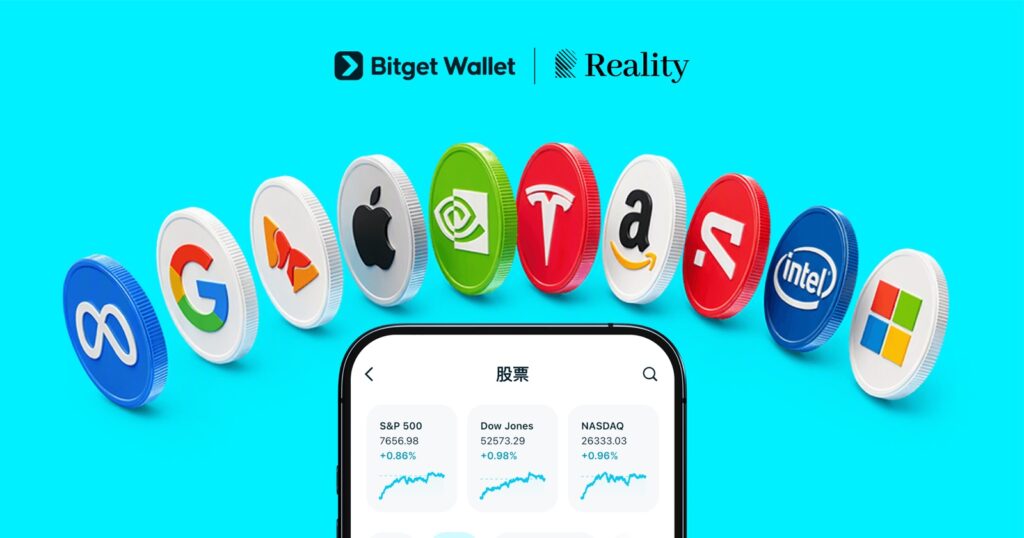
You can buy and sell tokenized U.S. stocks and ETFs directly within the wallet, with liquidity provided by Ondo and xStocks. The platform offers over 300 tokenized stocks, ETFs, commodities, and indices across the Ethereum, Solana, and BNB Chain networks. Trades start at a minimum of $5 and are available 24/7, unrestricted by U.S. stock market hours. The system uses a dual-track pricing model combining RFQ and AMM, which the company claims can save up to 20% in gas fees.
For Hong Kong readers, this means they don’t need to open a U.S. stock brokerage account or wait for the U.S. market to open—they can use stablecoins to purchase tokenized versions of S&P 500 ETFs or individual U.S. stocks.
What Exactly Did You Buy?
This is the point that needs to be clarified the most across the entire sector, yet is discussed the least. Take xStocks, one of the wallet’s liquidity sources, as an example. According to its official documentation:
- Full Endorsement: Each token is backed 1:1 by the corresponding real stock, and the underlying securities are held in a separate, segregated custody account.
- Dividend-paying: Cash dividends paid by the underlying stocks are distributed to holders; on Solana, they are distributed as USDC airdrops, while on EVM chains, they are reflected through a mechanism that automatically adjusts balances. In both cases, taxes required to be withheld by the custodian are deducted.
- No voting rights: The holder is the holder of the economic interests, not a registered shareholder; the voting rights attached to the underlying shares are exercised by the issuer in accordance with the custody agreement.
- Legal Nature: Debt Instrument: Each xStock is legally a bearer debt instrument and is classified as a tracking certificate rather than direct equity. The issuing entity is registered with the Jersey Financial Services Commission, and its issuance within the European Economic Area is governed by the Articles of Association approved by the Liechtenstein Financial Market Authority.
In other words, what you’re getting is economic exposure to price and dividends—not shareholder status. This doesn’t mean there’s anything wrong with the product, but it’s not the same as buying a single share of Apple through a brokerage firm; there are three additional layers of counterparty risk involved: the issuer, the custodian, and the jurisdiction in which the product is held. Readers investing larger sums or planning to hold these products for the long term should give this point careful consideration first.
Robinhood Chain: Connecting to the RWA public blockchain built by brokerage firms
In July 2026, Bitget Wallet entered into a strategic partnership with Robinhood to fully integrate with the Robinhood Chain mainnet. Robinhood Chain is an Ethereum Layer 2 built on Arbitrum, designed specifically for the native issuance of real-world assets (RWAs).
The scope of integration includes mainnet support, DApp connectivity, real-time quotes, and token trading. In other words, you can access the Robinhood Chain ecosystem directly within the Bitget Wallet to trade tokenized stocks and RWA assets without needing to install a separate wallet.
Arc Chain: Circle’s public blockchain for stablecoins, which offered support on its first day of launch
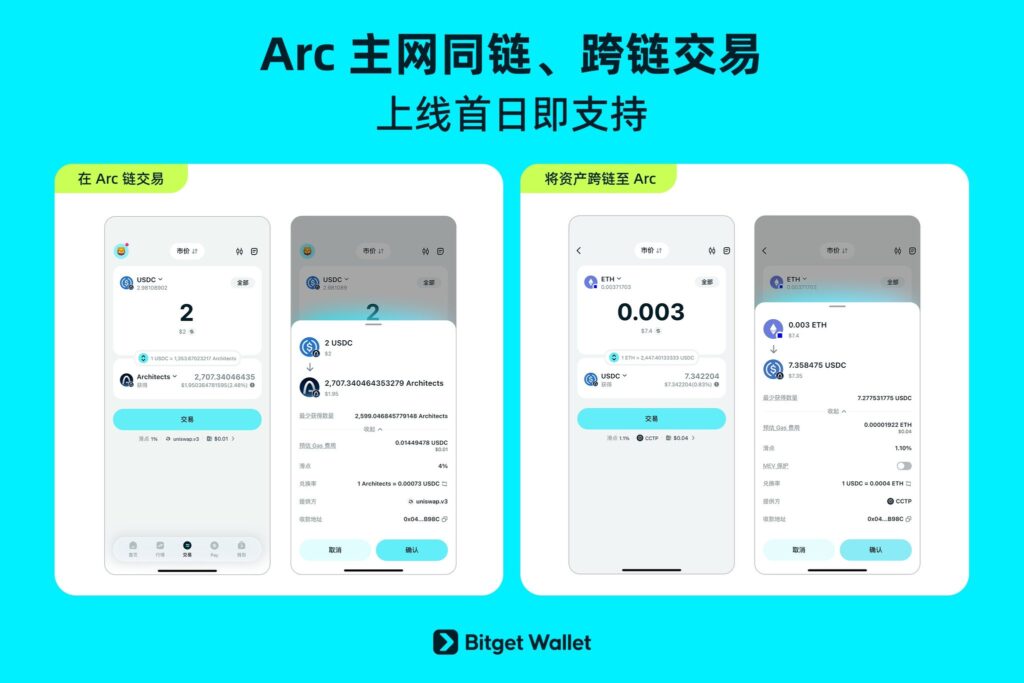
Arc is a Layer 1 public blockchain launched by Circle that uses USDC as its gas and focuses on payments, foreign exchange, and capital market settlements.
The design of paying gas fees with USDC makes a bigger practical difference for average users than it might sound. On most public blockchains, transaction fees are denominated in the chain’s native token, whose price fluctuates. This means you have to hold a separate balance of that native token specifically for paying fees—and you also have to guess when fees will be low. Arc prices gas fees directly in U.S. dollars and deducts them using USDC, making costs predictable and eliminating the need to hold a volatile asset just to pay for gas. For payment processing or frequent small-amount settlements, this makes a tangible difference. On September 16, 2026, the day the Arc mainnet launched, Bitget Wallet completed its integration, supporting direct access to the Arc mainnet, trading the Arc native token, viewing market data, and cross-chain transfers to Arc from major chains such as Ethereum, Solana, BNB Chain, and Base.
Since Arc pays gas fees in USDC, if you choose Option A (withdrawing ETH from Futu), the complete process is as follows:
- Exchange ETH for USDC within the Bitget Wallet.
- In the wallet, select "Cross-Chain," choose Ethereum as the source chain, and select Arc as the destination chain.
- Join the Arc Network: On the Wallet page, tap the network icon in the upper-right corner, select Arc, and join. The chain ID 5042 will be filled in automatically.
- Once you confirm that the USDC has been credited to your account, you can perform transactions on Arc; the gas fees will be deducted directly from your USDC balance.
When using the service for the first time, start by transferring a small amount to verify that the entire process goes smoothly before transferring your main funds. For a comprehensive breakdown of the Arc ecosystem and its opportunities, see What is the Arc Public Blockchain?。
Meme Coin Tools: MemeX and Hot Picks
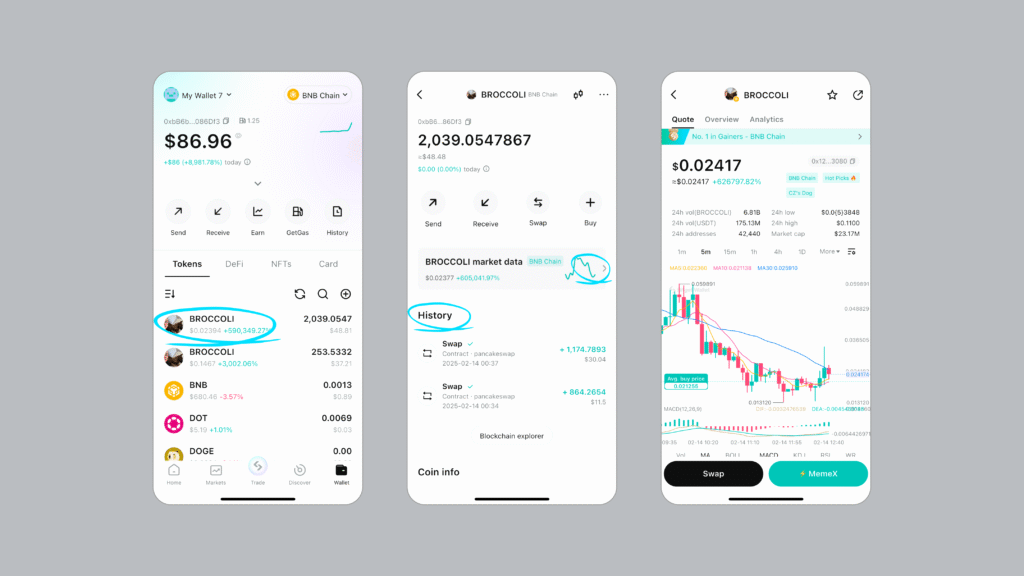
The wallet includes a built-in meme coin discovery tool. MemeX specializes in identifying newly launched tokens with a market cap under $1 million, while Hot Picks combines on-chain data, social media trends, and smart money signals to filter tokens with a market cap under $10 million. Both features come with real-time candlestick charts, buy/sell indicators, and a token dashboard that includes market cap, liquidity trends, trading volume, and social sentiment.
It’s worth noting that this set of tools was launched at the end of 2024—it’s not a new feature introduced this year—but it currently serves as the primary interface for the meme coin section within the wallet. The real new development is the increased number of platforms available for trading—following the launch of Arc, the wallet now supports trading both meme coins and DeFi assets on Arc.
The risks in this sector are significantly higher than in the rest of this article; the vast majority of tokens with a market capitalization of less than $1 million will eventually drop to zero, so you should only invest funds you can fully afford to lose.
Advanced Features: Which Ones Are Worth Using?
Swap and Cross-Chain Aggregation
The wallet aggregates quotes from multiple decentralized exchanges and cross-chain bridges, supports one-click cross-chain swaps for over 20 major public blockchains, and has a sandwiched-trade protection mechanism enabled by default to reduce the risk of arbitrage attacks on large-volume or popular token trades. This wallet is all you need for daily token swaps and cross-chain transactions—no need to look for a separate bridge.
Key Points for Implementation and Verification:
- Go to the trading page: Tap "Trade" in the bottom navigation bar, select the token you want to send at the top, and select the token you want to receive at the bottom.
- Select the source and destination networks: For on-chain exchanges, select the same chain for both sides; for cross-chain exchanges, set the destination chain to the network you want to transfer to, and the system will automatically choose the route.
- View Detailed Information: Click “Expand” below the quote to view the details, focusing on four key items—estimated gas fees, slippage, exchange rate, and provider. For cross-chain transactions, the provider will display the bridge used (for example, USDC uses CCTP).
- Confirm Minimum Received Quantity: This is the minimum quantity you will receive under slippage protection. If the number differs significantly from your expectations, it indicates insufficient liquidity; you should lower the amount or try a different approach.
- Submit the transaction: Submit it after verifying that the receiving address is correct; cross-chain transactions typically take anywhere from tens of seconds to several minutes to process.
Slippage for less popular tokens can be surprisingly high. Be sure to check the "Minimum Amount Received" field carefully before submitting your order—don’t just rely on the estimated amount shown above.
Stablecoin Wealth Management Plus
This wealth management product, in partnership with the lending protocol Aave, currently supports USDC on the Base network. It offers tiered annualized yields and allows for deposits and withdrawals at any time. To access this feature, navigate to “Wallet > Investments > Stablecoin Investment Plus > Subscribe Now.” The first subscription is gas-free; subsequent subscriptions require standard gas fees. Only one wallet per device is supported for subscriptions.
The actual annualized rate is subject to what is displayed in the app; please check the current tiered yield on the product details page before purchasing. The returns on these products come from on-chain lending interest and platform subsidies; they are not deposits, and risks associated with the underlying protocol still exist.
On-Chain Sustainability Contracts
The wallet has integrated Hyperliquid, a decentralized perpetual contracts platform, supporting trading pairs for over 300 crypto assets, including RWA perpetual contracts for tokenized stocks, with leverage of up to 150x, with transaction fees reduced to 0.06% to 0.09%. Please note that this is a feature integrated from a third-party platform and is not a product operated by the wallet itself.
The risks associated with leveraged trading are on a completely different level from those of spot trading; readers without relevant experience are advised not to start here. If you’d like to learn more about this platform first, you can check out Hyperliquid Complete Beginner's Guide。
Bitget Wallet Card
The cryptocurrency debit card that comes with the wallet can be linked to Apple Pay and Google Pay for in-store purchases. The fee for reloading the card is 1%. For eligibility requirements, regional restrictions, and details on how rewards are calculated, please see Bitget Wallet Card: A Complete Guide。
Security: Is Bitget Wallet secure?
This is the question with the highest search volume, yet the fewest serious answers. Let’s look at it from three perspectives.
What Does a Self-Managed Architecture Actually Provide?
The core benefit of self-custody is that your assets remain unaffected even if the platform goes out of business, has its funds frozen, or misappropriates funds—because you hold the private keys, and your assets are on-chain. This is fundamentally different from exchanges.
However, self-custody also shifts the responsibility to you. If you lose your mnemonic phrase, no customer service representative can reissue it, and if you authorize a malicious contract, no one can reverse the transaction. The $300 million user protection fund covers specific incidents at the platform level; it is not insurance against your own operational errors.
What happened in the past?
In 2022, there was an incident involving counterfeit app installation packages, in which some users downloaded fake versions through unofficial channels and suffered financial losses. At the time, the team issued a public statement and took action to address the situation for affected users. The lesson learned from this incident remains relevant to this day:Downloading only from official sources is the most important security rule for this type of wallet.... without a doubt.
A common source of confusion that can lead to mistaken transfers
The wallet supports both the “Arc Chain” and “ARC-20 Inscriptions”; while the names are similar, the two are completely unrelated:
- Arc ChainIt is Circle's Layer 1 public blockchain, with chain ID 5042; gas fees are paid in USDC.
- ARC-20 It is an inscription token standard on the Bitcoin network and is not affiliated with Circle.
Additionally, some on-chain data websites list the chain ID for “ARC Mainnet” as 1243, but that refers to a different, unrelated network. Be sure to verify the chain ID (5042) before making a transfer; assets sent to the wrong network may be permanently lost.
Five Must-Do Things
- Download only from official sources: Access the app through the official website or the official app store page; do not click on search ads or links shared in group chats.
- Offline Storage of Mnemonic Phrases: Write them down on paper, store them separately, and never enter them into any website or chat window.
- Regularly Clean Up Permissions: Revoke permissions for contracts you no longer use on your wallet's permissions management page.
- Segregating Large Amounts: Use one wallet for day-to-day transactions, and open a separate wallet or use a hardware wallet for long-term holdings.
- Test each new chain with a small amount first: When making your first transfer to an unfamiliar network, send a small amount first to confirm that the funds are received.
Risks and Limitations: What You Need to Know Before You Start
We’ve covered quite a few features so far, but each one comes at a cost. In this section, we’ll take a comprehensive look at the risks scattered throughout the discussion.
Self-custody puts the responsibility back in your hands
This is the source of all risks. No customer service representative can help you reverse a mistaken transaction, reissue a lost mnemonic phrase, or recover losses resulting from an erroneous authorization. In the exchange model, the platform assumes the operational risks on your behalf, but in the self-custody model, you bear all of these risks yourself. In return, your assets are protected from the platform’s bankruptcy or account freezes. This is a trade-off, not a one-sided upgrade.
Tokenized Assets: Three Additional Layers of Counterparties
The prices of on-chain U.S. stock and RWA products track those of their underlying assets, but your recourse is not against the publicly listed company, but rather against the issuer. The answers to these three questions—whether the issuer actually holds sufficient underlying assets, whether the custodian is reliable, and what you can do if a problem arises in the jurisdiction where the product is issued—determine the product’s true risk. Liquidity in the secondary market also differs from that of real stocks; illiquid securities may experience significant bid-ask spreads during periods of volatility.
Wealth management products are not deposits
Returns from stablecoin investments come from interest earned through on-chain lending protocols and platform subsidies. If the underlying protocol experiences smart contract vulnerabilities, liquidation failures, or bad debts in extreme market conditions, your principal may be at risk. The tiered annualized yield also fluctuates with market interest rates, so the figure you see at the time of purchase does not necessarily represent the actual annual return you will receive.
Leverage and Meme Coins: Two Different Levels of Risk
With perpetual contracts offering up to 150x leverage, a price movement of less than 1% in the opposite direction is enough to trigger a margin call. The vast majority of new tokens with a market cap below $1 million will eventually drop to zero, and a significant proportion of them are designed to scam investors. You should never invest money you can’t afford to lose in either of these sectors, nor should they serve as a starting point for beginners.
Regulatory Status
Bitget Wallet is not a virtual asset trading platform licensed by the Hong Kong Securities and Futures Commission (SFC). Features within the wallet—such as Swap, Wealth Management, and on-chain U.S. stock trading—are not covered by Hong Kong’s local investor protection mechanisms. The deposit process via a licensed brokerage firm described in Option A of this article is a separate matter; the two should be understood distinctly.
A Practical Suggestion
If this is your first time performing these operations, the recommended sequence is: Start by doing only the most basic transactions—receiving payments and making transfers—to confirm that the entire process works; then try small-amount swaps and cross-chain transactions; once you feel confident, consider investment strategies; and leave leverage and meme coins for last—or avoid them altogether. Whenever you add a new feature, start by going through the entire process with a small amount first.
Frequently Asked Questions
Does Bitget Wallet require identity verification?
Creating a wallet does not require real-name verification; you can download it and start using it right away. However, if you use the wallet’s fiat-to-crypto purchase or withdrawal features, third-party service providers (such as Mercuryo and MoonPay) will require you to complete identity verification. This is a compliance requirement for fiat payment channels and is unrelated to the wallet itself.
Does Bitget Wallet charge fees?
Creating and maintaining a wallet is free. Swap charges a small service fee; registering via an invitation link entitles you to a 10% fee discount. On-chain transfers require payment of the gas fee for that public blockchain; this fee goes to miners or validators, not to the wallet. The fee for reloading a card is 1%.
What should I do if I lose my mnemonic phrase?
Replacement is not possible. With self-custody wallets, no institution holds a backup of your private key; losing your mnemonic phrase means your assets are permanently lost. This is why beginners are advised to choose the MPC (Multi-Party Computation) solution without a mnemonic phrase—it uses a different mechanism for distributed custody, reducing the risk of a single point of failure.
What is the difference between Bitget Wallet and MetaMask?
MetaMask focuses primarily on the EVM ecosystem, featuring a simple architecture and a mature ecosystem. Bitget Wallet supports a much larger number of public blockchains and includes built-in features such as purchasing cryptocurrencies, withdrawals, wealth management, on-chain U.S. stock trading, and digital cards, positioning it as a one-stop solution. For DeFi exclusively on the EVM, both options are suitable; however, if you need multi-chain operations or fiat currency deposits and withdrawals, Bitget Wallet offers greater integration.
Can users in Hong Kong use it?
Yes, the wallet itself has no regional restrictions. Deposits and withdrawals in fiat currency are handled by third-party service providers; the supported currencies and payment methods are subject to what is actually displayed within the app. Route A in this article demonstrates depositing funds through a licensed Hong Kong brokerage firm and then withdrawing them onto the blockchain; this route is the most straightforward for readers in Hong Kong.
Is it better to keep assets in a wallet or on an exchange?
The two serve different purposes: exchanges are suitable for frequent trading and fiat currency deposits and withdrawals, while wallets are suitable for long-term holding and on-chain transactions. For a complete comparison, see Should I Keep Cryptocurrency on an Exchange or in a Wallet?。
Next Step
Once you’ve set up your wallet and transferred funds to the blockchain, the next step is usually to choose a blockchain to start working with. If you’re interested in native stablecoin blockchains like Arc, you can start by checking out What is the Arc Public Blockchain? Understand the opportunities and risks of the entire ecosystem before deciding where to invest your funds.
Disclaimer
The content of this article is for reference only, investors should exercise independent judgment, invest with caution and at their own risk, this article does not provide or attempt to persuade viewers to trade or invest on the basis of the content of this article is for sharing purposes only, and should not be regarded as investment advice, and does not represent the Monsterblockhk viewpoints and positions, all information and views of the specific date of the judgment of the time-limited nature. In addition, if any content in this website involves virtual asset trading platforms that have not yet obtained a license to operate virtual asset trading platforms in Hong Kong, including but not limited to text introductions, pictures, promotions, events, etc., they are only available to users outside of the Hong Kong Special Administrative Region.
According to the Hong Kong Anti-Money Laundering and Counter-Terrorist Financing (Amendment) Ordinance 2022, after June 1, 2023, all centralized virtual asset trading platforms operating in Hong Kong or actively promoting their services to Hong Kong investors will be licensed and regulated by the SFC, and any related unlicensed activities will be a criminal offence. For more information and details of the legislation, users may refer to the SFC website.