

Exchanges handle trading, while wallets handle storage—this is the simplest definition of their division of labor. However, hidden behind this definition is a core issue that beginners are most likely to overlook: when you “keep” cryptocurrency “on an exchange,” you do not truly own those assets; only when you hold the private key do you truly have sovereignty over your assets. The 2022 FTX collapse resulted in the assets of over one million users worldwide being frozen within a matter of days, turning this theoretical issue into a real-world cost. Starting with the concept of private key control, this article systematically breaks down the differences between exchanges and crypto wallets, the risks associated with each, and how to choose between them in different scenarios—helping beginners make informed decisions that suit their needs after understanding the full picture.
What exactly is an exchange used for?
Is the “balance” you see on the exchange really your cryptocurrency?
A cryptocurrency exchange is a platform that allows users to buy, sell, and trade digital assets; its core function is to execute orders and provide market liquidity. When you complete KYC and buy Bitcoin on an exchange, your account will indeed show a balance, but this figure is merely the exchange’s internal record; the private keys for the underlying assets are held by the platform. What you hold is a “claim against the exchange,” rather than direct ownership of the corresponding address on the blockchain. This is very similar to how a bank account works.
The core function of an exchange: a marketplace, not a safe
The primary purpose of the exchange is to enable the conversion of fiat currencies (such as the Hong Kong dollar, U.S. dollar, or New Taiwan dollar) into cryptocurrencies, as well as to facilitate trading between different cryptocurrencies. In addition, exchanges offer features such as limit orders, leveraged trading, and futures contracts. In other words, exchanges are positioned as “gateways to trading,” not “vaults for long-term storage.” Storing large amounts of assets on an exchange for an extended period is equivalent to keeping money in a place that was never designed to be a vault in the first place.
What Does the FTX Collapse Tell Us?
In November 2022, FTX, the world’s second-largest cryptocurrency exchange, filed for bankruptcy. The assets of more than one million users were frozen within a matter of days, and some users have still not been able to fully recover their funds. The FTX incident revealed three layers of counterparty risk associated with exchanges: first, operational risk (insolvency or misappropriation of customer assets); second, cybersecurity risk (hacker attacks); and third, regulatory intervention risk (government-imposed suspension of platform operations). These three risks do not exist at all in the context of self-custody wallets. Prior to its collapse, FTX enjoyed an excellent reputation in the industry; scale is no guarantee of safety—this is the most profound lesson FTX has left for the market.
What is a crypto wallet? How does it allow you to truly own your assets?
What are private keys and mnemonic phrases? Why are they equivalent to the assets themselves?
The function of a crypto wallet is not to “store cryptocurrency,” but to “store the private keys for the corresponding assets.” A private key is a set of mathematical keys; anyone who holds a private key can sign transactions and transfer assets at the corresponding blockchain address. A seed phrase is a human-readable backup of the private key, typically consisting of 12 or 24 English words. Whoever holds the seed phrase can restore the entire wallet and regain full control of all assets. Therefore, safeguarding the seed phrase is, in a technical sense, equivalent to safeguarding all assets.
Hot Wallets vs. Cold Wallets: How Do These Two Self-Custody Methods Differ?
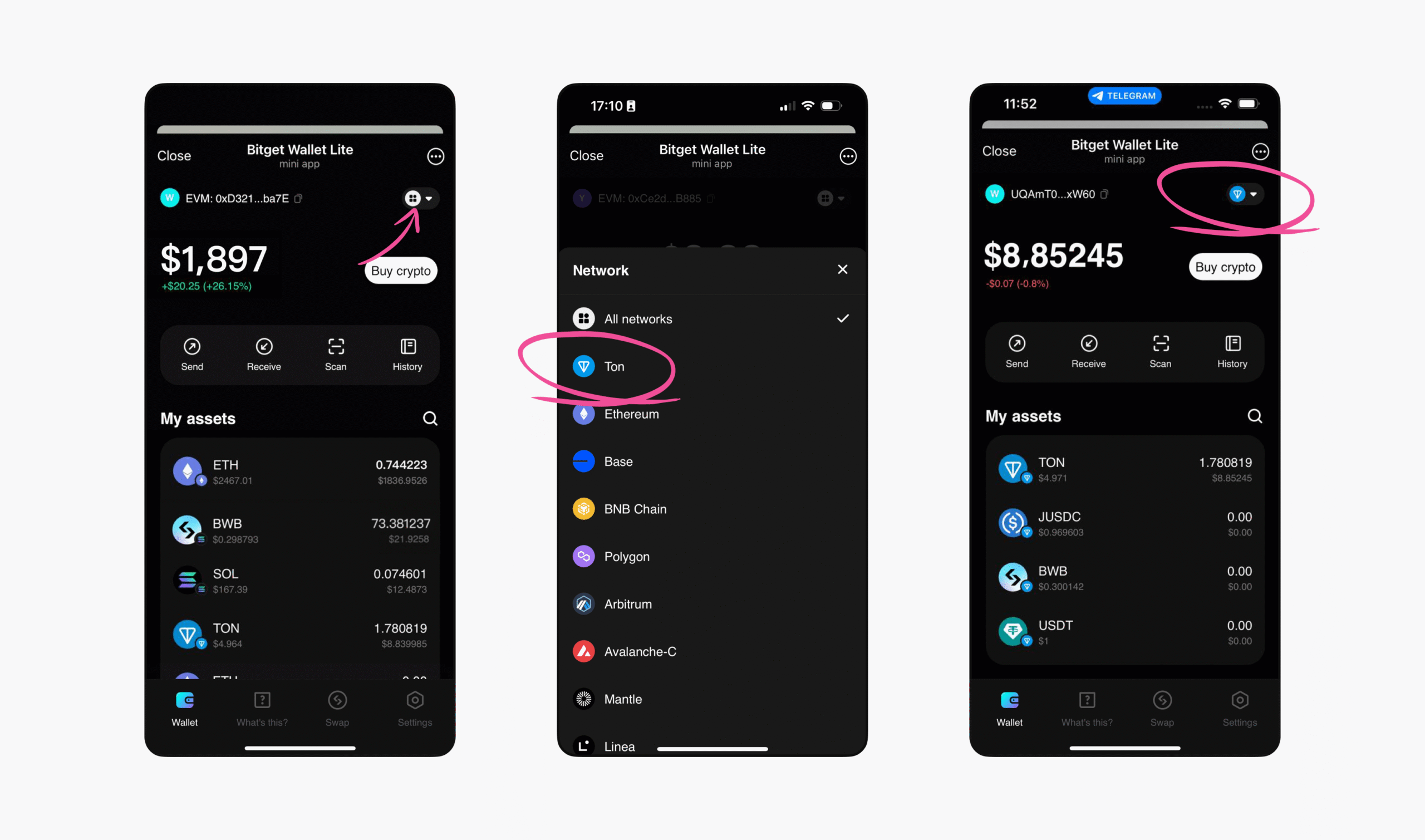
A hot wallet is a software wallet that is constantly connected to the internet, such as Bitget Wallett 和 Phantom and other wallets, which typically run as browser extensions or mobile apps. Hot wallets are convenient for everyday use and are well-suited for frequent participation in DeFi protocols, claiming on-chain airdrops, or trading NFTs; however, because they are constantly connected to the internet, they are at risk of phishing attacks or malware that could steal private keys. A cold wallet is a hardware device that stores private keys offline, such as a Ledger or Trezor. Since the private keys never come into contact with the internet, cold wallets offer the highest level of security among all wallet types and are suitable for long-term storage of large holdings.
What Responsibilities Do You Assume When Choosing a Self-Hosted Wallet?
Self-custody means you have complete control over your assets, but you also bear all the responsibility on your own. If you lose your mnemonic phrase, no customer service or technical measures can help you recover your assets; if you disclose your mnemonic phrase to someone else, that person can immediately transfer all your funds away. Crypto wallets have no “forgot password” option, no bank customer service hotline, and no third party that can step in to help. This is the true cost of self-custody—and a valid reason why many beginners choose to keep their assets on exchanges at first. Autonomy and responsibility are two sides of the same coin.
What is the key difference between an exchange and a wallet?
What does “Not your keys, not your coins” mean?
This is one of the most widely circulated sayings in the cryptocurrency community, meaning: if you don’t control your private key, you don’t truly own those cryptocurrencies. This is not just a slogan, but an accurate description of the technical reality. The design logic of blockchain is that asset ownership is determined entirely by private keys, not by any account names, platform records, or legal documents. Ledger’s official explanation is as follows:
“”Not your keys, not your coins’ is a popular expression in the crypto world—it refers to the fact that if you don’t own your private keys, you don’t have full control over your funds.”
Understanding the technical logic behind this saying is equivalent to understanding the most fundamental difference between exchanges and wallets.
Counterparty Risk vs. Operational Risk: Which Are You Better Equipped to Manage?
The primary risk associated with keeping assets on an exchange is counterparty risk—that is, issues arising from the platform itself, such as bankruptcy, hacking, or regulatory actions that freeze or restrict withdrawals. These are external risks that users can hardly predict or control. The primary risk associated with self-custody wallets, on the other hand, is operational risk—that is, errors made by the user themselves: losing their mnemonic phrase, accidentally sending coins to the wrong chain or address, or having their private key stolen by a phishing website. These two types of risk are fundamentally different, and the methods for mitigating them are also entirely distinct. Choosing which storage method to use essentially boils down to asking yourself: Between counterparty risk and operational risk, which am I better equipped to manage?
MetaMask's position on self-custody liability is clear:
“Not your keys, not your coins” is a motto we live by. If you’re not the only one in control of your secret recovery phrase, you don’t have full control of your funds.
— @MetaMask, https://twitter.com/MetaMask/status/1524458939147988992
When should you use an exchange? When should you use a wallet?
In what situations is an exchange most appropriate?
Exchanges are the most suitable tools in the following scenarios. Fiat currency deposits are the core, irreplaceable function of exchanges: purchasing cryptocurrency with Hong Kong dollars, U.S. dollars, or New Taiwan dollars must be done through an exchange, as personal wallets cannot directly handle fiat-to-crypto conversions. Active trading also relies on the suite of features offered by exchanges, including limit orders, stop-loss settings, and derivatives tools. Furthermore, for relatively small positions and funds that need to be accessed frequently in the short term, keeping them on an exchange is the most efficient option. For newcomers to the market who want customer support, exchanges also provide a relatively low-barrier entry experience.
In what situations are self-custody wallets most suitable?
Self-custody wallets are the more appropriate choice in the following scenarios. Holding medium- to large-sized positions for the long term (HODL strategy) is the most direct use case for self-custody, as it reduces counterparty risk to zero. Participating in on-chain applications is a technical prerequisite for self-custody: DeFi lending, liquidity mining, on-chain staking, airdrop claims, and NFT trading all require interacting directly with smart contracts via a self-custody wallet; these operations cannot be performed through an exchange account. UsingOn-Chain Asset Tracking ToolEven for advanced users analyzing cross-chain holdings, a wallet address is still required. For users who do not wish to provide KYC personal information, self-custody is the only option.
Special Considerations for Hong Kong Users: How Does the SFC Licensing System Affect Your Choices?
The Hong Kong Securities and Futures Commission (SFC) officially implemented the Virtual Asset Service Provider (VASP) licensing regime on June 1, 2023, requiring all centralized cryptocurrency exchanges operating in Hong Kong to obtain a license and comply with regulatory requirements such as the segregation of client assets, financial audits, and the separation of hot and cold wallets.OSL and other SFC-licensed exchangesSubject to a more stringent regulatory framework than unlicensed platforms, this reduces counterparty risk at the exchange level to a certain extent for Hong Kong users.FTSE BULLTraditional brokerages also offer cryptocurrency trading platforms, providing another compliant option for investors accustomed to traditional financial services. For instructions on how to transfer coins to your own wallet, see Futuhub Cryptocurrency Withdrawal Guide. However, holding an SFC license does not mean there is zero risk; assets are still held within the platform’s custody system rather than under the user’s own control via private keys.
The Three Most Common Misconceptions Among Beginners
Mistaking an "exchange account" for their own crypto wallet
This is the most common source of confusion for newcomers to the crypto market. The balance shown in an exchange account is merely the platform’s internal record for the user; the private keys for the underlying assets are held by the platform. “I have 0.1 BTC on Binance” and “I own 0.1 BTC” are, from a technical standpoint, two completely different statements. The former is an account record, while the latter is only valid if you have the private keys in your possession. It wasn’t until after the FTX collapse that a large number of users realized this distinction for the first time—by which point it was too late to take any protective measures. Until you understand this difference, you do not have full control over the security of your crypto assets.
The misconception that well-known, large exchanges are necessarily safe
"Binance is so big—how could it possibly go under?" This line of thinking is dangerous in the crypto market. Before its collapse, FTX was the world’s second-largest exchange, with a post-money valuation that once exceeded $32 billion, and enjoyed an excellent reputation in the industry. An exchange’s collapse isn’t necessarily due to its small size; it can result from poor internal governance, the misappropriation of customer assets, or a liquidity crisis triggered by external market shocks. In the days following FTX’s collapse, Exodus recorded a record number of users transferring their assets from exchanges to self-custody wallets for the first time, indicating a massive, collective correction of this misconception—albeit at a heavy cost.
I set up my wallet but didn't properly back up my mnemonic phrase
Owning a self-custody wallet but failing to properly safeguard your mnemonic phrase is more dangerous than simply keeping your assets on an exchange. The mnemonic phrase should be written down on paper or a metal backup plate and properly stored in multiple physical locations. Never take a screenshot and save it to your phone’s photo album, upload it to the cloud, or store it on any internet-connected device. Device damage or loss does not equate to the loss of assets; as long as the mnemonic phrase remains intact, the wallet can be fully restored on any compatible device. The mnemonic phrase is equivalent to the assets themselves—this understanding must be firmly established from the very first step of creating a wallet.
It’s important to establish your own framework for tiered asset management!
For most users, the most rational strategy is not to “choose between an exchange and a wallet,” but rather to establish a tiered management system based on the intended use of funds. Using an exchange to handle fiat deposits and active trading is the most efficient approach; transferring medium- to large-sized long-term holdings to a cold wallet is the method with the lowest counterparty risk; Keep a small amount of funds in a hot wallet for on-chain operations, ensuring the amount is kept within a range that remains tolerable even if lost entirely. With these three tiers each fulfilling their respective roles, you can maintain convenience without compromising security.
The specific allocation ratios vary from person to person, depending on the size of their investment, technical proficiency, and individual risk tolerance. If you’re still building a foundational understanding of cryptocurrency,Crash Course for Crypto NewbiesStarting with the fundamentals, we’ll walk you through your first on-chain transaction step by step to help you gain a clear understanding before making any decisions.
Frequently Asked Questions
Q1: What is the biggest difference between a cryptocurrency exchange and a wallet?
The biggest difference between exchanges and crypto wallets is control over private keys. Exchanges hold the private keys to users’ assets, and all you have is a record of your account balance; with self-custody wallets, users keep their own private keys, giving them full control over their assets without having to trust any third-party platform.
Q2: Should beginners start with an exchange or a wallet?
We recommend starting with an exchange. Exchanges offer fiat deposit options and a relatively low barrier to entry. Once you’re familiar with the market, you can gradually transfer your medium- to large-sized long-term holdings to a self-custody wallet; taking a step-by-step approach is the more prudent path.
Q3: Is it safe to store cryptocurrency on an exchange?
Choosing a reputable, large exchange or an SFC-licensed platform offers some protection for short-term holdings, but long-term storage of large amounts of assets still carries counterparty risks—such as platform bankruptcy, hacking, or regulatory freezes—which are not necessarily related to the platform’s size.
Q4: What happens to my assets if the exchange goes out of business?
If an exchange fails to implement segregation of client assets, users’ assets may be included in the bankruptcy estate, and the process of recovering them could be lengthy and may not result in full recovery. The Hong Kong SFC’s licensing regime requires asset segregation, which mitigates this risk to some extent, but does not guarantee absolute security of assets.
Q5: What is the difference between a hot wallet and a cold wallet?
Hot wallets remain constantly connected to the internet; while they are convenient to use, they are vulnerable to cyberattacks and are best suited for small amounts of daily use or on-chain transactions. Cold wallets store private keys offline, offering the highest level of security, and are ideal for long-term storage of large amounts of assets that do not need to be moved frequently. Using a combination of both provides the most balanced solution.
Disclaimer
The content of this article is for reference only, investors should exercise independent judgment, invest prudently and at their own risk, this article does not provide or attempt to persuade the audience to do trading or investment basis, the content is for sharing purposes only, and should not be regarded as investment advice.It does not represent the views and position of Monsterblockhk.All information and opinions are current as of the date of the judgment. In addition, if a judgment is rendered on aIn this siteAny content related to virtual asset trading platforms that have not yet obtained a license to operate virtual asset trading platforms in Hong Kong, including but not limited to text introductions, pictures, offers, events, etc., are only available to users outside the Hong Kong Special Administrative Region.
According to the Hong Kong Anti-Money Laundering and Counter-Terrorist Financing (Amendment) Ordinance 2022, after June 1, 2023, all centralized virtual asset trading platforms operating in Hong Kong or actively promoting their services to Hong Kong investors will be licensed and regulated by the SFC, and any related unlicensed activities will be a criminal offence. For more information and details of the legislation, users may refer to the SFC website.