


Robinhood Chain is an Ethereum Layer 2 solution launched by the U.S. brokerage firm Robinhood on July 1, 2026. It focuses on tokenizing stocks and ETFs and bringing them onto the blockchain, allowing users to trade 24 hours a day without being restricted by U.S. stock market hours. On-chain data shows that more than a month after the chain’s launch, the proportion of tokenized stocks in the total value locked (TVL) actually fell from nearly one-third at the start to just 6% by mid-August, It is speculation in meme coins and stablecoin lending—not the officially promoted tokenization of stocks—that is truly driving trading volume and enthusiasm.
This disparity is precisely what beginners need to understand first. This article breaks down, step by step, what Robinhood Chain can do, which tools to use, and the risks that are most easily overlooked. Finally, it provides a decision-making framework—because the tool ecosystem on this chain changes extremely rapidly, the leading launchpad has changed hands four times in just six weeks, and any static list of tools will become outdated within a few weeks—the only thing that won’t become obsolete is the decision-making process itself.
What is Robinhood Chain?
Why Did a Platform Focused on Stock Tokenization Turn Into a Meme Coin Haven?
What is the technical and legal structure of Robinhood Chain?
Robinhood Chain is an Ethereum Layer 2 built on the Arbitrum Orbit technology stack, with a block time of 100 milliseconds. Transactions are ultimately settled on the Ethereum mainnet, gas fees are paid in ETH, and the chain ID is 4663. It is provided by Robinhood Digital Assets (RHDA), which is explicitly positioned as a “software provider” in official documentation and is legally separate from regulated U.S. brokerage accounts—meaning U.S. users cannot even access the flagship stock token feature, and the only point of access is the self-custodial Robinhood Wallet.
The legal nature of stock tokens is also something beginners should understand first: Holders receive a claim against the issuer, Robinhood Assets (Jersey), not direct ownership of the underlying stock; they have no voting rights, and dividends are reinvested through a multiplier mechanism rather than distributed as cash. This distinction is easy to overlook during a bull market, but it defines the scope of your rights as a token holder.
Why did a platform that focused on stock tokenization end up becoming a hub for meme coins?
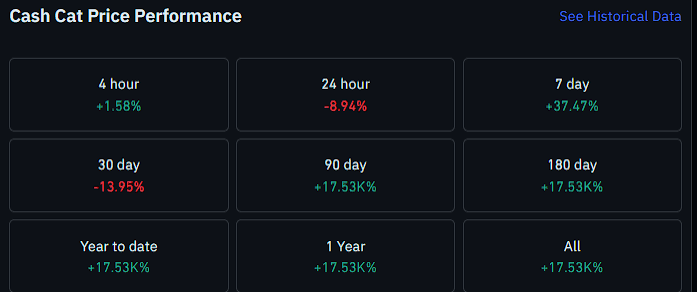
The answer is straightforward: The barriers to entry and the pace of narrative development for meme coins are far faster than those for products like tokenized stocks, which require legal frameworks and issuance processes. Within a week of the mainnet launch, while tokenized assets accounted for only about $4 million, the market cap of the meme coin CASHCAT had already surged to over $150 million, with active addresses on the chain at one point approaching 200,000. This is not a phenomenon unique to Robinhood Chain, but rather a pattern that repeats during the subsidy phase of every new public blockchain: speculative capital always arrives before institutionalized products.
By August, this gap had not only failed to narrow but had actually widened—the proportion of tokenized real-world assets out of the total value locked, which had been close to one-third in early July, to just 6% by mid-August. Even though the absolute amount grew by 120% that month, the growth rate still failed to keep pace with the expansion of stablecoin lending and meme coin trading.
Even the CEO’s own statements are contradictory—what does that mean?
In an interview with CNBC the day after the launch, Robinhood CEO Vlad Tenev emphasized that assets with no practical use won’t last long, and that tokenizing real-world assets is the way forward in the long run. Six days later, as CASHCAT’s market cap soared, he backtracked, saying that while the blockchain was built for RWA, it works just as well for meme coins, and he even followed the token’s official account.
This shift isn’t merely a PR spin; it reflects the most fundamental tension currently facing Robinhood Chain: the official narrative and the actual on-chain flow of funds are two entirely different things. When evaluating this chain, newcomers are advised to distinguish between “what Robinhood says” and “what the on-chain data shows,” rather than taking the narrative at face value.
What can beginners actually do on Robinhood Chain?

How do I transfer my assets into the platform?
The simplest method is to use the Robinhood Wallet, which natively supports the Robinhood Chain and does not require you to manually add a network. If you’re using another EVM wallet, you’ll need to manually enter the chain ID 4663 and the official RPC. Regarding cross-chain transactions, the official documentation lists several options, including the official Arbitrum bridge and several third-party bridge services. Be sure to keep a small amount of ETH on the source chain for gas fees, as it is required for on-chain authorizations, transactions, and cross-chain operations.
How are tokenized stocks traded? Who provides liquidity?
Trading of stock tokens primarily takes place through three channels: Uniswap’s public liquidity pools, Arcus—developed by the dYdX team (which offers zero-fee spot trading for over 95 U.S. stock tokens)—and Rialto, developed in collaboration with Offchain Labs (which employs its proprietary market-making model, Rivo Altus). It is worth noting that while Arcus holds only about 1% of the overall spot trading market share, its market share in the stock token segment exceeds 10%, indicating that it is a specialized protocol deliberately focused on this niche rather than competing with Uniswap for full-chain liquidity.
As of mid-August, there were approximately 200+ deployed stock tokens, with a total tokenized value of around $35 million and approximately 37,000 holders. The market remains relatively small, so beginners should not expect trading depth comparable to that of mainstream stock markets. It is recommended to check for slippage before placing an order.
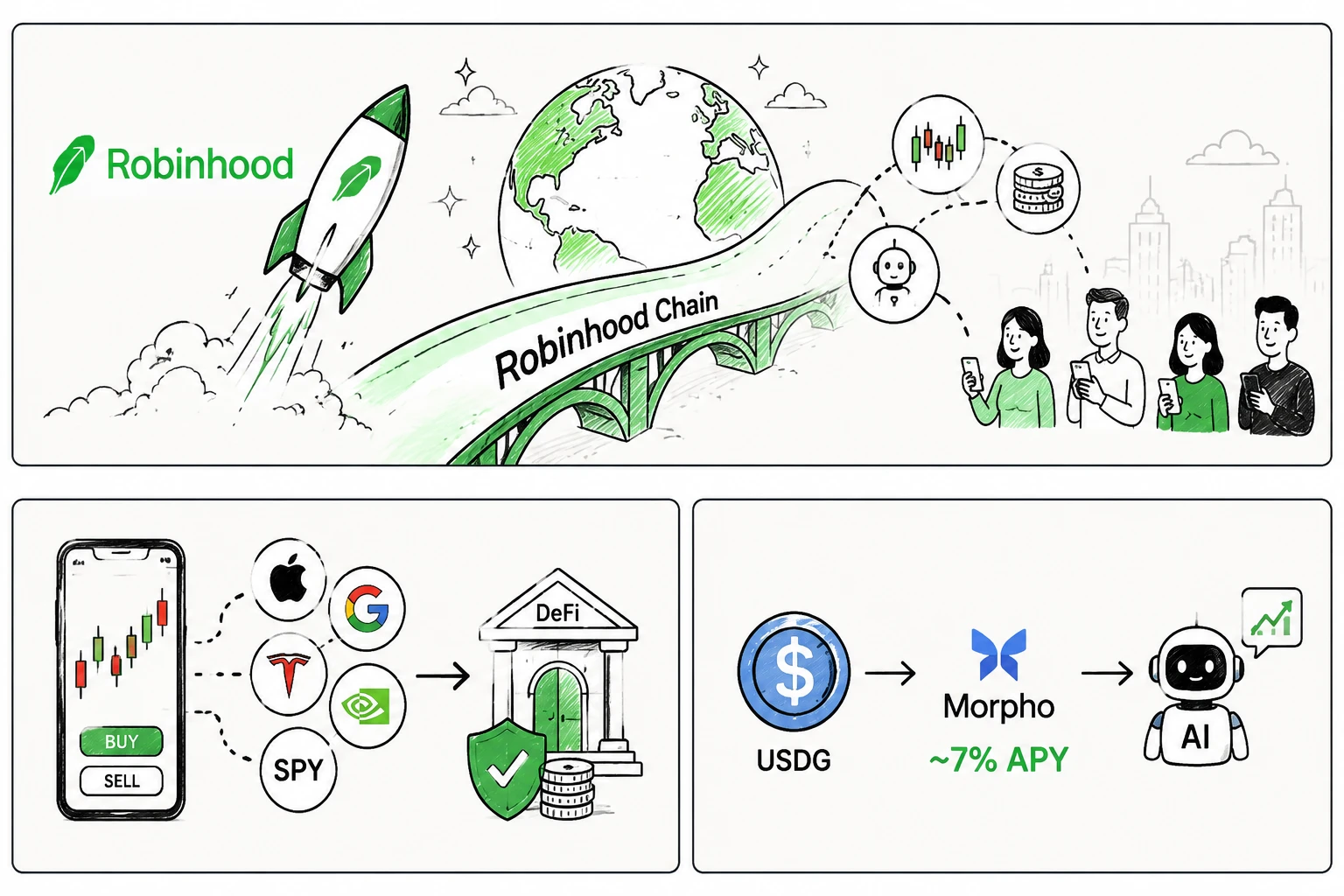
Is it worth it to earn annualized returns on a USDG deposit?
Robinhood Earn operates on the Morpho protocol. Its main vault, the Steakhouse USDG Vault, holds deposits in the hundreds of millions of dollars, with a total annualized yield of approximately 6.7%, consisting of the base rate plus additional incentives. This rate fluctuates based on market supply and demand and is not a fixed return. Before making a deposit, we recommend checking the current actual rate before deciding on the amount; do not rely solely on the first figure you see.
How do you trade meme coins? What rules should you follow?
Meme coins represent the most active—but also the most concentrated in terms of risk—segment on this blockchain. The basic process involves new tokens launched via a launchpad, followed by searching for targets on a DEX or scanning tool, and entering the market with a small test position. In terms of discipline, it is advisable to follow standard market principles for take-profit and stop-loss: take profits in batches once the price has risen by a certain multiple, and decisively cut losses if the price falls below a certain threshold. At the same time, diversify across multiple assets and avoid concentrating your funds on a single new coin, as the vast majority of meme coins on new blockchains will eventually see their market capitalization drop to zero in the early stages.
What Tools Should Be Used in the Robinhood Chain Ecosystem? Why Will the List of Tools Inevitably Become Outdated?
What do Launchpad, the scanner, and the browser do, respectively?
The biggest mistake beginners make is confusing three types of tools with completely different functions. Launchpad is responsible for “creating” new tokens; scanning/trading platforms are designed to “help you discover, analyze, and place orders for existing tokens.” For example, GMGN—a multi-chain meme coin trading platform—does not create tokens itself; instead, it offers features such as new token monitoring, security audits, portfolio analysis, and automated order placement.
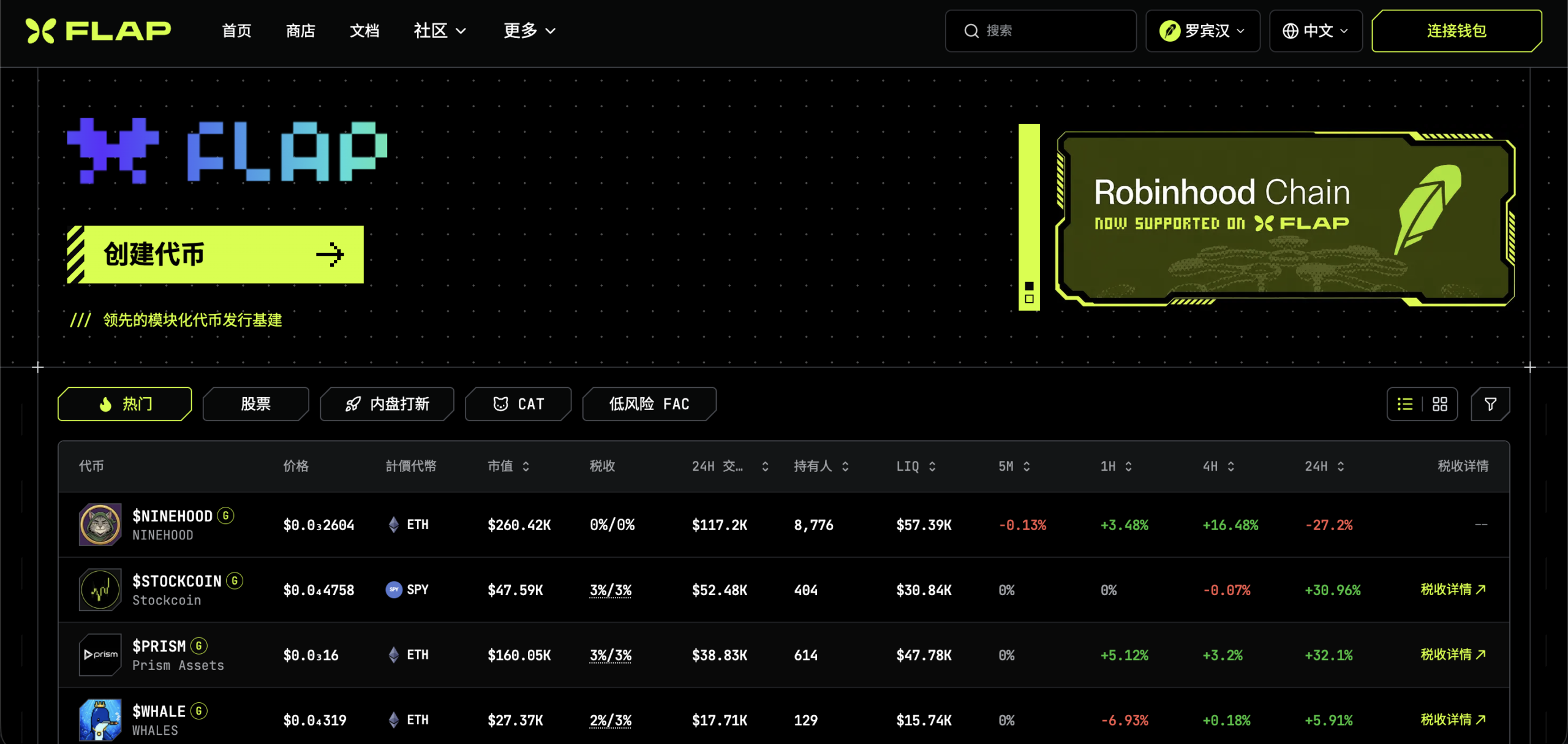
Blockchain explorers and on-chain analysis tools are designed to “let you verify transactions and addresses”—for example, official blockchain explorers and on-chain intelligence platforms like Arkham Intelligence. Only by distinguishing between these three layers can you understand the actual role each name on a list of tools plays.
What platforms are currently available (as of August 2026)?
The launchpad rankings on this chain fluctuate much more rapidly than on typical public blockchains. In the early stages, a single platform virtually monopolized all token launches. However, after that platform unexpectedly suspended new token launches in mid-July and gradually lost control of its domain, another platform briefly took over the market with nearly 80 percent market share, only to have roughly half of that market share subsequently taken over by a launchpad launched by a major DEX.
According to the latest figures as of mid-August, the market leader has changed once again; the top five firms collectively accounted for more than 90 percent of the day’s trading volume, with the gap between the second- and third-ranked firms being less than 10 percentage points. This means that the “current market leader” observed at any given moment is merely a temporary snapshot.
How can you determine for yourself whether a tool is safe?
Rather than memorizing the names of tools, it’s more important to remember the following criteria: First, check whether the team is recognizable and if there’s a history of other projects; second, verify that the domain and official social media accounts are stable and haven’t been taken over or compromised; third, examine the flow of funds and whether liquidity is locked up; Fourth, test only with small amounts, and prioritize using existing links from official sources or well-known protocols; do not blindly trust URLs shared via reposts or private messages. This logic remains valid even if the platform changes hands—this is what beginners truly need to internalize.
What Is the Biggest Risk for Robinhood Chain? What Did We Learn from the Platform Outage?
What happened to what was once the largest launchpad?
The leading platform, which at one point held a 75 percent market share shortly after its launch, suspended new token launches without warning after accumulating approximately $12 million in transaction fees. The official reason given was the proliferation of bots and low-quality tokens. Two days later, the official website went offline; the team attributed this to technical issues at the time.
Further developments are worth noting: The platform’s domain was subsequently acquired by a third party and relaunched under a new identity, while other reports indicated that its official social media accounts were hacked and contained malicious links. Multiple fact-checks found no on-chain evidence indicating that the original team had absconded with funds or transferred user assets. A more accurate description is that operations were abruptly suspended during a traffic surge, rather than a deliberate scam; however, the community generally continues to refer to the incident as a “scam” or “funds embezzlement.”
Why is the phrase “the best platform available right now” inherently risky?
This is because the accuracy of this statement is only guaranteed at the moment you read it. After the aforementioned leading platform ceased operations, existing tokens originally issued on that platform could still be traded normally through existing DEXs and scanning tools; the only feature affected was the ability to “issue new tokens”— —This illustrates that “whether this platform is secure” and “whether tokens on this platform can still be traded” are two separate matters that must be evaluated independently. You should not assume that your tokens are immediately worthless just because the platform has encountered problems, nor should you assume that the platform itself remains trustworthy simply because the tokens can still be traded.
What other structural risks do beginners tend to overlook?
First, Robinhood Chain has yet to launch a native token or announce an official airdrop plan; any message claiming there is a snapshot or a claim window should be considered a scam. Second, as of August, tactics such as counterfeit tokens, copied code, and tokens that lose liquidity shortly after listing continue to occur.
Third, there is an institutional-level factor: DTCC, the leading U.S. clearinghouse, completed a limited pilot program for tokenized securities in July and will launch full-scale commercial operations in October, with more than 50 institutions—including BlackRock and JPMorgan Chase—participating. This is an institutional-grade infrastructure that directly accesses physically held shares, offering greater legal certainty than Robinhood’s current model of packaging debt securities, and will pose substantial competition to Robinhood Chain’s stock tokenization narrative as early as next month.
Is Robinhood Chain Worth Keeping an Eye On in the Long Term?
What are the supporters seeing?
The bullish arguments center on distribution advantages: Robinhood itself has over 27 million paying users, and analysts believe the value of this blockchain lies not in creating yet another new public blockchain, but in extending its existing consumer-facing distribution capabilities into the world of programmable finance. Several investment banks have also raised their price targets for Robinhood’s stock following the blockchain’s launch, citing reasons such as revenue diversification driven by its crypto and blockchain-related businesses.
What are the critics worried about?
Critics, however, point out that the meme coin craze is essentially a fad and is not yet truly secure at this stage. They question whether a successful public company really needs to build its own public blockchain—given that most past attempts by companies to build their own Layer 2 solutions ultimately failed to live up to expectations. Another group of earlier investors has publicly called on the company to refocus its resources on real-world assets and avoid repeating the mistakes of past meme stock frenzies.
What do we think?
A relatively well-founded, neutral perspective is this: While this blockchain touts permissionless, open participation, the assets that truly possess long-term value—stock tokens— —are all backed by legally regulated structures. The tension between this “open infrastructure” and “regulated financial products” is not likely to disappear in the short term, and it is a key factor in determining whether this blockchain can transition from speculation to long-term demand. For beginners, rather than betting on whether this chain will succeed, it’s better to treat it as a living textbook for practicing “how to evaluate new public blockchains”—tools come and go, but the logic behind your judgment is what you’ll take away.
Frequently Asked Questions (FAQ)
Q1: Does Robinhood Chain have a native token? Is it worth getting in early for the airdrop?
A1: There is no native token, and the official team has not announced any airdrop plans. Any message claiming there is a snapshot or eligibility to claim airdrops should be considered a scam; we do not recommend making any preparations or transferring funds in anticipation of this.
Q2: What should a first-time participant do first?
A2: First, connect to the blockchain using Robinhood Wallet or an existing EVM wallet. Bridge a small amount of ETH to get familiar with the environment. Start by learning about products with clear structures, such as stock tokens and lending, before considering meme coins.
Q3: Are stock tokens the same as actually owning stock?
A3: No, they are not the same. The holder receives a claim on the issuer’s debt, which provides economic exposure, but does not have voting rights and does not directly hold the underlying stock.
Q4: Launchpads for meme coins are constantly changing. How can I stay up to date?
A4: Rather than memorizing the names of specific platforms, we recommend learning how to evaluate them: check the team’s background, verify the stability of the domain and social media accounts, assess any liquidity locks, and always start by testing with a small amount.
Q5: How is Robinhood Chain different from typical meme coin chains?
A5: The difference lies in the fact that it bears both the brand reputation and regulatory pressures of a publicly traded company; in theory, it should be more cautious, but in practice, its early activity is still driven by speculation. This discrepancy itself is the aspect most worth monitoring as we assess the future direction of this blockchain.