

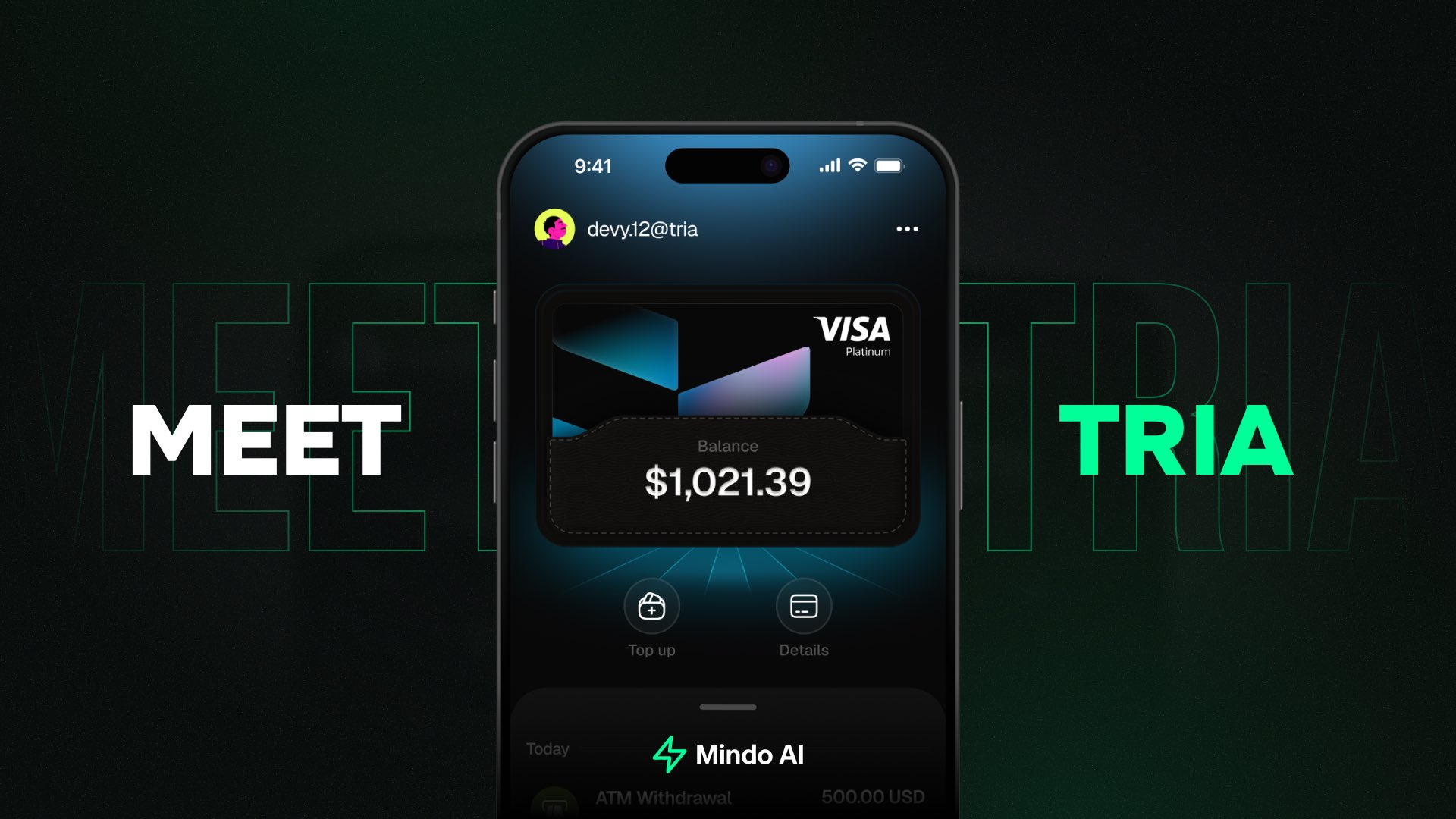
The TRIA Card is a debit card that allows holders to make purchases with crypto assets at 130 million Visa merchants worldwide. Its key selling point is that “assets remain in the user’s wallet throughout the entire transaction process, without the need to transfer them to any centralized platform.” The Premium card offers up to 6% in cashback on the first $2,000 spent each month, distributed in the form of the stablecoin USDT.
This design sounds appealing, but there are a few issues that retail investors tend to overlook: the rewards have a monthly spending cap; the KYC application process involves refund disputes due to a “pay first, review later” policy; and the list of restricted regions is broader than what’s officially advertised. Based on official terms and conditions, third-party reviews, and user feedback, this article provides a comprehensive breakdown of the TRIA Card’s fee structure, rewards system, and a list of pitfalls to avoid when applying, to help you make an informed decision before applying.
This article covers: a comparison of fees and cashback limits across the three card tiers; whether cashback is paid in USDT or tokens; the hidden benefits of Tria Travel; the annualized return on wallet balances; the list of restricted countries; the most common questions about opening an account; and an explanation of the new VIP Trading Badges program.
Why is the “self-custody” design of cryptocurrency cards so important?
Most cryptocurrency cards work the same way: You deposit Bitcoin, Ethereum, or stablecoins into your exchange account, where the platform holds and manages them, and only then can you use the card to make purchases. Both the Bybit Card and the Coinbase Card follow this logic—your assets are technically “yours,” but they are stored in the platform’s custodial wallet.
The FTX collapse in November 2022 served as a reminder to the market that when a custodial platform runs into trouble, user assets can vanish. During the FTX collapse, billions of dollars in user funds became inaccessible, affecting more than 1 million users worldwide. Not only were FTX Card holders’ cards immediately deactivated, but they were also unable to withdraw funds from their linked accounts.
TRIA uses a TSS (Threshold Signature Scheme) architecture, ensuring that your crypto assets remain in a Smart Account under your control from start to finish, rather than in a TRIA custodial account. When you make a purchase with your card, TRIA’s BestPath AI routing system instantly handles cross-chain settlement in the background. The merchant receives fiat currency, and the corresponding amount of crypto assets is deducted from your wallet—all without requiring you to manually bridge or switch networks. This architecture supports over 1,000 types of crypto assets across more than 200 blockchain networks, including Optimism, Arbitrum, and Solana.
This is what fundamentally sets TRIA apart from the vast majority of crypto cards on the market. As of April 2026, the platform had accumulated over 500,000 users and recorded a cumulative trading volume exceeding $100 million, demonstrating that the product has a solid user base (Source:kkinvesting.io TRIA Card Review)。
What are the fees and reward caps for the three tiers of the TRIA Card?
TRIA currently offers three membership tiers, with a one-time fee (based onOfficial Card Terms and Conditions(no monthly fee), with the rebate structure calculated based on a monthly spending cap.
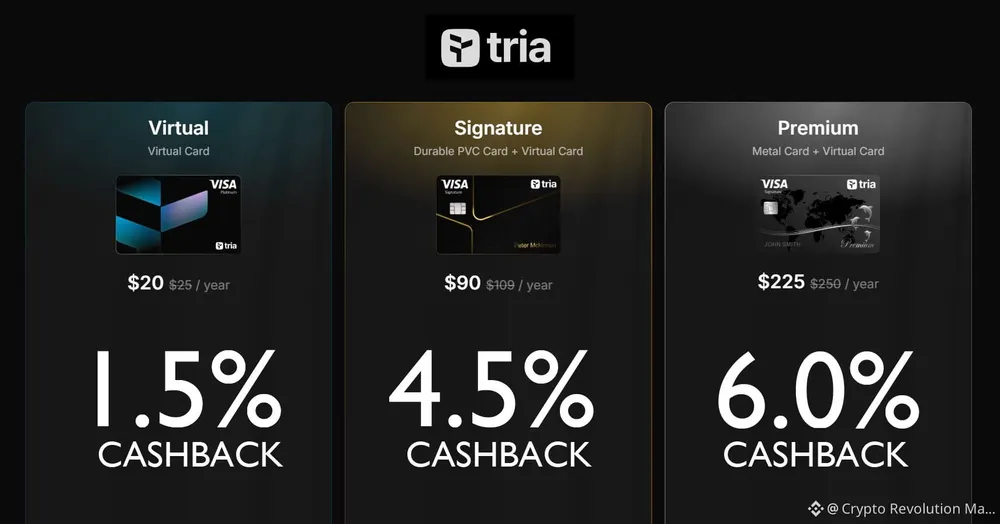
Virtual Card: A good option for beginners, but with the lowest monthly cashback limit
The Virtual Card costs $25 (one-time fee), is issued instantly as a digital card, supports Apple Pay and Google Pay, and is ideal for users who want to test the platform at a low cost.
The cashback structure is as follows: The first $100 spent each month earns 1.51 TP3T in cashback; once this limit is exceeded, the cashback rate drops to 0.51 TP3T. Based on $100 in monthly spending, the maximum monthly cashback is $1.5; if monthly spending reaches $500, the first $100 earns $1.50, and the remaining $400 earns $2.00, for a total cashback of approximately $3.50.
Coverage: Purchase Protection—$10,000 per account; Baggage Protection—$500 per trip; Price Protection—$2,000 per account.
It’s worth noting that some reviews indicate Virtual Card is currently offering free sign-ups during specific promotional periods; please refer to the information displayed in the app at the time of application for details.
Signature (Plastic) Card: The Best Choice for Most Users
The Signature Card costs $109 (one-time fee) and includes a physical card and Visa Signature travel protection, such as trip delay coverage, purchase protection, and price match protection.
The rewards structure is as follows: The first $1,000 in monthly spending earns 4.51 TP3T in rewards, after which the rate drops to 11 TP3T. Based on $1,000 in monthly spending, the maximum monthly reward is $45; the annual maximum is $540, which means you can recoup the $109 annual fee in about 2.4 months.
Coverage: Purchase Protection—$50,000 per account; Baggage Protection—$1,000 per trip; Price Protection—$2,000 per account.
For users who spend between $500 and $1,000 per month on everyday expenses (including grocery stores, subscription services, and restaurants), the Signature Card offers the best value-for-money rewards structure.
Premium (Metal) Card: Ideal for high-spending and frequent travelers
The Premium Card costs $250 (one-time fee) and includes a physical metal card and free ATM withdrawals (up to $750 per day).
The rewards structure is as follows: The first $2,000 in monthly spending earns 6% in rewards, after which the rate drops to 1%. Based on $2,000 in monthly spending, the maximum monthly cashback is $120, for an annual maximum of approximately $1,440. At this rate, you can recoup the $250 annual fee in 2 to 3 months, after which the monthly cashback becomes pure profit.
Coverage: Purchase Protection—$100,000 per account; Baggage Protection—$1,500 per trip; Price Protection—$2,000 per account.
Exchange Rate Fees:
Based on actual user testing, the TRIA Card currently does not charge foreign exchange fees (FX fees) and settles transactions directly at the Visa network exchange rate. The official card terms and conditions specify “up to 3%” as the contractual protection cap, which is not a fixed fee. We recommend checking the exchange rate displayed in the app before making a purchase.
Actual Return on Investment Calculations for Three Card Levels
The following payback calculations are based on monthly spending reaching the monthly limit and include only standard spending rewards (excluding Tria Travel and Staking Badge bonuses):
Virtual Card ($25)
First $100 of the month × 1.5% = $1.5 in rewards
Number of months to break even: $25 ÷ $1.5 = approximately 17 months (if only spending within the credit limit is counted)
Note: If your monthly spending exceeds $100, the amount exceeding that threshold will be calculated at 0.5%, which can significantly shorten the payback period.
Signature Card ($109)
First $ of the month: 1,000 × 4.5% = $45 in rewards
Number of months to break even: $109 ÷ $45 = approximately 2.4 months
Premium Card ($250)
First $2,000 × 6% = $120 cashback per month
Number of months to break even: $250 ÷ $120 = approximately 2.1 months
Cashback is calculated in USDT (as confirmed in the official Card Cashback Terms), and its value is not affected by fluctuations in the price of the TRIA token.
How Can I Get the Most Out of My TRIA Card?
By combining card spending with Perp DEX trading, you can activate three revenue streams simultaneously:
Article 1: Earn USDT Cashback on Card Purchases
Choose a card tier that matches your monthly spending, ensure your spending stays within the monthly cap, and maximize the efficiency of the high rewards rate. Rewards earned from booking flights and hotels through Tria Travel do not count toward the standard monthly cap and can be accumulated separately.
Article 2: Earn Tria Points by Trading on Perp DEX
When trading contracts via Hyperliquid or Decibel, the transaction fee is 0.051 TP3T, and the trading volume counts toward Season 3 points. Accumulate points to unlock Mystery Boxes, with the first boxes opening on August 31, 2026.
Article 3: Epoch 2 Event Reward Pool (Deadline: July 15)
Both spending and trading volume are counted toward the MindoAI Epoch 2 leaderboard. Users who rank in the Top 300 will share a reward pool ranging from $75K to $375K USDT.
To further increase your rewards, you can earn a spending bonus of up to +2% on purchases made within the monthly limit by holding a Staking Badge.
Are TRIA Card rewards paid out in USDT or TRIA tokens?
This is the issue that confuses the most users, and it is also a point of contention in some market data. According to a third-party review platform SpendNode Confirmation,All cashback rewards for Season 1 have been distributed in full in the form of USDT (stablecoin)., not the TRIA token.
Season 1 Rewards: Distribution Confirmed in USDT
The spending cashback for TRIA Season 1 (i.e., 1.5%, 4.5%, and 6% portions), calculated as a percentage of spending, were distributed to users in the form of USDT after the conclusion of Season 1, confirming the official commitment to “stablecoin rewards.”
Season 2 Reward Schedule
Cashback for Season 2 (February–May 2026) will be distributed no later than September 30, 2026, in accordance with the official Card Cashback Terms.
Season 3 and beyond (starting in June 2026):
According to the official Card Cashback Terms (docs.tria.so/card-cashback-terms), cashback for a new program cycle will be distributed within a maximum of 12 months after the end of each Cashback Period. Cashback is distributed in USDC or USDT via a Merkle distribution to users’ wallets.
It’s important to note that, in addition to cashback, the platform also features an XP points system: XP points will be converted into TRIA tokens in the future and are subject to a lock-up mechanism—they are locked up for 12 months at an annual interest rate of 10%, and upon maturity, they are unlocked linearly over the next 12 months, so it takes up to 24 months for them to be fully unlocked. XP points and cashback are two separate reward systems and should not be confused.
Key Takeaways: Cashback = USDT; XP Points Conversion = TRIA Tokens (long-term lock-up).
Can the TRIA Staking Badge further increase the reward rate?
Yes. The official Card Cashback Terms (Schedule 2) confirm that users who hold a Staking Badge are eligible for an additional cashback bonus on purchases made within the monthly limit:
- Seed: +0.25%
- Growth: +0.50%
- Momentum: +1.001 TP3T
- VIP: +1.50%
- VIP Infinity: +2.001 TP3T
Taking the Premium Card as an example, if you hold a VIP Badge, the effective reward rate within the monthly cap can reach 6% + 1.5% = 7.5%. The boost applies only to spending within the monthly cap; once the cap is exceeded, the floor rate applies, and there is no boost.
What is Tria Travel? Why is its reward cap structure completely different?
While all three card tiers have monthly caps on general spending rewards, Tria Travel offers an important exception: eligible travel purchases (including hotels, flights, and experiences) booked through the Tria platform earn rewards at the rate corresponding to the card tier, and such purchasesNot counted toward the regular monthly spending limit。
This means that Premium cardholders can also earn 6% rewards on flight or hotel bookings made through Tria Travel, and these purchases do not count toward the $2,000 monthly spending cap for general purchases. For frequent travelers, this feature effectively raises the effective cap on the overall rewards rate.
Please note that the scope of eligible spending and the method for calculating rewards for Tria Travel are subject to the terms displayed within the platform’s app. We recommend confirming whether specific items fall under the “Travel” category before making a reservation.
How do I earn Tria Points when trading on the TRIA Perp DEX?
Season 3 (starting in June 2026) will incorporate contract trading into the Tria Points system. Perp DEX trades conducted via Hyperliquid or Decibel—integrated through TRIA—will earn points based on the volume of each trade. Points can be used to unlock Mystery Box rewards (first opening date: August 31, 2026) and future ecosystem benefits.
Currently, the transaction fee for Perp DEX contracts is 0.05% (a reduction of 50% from the previous rate of 0.1%). For users who regularly trade contracts, this approach allows a single transaction to achieve three benefits simultaneously: earning Points by paying transaction fees, improving their ranking on the Epoch 2 leaderboard, and meeting the threshold to unlock a Mystery Box.
Both Hyperliquid and Decibel are controlled directly through the TRIA app, without the need to switch to an external platform.
Extended Reading:
2026 OSL User Referral Code Tutorial
Getting to know OSL: What is it? Security, Features
2026 Hong Kong OTC Trading Compliance Methods
MEXC Global Exchange In-Depth Review
Hyperliquid perpetual contract DEX analysis
Hot and Cold Wallet Principles: Self-Custody vs Exchange Custody
Can I earn an annualized return on my TRIA wallet balance?
In addition to consumer rewards, the balance in your TRIA wallet can earn an annualized return through the platform’s integrated “Earn” feature. According to SpendNode Review, The platform claims a maximum annualized yield of approximately 15% (applicable to idle assets in the wallet).
It is important to note that yields from this type of DeFi typically depend on the actual conditions of the underlying protocol and are not fixed rates. Users are advised to review the terms and conditions of currently available yield pools and the associated risk disclosures within the app before deciding whether to participate.
What's the difference between the TRIA Card and the ether.fi Card? Is it worth switching cards?
Products that are often compared to TRIA on the market are ether.fi Core Card, The latter offers free card activation and a 3% basic spending reward (distributed in ETH), with no monthly spending limit.
The main differences between the two are as follows:
| TRIA Premium Card | ether.fi Core Card | |
|---|---|---|
| Card Activation Fee | $250 (Disposable) | Free |
| Response Rate | 6% (First $2,000/month) | 3% (No Upper Limit) |
| Forms of Feedback | USDT | ETH |
| Self-hosted architecture | ✅ TSS | ✅ Ethereum Self-Custody |
| After exceeding the limit | 1% | 3% (No change) |
For users whose monthly spending consistently exceeds $2,000, TRIA Premium’s 6% (within the cap) is higher than ether.fi’s 3%; however, if monthly spending is well below $2,000, ether.fi’s free card sign-up and unlimited rewards may offer better value for money. Which card you choose essentially depends on your monthly spending and your preference for the reward currency.
Tip for Beginners: Test It First, Then Increase Your Bet
We recommend following these steps when using the TRIA Card for the first time to minimize uncertainty:
- First, complete the free KYC verification. Once your identity has been verified, you can purchase a card tier for a fee.
- Start with Virtual Card (currently available for free for a limited time) and test depositing small amounts of stablecoins (such as $50–$100 USDC); you can first use the funds to buy ETH on Futu, then Futuhui Cryptocurrency Withdrawal Steps Mention your on-chain wallet, then exchange it for USDC within the wallet
- Make one or two actual purchases to verify the currency exchange display, the app’s responsiveness, and whether the rewards are credited correctly.
- Once you've confirmed that the experience meets your expectations, consider upgrading to Signature or Premium.
This process allows you to evaluate the platform’s actual user experience at minimal cost before deciding whether to invest in higher-tier plans.
TRIA Card Application Restrictions and Things to Avoid
Which countries are ineligible to apply for a TRIA Card?
TRIA Card currently explicitly restricts applications from users in the following regions: U.S. citizens and residents of Russia, China, India, Turkey, Vietnam, Israel, and Ukraine. Users in Hong Kong and Taiwan are not currently on the restricted list, but they must still pass KYC verification and declare that they are not U.S. citizens when applying.
We recommend that you check whether your region and passport nationality are subject to any restrictions before applying, to avoid having your application rejected after you’ve paid the fee.
Can I get a refund if my KYC application is rejected?
We recommend completing the KYC verification (free) first, and then paying the card fee and selecting your card tier once you’ve been approved. This will help avoid refund disputes in the event your KYC application is rejected. When applying, we recommend using your passport and filling out your personal information in English.
TRIA’s card services are provided by Threely Dimensions Inc. (”Tria”). The card issuer is Nimbus, LLC (a Delaware corporation), which is not a licensed payment institution regulated by the Hong Kong Monetary Authority (HKMA). Users in Hong Kong should be aware that this platform is not protected by Hong Kong’s regulatory framework.
New in July 2026: An Overview of the VIP Trading Badges Program
On July 9, 2026, TRIA announced the launch of the VIP Trading Badges program, the platform’s first tiered rewards system for active futures traders (Reported by Benzinga/Chainwire)。
The plan will use an eight-tier trading volume scale, with the 30-day rolling contract trading volume serving as the threshold:
- VIP Spark: Join if your 30-day trading volume reaches $100,000
- VIP 7(Highest Tier): With a 30-day trading volume exceeding $100 million, you can enjoy up to a 50% reduction in contract fees, up to 9.5% in spending rewards, and a monthly spending limit increased to $102,000.
Ronald Tato, Head of the TRIA Ecosystem, noted that this program is designed to allow active traders to enjoy VIP-level fee discounts—previously available only on centralized exchanges—without having to give up self-custody of their assets.
Currently, TRIA contract trading is executed through two integrated protocols, Hyperliquid and Decibel, and the transaction fee has been reduced from the previous 0.1% to 0.05% (a 50% reduction).
Extended Reading:
2026 OSL User Referral Code Tutorial
Getting to know OSL: What is it? Security, Features
2026 Hong Kong OTC Trading Compliance Methods
MEXC Global Exchange In-Depth Review
Hyperliquid perpetual contract DEX analysis
Hot and Cold Wallet Principles: Self-Custody vs Exchange Custody
Are TRIA's team and funding background credible?
TRIA was co-founded by Vijit Katta (CEO) and Parth Bhalla, both of whom have worked on major Web3 infrastructure projects such as Polygon and Nethermind; their founding backgrounds are publicly available.
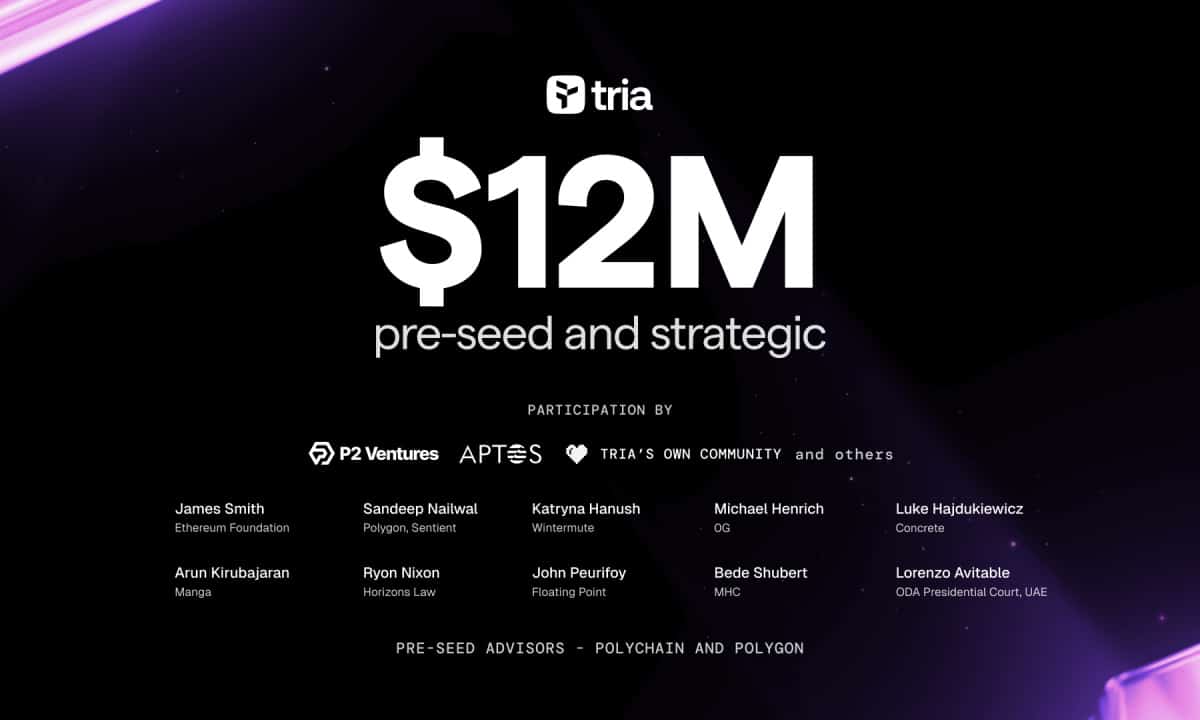
To date, TRIA has raised $12 million in funding (pre-seed and strategic rounds) from investors including Dragonfly Capital, P2 Ventures (a Polygon-affiliated fund), Aptos, and 0G, as well as individual advisors from the Ethereum Foundation and Wintermute. For more details, see Yahoo Finance reports. The platform currently integrates more than 70 DeFi protocols, covering over 200 blockchain networks.
It should be noted that some TRIA promotional materials cite figures such as “$15M+” financing or “$380M FDV,” but as of the time of this writing, verifiable third-party news reports confirm the amount to be $12 million; FDV is subject to real-time market data and should not be based on promotional claims.
How do I apply for a TRIA Card?
- Click the link below to go to the application page (an MB referral code has been embedded, allowing you to skip the waiting list):Apply for the TRIA Card Now →
- Download the Tria app and complete registration using your email or a Web3 wallet (MetaMask / Coinbase Wallet)
- Complete KYC identity verification (We recommend using your passport and filling out your personal information in English.)
- Select a card tier and pay the corresponding fee
- Virtual cards are issued instantly; physical cards require delivery.
Please confirm the following before applying: Your passport nationality must not be on the restricted list (specifically, you must not be a citizen of the United States, India, Turkey, or Vietnam); you may apply only if your KYC information is complete to avoid the risk of rejection after payment.
Risks to Be Aware of Before Using the TRIA Card
1. The distribution of rewards takes a long time
Rewards from the Season 3 New Program may be distributed up to 12 months after the end of the Cashback Period; they are not credited immediately. Please take this timeframe into account when planning your finances.
2. The monthly spending limit restricts the actual rewards
The maximum cashback rate featured in the advertisement (e.g., 6%) applies only to spending within the monthly limit. The actual effective cashback rate depends on your monthly crypto spending.
3. Complete KYC before payment to reduce the risk of refunds
KYC can be completed for free before making a payment, thereby avoiding the issue faced by users of earlier versions—where they were denied access after paying and could not receive a refund.
4. TRIA is not a licensed platform in Hong Kong
The card is provided by Threely Dimensions Inc. and issued by Nimbus LLC (Delaware, U.S.), which is not regulated by the Hong Kong Monetary Authority.
5. Applications are not accepted in certain areas
Citizens of the United States, India, Vietnam, Turkey, Russia, Israel, Ukraine, and China are currently ineligible to apply.
FAQ
Q1: Is the TRIA Card a credit card or a debit card?
Technically, the TRIA Card operates as a debit card but is settled through the Visa payment network, making it usable in situations that require credit card pre-authorization (such as car rentals). Transaction amounts are backed by the user’s cryptocurrency holdings in their wallet; no credit limit is provided.
Q2: What are the limitations of TRIA’s 6% rebate?
The 6% cashback rate applies only to Premium (Metal) cards and is calculated based on the first $2,000 of general spending each month; after that, the rate drops to 1%. Tria Travel-related spending is not included in this cap and qualifies for the corresponding cashback rate based on the card tier. Cashback is distributed in USDT. For Season 2 (February–May 2026), cashback will be distributed no later than September 30, 2026, in accordance with the official Card Cashback Terms.
Q3: Can users in Hong Kong apply for the TRIA Card?
Users in Hong Kong and Taiwan are currently not on TRIA’s list of restricted regions and may apply. However, please note that TRIA is not a licensed payment institution in Hong Kong; you should assess the relevant risks on your own before applying.
Q4: If my KYC application is rejected, can I get a refund?
Based on actual user experience, we recommend completing the free KYC verification first and paying the card fee only after it has been approved. This can effectively prevent refund disputes in the event of a rejection. When applying, we recommend using your passport and filling out your personal information in English.
Q5: What cryptocurrencies does TRIA support for spending?
TRIA supports over 1,000 cryptocurrencies, including ETH, SOL, BTC, USDC, USDT, and most major DeFi tokens, across more than 200 blockchain networks such as Optimism, Arbitrum, and Solana—all without the need for manual bridging.
Extended Reading:
2026 OSL User Referral Code Tutorial
Getting to know OSL: What is it? Security, Features
2026 Hong Kong OTC Trading Compliance Methods
MEXC Global Exchange In-Depth Review
Hyperliquid perpetual contract DEX analysis
Hot and Cold Wallet Principles: Self-Custody vs Exchange Custody
The information in this article is current as of July 2026. The cryptocurrency market changes rapidly; we recommend referring to the latest information on the official TRIA app and the Terms and Conditions page before applying. This article contains a card sign-up link; clicking it will not affect your application fee.
Disclaimer
The content of this article is for reference only, investors should exercise independent judgment, invest prudently and at their own risk, this article does not provide or attempt to persuade the audience to do trading or investment basis, the content is for sharing purposes only, and should not be regarded as investment advice.It does not represent the views and position of Monsterblockhk.All information and opinions are current as of the date of the judgment. In addition, if a judgment is rendered on aIn this siteAny content related to virtual asset trading platforms that have not yet obtained a license to operate virtual asset trading platforms in Hong Kong, including but not limited to text introductions, pictures, offers, events, etc., are only available to users outside the Hong Kong Special Administrative Region.
According to the Hong Kong Anti-Money Laundering and Counter-Terrorist Financing (Amendment) Ordinance 2022, after June 1, 2023, all centralized virtual asset trading platforms operating in Hong Kong or actively promoting their services to Hong Kong investors will be licensed and regulated by the SFC, and any related unlicensed activities will be a criminal offence. For more information and details of the legislation, users may refer to the SFC website.