


After your cryptocurrency has been stolen, the three immediate steps you can take are: verify where the funds went, revoke any authorizations that may still be active, and report the incident to the appropriate authorities to preserve evidence. While these three steps do not guarantee that the funds will be recovered, they will help you move from a state of “complete uncertainty” to one where you “have concrete evidence in hand.”
According to the FBI's Cybercrime Complaint Center (IC3) According to statistics from 2025, the center received more than 180,000 complaints of cryptocurrency fraud throughout the year, with losses exceeding $11 billion—an increase of approximately 22 percent from the previous year. This article will use free tools to demonstrate, step by step, how to trace where your stolen funds have gone. It will also alert readers to the “fee-based recovery” secondary scam traps that have become increasingly rampant in recent years, and provide a summary of official reporting channels in both Hong Kong and Taiwan.
What should you do first if your cryptocurrency is stolen?
Most victims panic the moment they discover their assets are missing and rush to search online for “how to get them back,” thereby missing the most critical window of opportunity. The first thing you should actually do is not to seek help from others, but to first determine exactly what kind of situation you’re facing.
How can I tell if my account has actually been hacked, rather than if it's just a system delay?
Open your wallet, check the time and amount of your most recent transaction, and use a blockchain explorer to verify whether that transaction has been confirmed. Network congestion, delays in block confirmation, or transfers made by mistake can all be mistaken for “missing assets,” and the way to handle these situations is completely different from dealing with an actual theft. The key to determining the cause is whether you initiated the transaction yourself: if your wallet history shows an outgoing transaction that you have absolutely no recollection of and did not authorize, then you are indeed dealing with a theft of your assets, rather than a simple network delay or operational error.
Why is “staying calm before taking action” more important than immediately asking someone for help?
Once you confirm that the assets have indeed been transferred to an address you don’t recognize, the sequence of actions you take next will directly affect the completeness of the evidence you have. Attackers typically move to split up the funds and transfer them across chains immediately after the attack. Hesitation or taking the wrong course of action will make subsequent tracking much more difficult—which is why it’s more important to remain calm and follow a set of established steps than to panic and seek help from everyone you know.
How can I track where the stolen funds went on my own?
Once you’ve confirmed that the assets were indeed stolen, the next step is to track down where the funds went. The following three tools offer varying levels of tracking depth; we recommend using them in order, as each tool can provide information that the previous one was unable to uncover.
What are the specific steps for checking an address and identity using Arkham Intelligence?
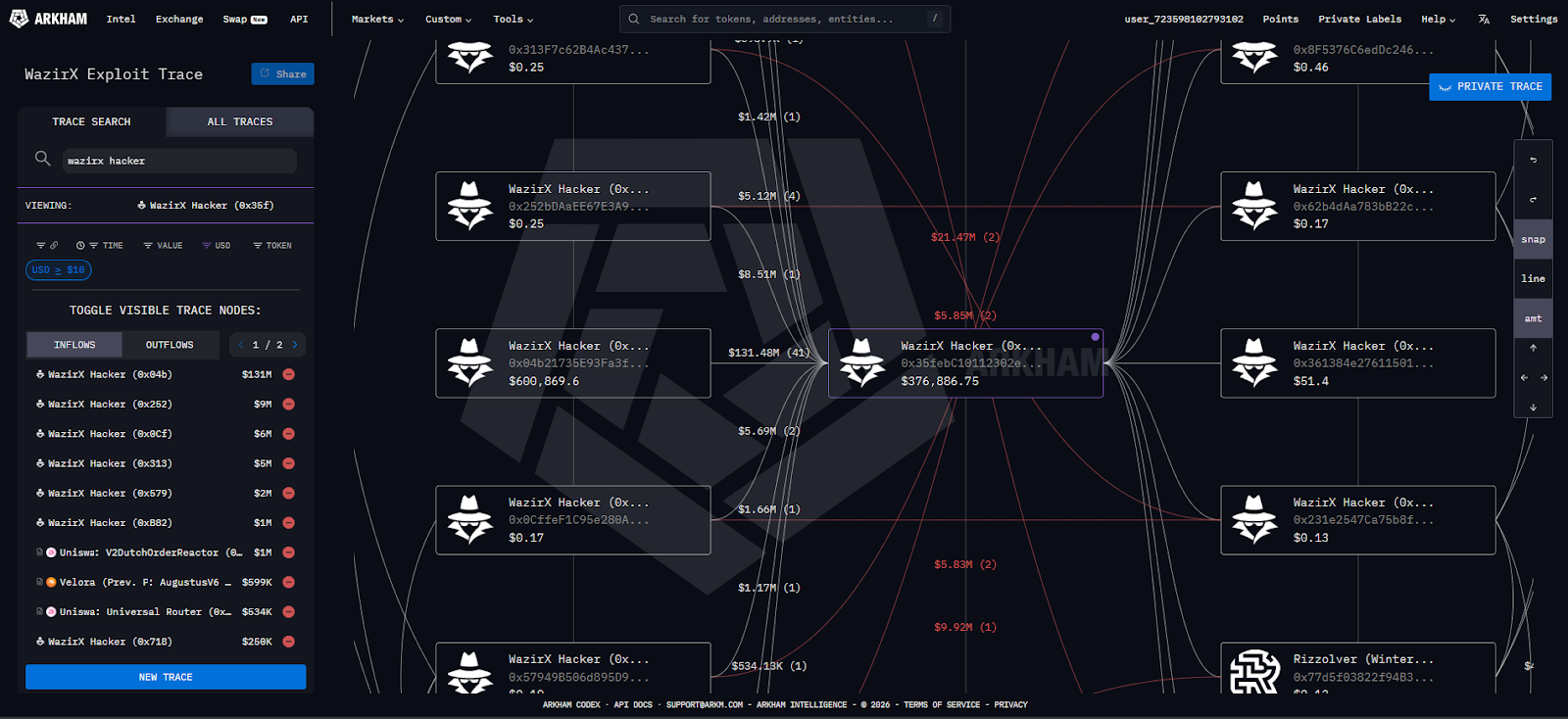
Arkham Intelligence is an on-chain analytics platform that leverages AI technology to link impersonal addresses to the real identities behind them—such as exchanges, fund wallets, or known scam addresses. Get started platform.arkhamintelligence.comPaste the attacker’s address into the search bar, click the “Visualizer” feature, and a transaction flow chart will appear on the screen. Red lines represent outgoing transfers, while green lines represent incoming transfers. You can clearly see which address the funds ultimately ended up in and even determine whether they flowed into a specific exchange. The value of this step isn’t in helping you catch the perpetrator, but in transforming vague panic into concrete evidence that you can submit to the police.
What information can a blockchain explorer display that Arkham cannot?
A blockchain explorer is a tool for querying the native ledger of each public blockchain; Ethereum uses EtherscanFor Binance Chain, use BscScan; for Solana, use Solscan. Arkham’s strength lies in its identity tags, but it doesn’t necessarily recognize every address; blockchain explorers, on the other hand, display the original transaction timestamps, amounts, and fee records—which cannot be altered by any third party—regardless of who the parties involved are. Even if Arkham cannot identify the attacker, the records you see in the browser still constitute valid evidence.
What can MistTrack do when funds are split into several transactions and transferred?
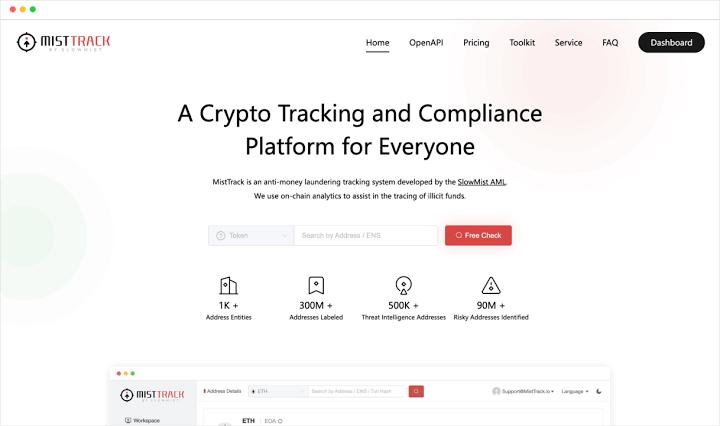
If an attacker splits the funds into multiple transactions, routes them through several intermediary addresses, or even transfers them across chains, manually tracking them using Arkham or a browser alone would be extremely time-consuming. In such cases, you can use MistTrackThis is a free on-chain tracking platform developed by the blockchain security company SlowMist. After pasting an address into the system, it automatically connects each transaction into a complete trail. It can continue tracking funds even when they cross chains and offers a “Monitor” feature that sends real-time notifications as soon as there is any activity on that address. In its official FAQ, MistTrack explicitly recommends that upon discovering a theft, users should first file a police report, then use on-chain tracking tools to search for clues, and finally submit the investigation results to the police to assist with the case. This sequence is also the recommended procedure outlined in this article.
Once you’ve traced the flow of funds, what other steps should you take at the same time?
Tracking is just one part of the overall response process. If an attacker has obtained authorization rather than the mnemonic phrase itself, assets may still continue to be drained; in this case, taking immediate action to stop the bleeding is just as important as tracking.
Why does revoking authorization have to happen at the same time as tracking?
If you suspect that your wallet’s authorizations have been misused, you should immediately use Revoke.cash to check and revoke any suspicious token authorizations to prevent your assets from continuing to be transferred while you’re investigating. MB has previously compiled a comprehensive step-by-step guide; please refer to “Revoke.cash Full Tutorial 2026: How to Revoke a DeFi Wallet Token License to Secure Crypto Assets》, which provides detailed instructions on every step, from connecting your wallet and viewing the authorization list to performing a revocation.
Under what circumstances are the chances of recovery higher?
Transactions on the blockchain are inherently irreversible, so any claims of a “guaranteed recovery” should be viewed with extreme skepticism. According to an analysis by the tracking firm Crypto Trace Labs, there is indeed a chance of recovering funds, but the probability only increases significantly when both of the following conditions are met: the victim acts quickly enough, and the funds ultimately end up in a compliant exchange that cooperates with law enforcement. Once funds pass through a mixer or remain dormant for an extended period, the difficulty of recovery increases dramatically. This means that the value of the tracking steps outlined in this article lies in establishing a chain of evidence as quickly as possible, rather than a guarantee that you will definitely recover your assets.
What are the official channels for reporting crimes in Hong Kong and Taiwan, respectively?
Regardless of whether the funds have been traced, filing a report with the authorities to preserve evidence is an essential step in the process that cannot be omitted, as this record may be used in future negotiations with the bank or in legal proceedings. Since the official procedures differ between Hong Kong and Taiwan, they are outlined separately below.
How do I use Hong Kong’s “Anti-Fraud Easy 18222” and “Anti-Fraud Camera” services?
The Hong Kong Police Force’s Anti-Fraud Coordination Center operates a 24-hour “Anti-Fraud Easy 18222” hotline, and members of the public can also contact the officialAnti-Fraud Surveillance SystemYou can use the mobile app to check whether the recipient’s address or account has been flagged as high-risk by other victims. If you suspect you’ve been scammed, we recommend calling 18222 for advice first, then going to the nearest police station to file a formal report.
What is the process for reporting a case to Taiwan’s 165 Anti-Fraud Hotline?
Residents of Taiwan can call the “165 Anti-Fraud Hotline” or contact us via 165 National Anti-Fraud Network When you file a report online, the system will assist in referring you to the nearest police substation to complete your statement. It is important to note that simply calling 165 for consultation does not constitute a formal report; you must obtain a “Case Acceptance/Processing Certificate” issued by the police. This document is required for subsequent negotiations with banks or other legal proceedings.
Why Might a “Fee Recovery Service” Actually Be a Second Scam?
After your assets have been stolen, the people you need to be most wary of are often not the attackers themselves, but a second group of people who reach out to you afterward, claiming they can “guarantee” to recover your assets.
What are the common tactics used in debt collection scam schemes?
The U.S. Federal Bureau of Investigation (FBI) has issued three consecutive public warnings (updated in August 2023, June 2024, and August 2025), specifically alerting the public to be on the lookout for fee recovery scams perpetrated by fake law firms or on-chain analysis companies. A common tactic used in these scams is to first charge a “diagnostic fee,” followed by “exchange coordination fees,” “cross-border settlement fees,” “tax documentation fees,” and other similar charges, each time promising that “this is the final payment, and once paid, you will recover your assets.” However, victims often end up recovering nothing at all. The North American Securities Administrators Association (NASAA) has also classified this scheme as a distinct category, officially naming it the “cryptocurrency recovery room scam.”
What is the key difference between legitimate organizations and scams?
Legitimate law enforcement agencies will never ask victims to pay any fees in advance when helping them recover frozen or seized assets. Any message claiming to be from the police, Interpol, or a government agency that asks you to pay first in order to recover your assets is almost certainly a scam. Similarly, you should immediately cease all contact with anyone offering “assistance” who asks for your mnemonic phrase, private key, wallet password, or remote access permissions—no matter how professional their credentials may sound.
After this incident, what other long-term habits do you need to develop?
After completing these three steps—tracking, containing the damage, and reporting the incident—what you should truly take away isn’t “how much you were lucky enough to recover this time,” but rather a set of asset management habits that will serve you well in the future. The root cause of most theft cases isn’t the sophistication of hackers’ techniques, but rather issues with how mnemonic phrases are stored, authorization management practices, or a lack of vigilance regarding phishing links—all of which can be prevented by establishing proper procedures, rather than relying solely on luck.
If you want to build a more systematic and comprehensive knowledge framework—ranging from wallet security to on-chain analysis—you can refer to MB’s guide for beginners, *Crash Course for Crypto Newbies》, or join MB Telegram Community... and stay up to date on the latest cybersecurity alerts and market information.
Frequently Asked Questions
Q1: Can cryptocurrency be recovered after it has been stolen?
It’s possible, but not guaranteed. The likelihood of recovering the funds depends primarily on how quickly action is taken and whether the funds ultimately end up in a compliant exchange that cooperates with law enforcement; if either of these conditions is not met, the difficulty will increase significantly.
Q2: Why is it not recommended to use paid “cryptocurrency recovery” services?
Because blockchain transactions are inherently irreversible, any fee-based service that guarantees the recovery of funds violates this fundamental principle; both the FBI and NASAA have classified this as a specific type of scam in their warnings.
Q3: What is the difference between Arkham Intelligence and a blockchain explorer?
Arkham excels at mapping addresses to real-world identities, such as exchanges or known scam addresses; blockchain explorers, on the other hand, provide the most raw transaction records, uninfluenced by third-party labels. The two are most effective when used in tandem.
Q4: What can the police actually do after a report is filed?
The police report is an essential document for subsequent negotiations with banks, cooperation with exchanges in investigations, and judicial proceedings. The police may also submit leads through cross-border law enforcement cooperation mechanisms, but the processing time will vary depending on the complexity of the case.
Q5: When is MistTrack best used?
It is particularly well-suited for complex cases where funds have been split into multiple transactions, passed through multiple intermediary addresses, or transferred across chains; in most cases, Arkham combined with a blockchain explorer is usually sufficient.
The content of this article is for reference and educational purposes only; it does not constitute investment advice and does not represent the position or views of Monsterblockhk. All information and analysis are based on publicly available data as of a specific date and are time-sensitive; readers should exercise independent judgment and carefully assess the relevant risks. If you suspect you have been the victim of fraud or that your assets have been stolen, please report the incident immediately through the official channels provided in this article, and remain highly vigilant against any unsolicited contact from services claiming to guarantee the recovery of your assets.