

Welcome back to Monsterblockhk's Alpha Report, this week saw the crypto market enter a near vacuum, with volumes dropping to quarterly lows, currencies lying static and sentiment indicators hovering in a state of numbness. The extreme panic of last week is over, but instead of a rebound, it's a dead silence that feels like an AFK. The community is in a rare state of silent fear. Investors are no longer panicking and selling, they are simply not selling. Looking at the market, BTC is oscillating slightly within a narrow range, ETH is only maintaining a weak rebound, and the cottage sector looks like the pause button has been pressed, with a lack of buying support and no new narrative to drive it. Funds are on the sidelines, liquidity has shrunk to freezing point, and even the Meme sector, which is usually the noisiest, has fallen silent. This kind of market rhythm, which can't go down and can't go up, is a typical post-panic recovery phase, characterized by disappearing volume, exhausting volatility, and stagnant narrative. In this week's Alpha Report, we will take you through the most critical macro events, chain movements and sector rotation, and analyze the true structure of this dead market. Market downturns often give the false impression that the cycle is over, but history has shown us time and time again that true reversals usually occur at the dullest, most weary, and most silent moments. When everyone is out of the market, the market is silently building up energy for the next momentum.

Funding Continues to Retreat, But Not Collapse: ETF Endurance Test Amid Extreme Fear
According to SoSoValue charts, Bitcoin spot ETF fund flows continued to oscillate weakly in the past week, with the largest one-day net outflow of the whole week on Nov. 20, amounting to nearly USD -900 million, which was the key turning point of the current round of retracement; the ETF briefly recovered on Nov. 21, with net inflow of about USD +250 million, but the momentum could not be sustained. On November 24, the ETF again turned to a net outflow of US$151 million, bringing the total asset size down to US$116.2 billion, while the price of Bitcoin fell back to US$89,089 at the same time. While most investors are beginning to characterize the market as a resumption of the bear market cycle, ETF funds have not been withdrawn continuously and out of control. Instead, they have maintained orderly outflows under high volatility, suggesting that long term funds are more concerned with risk management than a full retreat. From a cyclical perspective, such panic-driven phases, where capital has yet to dissipate, are often the moments when prices are depressed by sentiment to near their intrinsic value. The main theme of the current round of markets is no longer a full-blown rally, but rather a slow-paced rotation of structural differentiation and sentiment reversals. In an environment where extreme fears have yet to subside, instead of chasing short-term fluctuations, it is better to invest in core assets with a disciplined DCA allocation, so as to position for the next round of sentiment recovery and structural rebound in advance at a time when the consensus is the most pessimistic.

Extreme fear remains, but the chips are out first.
Over the past 24 hours, the city's total market liquidation amount dropped to USD292 million, which is significantly less than last week's extreme out-of-the-money positions that often exceeded USD1 billion, of which USD154 million was liquidated in long position and USD138 million in short position, and the ratio of long and short positions is getting more balanced. From the distribution of the underlying, BTC liquidation 89.92 million U.S. dollars, ETH 62.57 million U.S. dollars, is still the main source of risk; high volatility of emerging targets, such as HYPE also recorded 29.57 million U.S. dollars of concentration of liquidation, and the rest of the torrents of about 19.65 million U.S. dollars in total. 24 hours a total of 98,523 traders were liquidated, the largest single liquidation in the Hyperliquid The largest single position was in Hyperliquid's BTC-USD at $7.41 million. This structure implies a key twist: unlike last week's overcrowded long position and chain liquidation, most highly leveraged longs have been cleansed ahead of time this week, with leverage density dropping significantly, but sentiment is still stuck in the zone of extreme fear, and the community's consensus on the resumption of the bear market is getting stronger. This mismatch between stabilized leverage and pessimistic sentiment is typical of mid-to-late cycle conditions. Instead of indiscriminate series of bursts, there is structural volatility and sector rotation, meaning that while prices are still under pressure, systemic risk has been significantly reduced from last week. For traders, this is no longer a time to fight for direction, but a time to fight for risk control and rhythm.
Most Popular Cryptocurrency Trading Platforms
Hong Kong People's Top Choice for Bitcoin and Ether Trading 》 【2025 Introduction】OSL Registration Benefits, Security, Deposit and Withdrawal, Special Features
Suitable for traditional Hong Kong investors to buy and sell stocks and currencies at the same time. [2025 Introduction] What is Victory Securities? Security, Deposit and Withdrawal, Features
More choices of contract currencies, suitable for buying fake coins in cash. Trade on MEXC and enjoy 500x leverage and many other benefits!
Related Post:
Best Cryptocurrency Trading Platform for Hong Kong Users?2025 Latest Bitcoin Tips for Beginners
2025 Coin Ring Newbie Guide Lazybones|Chained Ecology Entry Guide
2025 Must Read for Newbies! Use these six data indicators to learn how to judge buying opportunities.

The Fear Index Has Hit Freezing Point: Value Misalignment Amid Extreme Pessimism
The latest reading of the CMC Fear & Greed Index is down to 15 (Extreme Fear), almost unchanged from yesterday's 15 and last week's 16, but with a marked collapse in sentiment from last month's 36 (Fear); the yearly high of 85 (Extreme Greed) was reached on 2024/11/27 and the yearly low of 10 (Extreme Fear) on 2025/11/22, and the index is now approaching the lower end of the yearly sentiment range. The annual high was 85 (Extreme Greed) on 2024/11/27 and the annual low was 10 (Extreme Fear) on 2025/11/22, with the index now approaching the lower end of the annual sentiment range. The chart shows that as Bitcoin price fell from its early November highs, the sentiment indicator dipped all the way down to the Extreme Fear Zone, suggesting that the market is not simply in a technical consolidation, but rather a panic-driven state of systemic risk aversion. Sentiment levels now fully reflect the collective expectation of a bear market return. However, behavioral finance and past cyclical experience suggests that this is the classic area where prices are most misaligned by sentiment rather than fundamentals. Extreme fear means that the market has pre-digested the most pessimistic narratives, and asset prices are often depressed below their long-term intrinsic value; conversely, it is greed and fervor, not immediate coolness and skepticism, that is the real cause for alarm. History has repeatedly shown that "buy in fear, sell in greed" is not a mantra, but a core discipline that works through cycles. Even if there is still a long period of shock or weakness ahead, as long as the assets you select have real cash flow, network effect and long-term demand, conducting DCA in batches during a breakdown in sentiment is essentially trading time for the potential premium of a valuation reversion. When the market is unanimously bearish, the risk is not gone, but has been priced in.
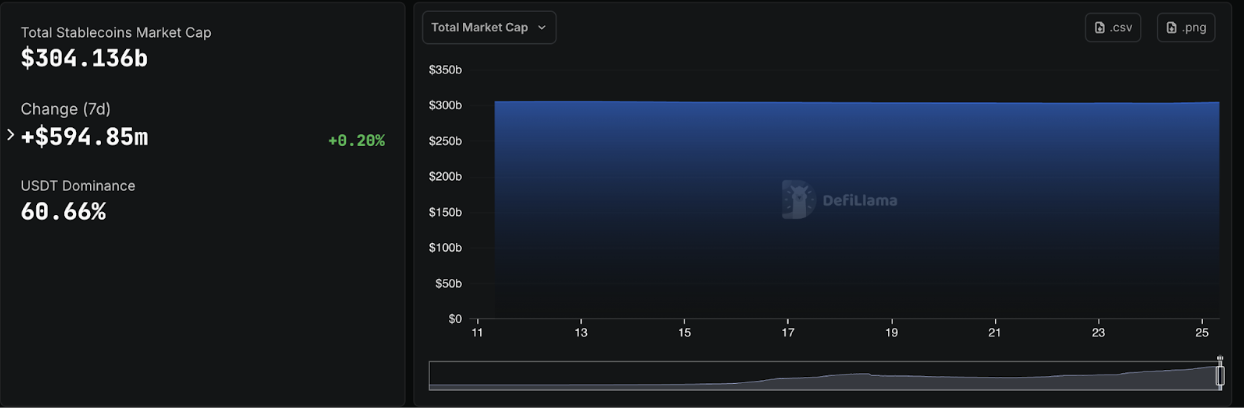
Stablecoin Market Capitalization Climbs Again as Funds Opt for a Break from Volatility
Over the past week, the market capitalization of stable coins has remained stable and slightly increased, with a total market capitalization of approximately $304.136B, a net increase of $594.85M over seven days, or 0.20%. USDT's market share of 60.66% continues to dominate the supply of stable coins. The chart shows a gently moving upward curve, with no significant contraction in response to the market shock, suggesting that although capital has left high-risk positions, it has not withdrawn from the crypto system, and instead, USD-denominated liquidity has remained on the chain to wait for its turn.
This accumulation of stable currency reflects the market's ability to retain buying power and reallocation options in the face of extreme fear. When cash volume remains at the 300B level and is dominated by USDT, the speed and magnitude of the next capital flow to risky assets will be amplified, implying asymmetric upside opportunities for undervalued assets in the near term. Combined with the U.S. policy experimentation in the direction of on-chain assets and monetization, this can be seen as a signal of rising structural demand. Investment stance is to take advantage of the discounts during panic periods to replenish positions in disciplined DCAs, while retaining a portion of stabilized currencies in case of unexpected entry windows. Thank you for reading. We will continue to track stable currency flows and capital trigger points next week.

Bitcoin Dominance Weakens, Structural Pressures Emerge
Over the past week, the Bitcoin Dominance Rate has fallen slowly from close to 59.3 to its latest level of 58.57, during which time it has failed to stabilize on several occasions, and the trend has continued to decline. The chart shows a recovery near the 24th, which was immediately followed by renewed selling pressure, eventually returning to near seven-day lows. This negative structure echoes the current climate of extreme fear in the market, where investors are not only reducing their positions in cottages, but even the relative strength of Bitcoin is beginning to erode, reflecting the overall risk appetite of capital is still declining. The drop in the lead rate does not mean that the cottage season is about to start, but rather highlights the structural constraints of the new cycle. New capital is now coming in mainly through ETFs, not through the chain as in the past, leading to a more conservative allocation of capital and a lack of natural spillover into ETH, SOL or small- and mid-cap tokens, while ETF investors are mainly traditional market arbitrageurs, returning to their cash positions after taking profits rather than switching to high-beta assets on the chain. This means that the cottage market will continue to be under liquidity pressure in the coming months. With fear running high, the fall in the dominant rate reminds us that rotation is not dead, it's just changed its rhythm. The real cottage season will require more incremental chain volume and a return of high risk appetite to ignite the fire.

Data Sentiment Turns Cold Across the Board as Memes Become a Psychological Exit for Speculators
This week's narrative price performance was generally weak, only DeSci and Memes recorded positive returns, with DeSci around +1.5% and Memes around +0.8%. The rest of the narratives were down across the board, with RWA, CEX, and Oracles in the -3% range, DePIN and DeFi close to -4%, NFTs and Gaming down around -5%, Layer1 and Privacy around -6%, and AI Agents around -7%. Gaming is down around -5%, Layer1 and Privacy is around -6%, AI Agents is around -7%, and Layer2 and DeFi related narratives are even deeper at around -8.5%. Overall the data suggests that the mainstream narratives have lost their mindshare in the short term, and capital is clearly pulling out of the high-beta circuit and the small- and mid-cap sectors. The overall data shows that the mainstream narrative has lost its mindshare in the short term. When investors suffer losses in mainstream narratives, they will instinctively look for the fastest way to make them back, and memes naturally become a psychological outlet for short-term gaming capital due to their short uptrend cycle and fast reaction time. Looking at this week, the rotation of narratives was entirely sentiment-driven rather than fundamentally-driven, and there was a clear contraction in all tracks of the market, with risk aversion and short-term speculation co-existing in capital behavior.
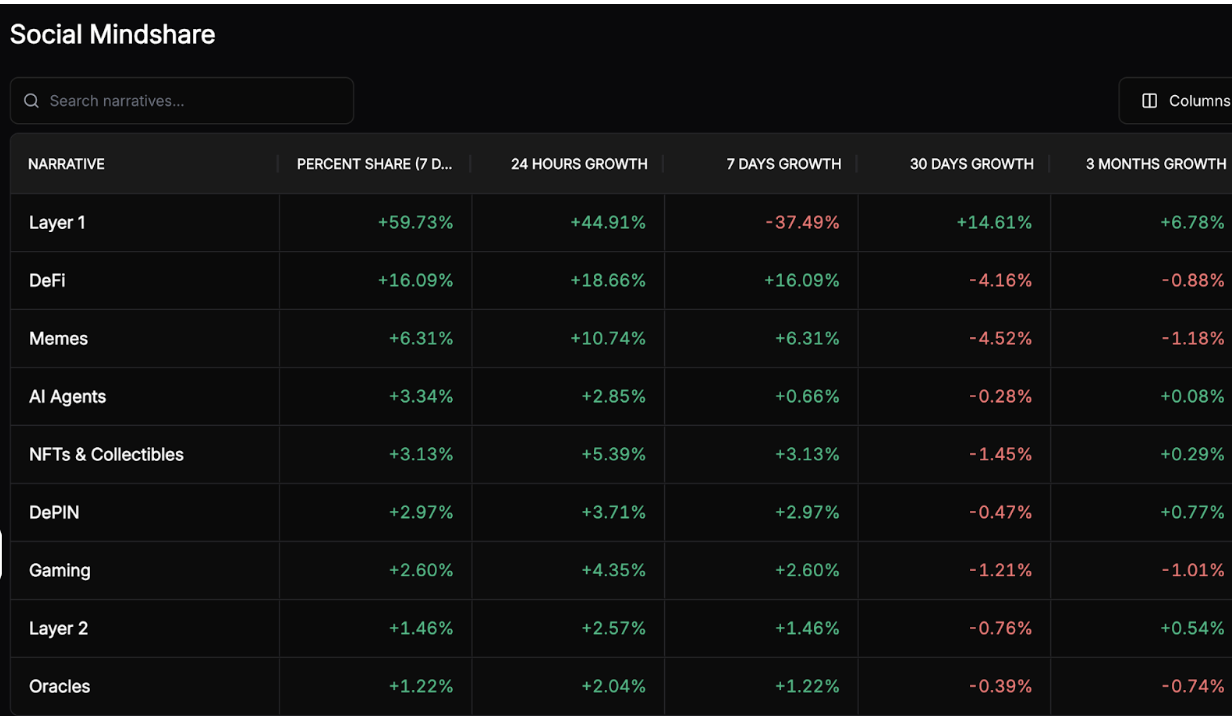
Narrative reorganization under emotional contraction, Layer1 and DeFi re-dominating the community mindshare
This week, there is a clear concentration in the community mindshare, Layer1 accounted for +59.73% with a 24-hour growth of +44.91%, although the 7-day growth was -37.49%, the overall voice is still much higher than the other narratives.DeFi ranked second with +16.09%, and simultaneously recorded 7-day growth of +16.09%. Memes accounted for +6.31%, with a 24-hour growth of +10.74%. AI Agents was +3.34%, NFTs & Collectibles was +3.13%, DePIN was +2.97%, and Gaming recorded +2.60%. Layer2 and Oracles maintained a low growth rate of +1.46% and +1.22%, showing a clear pattern of fragmentation. In terms of direction of change, this week's mindshare gravity clearly reflects typical capital reflexive behavior as sentiment cools. As market uncertainty rises, investors tend to favor sectors that are more historically validated and more representative of the prevailing narrative framework, and Layer1 and DeFi fit this profile. These narratives are highly recognizable, have more predictable fundamentals, and have stable community bases, so they naturally draw most of the attention when sentiment falls. Overall, mindshare showed a strong shift back to core narratives this week, with increased market focus, signaling a shift in risk appetite towards conservatism and structural consolidation.
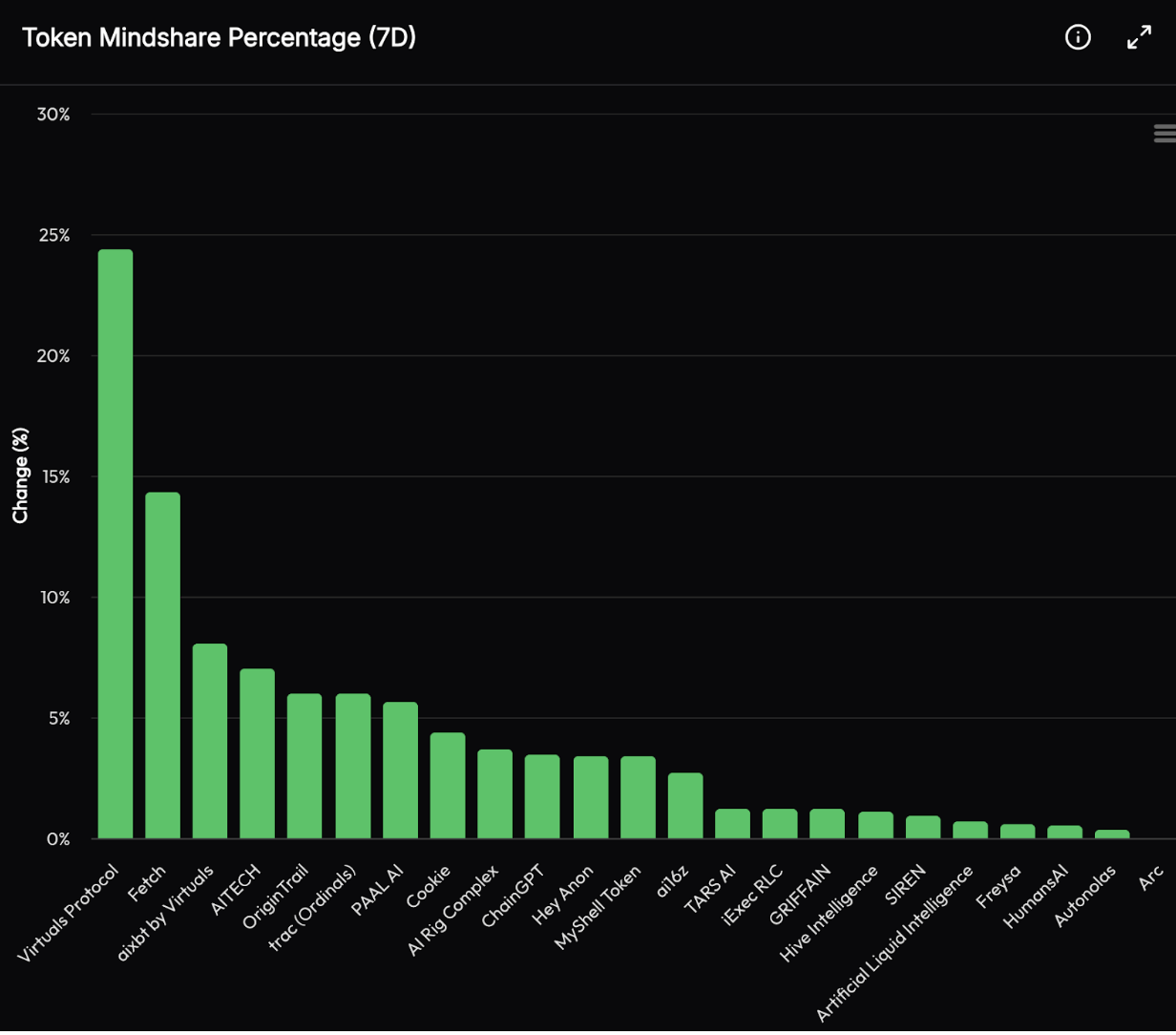
AI Narrative Reshuffles, Virtuals Protocol Leads the Way
This week's Token level mindshare showed a clear head-to-head split, with Virtuals Protocol leading the way at around +24%, Fetch at around +14%, and aixbt by Virtuals and AITECH falling between around +8% and +7%. OriginTrail and trac Cardinals were at +6%, PAAL and Cookie remained between +5% and +4%, and AI Rig and most tokens such as Compex, ChainGPT and Hey Anon were in the +4% to +3% range. Overall, there is a clear gap between the growth in the front segment and a relatively even distribution of tokens in the back segment, indicating that the market's attention is rapidly gathering on a few AI projects with outstanding performance. Structurally, Virtuals Protocol's continued strength is not only due to its technology positioning, but also to its highly active and viscous community, which has allowed it to steadily absorb mindshare during periods of heightened sentiment volatility, while other AI tokens have generally seen positive growth, but mostly in the mid-to-low range, reflecting investors' preference for a strong community backing in an uncertain environment, This reflects investors' preference for a dominant player with a clear and scalable narrative supported by a strong community in an uncertain environment. The overall pattern is one of increasing concentration, with market attention being redistributed to the projects with the most consensus and buzz.
Chain Data

Short-term cost benchmarks fail: Panic selling pressures in full swing
Sentiment deteriorated rapidly this week after Bitcoin price broke down through the 1 standard deviation support band of the short-term holder cost basis. According to the cost basis model shown in the chart, the price first broke below the ~$97,000 lower boundary and then plummeted to $89,000, hitting a new low near minus 1 standard deviation, which is a significant deviation from the overall cost basis of ~$109,000. This structure implies that the vast majority of the capital that has been invested in the market recently is now in the red, which is historically the area most susceptible to panic selling and short-term distortionary volatility. In the short term, the ability to regain this zone will be an important signal of whether the market is moving towards rebalancing. While the above price structure has led to a rapid loss of momentum, such a deep retracement is essentially in line with the cyclical logic of crypto assets. There has been no structural change in the supply/demand mechanism of Bitcoin, nor has the short-term emotional volatility deviated from the historical norm. In each cycle, the concentration of losses below the cost band often takes time to digest, but it is also the stage where medium- to long-term allocators are able to acquire discounted chips. At this stage, it is more important to maintain the analytical framework and discipline to wait for the market to complete its recovery, rather than being driven by sentiment to make decisions that deviate from the strategy.

Sinking period after a loss realization surge: a necessary window of absorption before price rebuilding
The recent sharp climb in short-term holders' realized losses suggests that market panic is at a heightened stage of activation. As can be seen from the chart, the seven-day average of short-term holders' realized losses has risen to approximately $523 million per day, the highest reading since the major event of 2022 and more intense than the two similar breakdowns earlier this year. This reflects a much denser high position structure in the $106-$118k area than in the previous cycle, which has led to a significant increase in the concentration of floating losses following the price pullback, further fueling short-term selling pressure and lengthening the rhythm of the market correction. This concentration of losses means that a large amount of short-term capital is being liquidated, and the market will need to wait for this group of vulnerable holders to fully exit before a stable absorption environment can be re-established. Historical experience has shown that when loss realization metrics are at extreme highs, it usually also means that supply is shifting to more tolerant medium- and long-term holders, and this type of structural precipitation is often a necessary precondition for the next upturn. At this stage, it is more important to maintain strategic discipline and lay out positions in batches, taking advantage of panic-induced discounts to complete allocations and wait for prices to rebuild after demand has re-accumulated, rather than operating against the trend at the peak of sentiment.
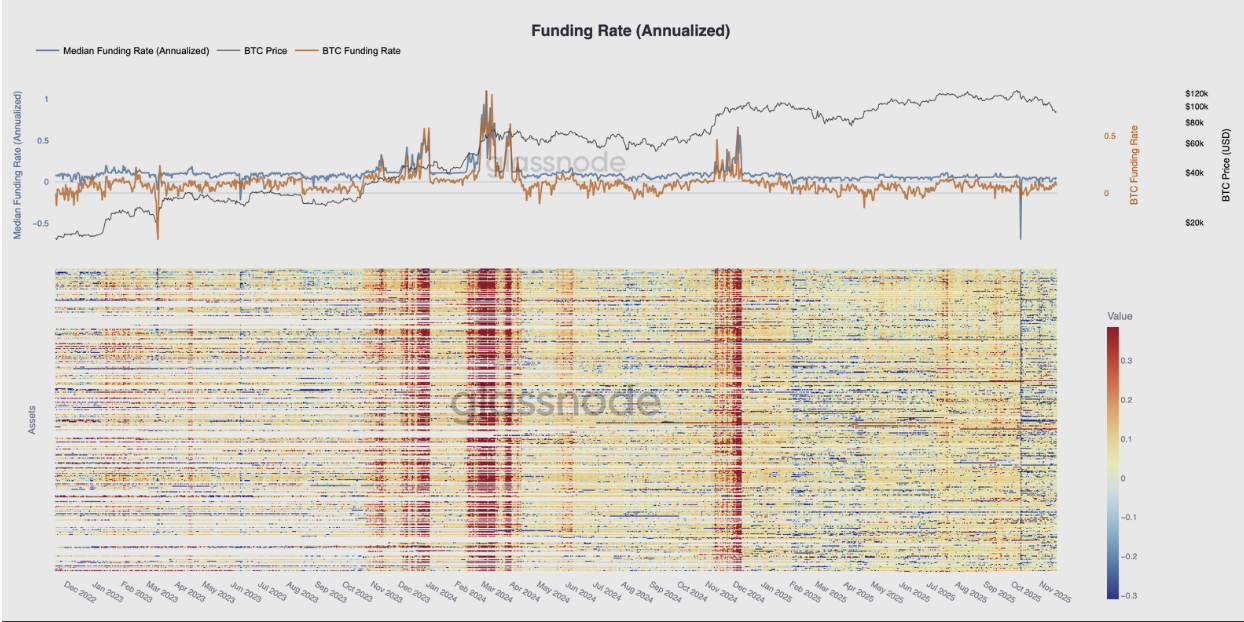
Leverage Sentiment Cools Across the Board: Capital Retreat Suppresses Bitcoin Price Momentum
Leveraged positions in the perpetual contract market have been declining recently, indicating a clear retreat of speculative capital. As seen in the chart, overall funding rates have gradually slipped from positive premiums at the beginning of the year to neutral to negative territory, with a consistent cooling distribution across most assets, and Bitcoin's own funding rate has also fallen back to near zero. This phenomenon is echoed by the continued contraction in open interest, suggesting that traders are choosing to reduce their positions on the downside rather than add to them, and that the market is significantly underleveraged compared to the past few pullbacks. This retreat in capital is directly inhibiting upside momentum and reflects a deeper contraction in sentiment, leaving prices without impetus in a weak environment. This negative capital structure means that the market is going through a typical period of leverage cleansing, setting the stage for a reshaping of subsequent trends. When the leverage is completely removed, price movements typically shift to be led by spot demand, and this type of environment is often an opportunity for medium to long term capital to be reallocated. The more panicky the sentiment, the thinner the leverage, and the more the pressure on prices comes from the sentiment side rather than from fundamental imbalances. Such sentiment-driven downturns are characterized by phases, and the market will have a chance to embark on a new accumulation cycle only after defensive positions have absorbed the short-term selling pressure. The focus should be on improving the cost of capital and leverage structure rather than short-term volatility, so as to prepare for the next leg of the market recovery.
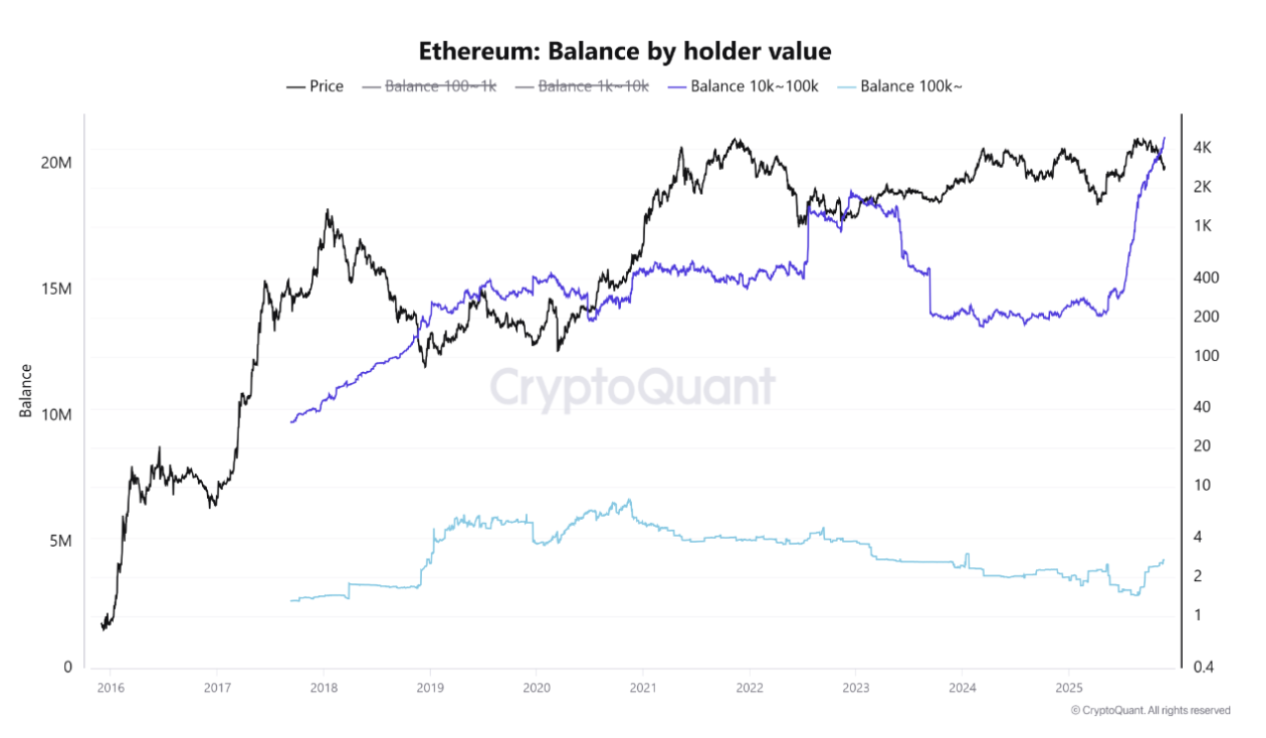
Whale Capital Absorption Expands Against the Trend: Structural Chip Concentration Amid Deep Fear
The chart shows that the balance of medium-sized whales holding between 10,000 and 100,000 Ether has surpassed 21 million, a record high since the chain's inception, while the large group of 100,000-plus holdings has risen to about 4.3 million. This double core group has not slowed down due to the price consolidation around $2,956, but rather has accelerated as market sentiment has turned to fear. Additionally, Coin's Ether inventory has been declining since September, falling to 3.76 million in November, suggesting that large amounts of capital are being pulled off the exchange and moved into cold wallets or pledged contracts, further shrinking the amount of liquid chips available for selling. Together, these data outline a clear trend of accumulation at the major level, the scale and rhythm of which reflects large capital choosing to increase its holdings against the tide in an uncertain environment. The historic rise in whale balances and the synchronized decline in exchange inventories imply a weakening of the selling pressure, while the consolidation of prices in the high range reflects a deliberate attempt to compress volatility in order to establish a more stable cost band. Several previous cycles of major buying have constructed the bottoms of subsequent uptrends, and the current sideways movement around the $2900 line is consistent with this pattern. The fact that the chips are locked in by high liquidity makes it easier for the market to enter a new phase under external catalysts, increasing the probability of a medium- to long-term uptrend in the future. In other words, observing the actions of the large position holders shows that the real trend-setting forces are quietly concentrating, and the market is on the eve of the next wave of directional choices.
Related Post:
Best Cryptocurrency Trading Platform for Hong Kong Users?2025 Latest Bitcoin Tips for Beginners
2025 Coin Ring Newbie Guide Lazybones|Chained Ecology Entry Guide
2025 Must Read for Newbies! Use these six data indicators to learn how to judge buying opportunities.
Chained Data Analysis:

BCH Functionality Reassessment Heats Up: Payment Narratives Make a Comeback
As the crypto market has seen a lot of capital rotation in recent years, and payment public chains are increasingly relying on performance and cost advantages to differentiate themselves, Bitcoin Cash, as a peer-to-peer e-cash system, has re-emphasized its original vision as a global currency by focusing on fast settlement, low fees, and larger block sizes. In the meantime, the market has remained focused on its upcoming capacity upgrade, privacy improvements, and faster block times, while the supply side of the system has become relatively clear with 33.6K holders and a circulation of 19.95M nearing the upper limit of the total supply. Then, many parties focused on its lower-cost payment capability and the strategic direction of gradually embedding DeFi. From the configuration perspective, market sentiment towards BCH has been rapidly heating up recently, driven by the expectation of increased institutional holdings, especially the rumored 500M buy orders and Coinbase's launch of BCH futures, which will strengthen its derivatives depth and enhance price discovery efficiency. With the overlapping of improving fundamentals and institutional demand, BCH is gradually building a business model centered on low-fee payments, fast confirmations, and scalability, and is strengthening its economic density on the chain with the upcoming DeFi feature. If the network usage and payment adoption can be expanded at the same time in the future, its long logic is still sustainable and is expected to maintain a relatively strong position in the next round of capital return.

Uniswap Fee Reform Upgrade: Agreed Revenue and Token Economy Repricing
Against the backdrop of accelerating competition for decentralized trading protocols, Uniswap has positioned itself as the core infrastructure to support mainstream DeFi token transactions with an automated market-making model, with a business model that revolves around aggregation efficiency, transaction costs and liquidity. Recently, the market has refocused on the agreement fee activation and 100M token destruction program, which is expected to create a concrete deflationary effect and reprice the governance stake if the transaction volume is maintained at the current level. Meanwhile, the key highlights of Uniswap v4 are the ability to customize liquidity pools and lower execution costs, creating room for capital providers to operate with more granular and customized strategies. Uniswap v4's customizable pooling feature enhances capital efficiency and aligns market making strategies with the needs of professional liquidity providers, which will help attract deeper levels of quantitative capital and portfolio market makers to stay ahead of the curve in the increasingly competitive DEX market. Consistency in governance in terms of fee allocation, parameter adjustments and token usage rights will increase agreement user stickiness and enhance ecological network effects. Taken together, Uniswap's medium-term bullish narrative is structurally supported by the formation of its revenue model, token deflation expectations and technology upgrades, and is expected to amplify its relative advantage when DeFi capital returns.

Ethena's Expansion Curve Accelerates: Synthetic Dollars and Earnings Narratives Go Two-Way
Against the backdrop of rising global demand for USD and the structural maturity of the crypto market, stablecoins have become the core infrastructure for on-chain transaction settlement, cross-border payments and capital movements, and their market capitalization continues to climb reflecting strong USD appetite. At the same time, approximately 450M ENAs are locked up in repledging, significantly reducing the pressure on token liquidity. The importance of the Stable Currency System not only stems from the demand for on-chain transactions, but also from its heavy allocation to short-term U.S. bonds and repo instruments, making it an important conduit for offshore demand for the U.S. dollar and the transmission of financial market liquidity, which helps to enhance the market fit and depth of use of the Ethena model.
At the macro level, the rapid growth of stable money has made it an extended pool of demand for U.S. Treasuries, as mainstream stable money issuers hold large T-bills to backstop U.S. dollar reserves, thereby indirectly enhancing the global absorption of U.S. dollar assets. This structure is even more advantageous in a downward interest rate cycle, as higher demand for yielding USD and lower money market fund returns make efficient yield alternatives such as USDe more attractive. For Ethena, the pace of USDe adoption and continued demand for yield products underpin medium-term growth, while the contraction in ENA supply due to repledging further reinforces price stability. Despite execution and regulatory risks, Ethena's business model has clear scalability, with its medium-term long story still structurally advantageous, in the context of the growing importance of stable currency markets, spillover from the US bond demand pipeline, and the restoration of macro liquidity.
Conclusion
Most Popular Cryptocurrency Trading Platforms
Hong Kong People's Top Choice for Bitcoin and Ether Trading 》 【2025 Introduction】OSL Registration Benefits, Security, Deposit and Withdrawal, Special Features
Suitable for traditional Hong Kong investors to buy and sell stocks and currencies at the same time. [2025 Introduction] What is Victory Securities? Security, Deposit and Withdrawal, Features
More choices of contract currencies, suitable for buying fake coins in cash. Trade on MEXC and enjoy 500x leverage and many other benefits!
Related Post:
Best Cryptocurrency Trading Platform for Hong Kong Users?2025 Latest Bitcoin Tips for Beginners
2025 Coin Ring Newbie Guide Lazybones|Chained Ecology Entry Guide
2025 Must Read for Newbies! Use these six data indicators to learn how to judge buying opportunities.

Disclaimer
The content of this article is for reference only, investors should exercise independent judgment, invest prudently and at their own risk, this article does not provide or attempt to persuade the audience to do trading or investment basis, the content is for sharing purposes only, and should not be regarded as investment advice.It does not represent the views and position of Monsterblockhk.All information and opinions are current as of the date of the judgment. In addition, if a judgment is rendered on aIn this siteAny content related to virtual asset trading platforms that have not yet obtained a license to operate virtual asset trading platforms in Hong Kong, including but not limited to text introductions, pictures, offers, events, etc., are only available to users outside the Hong Kong Special Administrative Region.
According to the Hong Kong Anti-Money Laundering and Counter-Terrorist Financing (Amendment) Ordinance 2022, after June 1, 2023, all centralized virtual asset trading platforms operating in Hong Kong or actively promoting their services to Hong Kong investors will be licensed and regulated by the SFC, and any related unlicensed activities will be a criminal offence. For more information and details of the legislation, users may refer to the SFC website.