


Prediction markets aren’t the fair game you might imagine, where “everyone votes and wisdom prevails.” According to a 2026 analysis of Polymarket’s public leaderboard, 14 of the top 20 most profitable wallets belonged to automated trading bots, not human traders. AI agents currently account for over 30% of all wallet activity on the platform, with 37% recording positive returns. In contrast, the long-term profitability rate for human traders ranges from only 7% to 13%.
This figure isn’t saying that AI is smarter than humans. It’s pointing to something more fundamental: prediction markets have become aThe Race for Execution Speed...and in this race, humans were destined to fall behind from the very beginning.
This article will break down how bots gain a structural advantage on Polymarket, the three areas where retail investors systematically lose money, and how AI signal tools can help ordinary users narrow this gap.
Polymarket Related Articles:
What Is Polymarket? A Comprehensive Guide from Beginner Tutorials to Advanced Strategies
The Complete Guide to Polymarket’s Smart Money Copy Trading Tool | Hands-On Tests of Four Free Monitoring Platforms and a Guide to Avoiding Pitfalls
Polymarket A Step-by-Step Guide to Identifying Insiders and Achieving an Extremely High Win Rate! How to Perform On-Chain Analysis?
Is “collective intelligence” a beautiful lie?
The Top 31 TP3T Players Raked in 301 TP3T in Profits—The Data Reveals the Truth
The original rationale behind Polymarket’s founder’s design of the platform stems from economist Friedrich Hayek’s theory of “price signals”: when enough people place bets with real money, market prices can aggregate dispersed information to form predictions that are more accurate than those of any single expert. This theory is entirely valid from an academic standpoint.
However, academic research data from April 2026 revealed a starkly different reality. According to an on-chain analysis of 95 million transactions on Polymarket, only 0.51% of wallets achieved profits exceeding $1,000, while more than 70% of users incurred cumulative losses on the platform. More importantly, the top 3% players pocketed 30% of the market’s total profits.
This is not “wisdom of the crowd.” It is a small number of highly specialized participants—most of whom are automated systems—that dictate the distribution of profits and losses across the entire market.
Why does the assumption that “the more people there are, the more accurate the prediction” fail in prediction markets?
The theory of “collective intelligence” rests on a key premise: participants must be capable of independent judgment, and that judgment must be based on diverse sources of information. However, the reality of prediction markets is exactly the opposite: a large number of retail investors are simultaneously following the same news and mirroring the emotional reactions of the same community. This is not dispersed intelligence, but rather an amplification of collective emotion.
When the market is flooded with emotion-driven decisions, automated systems capable of systematically identifying mispricing and acting quickly gain a structural advantage. Polymarket in 2026 is precisely such an ecosystem.
Three Structural Reasons Why Retail Investors Lose to Bots
Reason 1: Execution speed—humans simply can't keep up
In 2025, researchers at the IMDEA Networks Institute analyzed 86 million Polymarket transaction records and and found that between April 2024 and April 2025, arbitrage traders extracted approximately $40 million from structural pricing discrepancies on the platform. This profit was not earned through accurate predictions, but by reacting faster than the market.
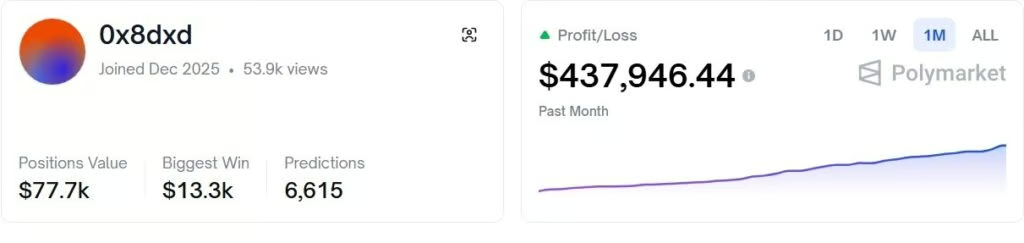
The most notable example is the trading bot “0x8dxd,” deployed in December 2025. Starting with $313, this bot generated approximately $437,000 in profits within about a month, yielding a return of nearly 139,000%. Its strategy was straightforward: continuously monitor Bitcoin spot prices on Binance and Coinbase, and when price fluctuations made a particular outcome nearly certain, bet on that “already occurred” outcome before Polymarket’s pricing system had fully reflected it.
How short is this time window? According to data from the first quarter of 2026, the average duration of an arbitrage opportunity was only 2.7 seconds, compared to 12.3 seconds in 2024. The arbitrage profits from 73% are captured by bots with execution times of less than 100 milliseconds. It often takes an average person several seconds to several minutes to go from seeing the news to making a decision. The gap is not a matter of a few percentage points, but rather several orders of magnitude.
Reason 2: Emotional decision-making—people often react incorrectly when odds shift
When faced with uncertainty, humans have a systematic cognitive bias: overbetting on “exciting” outcomes. When a team shows signs of an upset, or a politician makes a statement that shocks the public, retail investors’ first reaction is often to emotionally bet on the widely discussed outcome—an outcome that has usually already been priced in, or is even overvalued.
The data supports this observation. According to an analysis of Polymarket bot strategies, there is a particularly effective type of bot strategy known as “reverse betting”: These strategies systematically bet on “no” outcomes, as statistics show that approximately 70% of prediction markets settle on “no,” and humans habitually overbet on “exciting” outcomes.
This isn’t to say that retail investors are foolish, but rather that the human brain hasn’t evolved to be optimized for rational decision-making within a probabilistic framework. When odds shift dramatically, most people’s instinctive reaction is not to calculate expected value, but to follow market sentiment.
Reason 3: Information processing speed—there is a critical time lag between decision-making and execution
Even if a retail investor makes the right call, the time lag between “thinking” and “acting” often causes the opportunity to slip away.
When major news breaks, Polymarket odds typically have an adjustment window of 30 seconds to 5 minutes, during which prices have not yet fully reflected the new information. The automated system works as follows: The AI model analyzes news headlines and calculates probability updates within a few milliseconds, while simultaneously assessing the credibility of the information source. It then compares these results with the platform’s existing odds to identify mispricing and executes trades within one second.
Compare this to a human trader’s workflow: reading the news, understanding the content, assessing the impact, determining the direction, calculating the position size, opening the trading platform, and executing the trade. The entire process takes a few minutes. But five minutes later, that pricing window has already closed completely.
Extended Reading:
2026 OSL User Referral Code Tutorial
Getting to know OSL: What is it? Security, Features
2026 Hong Kong OTC Trading Compliance Methods
MEXC Global Exchange In-Depth Review
Hyperliquid perpetual contract DEX analysis
Hot and Cold Wallet Principles: Self-Custody vs Exchange Custody
What is an AI signal tool? It differs fundamentally from an automated trading bot.
Signals vs. Automated Trading: The Two Have Completely Different Roles
Before discussing AI signal tools, it is important to clear up a common misconception. The goal of an automated trading bot is to replace human decision-making; it executes buy and sell orders directly in the market, without requiring any judgment on the part of the user. The goal of an AI signal tool, however, is entirely different: it isTo assist human decision-making...provides reliable market analysis, enabling users to make their own decisions based on more comprehensive information.
This difference is crucial in practice. The success rate of automated trading bots depends heavily on technical infrastructure, including dedicated RPC nodes, millisecond-level execution speeds, and substantial capital. An analysis of 95 million transactions revealed that only 0.51% wallets achieved significant profits; the vast majority of those able to successfully deploy profitable bots were professional institutions, rather than individual retail investors.
AI signal tools, on the other hand, address a different problem:Help ordinary users bridge the gap with institutions in terms of information processing, rather than trying to keep up with machines in terms of execution speed.
How the Confidence Framework Helps Users Make More Rational Decisions
The traditional way to participate in prediction markets is as follows: Users see a question, decide “yes” or “no” based on their intuition or news reports, and then place a bet. The problem is that this process does not quantify the judgment at all, nor does it provide a way to systematically evaluate whether one’s judgment is reasonable.
The AI signal tool incorporates the language of a probabilistic framework. When the system outputs “confidence 74%,” it conveys more than just a directional recommendation; it conveys aProbability Assessments Open to Scrutiny. Users might ask: “The current market odds are 60%, but the signal shows a confidence level of 74%. Is this 14-percentage-point difference worth investigating to understand the reason behind it?”
The value of this framework lies not in providing you with answers, but in helping you transform intuitive decision-making into probabilistic thinking—which is, in itself, one of the most effective ways to improve performance in prediction markets.

Alice AI: An Example of a Signals Tool Integrated with the Polymarket API
When it comes to translating the concept of AI signal tools into a specific product, Alice AI is currently one of the leading tools designed for the Polymarket ecosystem. It integrates with Polymarket’s API to track capital flows and odds changes on the platform in real time. After analysis by AI models, it pushes market signals with confidence scores to users via a Telegram bot.
Alice AI is positioned asA tool to aid decision-making, not a trade execution order. After receiving a signal, users still need to decide for themselves whether to participate in the corresponding market and how to manage their positions. There is a clear logic behind this design choice: one of the root causes of the 99.49% failure rate of the automated trading bots mentioned earlier is that the zero-barrier “click-to-follow” feature deprives users of the opportunity to develop their own market judgment. The value of a signal tool lies precisely in helping users make judgments, not in replacing the judgment itself.
Alice AI currently covers multiple market categories on Polymarket, including major topics such as politics, sports, economics, cryptocurrency, and film and television culture, providing signal analysis for virtually all mainstream prediction markets on the platform. Users can select the types of signals they wish to receive within the Telegram bot. Each push notification is labeled with a confidence percentage, allowing users to assess the strength of the signal rather than passively accepting all notifications.
Alice AI: An In-Depth Analysis—How Does It Actually Work?
How the Three-Tier Structure Addresses the Three Reasons Retail Investors Lose Money
Alice AI’s product design revolves around one core question: If retail investors can never keep up with machines in terms of execution speed, at what stage can AI tools truly make a difference?
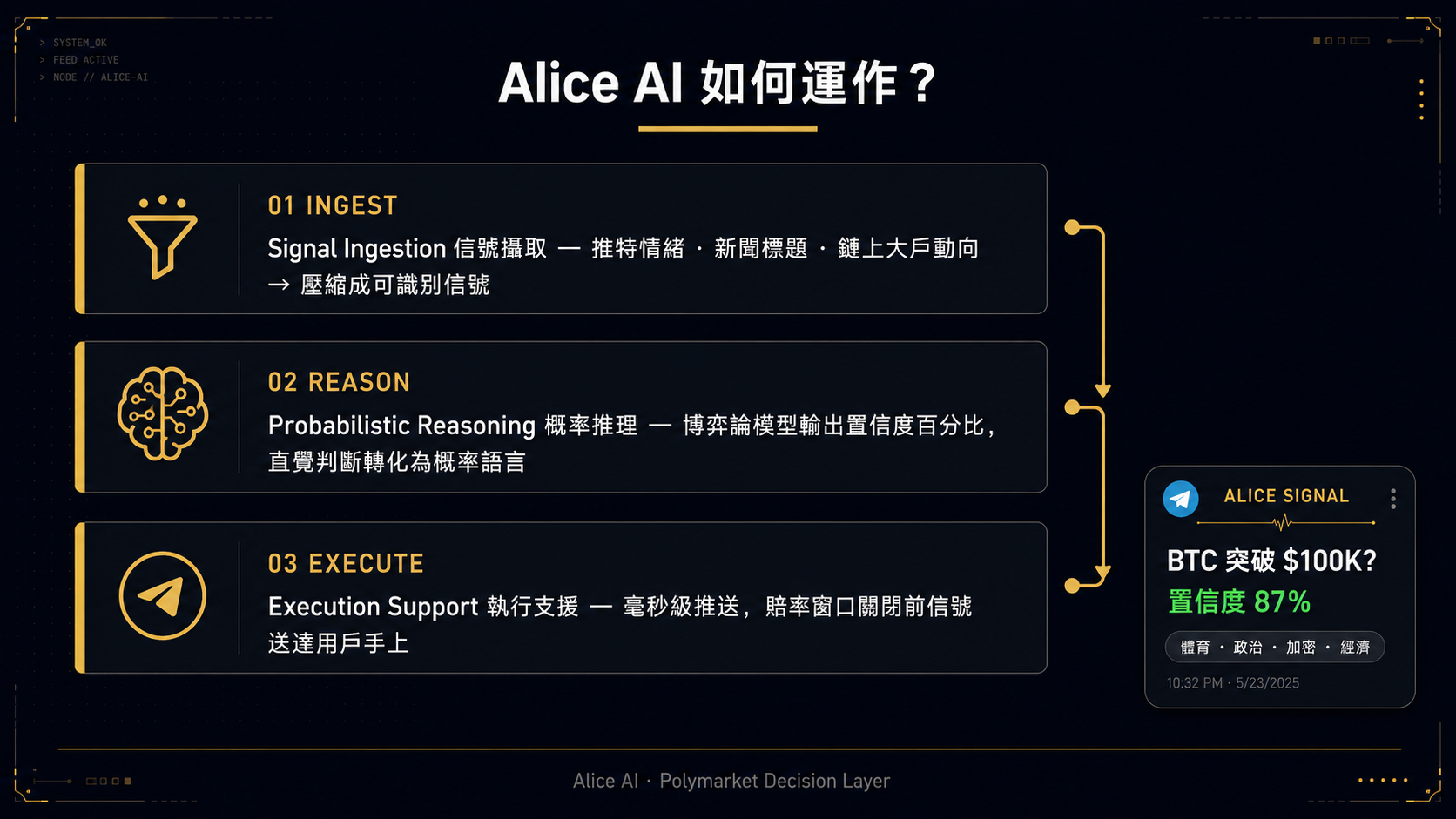
The answer isData Compression Layer. There are three structural reasons why retail investors lose money: execution speed, emotional decision-making, and delays in information processing. The latter two occur during the “decision-making process before placing a trade,” rather than at the moment of execution. Alice AI’s three-tier architecture is designed specifically to address this decision-making process:
The first layer is Signal Ingestion...The system taps into global streams of unstructured information, condensing scattered market noise—such as Twitter sentiment, news headlines, and the on-chain activity of major players—into recognizable signals. This process eliminates the need for retail investors to spend hours each day sifting through information.
The second level is Probabilistic ReasoningThe system uses a game theory model to assign a probability score to signals and outputs a confidence percentage. The purpose of this step is to translate “intuitive judgments” into “probabilistic terms,” allowing users to quantitatively compare the gap between their intuition and current market pricing, thereby identifying potential mispricing opportunities.
The third level is Execution SupportThe system sends real-time signals via Telegram, so users don’t have to constantly monitor the market. This feature addresses the problem of “knowing about an opportunity but failing to act in time”; signals are delivered to users before the odds window closes.
Why choose a Telegram bot instead of an app or a website?
Alice AI chose to use a Telegram bot as its primary delivery interface rather than developing a standalone app; this decision was based on several noteworthy considerations.
First of all,Seamless Onboarding. Signals in prediction markets are extremely time-sensitive, and the window for odds adjustments is often only a few minutes. If users have to open a separate app, log in to their account, and wait for the interface to load, the window of opportunity for the signal may have already passed. Telegram notifications are virtually instantaneous, allowing users to see signal alerts right on their phone’s lock screen. At the current push frequency, Alice AI sends approximately 5 to 10 signals per hour,Users do not need to constantly monitor the market; signals are delivered automatically.
Next isLow-Threshold Access. For users new to prediction markets, the Telegram bot operates in a way that closely aligns with their everyday habits, so there’s no need to learn a new interface.
Third isCommunity Ecosystem OverviewTelegram is the most central communication platform in the encrypted community. Its push notifications can be seamlessly integrated into users’ existing information consumption habits, rather than requiring the creation of a separate, isolated tool.
What does Alice AI's funding history tell us?
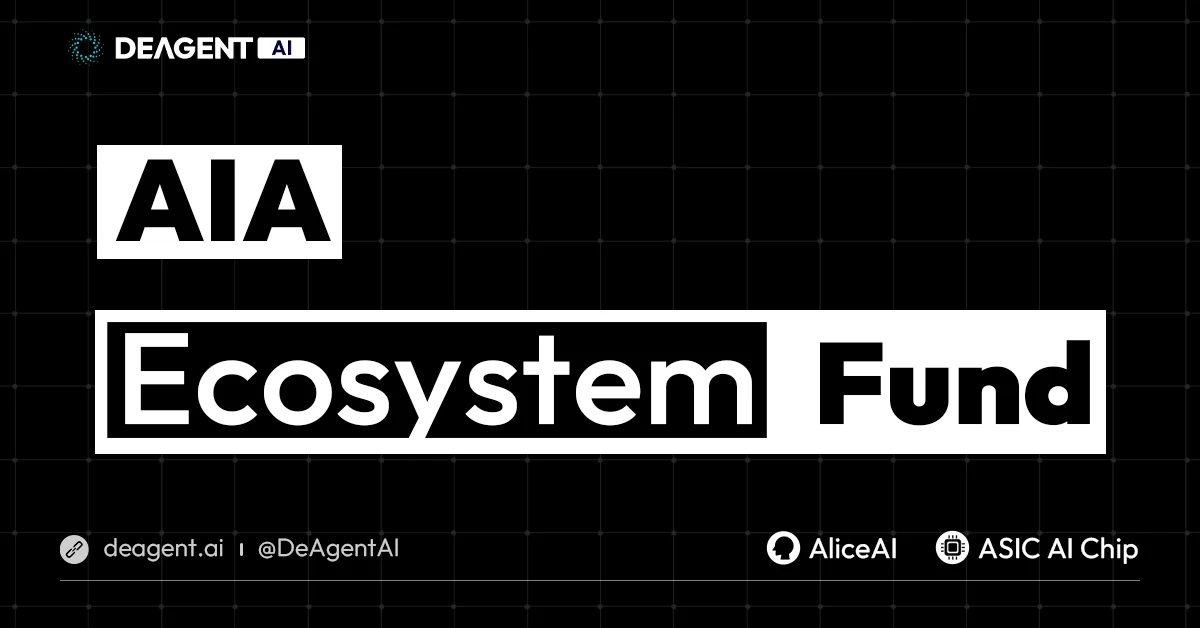
Alice AI was founded in April 2026 DeAgentAI (AIA) Ecosystem FundSeed Round Funding. DeAgentAI is an AI agent protocol deployed on both the SUI and BNB Chain. In 2024, it completed a $6 million seed round (led by Web3.com Ventures and Vertex Ventures).
DeAgentAI’s investment in Alice AI is part of its ecosystem fund strategy, which focuses on supporting projects that build specific vertical applications on top of AI agent infrastructure. Prediction markets are one of the first key sectors identified by DeAgentAI, as their decision-making mechanisms are naturally suited for AI agent applications: problems are structured, results are verifiable, and pricing mechanisms are transparent.
It is worth noting that Alice AI is currently still in its early stages (Phase 01 — Foundations), and its core signal engine and on-chain performance ledger are in the process of being launched. For users interested in trying it out, this timing offers an opportunity to gain early familiarity with the tool at a relatively low cost, while also recognizing that the product is still undergoing iteration and historical performance data has yet to be accumulated.
Who is Alice AI suitable for? Who is it not suitable for?
Ideal User Profile: Users who already understand the basic mechanics of Polymarket and are consciously seeking to shift their prediction market decision-making from “gut-feel” to “probability-driven,” or users who have some background knowledge of sporting events such as the World Cup and wish to gain a deeper level of information before participating in prediction markets.
Not suitable for: Users who are completely unfamiliar with prediction markets and expect to “automatically make a profit just by following the signals.” Confidence signals require users to have a basic understanding of probability in order to use them correctly; otherwise, high-confidence signals may be misinterpreted as a guarantee of certainty, which could actually increase the risk of irrational decision-making.
If you are not yet familiar with the basic operations of Polymarket, we recommend that you first read the Polymarket basics tutorial to understand the market mechanisms, deposit methods, and settlement rules before using the AI signal tool as an aid.
Readers interested in AI signals for prediction markets can learn more through the following resources:
Alice AI Official Community (Discussions, Market Analysis, Latest Updates):t.me/thealiceai
Alice AI Telegram Bot Trial:t.me/thealice_ai_bot
Before participating, please ensure that you understand the basic operations of Polymarket and the risk characteristics of prediction markets.
World Cup: The Most Intuitive Example of Understanding Prediction Market Signals
Why are odds movements in sports events easier to understand than those in political events?
Odds movements in political prediction markets are often influenced by a great deal of non-public information, making it difficult for ordinary users to determine whether these movements reflect “genuine probability updates” or “insider money flowing into the market.”
Sports events are different. The reasons for odds movements are usually visible and verifiable: key players confirmed to be out, weather affecting field conditions, and teams’ past head-to-head records—all of this information is publicly available. For retail bettors, sports events are the best training ground for practicing “identifying mispricing,” because you can more clearly understand why odds are moving.
Enciso Absence Cases: A Real-Life Illustration of Information Asymmetry
June 12, 2026, In the opening match of Group D of the World Cup between the USA and Paraguay, Paraguay’s most important offensive player, Julio Enciso (21, considered the core of Paraguay’s attack), was confirmed to be out of the game prior to kickoff, but the full pricing adjustment on Polymarket did not occur until several minutes after the news was released.
During those few minutes, the automated system—which had already been monitoring player injury updates—quickly adjusted its positions, while most retail investors hadn’t even had time to react. The final score was a 3–0 victory for the United States. This case perfectly illustrates how the “information gap” works: critical information emerges, odds adjustments take time, and participants with systematic monitoring systems act before the adjustments are complete.
One of the key benefits of AI signal tools is that they help users more quickly identify such opportunities—specifically, situations where “known information has not yet been fully reflected in the odds.”
How Should Ordinary People Use AI Signal Tools Correctly?
Which types of users are best suited for this, and which types should exercise caution?
The ideal user profile for the AI Signal Tool: Users who have a basic understanding of predictive markets, are familiar with the fundamentals of Polymarket, and are willing to understand the market’s probabilistic framework before placing a bet, rather than relying solely on intuition to make decisions.
A situation requiring caution: If you are completely unfamiliar with the basic mechanisms of prediction markets, the confidence figures generated by AI signal tools may be misinterpreted as a “guaranteed win rate.” A signal with a confidence level of 74% statistically indicates that there is a 26% probability that this judgment is incorrect—this is not a small probability; it means that nearly one out of every four times, the signal will be wrong. Understanding this fundamental concept is crucial before investing any real money.
Enciso Absence Cases: A Real-Life Illustration of Information Asymmetry
The right approach to using AI signal tools is to treat them as “a friend who understands probability and offers advice,” rather than “handing everything over to AI to make money for me.”
The difference is this: the former helps you make more informed decisions; the latter leaves you unable to reflect on your losses or improve. In the prediction market, the problem with blindly following others’ trades isn’t just that you might lose money—it’s that you’ll never know why you lost, so you’ll end up repeating the same mistakes next time.
The long-term value of AI signal tools lies not only in helping you identify a specific trading opportunity, but also in helping you develop a more systematic framework for understanding the market. This framework is the core asset that will allow you to remain competitive in market forecasting over the long term.
Frequently Asked Questions
Q1: Are bots on Polymarket against the rules? The Polymarket platform itself allows automated trading, and using bots does not violate the platform’s rules. However, certain strategies (such as those that exploit non-public information) may pose regulatory risks. In February 2026, the U.S. CFTC issued a proposal explicitly stating that trading in prediction markets based on non-public information may violate the insider trading provisions of Rule 180.1.
Q2: Can AI signal tools guarantee profits? No. AI signal tools provide probability assessments calculated based on existing information, not definitive answers about future events. Any prediction market tool that claims to guarantee profits should be viewed with extreme caution. The CFTC has also explicitly warned that fraudsters are exploiting the AI craze to promote automated trading systems that claim to offer “guaranteed high returns.”
Q3: Do ordinary people have a real advantage in prediction markets? Yes, but only in specific types of markets. According to research, human traders have a structural advantage in the following two types of markets: first, long-term markets (with a settlement date more than 30 days away), because the speed advantage of bots becomes less significant in such markets; and second, niche markets that require deep domain knowledge, because the relevant information has not yet been digitized and bots cannot process it effectively.
Q4: How do I get started with Alice AI Bot? We recommend joining the official Alice AI community first (t.me/thealiceai) Stay up to date on the latest signal updates and market discussions, then start receiving signals via the Telegram bot (t.me/thealice_ai_bot). Within the bot, you can choose to enable signals for sports events or the crypto market. It’s currently available for a free trial and works best when used with a Polymarket account.
Q5: Are prediction markets legal in Hong Kong? Polymarket is a blockchain-based decentralized platform. Users in Hong Kong can participate directly through their cryptocurrency wallets without the need for any special verification process. There is currently no specific legislation in Hong Kong governing decentralized prediction markets. However, any market participation involving real funds carries the risk of loss, and users should assess this risk based on their individual risk tolerance. The above does not constitute legal advice.
Extended Reading:
2026 OSL User Referral Code Tutorial
Getting to know OSL: What is it? Security, Features
2026 Hong Kong OTC Trading Compliance Methods
MEXC Global Exchange In-Depth Review
Hyperliquid perpetual contract DEX analysis
Hot and Cold Wallet Principles: Self-Custody vs Exchange Custody
Disclaimer
The content of this article is for informational and educational purposes only and does not constitute any investment advice, nor does it represent the position and views of Monsterblockhk. All information and analyses are based on publicly available information as of a specific date and are subject to change. Readers are advised to exercise independent judgment and carefully assess the associated risks. This article does not constitute any invitation or solicitation to buy or sell securities, funds or other financial products, and Monsterblockhk is not a licensed investment adviser of the Securities and Futures Commission of Hong Kong. If necessary, readers should consult a licensed professional for advice on their own circumstances.