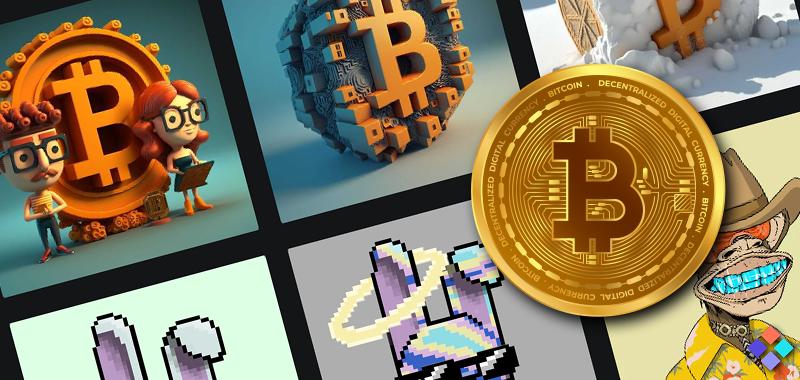
At the end of last year, Casey Rodarmor, a core contributor to Bitcoin, created Ordinals, and since then, the emergence of Ordinals and BRC-20 has led to the emergence of the entire Bitcoin ecosystem, and the volume of transactions has risen dramatically. However, the innovation of Bitcoin has never stopped, and now there are even new ways to play it. What is "Rare Smart" or "Epic Smart"? In this article, we'll take you on a journey to learn more about this valuable "smart"!
What is BRC-20?
The name is an interpretation of Ether's ERC-20 standard, which utilizes serial number mnemonics of JSON data to deploy token contracts, mint tokens, and transfer tokens.The BRC-20 standard is an experimental homogenized token standard created by @domodata on March 8 of this year. With BRC-20, everyone can issue tokens on the Bitcoin network just as they can on Ether!
What is Ordinals
A Bitcoin can be divided into multiple units, each of which is called a "satoshi," and the Ordinals protocol recognizes and trades each individual satoshi by inscribing text, images, music, videos, and other files on each satoshi through an Inscription action. Ordinals has the same characteristic as Bitcoin: decentralization.
If you haven't heard of Ordinals and BRC-20 yet, check out the following articles
Bitcoin NFT 】BRC-20 How to play and what is Ordinals? Teaching Articles
What is "Rare Smart"?
Each Bitcoin is made up of 100 million satoshis (or sats), and Ordinals is a protocol for numbering satoshis, with each satoshi having its own numerical number. Regarding the rarity of a satoshi, according to the official documents of Ordinals, it is essentially based on some regular events of the Bitcoin itself to give a difference. For example, in the Bitcoin world, some events are frequent and some are rare, and these events naturally form a rarity system.
BTC Ordinals are inscribed directly onto individual Satoshi's and then incorporated into blocks of the Bitcoin blockchain, so Ordinals inherit the simplicity, tamperability, security and durability of Bitcoin itself.
These periodic events include:
- Blocks: A new block will be dug up about every 10 minutes and will always be at this value.
- Difficulty Adjustment: Every 2016 blocks, i.e., every two weeks, the Bitcoin network adjusts the difficulty target based on changes in the hash rate.
- Halved: Every 210,000 blocks, i.e., every four years, the reward for each block dug is halved.
- Cycles: Every 6 halves, something magical happens: the halves and the difficulty adjustments happen at the same time. This is called an "overlap" and the period of time between overlaps is called a "cycle". An "overlap" occurs about once every 24 years. The first overlap should occur around 2032.

Hierarchical Distribution and Aggregation of Smart
- Common: Any smart other than the first smart of the block (total supply of 21 trillion)
- Uncommon: The first smart in each block (with a total supply of 6929999)
- Rare: The first smart (total supply of 3437) in each difficulty adjustment period.
- Epic: First smart after each halving (total supply of 32)
- Legendary: The first smart of each cycle (total supply of 5)
- Mythic: First smart in the Genesis block (total supply of 1)
In addition to these classifications, Rare Clever has also created some classifications, that count as rare, for example:
Each smart has its own name, and these are combined with random words, or rarer if they happen to be combined into a single word.
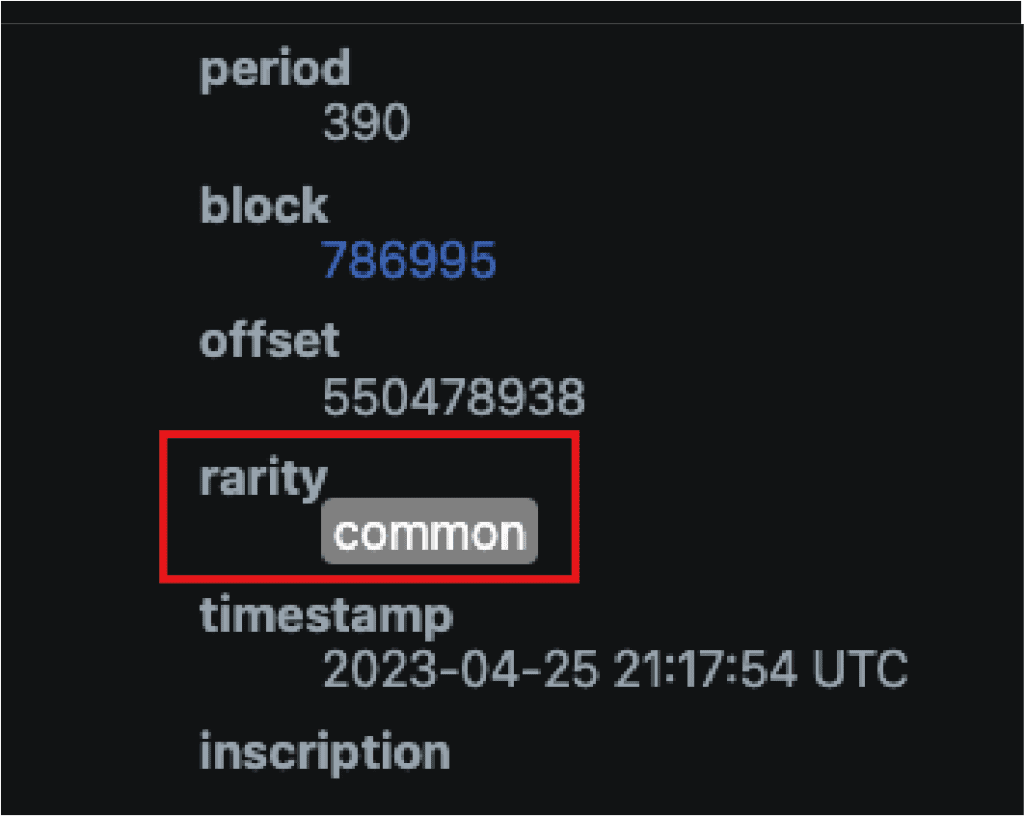
How do I check the rarity of an inscription in my wallet?
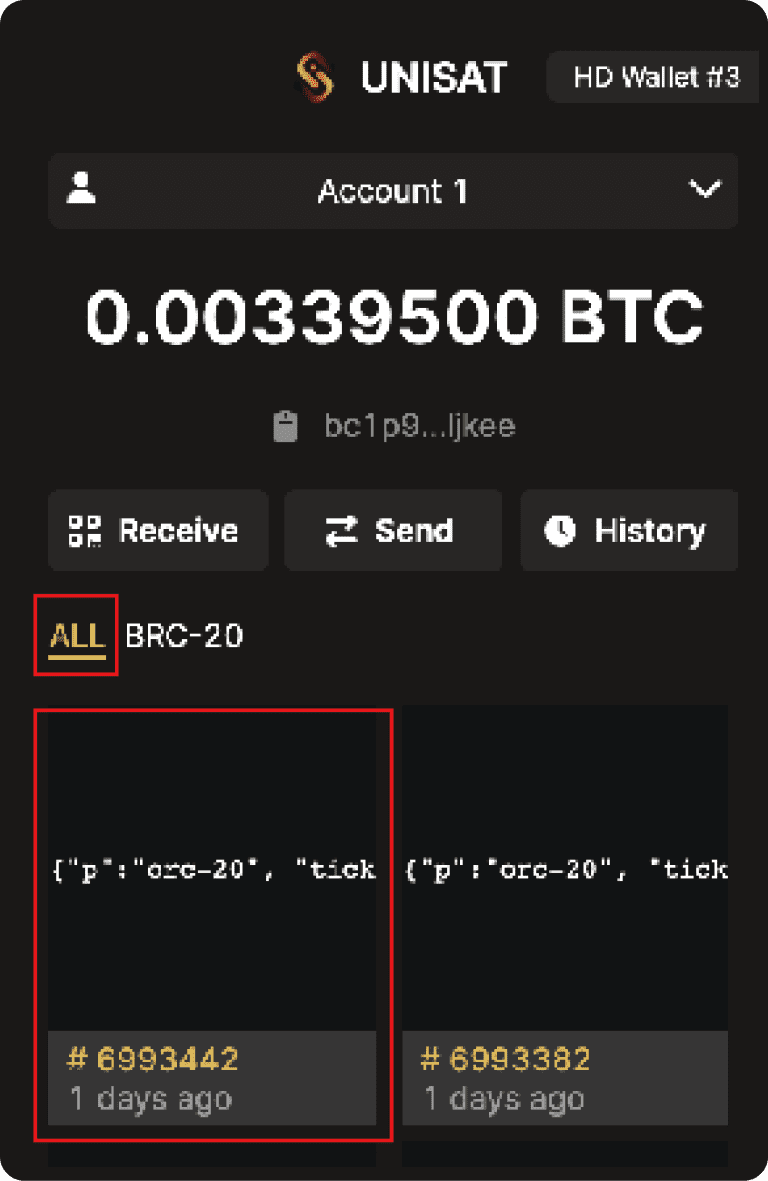
- open up Unisat Wallet, click "ALL"
- Click on the inscription you want to search and copy the "id".
- leave for ordinals.comand paste the copied id
- Look for "sat" at the bottom of the inscription's data page and click on it.
- You can tell the rarity of the smart by seeing the location on the picture below!
How to get Rare Smarts?
***The high time and monetary costs of the following operations***
- Download Sparrow Wallet
- Buy BTC on the exchange and put it in your Sparrow wallet.
- Check UTXO in Sparrow.
- Let's see if there's a rare smart in this freshly reloaded transaction.
- If not, sell the BTC and repeat until you find something rare.
How can I buy BRC-20 tokens?
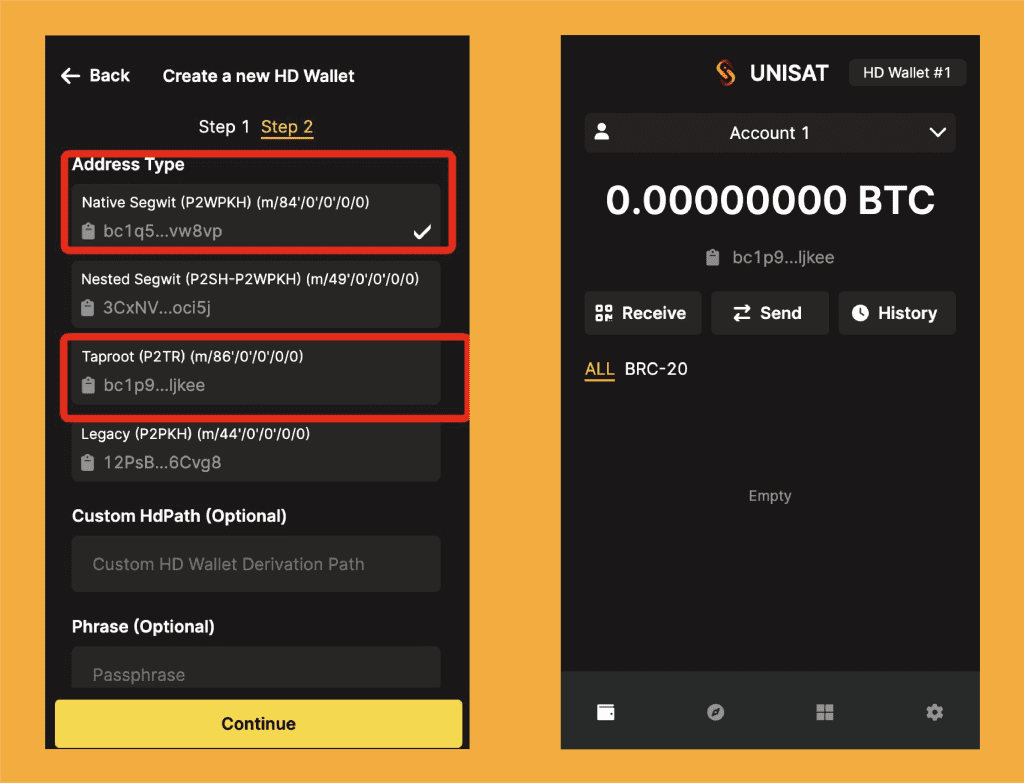
First, create a wallet:
After you have successfully created a wallet:
- When adding a wallet, select the Taproot network (the wallet address beginning with bc1p) because you want to receive the BRC-20 asset, then click Continue.
- The wallet page on the right side of the picture below will have a wallet address for storing BRC-20 tokens.
Steps to deposit
It is very easy to withdraw funds from the exchange, send them to your wallet address and wait for confirmation of the transfer.
If you don't have an exchange account yet, you can refer to the following articles
IV. Buying $ordi
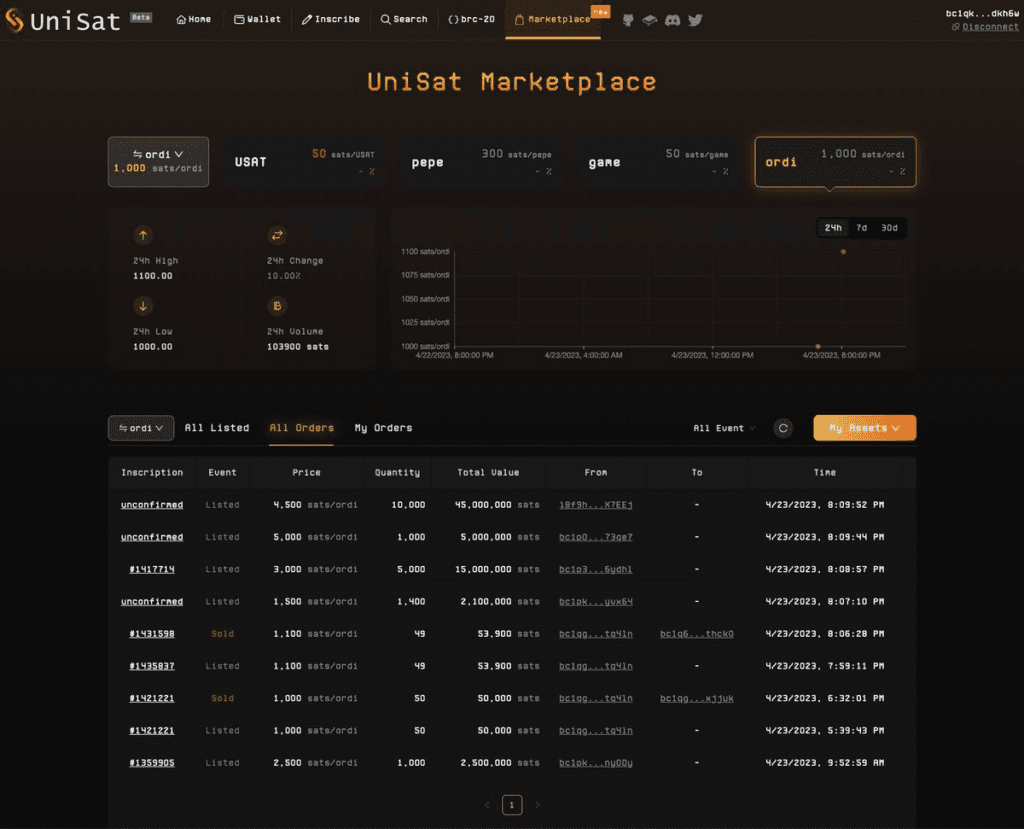
- Enter https://unisat.io/market
- Click ordi, confirm the quantity and unit price, and click the Buy button.
- The Confirm Transaction screen will pop up, click Confirm.
- Sign in the pop-up Unisat wallet
- Complete the purchase!
Conclusion
Ordinals created another use case for a Bitcoin network, but the protocol was controversial, with some arguing that Bitcoin's relative simplicity should be preserved and limited to storage and transmission values, while others argued that Bitcoin should evolve to incorporate new features and use cases.
However, please be reminded that when transferring money using Bitcoin wallets, there is a chance that the BTC NFTs will be sent out together (a mechanism problem), so it is recommended that the wallet that receives the NFTs should not be used for any other operations, so as to avoid the risk of losing the NFTs.