

Smart contracts are an important component of decentralized programming platforms, which are applications that assist the blockchain in executing programmatic commands. With smart contracts, users are able to execute programmatic protocols that are highly trusted, fast, reliable, and low-cost to operate.However, a common problem with blockchain is that the technology does not provide a well-developed way of accessing external data, connecting data up and down the chain, which is one of the great challenges facing smart contracts.
How to transfer data to the blockchain
Chainlink's project provides a decentralized prophet service that transforms external data into a language understood by smart contracts. Through its prophet technology, it creates an access point for multiple data inputs and outputs, including real data outside the blockchain, related applications and APIs.
What is a centralized prediction machine? It's not that difficult - it's a single provider of information external to the smart contract, and although there is only one source, it can be very problematic. What if that prophet provides false or incorrect information? All the systems that depend on it will fail.
Generally speaking, this is called the "prophet problem", and it is also a problem that Chainlink is trying to solve. Traditional prophecy machine services are centralized, with the risk of "single point of failure" (single point of failure), and contradict the concept of decentralization.
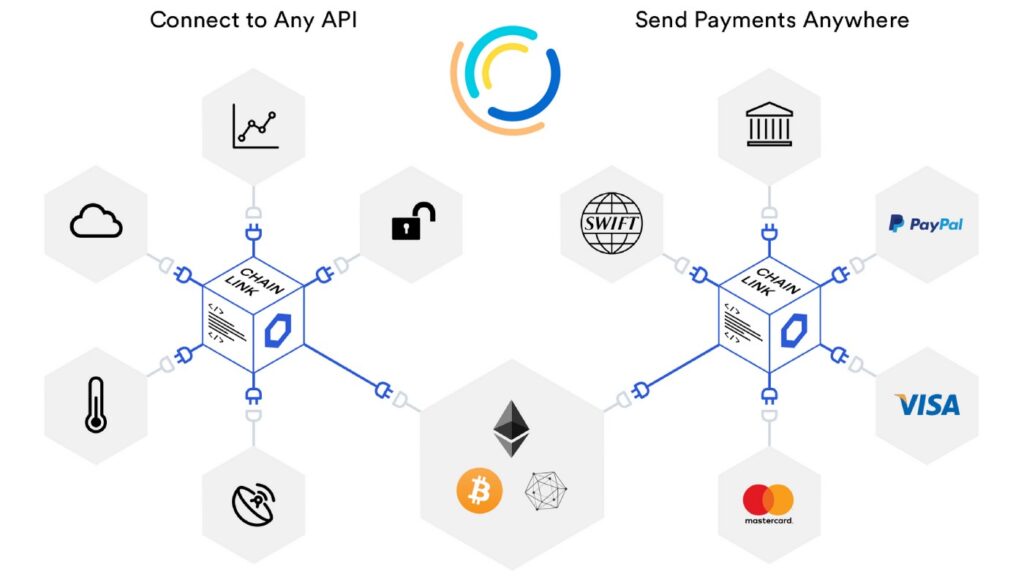
Chainlink's prophetic machine is an open network of nodes that allows anyone to run their own network.
In order for smart contracts to be able to establish protocols on data outside of the blockchain, Chainlink needs to use off-chain data in an on-chain format. One of the main limitations of blockchain smart contracts is the lack of connectivity to external sources of information, which Chainlink can address using its Oracles prediction machine program.
Detailed Steps for Chainlink Operation
- Smart contracts on the blockchain ask for data as information.
- Chainlink registers this data request or query as an “event” and creates a corresponding intelligent contract, known as a Service Level Agreement (SLA) Contract, to capture the data down the chain.
- Chainlink's SLA agreement will result in three sub-contracts: Reputation Contract, Order-Matching Contract, and Aggregating Contract.
- And then. Chainlink In the case of reputational contracts, the Predictive Machine Data Provider's track record will be examined to ensure the reliability of its data and past performance record to assess the data provider's nodes and to exclude those that are not reputable or reliable.
- Chainlink The Requesting Contract will be delivered to the Company in accordance with the Order Matching Contract of the Company.Chainlink node and accepts bids based on data requests and selects the appropriate number and type of data providers to fulfill the data requests.
- Chainlink The convergence contract will validate and integrate all data from the selected prophecy machine.
- Chainlink The nodes on the Node will receive data requests from the requesting contract and use the Chainlink Translation Software Chainlink Core, converts data requests from blockchain programming language to off-chain programming language so that off-chain data sources can receive and understand them.
- The translated version of the data request will be collected from the data source via the API.
- After the data is collected, the information will be transmitted through the Chainlink Core translates back into blockchain-ready programming language and eventually sends it back to the Chainlink Total amount of exchange contracts
OKX Exchange Introduction|Inside the account 20% free of charge offer
Bitget Invites Friends to Money Pie|Zero Trading Fee
Bitget Launchpool Win 150,000 XRP Prize Pools
Bitget Zero Fee Trading - 5 Incentive Programs
Five Tools for Finding Potential NFT Explosion Projects