

What Are Cryptocurrency KOL Partnerships? Why Are Trading Platforms Willing to Pay for Them?
Collaborations with crypto influencers involve crypto projects or trading platforms paying influential creators to promote their products on X, YouTube, Telegram, or Instagram. Compensation isn’t necessarily in cash; common forms include project tokens, referral commissions, and a share of transaction fees. The form of compensation directly affects whether influencers can provide unbiased reviews of the products.
On October 20, 2026, the meme coin platform Pump.fun announced that trader Kimchi had become a creative partner. At the time, Pump.fun was competing with its rival, Fomo, for the same pool of traders; the platform wasn’t looking for just an advertisement, but rather the trust that a large group of people placed in this trader.
This collaboration took a turn just two days later. On-chain analysis suggests that Kimchi may have received approximately 1.35 billion PUMP tokens, worth about $6.25 million, but neither party has confirmed this to date; two days after his promotion, he removed Pump.fun from his profile. This example clearly illustrates that in the crypto space, it’s more important to understand the nature of the compensation for a partnership than the monetary amount itself.
If you'd like to share collaboration experiences with other crypto enthusiasts, feel free to join the MB community first. Readers in Taiwan are welcome to join. MB Telegram Community:
What are the 7 common types of collaboration models for crypto influencers?
Collaboration models for crypto influencers generally fall into three categories: cash payments based on content, project tokens, and performance-based commissions. The following seven are currently the most common arrangements, and a single collaboration may combine several of these models.
Fixed-Price Cash: Charged per piece of content
A flat-rate cash payment is the most straightforward collaboration method: the client pays in cash or stablecoins per post, per video, or per live stream. Several KOL marketing agencies have mentioned an installment payment method: 40% is paid upon signing the contract, another 40% is paid when the content goes live, and the remaining 20% is paid 30 days after going live. This method is most common among small and medium-sized accounts, and the advantage is that compensation is not tied to cryptocurrency prices.
Monthly Subscription Plan: A fixed amount of content over a fixed period of time
A retainer arrangement involves charging a fixed monthly fee in exchange for a set amount of content over a specified period. In its 2026 Budget Guide, marketing firm Disence states that during the growth phase following a token launch, the monthly fee for each mid-tier KOL ranges from approximately $5,000 to $15,000. Retainer agreements are also primarily cash-based, but since the collaboration period is longer, KOLs need to evaluate the project itself more carefully.
KOL Round: Obtain Project Tokens at a Discount
A KOL Round is a process in which a project allocates a portion of its tokens to KOLs at a discounted price prior to the token’s listing, in exchange for promotion. Both Flexe.io and Shilika Jain’s 2026 pricing guides list similar scales: 5% to 15% of the total fundraising amount, distributed among 10 to 30 KOLs, with tokens unlocked linearly over 12 to 24 months.
Hybrid System: Cash Base Salary Plus Tokens Unlocked in Installments
The hybrid model consists of a cash base salary plus tokens that are unlocked in installments, with a typical unlocking period of 6 to 12 months. Disence notes that among top KOLs with rates exceeding $10,000 per post, about 90 percent prefer token-based or hybrid terms. The hybrid model ties KOLs to the project over the long term, but it also means their income will fluctuate with the token price.
Referral Commission: A commission based on the fees paid by referred users
Referral commissions occur when a KOL uses their referral link to get people to open accounts and then earns a share of the trading fees paid by the referred users. Exchange referral programs generally follow this model; claims commonly found online, such as “X Exchange offers up to 50% in commissions,” mostly originate from third-party websites, and the actual rates should be verified on the platform’s official website.
Creator Fees: Directly Linked to Token Trading Volume
Creator fees are a mechanism on meme coin platforms: token issuers can designate an address to permanently receive a share of the transaction fees for that token. Taking Pump.fun as an example, the fee share during the bonding curve phase is 0.30% of the trading volume; after the token is transferred to PumpSwap, the fee share ranges from 0.05% to 0.95% depending on market capitalization. For the token named “Kimchi,” the creator fee is set to be permanently transferred to an address labeled “Kimchi”; however, there is currently no evidence that he personally deployed or controls that address.
Platform Partners: Long-term representatives of a platform by title
Platform partners are KOLs who serve as long-term representatives of a particular platform under a specific title, such as “Ambassador” or Kimchi’s “Creative Partner.” Compensation may take the form of cash, tokens, or both. The greatest risk of this type of partnership is that the KOL’s name becomes tied to the platform: if the platform runs into trouble, the KOL’s credibility will be affected as well.
| Cooperation Models | Forms of Compensation | Do returns follow the price of the cryptocurrency? |
|---|---|---|
| Fixed Price, Cash Only | Cash or stablecoins | 否 |
| Monthly Subscription Partnership | Cash or stablecoins | 否 |
| KOL Round | Discount Tokens | 是 |
| Mixed Ownership System | Cash and Tokens | Part |
| Referral Rebates | Service Fee Breakdown | Depending on the contract |
| Creator Fees | Trading Volume Split | 是 |
| Platform Partners | Cash, tokens, or both | Depending on the contract |
How much do crypto influencers charge? Why do the quotes from these three companies differ by several times?
There is no standardized pricing list for crypto influencers. According to quotes released by three influencer marketing agencies in 2026, rates for accounts of the same tier can vary by two to three times, and each agency defines the follower counts for “Nano” and “Micro” tiers differently. The figures below are reference values taken from public articles by each company, with prices listed in U.S. dollars.
X Quote for a Post
| Level | Flexe.io (X thread) | Shilika Jain (X posts) | Disence (X posts) |
|---|---|---|---|
| Nano | 200–1,500 | 200–1,500 | 100–500 |
| Micro | 1,500–6,000 | 500–5,000 | 1,000–2,000 |
| Mid | 6,000–25,000 | 5,000–30,000 | 3,000–8,000 |
| Macro | 25,000–80,000 | 10,000–100,000 | 10,000–50,000 (per event) |
| Top-tier | 80,000–200,000+ | 20,000–200,000+ | 80,000–200,000+ |
Source:Flexe.io(Updated in October 2026),Shilika Jain(October 2026),Disence(Article dated May 2026).
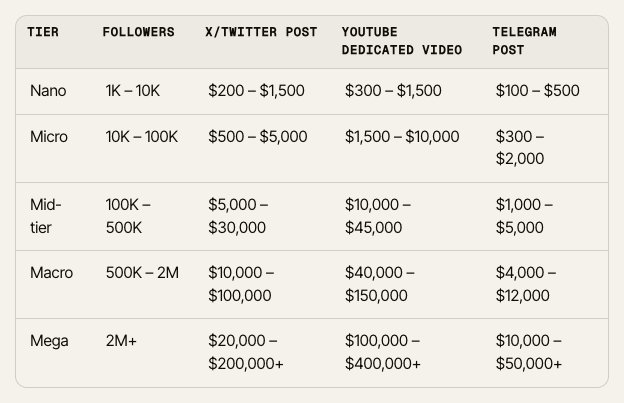
In terms of tier definitions, Flexe.io and Disence classify “Nano” as accounts with 5,000 to 25,000 followers, with the top tier defined as accounts with over 1 million followers; Shilika Jain, on the other hand, defines “Nano” as 1,000 to 10,000 followers and “Top Tier” as 2 million or more. Even among accounts classified as “Micro,” the maximum quoted price can range from $2,000 to $6,000.
YouTube Video Quotes
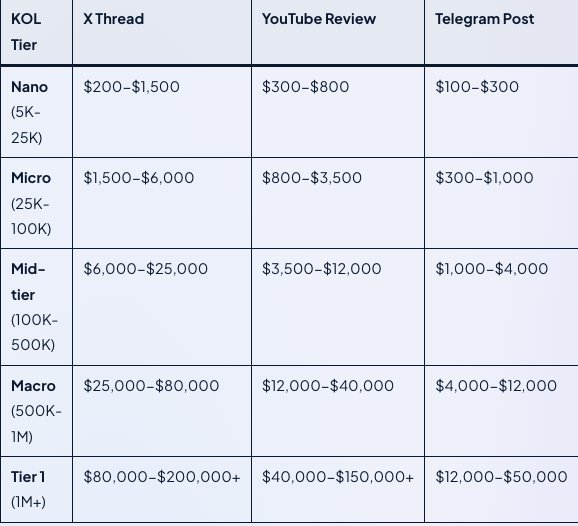
| Level | Flexe.io (Review Video) | Shilika Jain (Feature Video) | Disence (Video Insert) |
|---|---|---|---|
| Nano | 300–800 | 300–1,500 | Not listed |
| Micro | 800–3,500 | 1,500–10,000 | 2,000–8,000 |
| Mid | 3,500–12,000 | 10,000–45,000 | Not listed |
| Macro | 12,000–40,000 | 40,000–150,000 | Not listed |
| Top-tier | 40,000–150,000+ | 100,000–400,000+ | Not listed |
What other fees are there besides the quoted price?
The quote is just the starting point. Shilika Jain lists several common surcharges: agency commissions ranging from 15% to 30%, an exclusive partnership surcharge ranging from 20% to 50%, content usage rights at an additional 10% to 25%, and a 48-hour turnaround at an additional 25% to 50%. She recommends that clients budget 1.4 to 1.8 times the quoted price. Disence recommends adding an additional 25% to 40% to account for hidden costs. Regional differences are also significant, with quotes from creators in Vietnam and the Philippines ranging from 50% to 70% lower than those from Western creators with comparable followings.
For KOLs, these figures mean this: First, figure out which tier you belong to and what criteria the other party is using, and then discuss pricing—that way, you won’t have your rates driven down due to differing definitions.
If you want to know how other creators set their rates, you can discuss it directly in the MB community:
What terms should you review before accepting token rewards?
Before accepting token rewards, you should at least clarify three things: the discount amount, when the tokens will be unlocked, and whether public disclosure is required. These three terms determine whether there is a conflict of interest between the KOL and the audience.
Discount: How much lower is the entry price for KOLs compared to retail investors?
Discounts for KOL rounds can be quite substantial. Bloomberg previously reported on the Monad case, noting that some KOLs were able to invest at a price equivalent to about one-fifth of the valuation set by the venture capital firm Paradigm; some token issuance platforms have also indicated that KOLs participating in such transactions can receive discounts ranging from 20% to 50%. The lower the entry price, the greater the incentive for KOLs to sell their tokens after the listing.
Unlock: Can KOLs sell their shares earlier than other investors?
The vesting period determines when KOLs can sell their tokens. According to the pricing guide, the vesting periods for KOL rounds are typically 12 to 24 months, while those for hybrid rounds range from 6 to 12 months; However, a Bloomberg report notes that KOLs often receive shorter lock-up periods, allowing them to sell their tokens earlier than other investors. For KOLs, a linear unlocking schedule is generally more prudent; terms that result in a large number of tokens being unlocked immediately upon listing can easily lead audiences to question the motives behind the promotion.
Disclosure: Do viewers know that you hold tokens?
The Bloomberg report also noted that the terms of KOL arrangements are not necessarily disclosed to the public. Since viewers do not know how many tokens a KOL holds or when they will be unlocked, they have no way of knowing when the KOL might sell them. In 2022, while handling the case involving Kim Kardashian’s promotion of EMAX tokens, the U.S. Securities and Exchange Commission (SEC) made it clear that anyone promoting crypto assets that qualify as securities must disclose the nature, source, and amount of any compensation received.SEC Press ReleaseShe was accused of accepting $250,000 to promote products on Instagram without disclosing it, and ultimately agreed to pay approximately $1.26 million to settle the case.
What are some notable examples of crypto influencers from the past two years that are worth looking at?
From late 2024 through 2026, both the Chinese-speaking community and international markets saw numerous incidents related to collaborations with KOLs, including undisclosed paid promotions, sharp declines in celebrity tokens, and lawsuits filed against KOLs for promoting unlicensed platforms. The following is a breakdown by incident type.
ZachXBT Releases a Price List for Over 200 KOLs (September 2025)
On September 1, 2025, on-chain investigator ZachXBT posted a rate sheet on X that had been compiled by a token project. The sheet listed the per-post rates and payment wallet addresses for over 200 crypto influencers, with rates ranging from hundreds to tens of thousands of dollars. He noted that among the approximately 160 accounts open to collaborations, fewer than five clearly labeled their posts as advertisements.
— @zachxbt
This incident has transformed the practice of “getting paid to promote trades” from mere rumor into a verifiable fact backed by on-chain records, and it also demonstrates that payment records on the blockchain are public—meaning undisclosed partnerships could be exposed at any time.
Argentine President's Endorsement of the LIBRA Token Triggers Sharp Drop (February 2025)
On February 14, 2025, Argentine President Javier Milei promoted the LIBRA token on the Solana blockchain via social media, causing its market capitalization to briefly surge to several billion dollars before plummeting within a few hours. On-chain analytics firm Nansen tracked approximately 15,000 wallets and found that 86% had recorded realized losses totaling approximately $251 million. Milei subsequently deleted the post and denied actively promoting the token, and the incident triggered a local investigation. This case illustrates that the greater the influence, the more significant the consequences of endorsing a token.
HAWK Meme Coin Plummets After Launch (December 2024)
In December 2024, American influencer Haliey Welch launched HAWK, a meme coin themed around her image. At its peak, the coin’s market capitalization approached $500 million, but it subsequently plummeted by more than 90 percent. On-chain analysis indicated that certain wallets had made large-scale purchases early on and then sold off their holdings. Welch later stated that she had “trusted the wrong people,” and investors filed a class-action lawsuit against the project’s team; her attorney stated in March 2025 that the SEC had concluded its investigation and taken no action against her.
Kimchi and Pump.fun's partnership took a turn for the worse two days later (October 2026)
On October 20, 2026, Pump.fun announced that trader Kimchi had become a creative partner. That same evening, a meme coin named KIMCHI went live, and its market cap surged to approximately $40 million within an hour before falling steadily thereafter. On-chain analysis suggests he may have received approximately $6.25 million worth of PUMP tokens, though neither party has confirmed this; two days after promoting the project, he removed Pump.fun from his profile. During the same period, Pump.fun’s daily revenue also fell from approximately $1.61 million to about $1.35 million.
Hong Kong JPEX Case: KOL Charged with Promoting an Unlicensed Platform
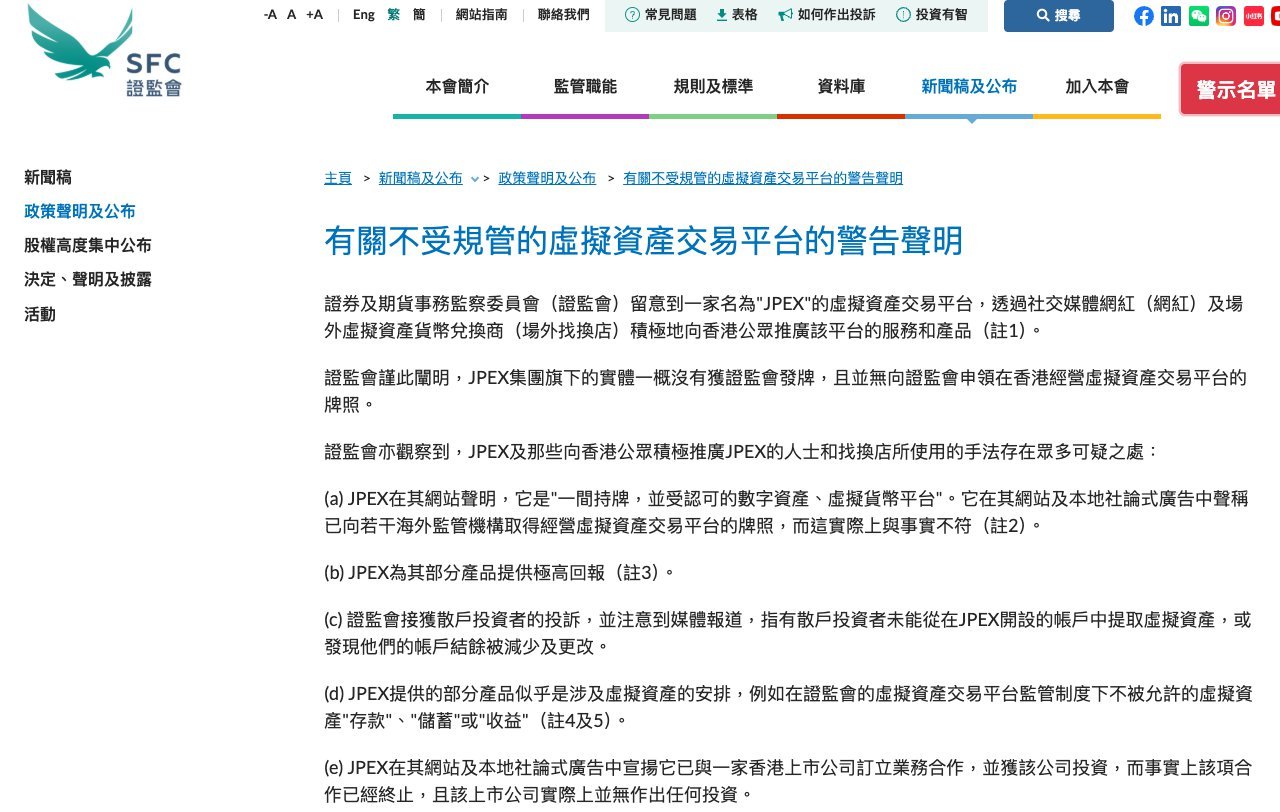
The Hong Kong Securities and Futures Commission issued on September 13, 2023Warning Statement, referring to the fact that JPEX was unlicensed and was actively promoting its services to the Hong Kong public through social media influencers and over-the-counter currency exchange shops. The police subsequently arrested several people, and approximately two years after the arrests,Charges Filed Against 16 People...including influencers such as KOL Lin Zuo and YouTuber Chen Yi; the total number of individuals charged subsequently rose to 26. This is Hong Kong’s first large-scale virtual asset case in which KOLs have been held liable for promotional activities.
Taiwan: Financial Supervisory Commission Plans to Regulate KOLs Promoting Trades; Crypto Influencer Sentenced
In March 2026, Taiwan’s Financial Supervisory Commission announced that it would regulate behaviors by cryptocurrency influencers—such as “recommending trades”—that constitute investment advice through subsidiary regulations authorized by the Financial Consumer Protection Act (seeUnited Daily News Report). On October 6 of the same year, the Taipei District Court sentenced Liu Ting-wei, founder of the Taiwan Blockchain Association, to five years and six months in prison; The court found that he had defrauded six investors out of approximately 66 Ether using tokens he had created himself—which were of virtually no value—in conjunction with investment seminars. The verdict is still subject to appeal (seeETtoday Report)。
If you'd like to follow the latest developments in cases like this, join the discussion in the MB community:
Before Partnering with a Crypto Company, What Are the 7 Questions You Should Ask?
As can be seen from the examples above, most failed collaborations aren’t due to the amount being too small, but rather because the terms weren’t clarified. Before accepting any collaboration in the cryptocurrency space, we recommend confirming the following seven questions one by one:
- Form of Compensation: Is the compensation in cash, stablecoins, or project tokens?
- Token Terms: If tokens are accepted, what is the discount rate, how long is the lock-up period, and when does the unlocking period begin?
- License: Does the other party hold a license in the jurisdiction where your audience is located? Readers in Hong Kong can check the Securities and Futures Commission’s website for a list of licensed virtual asset trading platforms and a warning list.
- Content Restrictions: Does the contract prohibit you from posting negative content, or require you to hold tokens?
- Disclosure Method: How will you disclose the partnership and compensation to your audience?
- Termination Clause: If something goes wrong with the project, does the contract allow you to terminate the partnership?
- Would you use it yourself: Would you actually use this product with your own money?
Another practical approach is to first search for KOLs the project has collaborated with in the past and check whether their promotional posts were deleted after the token’s launch. This is a better indicator of a project’s quality than any price quote.
Frequently Asked Questions
What are the typical fees for collaborating with influencers in the cryptocurrency space?
There are typically seven common models: flat-rate cash payments, monthly fees, KOL token rotations, a hybrid cash-and-token system, referral commissions, creator fees, and platform partnerships. Pricing varies by platform, number of followers, and region; public quotes from three marketing agencies for accounts of the same tier can differ by a factor of two to three.
What's the difference between receiving payment in tokens and receiving cash?
When paid in cash, the compensation is not tied to the token price, making it easier for KOLs to remain neutral; when paid in tokens, however, earnings fluctuate with the token price, and the tokens may be unlocked and sold without the audience’s knowledge. Before accepting payment in tokens, be sure to carefully review any discounts, unlock periods, and disclosure requirements.
What is a KOL wheel?
The KOL round is a phase prior to a token’s listing in which a portion of the tokens is allocated to KOLs at a discounted price in exchange for promotion. The pricing guidelines typically list fundraising targets ranging from 5% to 15%, distributed among 10 to 30 KOLs, with a linear unlocking period of 12 to 24 months.
What should you keep in mind when promoting a crypto platform in Hong Kong?
Promoting virtual asset trading platforms in Hong Kong that are not licensed by the Securities and Futures Commission (SFC) to the public carries legal risks. In the JPEX case, several influencers who promoted the platform were charged approximately two years after their arrest. Before entering into any collaboration, you should first check the SFC’s list of licensed platforms and its warning list.
Do paid promotions have to be labeled as ads?
Regulations vary by region, but disclosure is a basic requirement. In the Kim Kardashian case, the U.S. SEC made it clear that promotions for crypto asset securities must disclose the nature, source, and amount of compensation; a list published by ZachXBT also shows that payment records for most undisclosed paid promotions can ultimately be found on-chain.
Disclaimer
The content of this article is for reference only, investors should exercise independent judgment, invest with caution and at their own risk, this article does not provide or attempt to persuade viewers to trade or invest on the basis of the content of this article is for sharing purposes only, and should not be regarded as investment advice, and does not represent the Monsterblockhk viewpoints and positions, all information and views of the specific date of the judgment of the time-limited nature. In addition, if any content in this website involves virtual asset trading platforms that have not yet obtained a license to operate virtual asset trading platforms in Hong Kong, including but not limited to text introductions, pictures, promotions, events, etc., they are only available to users outside of the Hong Kong Special Administrative Region.
According to the Hong Kong Anti-Money Laundering and Counter-Terrorist Financing (Amendment) Ordinance 2022, after June 1, 2023, all centralized virtual asset trading platforms operating in Hong Kong or actively promoting their services to Hong Kong investors will be licensed and regulated by the SFC, and any related unlicensed activities will be a criminal offence. For more information and details of the legislation, users may refer to the SFC website.
Next, join the MB community to exchange quotes and share experiences regarding crypto collaborations with other creators:
Readers in Taiwan can join MB Telegram Community。