

What is Defi? How is it different from traditional finance?
At present, the banking and investment financial system that we use every day, including all kinds of stocks, bank deposits, insurance savings and even funds, etc., are all centralized Centralized. Centralized means that there areUnified Management Organization,Information is not fully transparentfurthermoreThe mechanism for managing manpower is sometimes not made public.The system.
How DeFi came to be
Back then, Bitcoin was the first decentralized financial application that allowed you to literally own and control the value of money and send it anywhere in the world. Bitcoin also provided a way for a large number of distrustful people to agree to use the same set of books, while eliminating the need for a trusted intermediary to make transactions.
Bitcoin is open to everyone and no one has the right to change its rules. Bitcoin's rules, such as its rarity and openness, are inherent to the technology. In contrast to traditional finance, where governments can print money to devalue your assets and savings, and corporations can shut down markets, Bitcoin is very different from traditional finance.
The Revolution: Developments in DeFi
The concept of DeFi comes from Brendan Forster, co-founder of the lending product Dharma, who published a post on Medium on 2018/08/31, "Announcing De.Fi , A Community for Decentralized Finance Platforms" to Announcing the concept of DeFi, the article mentions that DeFi has to fulfill four requirements:
- The project is building on a decentralized blockchain: building on a decentralized blockchain
- The project is in the finance industry: for the finance industry
- The project's code is open source:程式碼開源
- The project includes a robust developer platform.

How to Evaluate DeFi Program Security
I. Mobility
Whereas "liquidity" in traditional finance might be the same as "liquidity" provided by a quantitative fund or a professional organization, in DeFi, everyone can now provide liquidity to a Defi project such as DEX (Decentralized Exchange)。
II. Uncommon Losses
After we have put two different currencies into the pool in pairs and successfully provided liquidity in that currency, if the two currencies move up or down too much and the pool needs to be liquidated due to the automatic market maker mechanism, the pool will be able to provide liquidity in the two currencies.Based on the latest exchange rate來reconsiderIf you allocate two currencies, then the currency that has risen less or declined in value will incur a loss compared to simply holding the currency.
The no-currency loss is actually caused byValue ChangeThe pooling of liquidity by non-users would technically "not" result in the pooling of liquidity if non-users were to cash out and siphon off liquidity from the pool.resulting inAny actual loss.
iii. total locked-in value
- Floating Token Prices TVL is a measure of the total liquidity of a DeFi program agreement and is calculated as TVL = Token Count x Current Token Price. If the TVL has risen and fallen, but the number of tokens has not increased or decreased, we need to consider whether the price of the tokens has been constantly changing, which affects the accuracy of the TVL value.
- Available Assets in Locked Positions The DeFi program provides a lending service that allows investors to pledge assets and lend out other assets, but at the same time it means that users can utilize the lent funds in other DeFi agreements by pledging them repeatedly between the two program agreements, magnifying the asset multiplier. In this case, asset pledges will also multiply because the initial pledge and the repledged funds will be double-counted in the TVL, resulting in a significant deviation in the TVL's valuation as it grows significantly.
IV. Third-party security audits
Whether a DeFi project's smart contract has passed a third-party security audit can also be an indicator, but it just means that the code has been seen by more people and is not technically flawed.
Of course, most people don't read audit reports so Certik There is a data dashboard that contains all the reviewed items. In this dashboard, you can check the "Trust Score" of an item, where a higher number means it is safe.

Ask questions if you don't understand
The last simple method I want to introduce to you is:Join the project's community to ask questions directly。
- Is there an insurance fund for the project?
- Does the team avoid questions?
- What is the team doing to improve safety?
DeFi Play|How to make money with Defi?
Many people ask how DeFi works, but in fact it's just about investing money and earning extra income by making good use of the smart contract conditions set by different DeFi's, of which the most widely used on-chain operations areLiquidity Mining / Yield farming。
I. Mobility Mining
Liquidity Mining Yield farming The term "liquidity" in Yield farming refers to the liquidity of the funds provided by the users as mentioned earlier.
When a user provides specific currency liquidity for a DeFi program, on the platform, he or she can be rewarded with native token incentives from the platform, and a share of the handling fee as a bonus, an operation calledMobility MiningIt is also the gold mine that everyone wants in a bull market.
Where does this reward come from? If you think about it, these tokens cost the project owner almost nothing, they are just issuing tokens. If you believe in the DeFi program and are willing to invest early, the tokens will be valuable to you. Otherwise, if you just keep selling the reward you got, it will lead to a death spiral of "mining and selling".
Generally speaking, the more participants there are in a liquidity mining trading pair composed of mainstream currencies, the lower the APR will be, which is normal, because there are so many people eating from the same bowl of rice, and everyone will naturally get a smaller share of the rice. Usually, the APR and the reward per block of a trading pair composed of platform currencies are higher, and of course, the risk is also higher.With large mainstream or stablecoinsIt would be relatively safe for the owner to do so.
DeFi Lazybones: How to start investing in Defi from 0 to 1?
First of all, you need a hot wallet: Metamask.
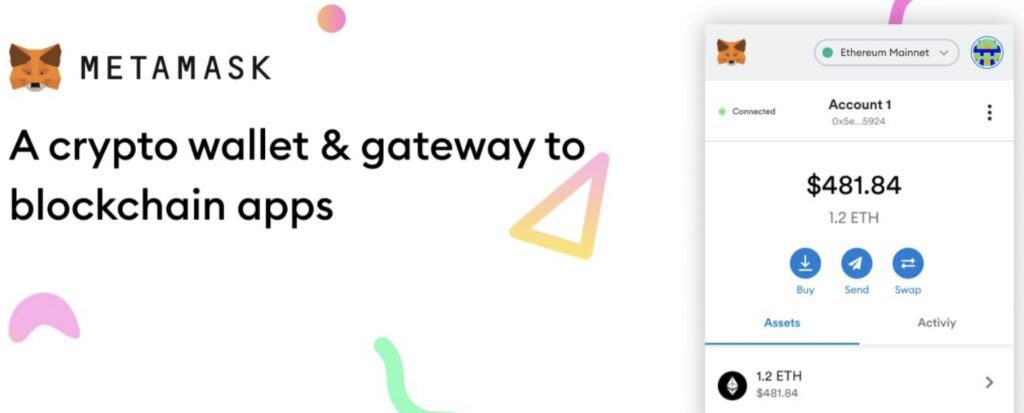
Install MetamaskPlease make sure you download the official version of the wallet from the website, and do not download a pirated version of the wallet, as this will put your assets at risk.
Methods of Saving Handling Fee

In addition to using DeFi on Ether, you can head to other blockchains such as Avalanche, Fantom, and Polygon if you want to save a little bit of money on handling.
At this point. Chainlist You can add other links to your Metamask with a single click from that page.
How to buy coins to Metamask?
After buying each native currency from the exchange, it can be transferred to your Metamask blockchain address, and the asset is complete!
Let's take Ethereum as an example: buy $ETH on the exchange and withdraw it to your Metamask via the Ethereum chain.

I introduced the DeFi Introductory Knowledge Tool in another article earlier.Go here to learn moreTo analyze chain actions, including chain transaction status, transaction fees, large account actions, etc.
We are in a world of abundant resources, and in the blockchain space there are a variety of on-chain analysis tools. As cryptocurrency investors, how can we identify potential coins, 10x coins, or even 100x coins in the primary and secondary markets? As the saying goes, "Bear market is a good time to accumulate learning", we should seize the time and resources to optimize our personal skills now!