

Welcome back to Monsterblockhk's Alpha Report, it's been a boring couple of weeks in the crypto markets. The currency is in a slump, the fear index is stuck in "fear" for a long time and technical analysis shows that it has been testing the support level repeatedly. BTC continues to be in a fragile frame, with unrealized losses from short-term holders increasing, the supply structure nearing a tipping point, and so on, raising the possibility of further downside for the broader market. However, on the other side of the coin, precious metals have been on the upswing, with gold breaking through the 4,500 mark, and silver surging 10% in a single day, breaking through the 80 mark just before press time. Should you chase the highs or not? This Alpha Report will break down the mindset of an investor and why you should start DCAing coins instead of chasing silver or gold at this point in time.

Bitcoin Continues to Stall in Macro Fog as ETF Funding Back-and-Forth Sawmongering Continues
According to the chart of SoSoValue, the Bitcoin Spot ETF has shown a significantly weaker flow direction over the past week, with overall oscillating outflows, with consecutive large net outflows on December 15 and 16, each with a one-day withdrawal of close to $300 million, and a one-day net inflow of about $450 million on December 17, which was the only notable recovery of the whole week, but the momentum quickly faded. From December 18 to 23, the ETFs again recorded consecutive net outflows, with December 23 recording a net outflow of US$189 million. During the same period, the ETF's total assets remained at around US$114.29B, while Bitcoin price fell back to US$87,500 and continued to oscillate within the range. This capital structure reflects a highly uncertain kangaroo market, with ETFs acting more as passive regulators than trend pushers. Macro uncertainty remained high compared to last month, and capital tended to reduce exposure to highly volatile assets, instead allocating to rare metals such as gold and silver, causing the crypto market to continue to lag in relative performance. Even when large one-day inflows have occurred, they have not been continuous, suggesting that institutional capital is still focused on short-term responses. This type of volatility usually means that the market is not yet ready to move in the right direction, and prices are more likely to continue to swing up and down.

Leverage passive deleveraging dominates the market, liquidation becomes a normal rhythm in shock markets
Over the past 24 hours, the crypto market liquidated a total of $224.56M, with the structure of the crypto market clearly dominated by long orders. Long orders were liquidated for approximately $169.74M, while short orders were liquidated for approximately $54.82M, indicating that prices are swinging in a range with a downward bias to clear long positions. Around 85,000 traders were liquidated across the market, with the largest liquidation occurring in Hyperliquid's BTC USD pair at $7.92M, reflecting the continued concentration of highly leveraged positions in mainstream assets. This type of liquidation structure is not a panic stampede, but a typical deleveraging phenomenon in an oscillator market. Both long and short sides have moved in and out of the market over the short-term cycle, allowing the market to continue to release risk through liquidation, but without forming a unilateral trend. This is in line with the current highly uncertain macro environment, where sentiment is still high and tight compared to last month, and the crypto market is under relative pressure as capital preference shifts to rare metals such as gold and silver. As leverage continues to be slashed without new momentum, prices are more likely to remain in an up-and-down pattern.
Most Popular Cryptocurrency Trading Platforms
Hong Kong People's Top Choice for Bitcoin and Ether Trading 》 【2025 Introduction】OSL Registration Benefits, Security, Deposit and Withdrawal, Special Features
Suitable for traditional Hong Kong investors to buy and sell stocks and currencies at the same time. [2025 Introduction] What is Victory Securities? Security, Deposit and Withdrawal, Features
More choices of contract currencies, suitable for buying fake coins in cash. Trade on MEXC and enjoy 500x leverage and many other benefits!
Related Post:
Best Cryptocurrency Trading Platform for Hong Kong Users?2025 Latest Bitcoin Tips for Beginners
2025 Coin Ring Newbie Guide Lazybones|Chained Ecology Entry Guide
2025 Must Read for Newbies! Use these six data indicators to learn how to judge buying opportunities.

Fear is not gone, confidence is not established: Tug-of-war continues amidst sentiment jitters
The CMC Fear and Greed Index has been trading in a low range for the past 2 weeks, with the latest reading at 27, which is in the fear category, compared to last week's reading of 25, suggesting a temporary recovery in sentiment but a lack of sustained momentum. The chart shows that the index recovered briefly in early December as Bitcoin prices rebounded, but quickly fell back again, never reaching the neutral 40 range. During the same period, the Bitcoin price oscillated between USD 86K and USD 94K, with no significant volume expansion, reflecting limited capital participation and a high degree of hesitation in choosing a direction. Sentiment indicators are unable to break out of the fear zone, indicating that investors have not yet regained confidence in risky assets and prefer to maintain a defensive stance. Such a sentiment structure is highly consistent with the current macro uncertainty. The path of interest rate policy remains unclear and economic data divergence has intensified, keeping the market in a kangaroo-like back and forth. Meanwhile, rare metals such as gold and silver have been relatively strong recently, highlighting a reallocation of capital between safe-haven and high volatility assets, while the crypto market as a whole has lagged. A prolonged stay in fear territory would indicate a gradual release of selling pressure. If the fear index does not reach a new low, but continues to move sideways, it often means that a bottom structure is brewing. The author started DCA into BTC.
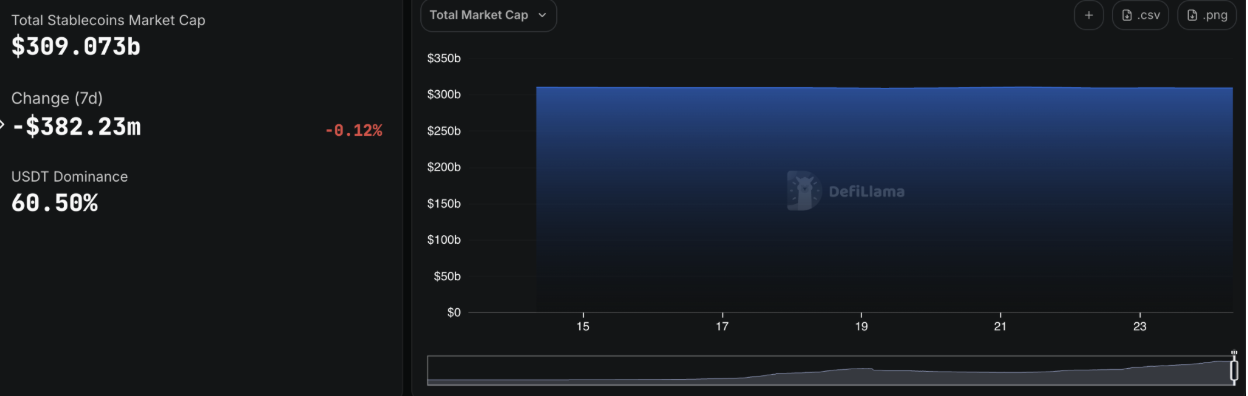
Stabilized Currency Funding Stands Still, Liquidity Defenses Under Pressure in a Shaky Market
Over the past week, the total market capitalization of stable money has remained at the level of about 309B USD, and the chart shows that the 7-day change is -382M USD, with a weekly decrease of only -0.12%, the overall size is almost unchanged. The overall size is almost stagnant. This means that there is no significant withdrawal of capital, but there is also a lack of new incremental inflows, and the stable currency's function as a liquidity floor for the market has entered a low-speed operation. Meanwhile, USDT's market share increased to 60.50%, indicating that capital is more concentrated in a single mainstream stable currency system, reflecting the market's preference for familiar and most liquid instruments in an uncertain environment. This stablecoin sideways movement is highly consistent with the structure of a kangaroo market, where the market is swinging up and down to test its direction, but has yet to make a trend breakout. Macro uncertainty remains as high as it was last month, with interest rates and the economic outlook uncertain, so capital prefers to stay within stable currencies rather than move into crypto risk positions. Rare metals such as gold and silver have strengthened over the same period, attracting the attention of risk averse funds and further compressing the relative performance of the crypto market.

Bitcoin's Defensive Role Unmagnified as Dominant Rates Are Under Pressure at Higher Levels
Over the past week, Bitcoin's leadership rate has been oscillating in a high range, with the chart showing that it has fallen back from around 59% to a level close to the middle of the 58% range, and overall it has been slightly lower but has not yet lost the key area. During the period, several short-term bounces stopped below the previous highs, suggesting that buyers were not willing to chase prices, while the extent of the pullback was relatively controlled and did not form an obvious breakout level. This trend reflects that capital has not withdrawn from the Bitcoin system on a large scale, but there is also a lack of momentum to focus on defense, keeping the dominant rate in a sideways oscillator structure, which is corroborated by the overall market's low volume. The inability of the dominant rate to attack means that the market has not yet chosen to use Bitcoin as a clear safe haven. Against the backdrop of persistently high macro uncertainty, capital has neither shifted to cottage assets to take risks nor returned to Bitcoin for defense, creating a typical kangaroo market rhythm. During the same period, precious metals such as gold and silver strengthened, attracting the attention of some safe-haven funds and putting the crypto market under pressure. From a structural point of view, the high level of volatility is more of a result of energy compression rather than a trend reversal signal. Once the macro signals become clearer, this type of prolonged oscillator structure is often a prelude to capital choosing sides again, until then the market will continue to wear out its patience in the tug-of-war.

Sector Synchronized Stall Digestion Period, Reversal Still Needs Time
Over the past 7 days, sector token prices have been under overall pressure, with the chart showing almost all major sectors in negative return territory, with Layer 1 dropping by around -14% to -16%, and Gaming and Privacy expanding to around -17% to -19% at one point in time, making it a relatively weak sector for the week. In contrast, Memes and DeSci were less volatile, down around -2% to -5%, while CEX Token and AI Agents only dropped slightly to around -6% to -8%, indicating that high liquidity or short-term mindshare sectors have some cushion, but there is no clear signal of capital inflow. The overall trend shows a clear pattern of weakness with a collective bottoming around 12/19, followed by only a technical rebound. This generalized pullback suggests that the market is still in a risk-off and patience-testing phase, and the mindshare has yet to refocus on any single growth narrative. Under USD pricing framework, the lack of new capital has made the rebound more of a mean-reversion than a trend-reversal, and sector rotation is inefficient in the short term. This structure also suggests that it will take longer for chips to change hands, and a clear uptrend could emerge only after selling pressure is fully absorbed and macro and liquidity conditions improve. Until then, weak oscillators and low-slope declines are likely to continue, a typical mid-cycle cooling-off period rather than the start of a new full-scale uptrend.
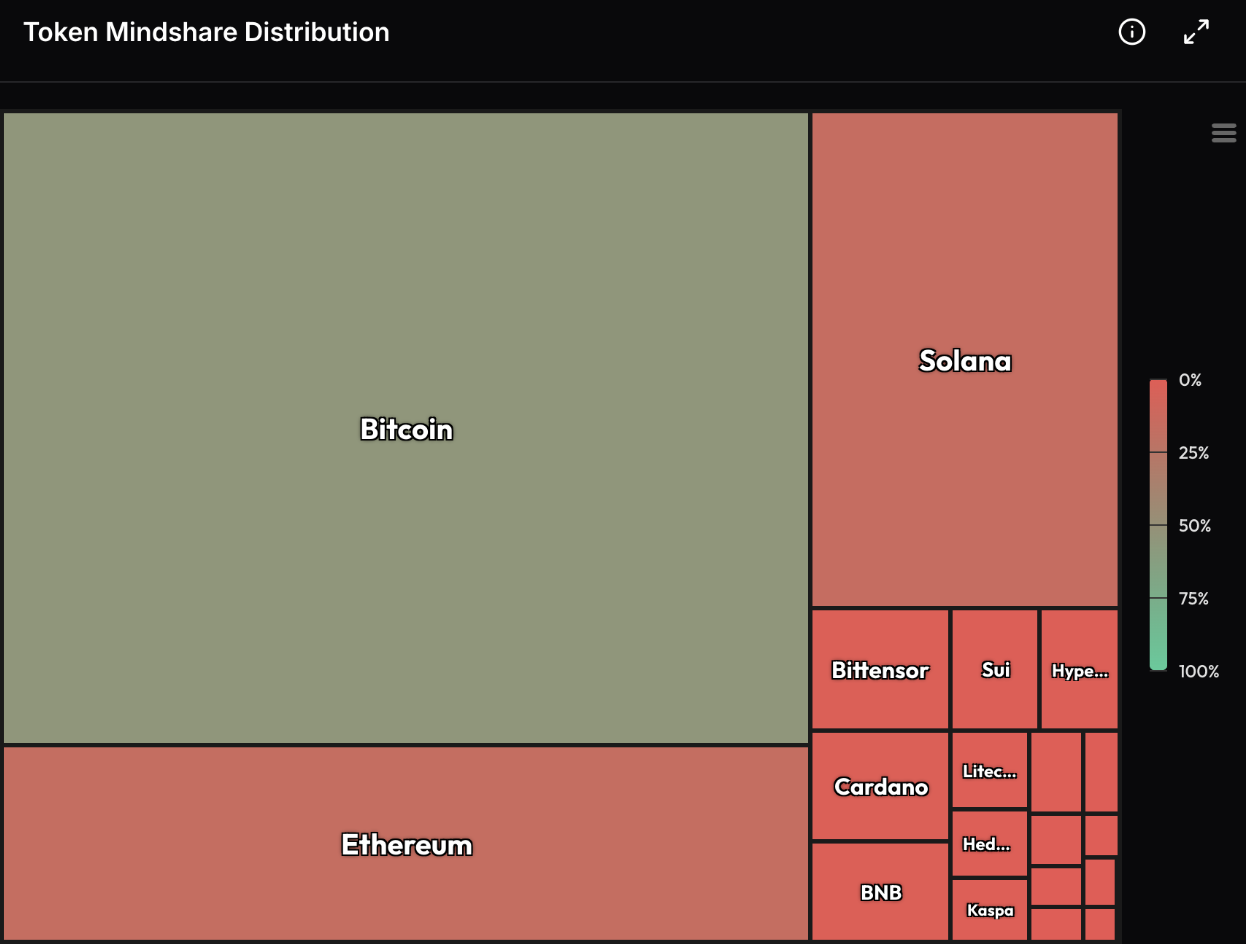
Mindshare flows to big currencies as currency buzz dies down
Over the past 7 days, the mindshare structure has further concentrated on Bitcoin, with BTC mindshare dominance continuing to rise, as the chart shows that its share has risen back to around 50%-75%, while most cottage sectors are still posting negative returns. During the same period, the price of BTC remained relatively stable, with weekly fluctuations significantly smaller than other assets, showing a clear contrast in the direction of capital flows. In contrast, Layer 1, DeFi and high beta sectors continued to lose mindshare and failed to attract new capital. This simultaneous strengthening of dominance and price stability reflects that the market is proactively selecting the least risky and most liquid allocations in a high uncertainty environment.
This structure implies that the market has entered a defensive capital allocation phase, with BTC becoming one of the few core assets with long-term DCA logic. When overall liquidity is low and the narrative cannot be spread effectively, capital naturally flows back to the assets with the strongest consensus and the clearest cost of ownership curve, which is the essence of the dominant uptrend. From a cyclical perspective, BTC's dominant uptick often occurs in the transition period before the cottage is fully restored, with retail investors retreating and long-term capital focusing on the layout.
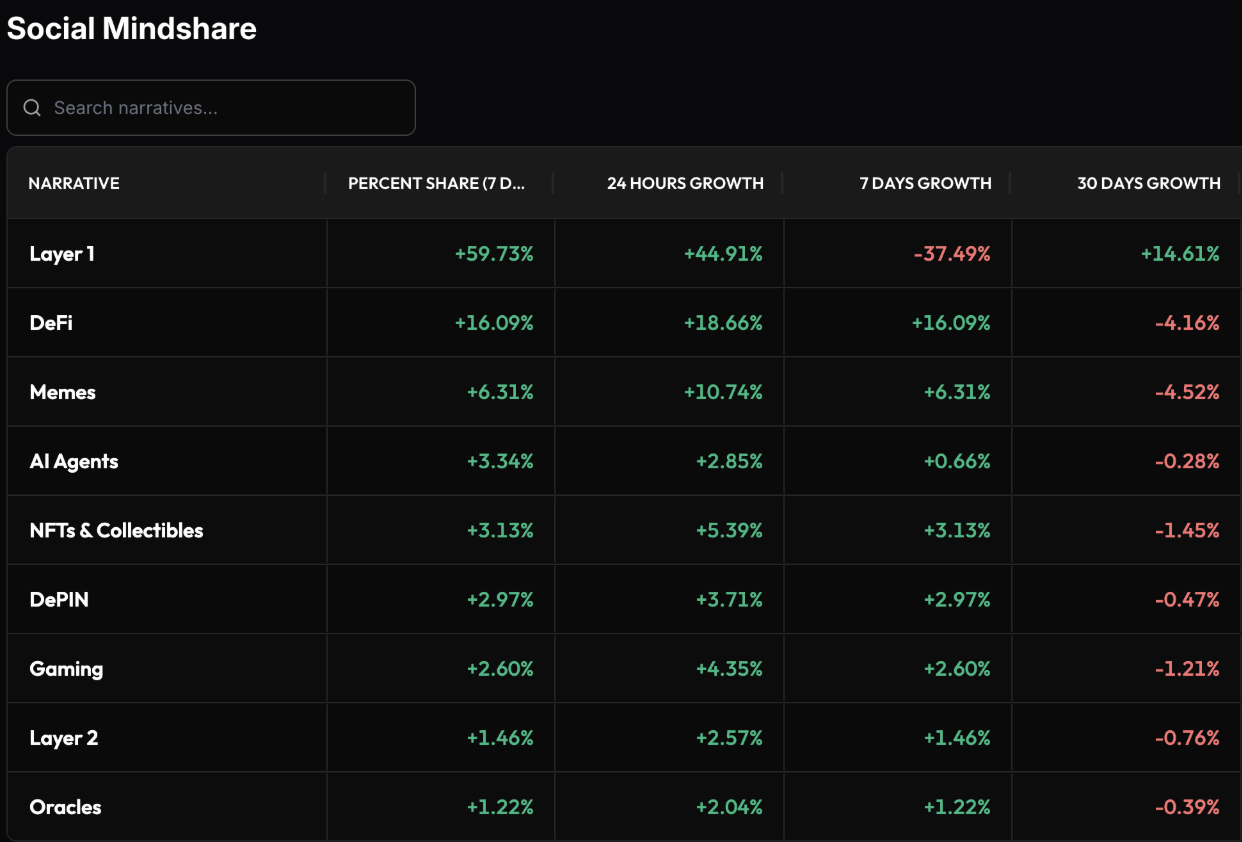
The Haven Effect during Attention Retreat: Layer 1 mindshare Structural Refocusing
The past week has seen a clear concentration of social mindshare on the larger boards, with Layer 1 absolutely dominating with 59.73% of 7D mindshare, which is much higher than any other narrative even though its 7D growth is -37.49%. DeFi is next with 16.09%, and the rest of the boards, such as NFTs, DeFi is next with 16.09%, while the rest of the boards such as NFTs, DePIN and Gaming are in the borderline range. The data shows that although most sectors have bounced back in 24H, such as Layer 1 24H growth of +44.91% and DeFi +18.66%, the cyclical hierarchy is still highly focused on a few large narratives, with the overall structure being more convergent than divergent. This mindshare focus reflects rational choices rather than simple topic rotation in a market with low confidence. In an environment of weak sentiment, trendless prices, and unresolved macro uncertainty, investors are more likely to discuss and focus on high market cap, high liquidity, and long term consensus assets rather than small, medium, or high risk narratives. layer 1, and in particular Bitcoin and Ethereum, are at the center of the discussion, which is essentially the result of the market searching for narrative anchors in a defensive mode.
Chain Data

Sentiment anchors key variable: 101.5K support determines short-term direction
Bitcoin prices have fallen back to levels close to a year ago, but in that time have experienced 2 significant bounces, allowing for a highly dense supply structure of high level buyers to accumulate in the $93K-$120K area. The chart shows clear overhead pressure in this area, which is structurally very similar to early 2022, as the recovery has repeatedly been met with early selling pressure. In particular, the short-term holders' cost benchmark of $101.5K has become a watershed, and as long as prices remain below this level, the market is unlikely to break out of its corrective pattern and remains exposed to further downside risk. With a high concentration of chips at high levels, market sentiment over the next month will be the decisive variable. If risk appetite picks up and pushes prices back above $101.5K, short-term holders will be back in breakeven, supply pressures from above are likely to be gradually absorbed, and the market structure is expected to shift from defensive to restorative. On the other hand, if sentiment continues to be weak and prices are repeatedly held below this cost basis, the demand for unwinding of high level buyers will continue to amplify the selling pressure, bringing the market closer to the slow downward correction pattern seen in early 2022. Therefore, sentiment itself has become a key asset and its direction will directly determine whether Bitcoin completes its structural rebalancing or embarks on a new downtrend.

Loss Timing Spreads: Pressure Buildup Pushes Up Selling Risks
Currently there is approximately 23.7% of circulating supply in the Bitcoin market at a loss, of which 13.5% is held by short-term holders and 10.2% has been transferred to long-term holders, suggesting that the loss-making chips are gradually settling over time. The structure of the chart reflects a process similar to that of previous cycles as they move from correction to deeper adjustment, whereby the floating loss supply of recent buys is no longer quickly liquidated, but is forced to extend its holding period in the face of stagnant prices.
If prices remain under pressure and below key cost benchmarks, the time cost of supplying losses will rise further, and some holders with weaker convictions will inevitably choose to take a long, tortured position, resulting in an incremental release of selling pressure. However, this process also creates opportunities to allocate to assets where consensus is mature and the market has proven itself over time. For long term investors, a tranche of fixed investments during a period of market sentiment pressure and aging loss supply often offers a more attractive cost structure and return potential.
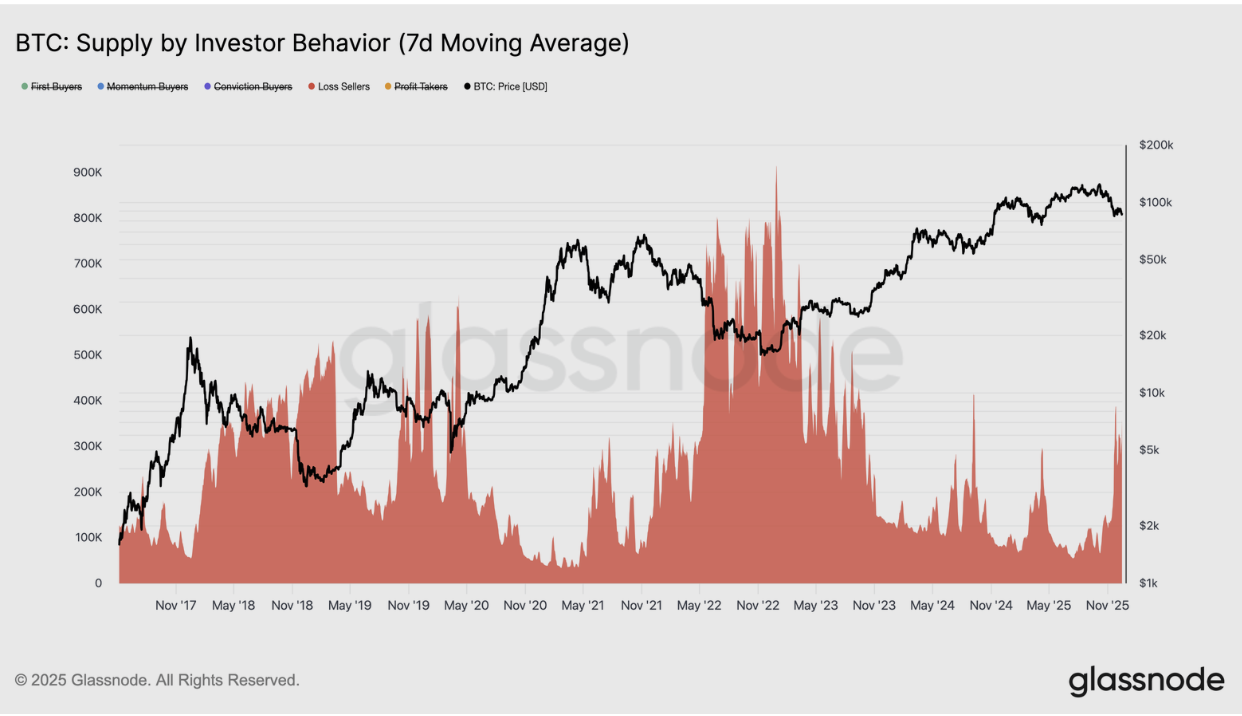
Loss Sell-Off Critical Expansion: 360,000 Pieces a Warning Signal of Sentiment Failure
As time pressure continues to build, the market is seeing a shift in loss-making supply from short-term holders to actual selling behavior. According to the Investor Behavior Distribution Indicator, the supply of those categorized as loss-making sellers has risen to approximately 360K BTC, suggesting that some holders are choosing to exit at a loss after prolonged periods of pressure. The chart shows that the expansion of this group usually occurs during a period of significantly weakened market confidence and is highly consistent with the turning point of a correction into a bear market. The emergence of loss-making sellers reflects the exhaustion of capital patience while prices remain below the primary cost anchor zone. If Bitcoin falls further below the true market average of $81.3K, loss-making seller supply is likely to continue to expand, creating a chain release of selling pressure and accelerating a shift in sentiment from defensiveness to panic, which constitutes a key signal that bear market conditions have been formally triggered. In such a scenario, overexposure would significantly magnify the risk of asset retracement, making capital management more important than directional judgment. However, this does not mean that the market loses its long-term value, but rather provides a long period of cost rebalancing for assets with a consensus base and network effect.
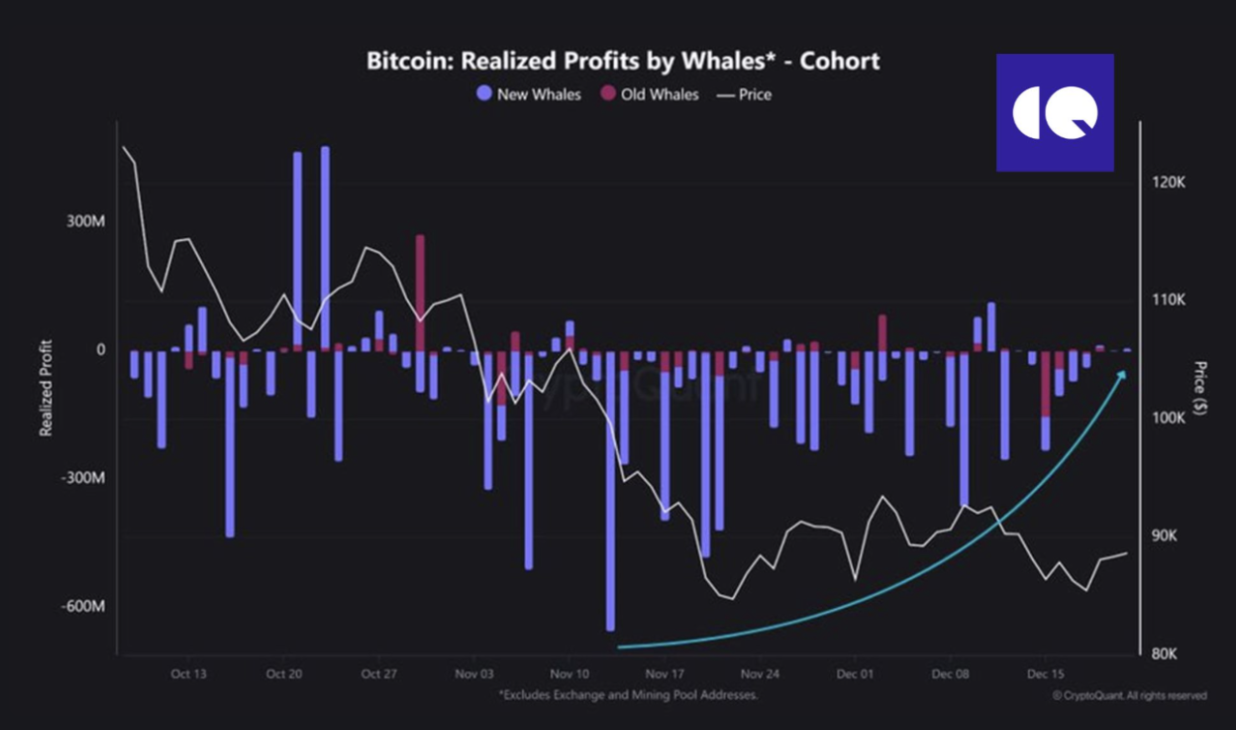
Dulling Downside Momentum: Structural Observation Period after Extreme Overselling
Bitcoin is currently in a bearish but converging consolidation pattern, with downside momentum having slowed significantly. The chart shows that the price retreat from ~$124K to $84K was largely driven by large realized losses borne by large new holders, the peak of which was first seen and has flattened out recently. Structurally, the market has touched extreme oversold territory, which has only been seen six times in history, suggesting that one-way selling momentum is no longer amplified. This pattern is more akin to a pause in loss liquidation than the start of a new liquidation cycle, suggesting that selling pressure is gradually cooling. The current price behavior suggests that the market is shifting from an accelerated decline to a watchful eye to see who will be the active buyers in the next phase, and the chances of a green rebound in the near term are accumulating. If buyers can gradually take over at lower levels, a technical recovery and sentiment stabilization will be the natural outcome. However, before the overall structure turns more positive, the rebound is more likely to be a rhythmic correction rather than a trend reversal. In this environment, appropriately locking in a portion of profits during the rebound phase can help reduce volatility risk and retain flexibility in subsequent operations. Meanwhile, the market's consolidation period also reminds investors to focus on capital allocation and disciplined management, so as to reserve sufficient room for the next confirmation of direction.
Related Post:
Best Cryptocurrency Trading Platform for Hong Kong Users?2025 Latest Bitcoin Tips for Beginners
2025 Coin Ring Newbie Guide Lazybones|Chained Ecology Entry Guide
2025 Must Read for Newbies! Use these six data indicators to learn how to judge buying opportunities.
Selected tokens:

Decentralized Finance Foundations Established: Blue Chip DeFi Returns Value Amidst Panic
Aave is currently the largest and most mature lending agreement in the decentralized finance sector, and has long been ranked No. 1 in the DeFi TVL rankings. Its core business is decentralized lending and interest rate market aggregation of crypto assets, and it has established a stable financial intermediation mechanism through overcollateralization, real-time clearing, and dynamic interest rate modeling. According to charts and market data, AAVE price has continued to fall from its previous high of around 300 USD, and recently hovered around 150 USD, with the maximum retracement close to -50%. At the sector level, DeFi has generally declined by around -12% to -15% over the past 7 days, reflecting that the market is at a low point in terms of risk appetite. From a business model perspective, Aave has transformed from an early DeFi experience into a sustainable on-chain financial infrastructure with clear revenue streams from lending spreads, flash loan fees and stable cash flows after adjusting for agreement parameters, and internalizing risk through the AAVE pledge and security module to form a complete risk control closed loop. The current price is clearly below its historical valuation pivot, corresponding to an emotional discount rather than a structural decline. Even though there is still room for downside in the short term, the gradual deployment around 100 USD is a rational DCA strategy of trading time for space.

Bitcoin Supply Cap Irreversible: The Final Value Anchor in a Turbulent Cycle
Bitcoin is a digital currency system based on fixed supply and decentralized consensus. Its business nature is not to innovate at the application level, but to provide a non-dilutable benchmark for storing value. As seen in the chart, the current price of Bitcoin is around 86,943 USD, which corresponds to a total market capitalization of around 1.73T USD, with a supply of around 19.96M pieces in circulation, leaving very little room to reach the ultimate limit of 21M pieces. Bitcoin's core advantage lies in the absolute certainty of its supply curve. The 21M-unit limit precludes the possibility of any governance, artificial adjustments or runaway inflation, giving it sovereign-like asset properties in an environment of macro instability and opaque policies. Compared to most tokens, which rely on narrative continuity and capital inflows to maintain valuation, the demand for Bitcoin is more oriented towards long-term storage and asset allocation rather than short-term speculation. As the market enters a phase of high volatility and low visibility, DCA strategies naturally focus on the lowest-risk assets with the purest logic.
Conclusion
To summarize, the state of the cryptocurrency market has really fallen into a slump in the past two weeks, and it seems like we have really entered a bear market. The chain of losses of short-term holders suggests that the price may drop even lower. However, just think about the thoughts you had when the virtual currency went up in price: I wish I had bought at $xXX. These downturns are what we as retail investors need to catch. However, this "bear market" period should continue for a few more months, so there is no need to get a lot of positions at once, there is still time. Secondly, the author believes that the recent strength in precious metals and U.S. stocks cannot be sustained for too long, as liquidity will eventually flow into the currency market. Therefore, while people are in a state of FOMO, chasing highs in rare metals and US stocks, it would be better to go for an asset that is undervalued at this moment due to the impact of low sentiment, a more stable leader in virtual currencies (such as BTC).
If you have learned something from this update, or learned more about the market, please follow us on Monsterblockhk. Twitter ,並Join our Telegram GroupsWe will be able to share and discuss the next wave of opportunities!
Most Popular Cryptocurrency Trading Platforms
Hong Kong People's Top Choice for Bitcoin and Ether Trading 》 【2025 Introduction】OSL Registration Benefits, Security, Deposit and Withdrawal, Special Features
Suitable for traditional Hong Kong investors to buy and sell stocks and currencies at the same time. [2025 Introduction] What is Victory Securities? Security, Deposit and Withdrawal, Features
More choices of contract currencies, suitable for buying fake coins in cash. Trade on MEXC and enjoy 500x leverage and many other benefits!
Related Post:
Best Cryptocurrency Trading Platform for Hong Kong Users?2025 Latest Bitcoin Tips for Beginners
2025 Coin Ring Newbie Guide Lazybones|Chained Ecology Entry Guide
2025 Must Read for Newbies! Use these six data indicators to learn how to judge buying opportunities.

Disclaimer
The content of this article is for reference only, investors should exercise independent judgment, invest prudently and at their own risk, this article does not provide or attempt to persuade the audience to do trading or investment basis, the content is for sharing purposes only, and should not be regarded as investment advice.It does not represent the views and position of Monsterblockhk.All information and opinions are current as of the date of the judgment. In addition, if a judgment is rendered on aIn this siteAny content related to virtual asset trading platforms that have not yet obtained a license to operate virtual asset trading platforms in Hong Kong, including but not limited to text introductions, pictures, offers, events, etc., are only available to users outside the Hong Kong Special Administrative Region.
According to the Hong Kong Anti-Money Laundering and Counter-Terrorist Financing (Amendment) Ordinance 2022, after June 1, 2023, all centralized virtual asset trading platforms operating in Hong Kong or actively promoting their services to Hong Kong investors will be licensed and regulated by the SFC, and any related unlicensed activities will be a criminal offence. For more information and details of the legislation, users may refer to the SFC website.