
Recently, thanks to the efforts of developers, the Bitcoin-based NFT protocol Ordinals has been successfully created, and in just a few days it has already become a craze. Currently, the total number of Ordinals minted has exceeded 194,000, and the floor price has also exceeded 4 BTC.
So, what is Bitcoin NFT Ordinals? Why has it become a hot spot? How can people buy it?
Bitcoin. What's NFT?
When it comes to Bitcoin NFTs, it's important to explain what Ordinals are; the Ordinals protocol adds NFTs to Bitcoin transactions so that NFTs can be used on the Bitcoin blockchain, but they are not technically tokens.
NFTs on Bitcoin are actually metadata added to the details of UTXO transactions; more simply put, they are immutable, and no one can actually own them.
Launched in January 2023, the Ordinals protocol allows various forms of data, such as images, to be encoded directly onto sat, the smallest bitcoin unit on the Bitcoin blockchain worth 0.00000001 BTC.Ordinals agreements will be numbered in the order in which the SATs were mined.The upside is that when a Bitcoin halving event occurs, it will be more valuable because of the sequential significance assigned to it.
Now that many different types of data, such as JPEG images, digital art, and PFP projects, have been encoded onto the Bitcoin blockchain using the Ordinals protocol.This behavior is known as Inscription.
Unlike other NFT projects on public chains, such as Ether and Solana.Every item created using Ordinals on the Bitcoin network is considered a permanent "digital artifact" and is stored forever on the Bitcoin blockchain. While smart contract creators of projects developed on other public chains can modify and delete metadata, Ordinals stores the entire image or content directly on the blockchain, not just pointing to an external link server.
Bitcoin Network Taproot Upgrade
Bitcoin is in the system after Segwit in 2017 and Taproot in 2021. Two major upgradesThe cost of storing data in the Bitcoin system has been dramatically reduced since then, giving room for protocols like Ordinals to flourish. Now anyone who is willing to pay can store as much data as they want, but the total size of the block must be kept below 4MB.Since these protocols store metadata on transaction details, they will work very differently from Ether, which uses NFTs as tokens.
Ordinals and NFT's Impact on the Bitcoin Blockchain
Transaction Fee
The first immediate question isScalability issuesThe Bitcoin network now has limited throughput. The current Bitcoin network has limited transaction throughput and requires higher fees when demand is high. The future integration of NFTs could exacerbate these problems, making it even more difficult and expensive to conduct transactions on the network. In fact, according to Dune Analytics, more than 50% of block space is now occupied by Ordinals. We have also seen a significant increase in utilization of the protocol that supports Ordinals - Taproot:
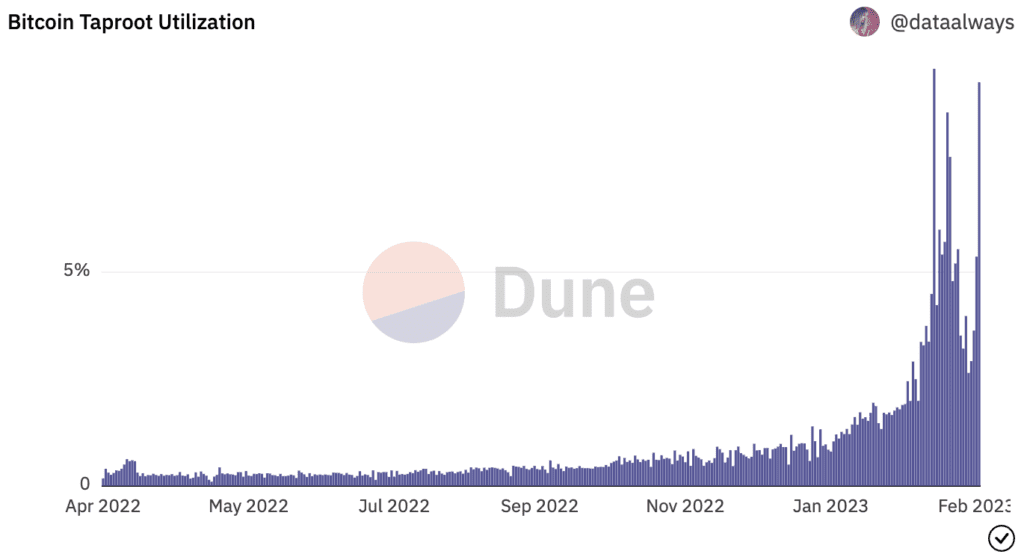
An increase in Taproot utilization means an increase in block size, which ultimately leads to an increase in transaction costs, which can lead to network congestion, and of course provides a good example for Layer 2 and a specialized use case for Ordinals.
Storage Requirements
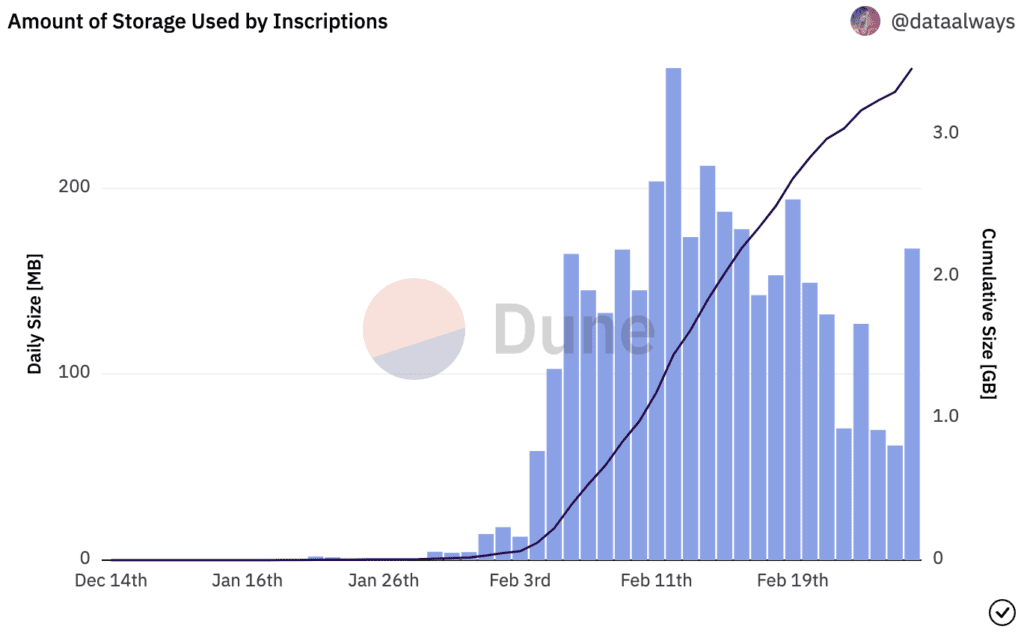
By storing NFT data directly on the Bitcoin blockchain, the blockchain would store more data than it currently does, which would directly lead to increased storage costs and could make it more difficult for nodes to participate in the network.
The data also shows that block sizes have more than tripled since Ordinals was introduced, with each block jumping from about 0.7mb to more than 2.2mb.
Bitcoin holders divided
Some opponents argue that the emergence of BTC NFT violates the original intent of being a decentralized peer-to-peer currency, thoughIntroducing NFT to the Bitcoin blockchain could help diversify the Bitcoin ecosystem, opening up a new use case of sorts. But opponents argue that Bitcoin was always meant to be a trustless, decentralized, peer-to-peer, and fairer currency.
Bitcoin NFT is full of controversy, and I believe that the new narrative of BTC NFT is still in its early stages, and its future development remains to be seen. While BTC NFT has potential benefits, it also has significant challenges and limitations. Like any new technology, it will take time to develop, but it is hoped that in the future there will be side-chain solutions that can reduce the load on the blocks of the Bitcoin network.
How to buy BTC NFT and what are the items of interest?
It is important to note that unlike Ether, where there is a mature secondary trading market for NFTs, the main Bitcoin website does not have a trading market or a casting page, so everything is OTC, and most of the current offering models are "pay the creator > the creator uploads the NFTs > distribute the NFTs to the buyers manually.
Users can go to the project's official website to "Mint" NFTs by simply transferring money to the address provided on the website, but it is still important to note that there are trust issues with BTC NFTs at this stage, and as stated above, creators will need toManually distribute NFT's to purchasers.
1. Ordinal Punks
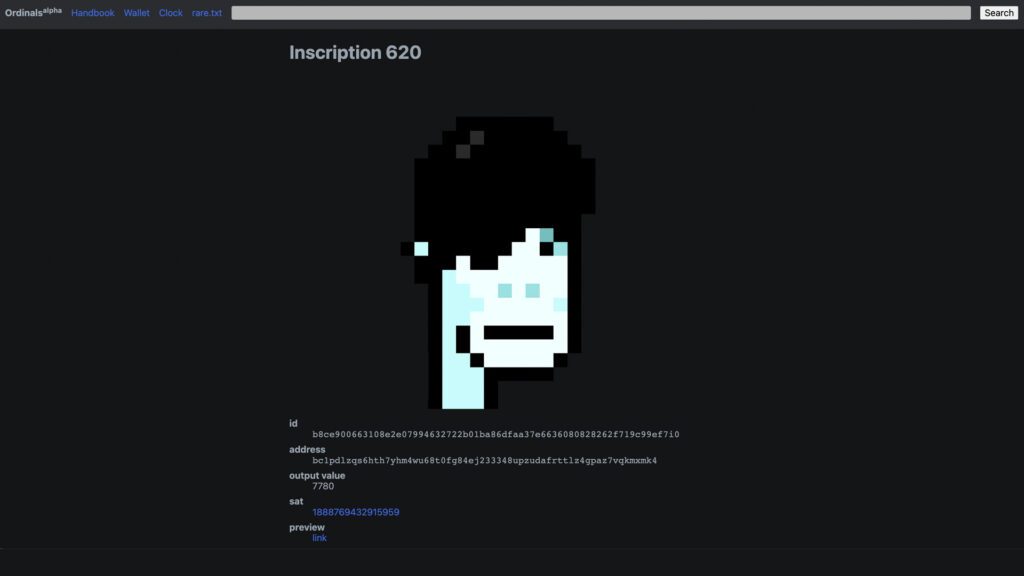
Launching on the Bitcoin blockchain in late January 2023, Ordinals Punks consist of 100 pixelated avatars that have been "minted" on the Bitcoin blockchain via the Ordinals protocol and are ready to be traded. However, unlike some Punks clones seen in the past, Ordinals Punks are not a direct copy of the original CryptoPunks line.
The cryptocurrency community believes that Ordinal Punks is based on a derivative ethereum collection called Mutant Punks, which is sort of a derivative of a derivative of a derivative, but sources connected to the project have revealed that the open-source algorithm used by Ordinal Punks is in fact similar to that of the "CCo Punk Wizard", and that it is also based on that algorithm for generating new Punks.
Recently, an Ordinal Punk was sold for 9.5 BTC, bringing the price to $215,000, which is twice the price of the CryptoPunk floor (CryptoPunks currently have a floor price of 64 ETH, or about $106,000). On the same day, dingaling, an anonymous NFT investor, claimed to have purchased 7 Ordinals Punks for 15.2 BTC, a price of about $349,000 USD.
2. Bitcoin Punks
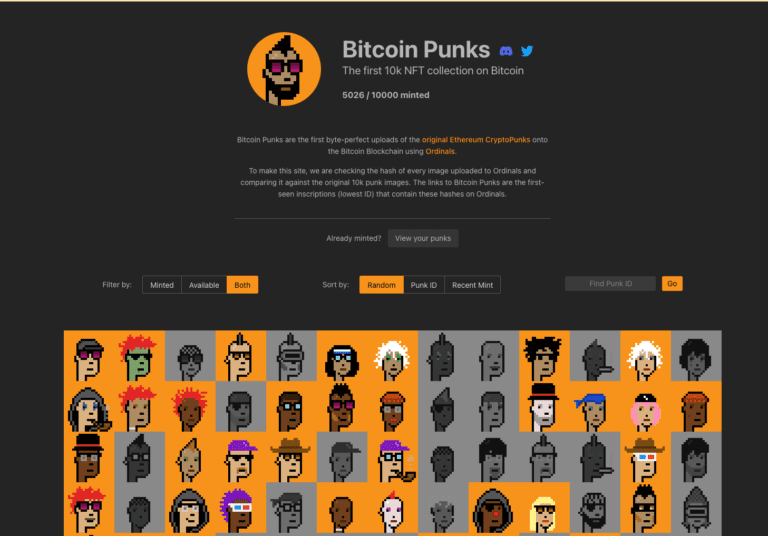
On February 9th, Bitcoin Punks, an NFT project based on the Ordinals protocol of the Bitcoin Mainnet, were minted in 10,000 pieces. According to the official introduction, Bitcoin Punks is the first project to successfully upload original Ether CryptoPunks to the Bitcoin blockchain using Ordinals, and all assets have been minted by collectors for free.
According to its development team, they've been checking the hashes of each image uploaded to Ordinals and comparing them to the original 10,000 Crypto Punk images, and the link to the Bitcoin Punks must be the first appearance of the inscription, which must also contain the corresponding hash value from the Ordinals agreement.
The cost of minting Bitcoin Punks is said to be around $25, but there are currently no OTC trades, and sources say that the secondary market price of the NFT will reach over 1 Bitcoin after the minting transaction is completed, which is a hundred times the cost. However, it remains unclear how much demand there is for the Bitcoin Punks series, or whether minting will be expanded in the future, and moderators on the project's official Discord server have warned holders to "trade with caution" until the code audit is complete.
3. OnChainMonkey
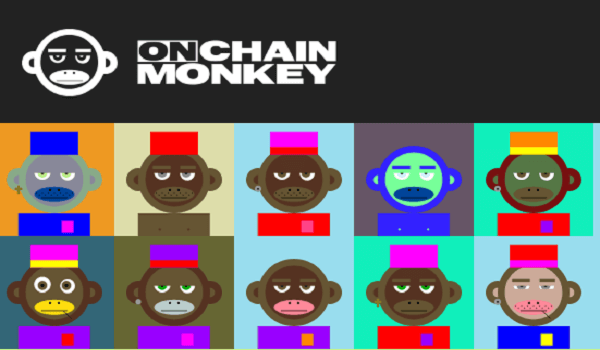
OnChainMonkey has also joined the Ordinals protocol and started "minting" on the Bitcoin blockchain, and now all of its 10,000 NFT collections have been uplinked, pushing the amount of NFTs minted in the Ordinals protocol on February 9th to more than 20,000 pieces.
OnChainMonkey, the NFT series from NFT startup Metagood, which aims to give community members the opportunity to promote and fund social good projects through their DAOs, closed a $5 million Pre Seed round last December with participation from Animoca Brands, Mark Yusko, founder and CEO of Morgan Creek Capital, and Freddie Andrewes, investment manager at Virgin Group. Animoca Brands, Mark Yusko, Founder and CEO of Morgan Creek Capital, and Freddie Andrewes, Investment Manager at Virgin Group, participated in the round.
What's next for Oridinals?
The increase in transaction fees is indeed an effect of NFT's addition to the main Bitcoin network. Bitcoin transaction fees depend on the amount of data in a transaction and the speed at which users wish to complete the transaction, and once network traffic has increased, users who wish to prioritize their transactions will need to pay more to have their transactions confirmed earlier.
However, the real change that Ordinals brings to the Bitcoin network may not just be the creation of new digital collectibles, but to prove that developers can make history on the oldest blockchain of all, and while the "Bitcoin maximalists" have stuck to the original intent of Satoshi Nakamoto to make it a peer-to-peer electronic currency, the Ordinals agreement undoubtedly allows the Bitcoin network to bring about The Ordinals protocol will undoubtedly allow the Bitcoin network to bring about innovative applications.
Overall, the Ordinals protocol is a positive development for the Bitcoin network. Whether or not Bitcoin will ever be a peer-to-peer electronic currency is up to the community and users, and it's unrealistic to limit the number of instances in which Bitcoin can be used. In fact, people have been exploring and experimenting with Bitcoin since its inception, otherwise there wouldn't be second-tier solutions like the Lightning Network - after all, nothing is impossible in a decentralized world. Finally, will the added effect of using Bitcoin to trade NFTs further increase the price of Bitcoin, benefiting both miners and long-term holders? We'll have to wait and see.