

Welcome back to Monsterblockhk's Currency News. This week was a dramatic week for the market: firstly, the market continued to rise at the beginning of the week, with Bitcoin stabilizing at 120,000, Ether exceeding 4,300, and BNB hitting a new high of 1,300. However, it didn't last long, and the market took a sharp turn for the worse in just a few days. Sentiment fell from "greed" to "fear" in the middle of the week, leading to the largest liquidation of $19.25 billion in history, affecting more than 1.65 million traders.
As early as last week, we warned that although the market had entered a risk-on season, high leverage and overheated sentiment meant that a potential pullback could come at any time. Today's selloff confirms that warning. The market has entered a cooling-off period after the euphoria, and the real winners will always be those who can remain calm and disciplined in the face of risk.
This weekly report will provide a quick rundown of crypto news, chained data and macroeconomic trends to help you stay clear of short-term fluctuations and avoid being washed out of the market as sentiment swings.

Fear and Opportunity in the Correction of the Rally's Breathing Period
According to SoSoValue, as of October 8, the Bitcoin spot ETF recorded a one-day net inflow of US$441 million, bringing the total asset size to US$168 billion, and the price of Bitcoin was quoted at US$123,450. Looking back at the past week, capital inflows remained positive for several consecutive days, with a peak of nearly US$1.2 billion on October 6, which was the strongest day in recent memory; however, the scale of inflows slowed down significantly from October 8 onwards. This change in rhythm reflects that some short-term funds chose to take profits at high levels, while long-term institutions maintained stable allocations. The slowdown in ETF liquidity echoes a short-term pullback in the market after a series of rallies. This is not a sign of trend reversal, but more like a pause in the uptrend. Sentiment is currently oscillating between greed and fear, and it is natural for some capital to exit the market. Investors should be wary of short-term fluctuations and should not leave the market in fear. Historically, every major rally is often preceded by a similar period of capital cooling and price consolidation. From a medium-term perspective, this "respite" period is paving the way for a stronger push upwards, and the real highs are yet to come.

Two Billion Dollar Day: Doomsday Purge or Mad Cow Precursor?
According to the latest data, a total of 1.65 million traders have been liquidated in the past 24 hours, with a total size of $19.25 billion, a record. 5.35 billion in BTC positions were liquidated, followed by $4.4 billion in ETH, $2 billion in SOL, $705 million in XRP and $468 million in DOGE. The largest single liquidation occurred on the Hyperliquid exchange, with a $203 million ETH-USDT position. From the distribution of the data, this round of liquidation was concentrated in multiple orders, reflecting the fact that the funds leveraged by FOMO in the previous period were collectively "washed out" of the market when the price plummeted. This is the largest amount of liquidation in the history of the cryptocurrency world (the previous largest one-day liquidation was $200 million).
A liquidation wave of this magnitude actually highlights that the market has entered the end of the high volatility period. Sentiment has been pushed to extremes by several days of generalized gains, but there has been no structural deterioration in fundamentals or chain data, and net inflows into ETFs have held up. This implies that the sharp turn in the red was more a result of macro sentiment and over-leveraging than the end of the bull market. History has shown us that extreme outbursts are often the final cleansing phase of an uptrend. When fear spreads and traders are forced out of the market, the market is quietly brewing for the craziest push up. In other words, this "$2 billion burst" may not be the end, but the prelude to the climax.
Most Popular Cryptocurrency Trading Platforms
Hong Kong People's Top Choice for Bitcoin and Ether Trading 》 【2025 Introduction】OSL Registration Benefits, Security, Deposit and Withdrawal, Special Features
Suitable for traditional Hong Kong investors to buy and sell stocks and currencies at the same time. [2025 Introduction] What is Victory Securities? Security, Deposit and Withdrawal, Features
More choices of contract currencies, suitable for buying fake coins in cash. Trade on MEXC and enjoy 500x leverage and many other benefits!
Related Post:
Best Cryptocurrency Trading Platform for Hong Kong Users?2025 Latest Bitcoin Tips for Beginners
2025 Coin Ring Newbie Guide Lazybones|Chained Ecology Entry Guide
2025 Must Read for Newbies! Use these six data indicators to learn how to judge buying opportunities.

Fearful shadow of mood drop again, a cool-down period before the end-of-bull rotation
According to CMC data, the Crypto Fear and Greed Index has fallen back to 35 (Fear) as of mid-October, significantly lower than yesterday's 54 and last week's 59, and back to a colder position compared to 47 last month. The chart shows that the index touched 'greed' territory in late September and early October, with sentiment boosted by Bitcoin's breakout above $120,000. However, after a few short days of generalized gains, sentiment took a sharp turn for the worse, with fears quickly replenishing as volumes contracted. This dramatic shift in sentiment is highly consistent with the historic liquidation wave of $19.25 billion in the past 24 hours, reflecting the rapid liquidation of overleveraged funds. The sharp fall in sentiment from "greed" to "fear" is typical of the high volatility at the end of a bull market: short-term FOMO triggers leverage, followed by a crash that sweeps the fickle capital out of the market. This does not mean the end of the bull market, but suggests that the final wave is still brewing. While fear spread and retail investors retreated, fundamentals and ETF inflows did not deteriorate, highlighting that the market is only a short-term suppression of the macro atmosphere. History has shown that the largest liquidations and extreme fears are often the prelude to a wild rally. The real challenge is not to be swayed by sentiment shocks, as the next most frenzied wave of the market is often approaching in the midst of fear.

Liquidity structure reshaped, the market enters a period of silence before the exchange of hands between the long and short side.
According to Artemis data, as of early October, Arbitrum has seen more than $8 billion in inflows and outflows over the past month, and ultimately remains a positive net inflow, placing it firmly at the heart of Layer 2 funding, with Hyperliquid following suit with a similarly sized round-trip, suggesting that there are frequent short-term adjustments between the two ecosystems. BNB Chain, Starknet and OP Mainnet recorded medium-sized positive net inflows, showing a clear preference for chains with a stable application base. In contrast, Ethereum and Base both saw net outflows of around US$500 million, with capital withdrawing from both the main chains and high beta regions, making them a major source of bleeding this month. This structure reflects a short-term "liquidity redistribution" phase. Although the mainstream chains are still attracting long term capital, the overall net flows are shrinking, suggesting that capital is shifting from high volatility targets to defensive allocations. The combination of this week's green to red rhythm suggests that investor sentiment is once again conservative after a brief rebound, casting doubt on the continuity of the cottage season. However, such silence is not an exit signal, but more like a momentum building phase before a big market. For rational investors, the focus at this stage should be on restructuring positions and batching DCA positions to capitalize on pullbacks and reduce cost averaging. The current calm is the most valuable window of time before the next round of liquidity spread and sentiment explosion.

Locked-up positions are under pressure again as the market enters the final period of liquidation.
According to DefiLlama, as of early October, DeFi's Total Locked Position (TVL) was reported at $166.325B, a slight drop of 2.7% from the high point at the beginning of the month, indicating that the overall capitalization still remains in the mid-to-high range. The market capitalization of stablecoins reached $303.714B, which continues to provide sufficient liquidity support. The 24-hour trading volume of DEX and Perps was $24.234B and $38.31B respectively, indicating that although short-term trading has cooled down, the chain is still active. As seen from the chart, TVL showed a slow decline from early to mid-October, followed by a decline in volatility, reflecting a gradual shift in market capitalization to a wait-and-see approach. This structure suggests that the market has entered a "high level oscillator" phase, where capital has not been withdrawn but the momentum has become weak. The short-term pullback is more like a healthy washout, leaving room for the next phase of liquidity expansion. Echoing the recent warming of the fear index and the green-to-red market rhythm, some investors chose to take profits and reduce their positions to avoid risk, resulting in short-term pressure on TVL. However, the main capital is still locked in the chain, meaning the market has not entered a structural weakening phase. For rational operators, this period of consolidation is a good opportunity to reorganize chips and rebalance costs. If you have already pocketed the gains in the previous period, you can re-locate your position through batch DCA at this stage, waiting for the eventual release of sentiment and the launch of the main uptrend wave, instead of being forced to leave the market when the fear spreads.
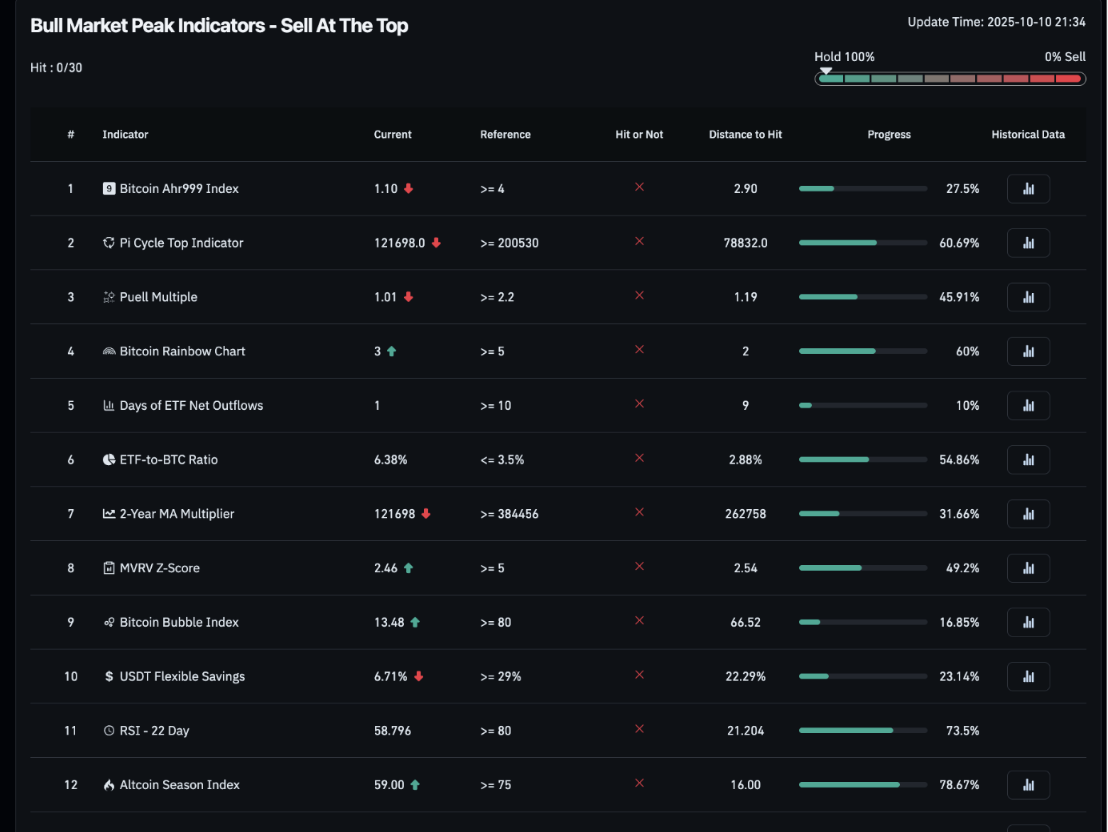
Wave Intensification Before the Top: The Undercurrent Before the Final Rush
According to the latest Bull Market Peak Indicators data on October 10th, the 30 top indicators still have zero triggers, and the system maintains a 100% "hold" signal. Among them, the Altcoin Season Index was 59, just 16 points short of the threshold of 75, with a progress of 78.67%, indicating that capital continues to favor high-risk assets; the RSI (22nd) also rose to 58.8, close to the threshold of 80, with a progress of 73.5%, suggesting that market sentiment is gradually warming up. On the other hand, the Bitcoin Ahr999 Index is only 1.10, still more than 2.9 from the high of 4, with a progress of only 27.5%, echoing core valuation indicators such as the Puell Multiple (45.91%) and the MVRV Z-Score (49.2%), which suggests that the market, although warming, has not yet entered the overheated zone. Such a structure shows that capital is still skewed towards risky assets, implying that the market is still in a typical "risk-on" phase, where high risk corresponds to high reward, but short-term gains need to be pocketed with caution. As the key top signal has not yet been triggered, the bull market is not yet in its final stage, but it is approaching its end. For investors, they should not be swayed by short-term red and green swaps, but should capitalize on position adjustments during regional oscillations to prepare for the last large-scale frenzied rally, and at the same time, reserve room to maneuver for a potential bear market reversal in the future.
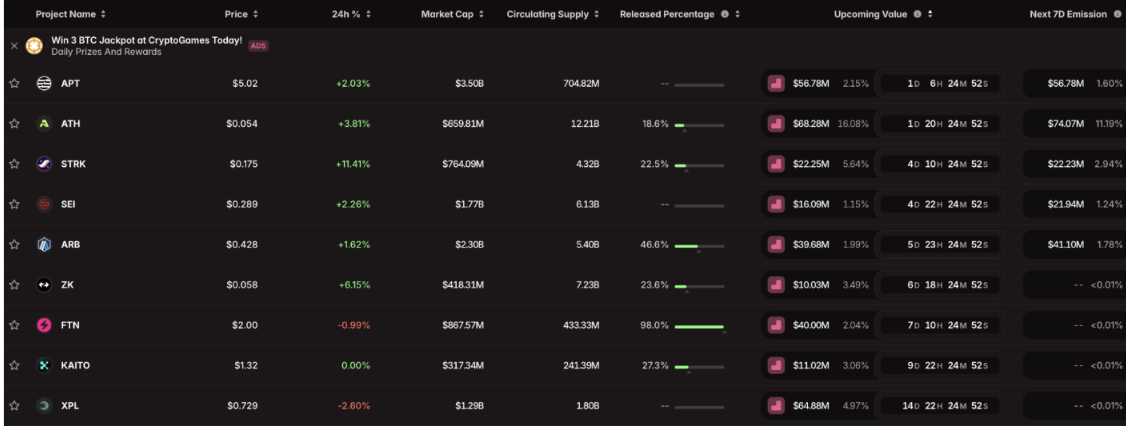
Unlocking Wave: Hidden Selling Pressure Behind Big Currencies
Data shows that there will be a number of unlocking events this week and in the next two weeks, and the potential selling pressure should not be ignored: APT will unlock US$56.78 million after 1 day, accounting for 2.15% of the outstanding market capitalization; ATH will unlock US$74.07 million in just 1 day and 20 hours, amounting to 11.19% of the market capitalization; STRK will unlock US$22.23 million after 4 days, representing 2.94%; SEI and ARB will unlock US$21.94 million and US$39.68 million respectively after 4 to 5 days, corresponding to market capitalization pressure of 1.24%. STRK will unlock US$22.23 million after the 4th day, accounting for 2.94%; SEI and ARB will unlock US$21.94 million and US$39.68 million respectively after the 4th to 5th day, corresponding to the pressure of market capitalization of 1.24% and 1.78%. In addition, the unlocking ratios of ZK, FTN, and KAITO are also not low, of which FTN has already unlocked US$98%, and will unlock US$40 million soon, so supply space is almost saturated. FTN has released 98% and is about to unlock 40 million dollars, so the supply space is almost saturated. The fact that this round of unlocking occurred after the short-term rise of the Wall Street Currency shows that the early capital tends to "bounce back and cash out". In terms of scale, ATH's single unlocking amount and share is extremely shocking, and may be a short-term trigger for market sentiment; while APT, ARB, SEI and other high-capitalization items are relatively decentralized, but the overlapping effect will gradually erode confidence. Echoing the current market trend: after a few days of uptrend, the red market panic has resurfaced with the unlocking wave. This is not the end of days, but more like the "final purge", where capital is quickly looking for a place to take over. If the release of fear accelerates, it could set the stage for the next round of massive frenzy. Investors should not be deterred by short-term fluctuations, but rather utilize the lows brought about by the unlocking to position themselves gradually, waiting for the final "madness" to unfold.

Liquidation of tens of billions of dollars to reshape the bottom of sentiment, rational layout or the best opportunity
According to Crypto Bubbles data, the market has been sharply diverging over the past week after a historic $20 billion liquidation wave, with the overall structure turning from green to red and investment sentiment cooling rapidly. A few strong tokens such as ZEC +62.3%, TAO +20.4%, STRK +17.7% are still showing resilience, while most mainstream and fake tokens are under pressure, with MYX -39.7%, 2Z -34.9%, MORPHO -20.3%, and FET -16.4% all experiencing a significant pullback. The rapid imbalance in sector rotation, the rapid ebbing of market hotspots, and the return of fear to dominate the investment rhythm indicate that capital is being withdrawn from high-risk targets and shifted to defensive assets.
However, this sentiment crash does not necessarily mean the end of the bull market. Looking at the chain of data and sentiment cycles, although the market has cooled down significantly, it has yet to show the end of the typical "crazy period" - such as mainstream media coverage, a disorderly influx of retail investors, and a general rise in fiat currencies. This means that the current period is still late in the bull market but not yet at its climax, and the market still has potential upside. The capital structure is becoming healthier as volatility declines and leverage resets after liquidation. However, it is important to note that when the downside correction is over, a return to short-term exuberance and chasing highs will most likely result in an eventual top. In other words.The bull market is not over, but it is nearing its end. This uptrend will be faster and more intense and could reverse at any time.
Therefore, for investors, the core strategy at this stage should be to "plan in fear and harvest in excitement". By entering the market in batches of DCA and locking in high-quality targets, we can capture the last wave of upside dividends, while preserving chips and a margin of safety for the potential turnaround. In this quiet market adjustment, the calm ones will eventually become the leaders of the next wave.

10-11 Black Shock Day: $2 Billion Liquidation Hits Market Confidence Hard
With President Trump's announcement of 100% tariffs on Chinese imports and expanded tech export controls, the markets were thrown into a full-blown panic in a matter of hours. The global cryptocurrency market capitalization plummeted from around $4.25 trillion to $4.05 trillion, evaporating more than $200 billion. Bitcoin fell 10% to $107,000, while Ether, XRP, BNB and other major currencies all fell more than 15%. Meanwhile, the week saw the largest 24-hour, $20 billion leveraged liquidation in history, with some fake currencies (e.g., XPL) dropping by as much as 46% in a single day, and some tokens even collapsed in a matter of hours, which is suspected to be due to the collapse of liquidity in OTC and market maker markets. It is suspected to be related to the collapse of OTC and market maker liquidity. The market shifted into a typical "risk-off" mode, with investors generally reducing their positions to avoid risk, as fear once again dominated the market. The crash not only reveals that the crypto market is still in a highly volatile, highly leveraged risk appetite phase, but also highlights the instantaneous impact of sentiment and macro policies on prices. It is worth noting that despite the spreading panic, the market has not yet experienced the "full-blown frenzy" that is often seen at the end of a bull market - no mainstream media frenzy, no uncontrolled influx of retail investors, or a generalized rise in cryptocurrencies. This suggests that the bull market may not be over, but the end is near and the rebound will be faster and more dramatic. The key now is to remain calm and disciplined: if anxiety and fear are affecting your decision-making, you should reduce the size of your positions to minimize emotional interference. The first principle of investing is "not over-investing". Only by maintaining rationality in the midst of the storm can we capture the next wave of opportunity in the midst of the chaos. Market shocks are not the end of the story, but the silent epicenter before the mad cow - the calm at this time is the ticket to the next rally.
The World's Largest Bitcoin Confiscation Case: Profiteering and Blackmail
A British court ruled in early October that a Chinese woman, Qian Zhimin Zhang Yadi, had been convicted of Ponzi-style fraud and illegal possession of assets. She defrauded more than 128,000 victims between 2014 and 2017, converting the proceeds into 61,000 Bitcoins with a market value of more than £5 billion (about US$670 million). The case involved cross-border money laundering, false documents, and real estate purchases, making it the largest cryptocurrency confiscation in the history of the UK. This case not only demonstrates the incredible wealth effect of crypto assets, but also reflects their high degree of anonymity and cross-border mobility, which makes them the first choice for criminals to hide and transfer funds. This case reveals a paradox that cannot be ignored: while cryptocurrencies can generate huge profits, they also create an "untraceable financial black hole". The decentralized nature of cryptocurrencies renders traditional regulation ineffective, further facilitating fraud, money laundering and illicit asset transfers. Although the authorities have attempted to strengthen the confiscation and freezing mechanisms through legislative reforms, the case itself reflects the fact that investors' interests and market trust are still suspended in an opaque black net. For the crypto market, this is not just a single case, but a wake-up call: beneath the surface of soaring prices lie deeper institutional risks and social costs.

BNB breaks $1,300, hot but can't beat the pullback wave.
BNB surpassed $1,300 on October 6, 2025, setting another all-time high in a short period of time, with a market capitalization of more than $154 billion, second only to Bitcoin and Ether. The BNB chain is ranked number one among all blockchains in terms of 24-hour fees, followed closely by Hyperledger and Solana. 19% of supply has risen in the past week, and about 30% of supply is now locked up in the DeFi ecosystem with institutional capital inflows, indicating that capital is being concentrated on the BNB chain. BNB has risen 19% in the past week, and about 30% of supply is now locked up in the DeFi ecosystem, where institutional money is flowing in, suggesting that money is concentrating on the BNB chain, which has a significant liquidity advantage due to the high activity of Chinese traders and institutions on the chain. However, BNB retraced from the highs for a short period of time, with the price dropping back to around $1,100, testing the support of the previous breakout zone. This retracement was mainly due to short-term profit-taking and capital rotation, but the overall long structure has not been damaged. Historical data shows that BNB has recently risen more than 1,00% since the bottom of $600, and after breaking through the consolidation zone of $1,193, the third wave of technical breakout is still targeting $1,500, with a potential increase of 51%. The active trading in the Chinese market and the large capitalization, coupled with a high ratio of on-chain trades and lock-ups, reduce the price volatility brought about by a single market fluctuation. The active trading in the Chinese market, coupled with the large scale of capitalization and the high ratio of chain trading and locking positions, reduces the risk of a price correction due to a single market fluctuation, and forms a solid upward support. Thus, BNB's high liquidity and ecological activity give it the momentum to continue to advance even after a short-term correction.
Bitcoin Tumbles After Record High: $125,700 Sets New Record, Highs Fall Back to 90,000 Area in a Flash
Bitcoin surpassed US$125,700 in the early hours of October 6, breaking the record high of US$124,290 set on August 14, with a cumulative gain of more than 50% for the year, and a rise of 11% in the first five days of October alone. market data showed that the spot Bitcoin ETF recorded the second-highest inflow since its launch in the last week, reflecting the weakening of the long term selling pressure and the stabilization of the short term capital. Historical statistics also show that Bitcoin has recorded positive returns in October in 10 out of the past 12 years, creating the so-called Uptober effect and deepening investors' perception of crypto assets as a hedging and value-added tool. However, the frenzy lasted only a few days before it took a sharp turn for the worse, with Bitcoin dropping nearly 30% from its highs on October 10th to as low as $98,000, the first time it had fallen back into the five-digit range in nearly two months. The crash was accompanied by the largest 24-hour liquidation of $19.25 billion in history, forcing more than 1.65 million traders out of the market and sending the market's fear index plummeting from 59 the previous week to 35. Analytically, frequent milestone breakthroughs don't mean that the bull market is going to be a smooth ride. History has shown that sharp rallies are often accompanied by structural pullbacks and sentiment cleansing, especially in macro contexts such as government shutdowns, fiscal deficits and liquidity easing, which can exacerbate market overheating.

MicroStrategy Holds Its Ground: The Signals Behind the Giant Whale's Halt
As sentiment continues to rise following Bitcoin's record highs, two of the biggest digital asset warehouses - MicroStrategy and Metaplanet - have failed to add to their holdings at the usual time of the week. This unusual move stands in stark contrast to their past behavior, especially when a digital asset repository firm in Solana announced a position of more than $530 million on the same day. It's worth noting that MicroStrategy is already under pressure from its massive debt and share dilution, and if it fails to keep up its buying program, it could lose a central driver on the demand side of the Bitcoin equation. Such silence reflects not only an adjustment in the capital cycle, but also suggests that the impetus for Bitcoin's price rise is relying more on leverage and derivatives trading than on fundamentals such as active wallet addresses. In other words, when the "big whale" that drives the market chooses to wait and see, the message behind it is a warning that while investors are basking in the optimism of record highs, the actual incremental buying is starting to wane. If macro uncertainty rises or prices stagnate, this structural break could trigger a cascading effect, laying a potential worry for the market.
MetaMask Airdrop on the Horizon: $30 Million Linea Incentive Program Launches
MetaMask has announced that it will be launching its first quarterly Linea Token Incentive Program of over $30 million equivalent in the coming weeks, making it one of the largest on-chain incentive programs in history. The program includes referral bonuses, incentives paid in the mUSD stablecoin, partner-specific incentives, and token preference rights, with a special emphasis on additional rewards for long-term users. This program is designed not only to drive activity on Consensys' Linea Layer-2 network, but also to solidify the mUSD stablecoin landscape and build a complete ecosystem by introducing MetaMask's large user base. From an analytical perspective, the rewards program is not just a single airdrop, but ties user behavior directly to future token value capture. In other words, by frequently using MetaMask's built-in Swap and Bridge features, real users who participate in multi-chain interactions are more likely to receive long-term rewards and subsequent token allocations. This incentive design effectively filters out short-term farmer behavior and instead encourages real liquidity and cross-chain applications. For the crypto market, this means that the next wave of airdrops will no longer be a "short-term arbitrage" but a test of deep engagement. For investors, instead of just expecting price breakthroughs, it is better to seize the opportunity to participate in the interactions and turn daily on-chain behavior into future asset accumulation.
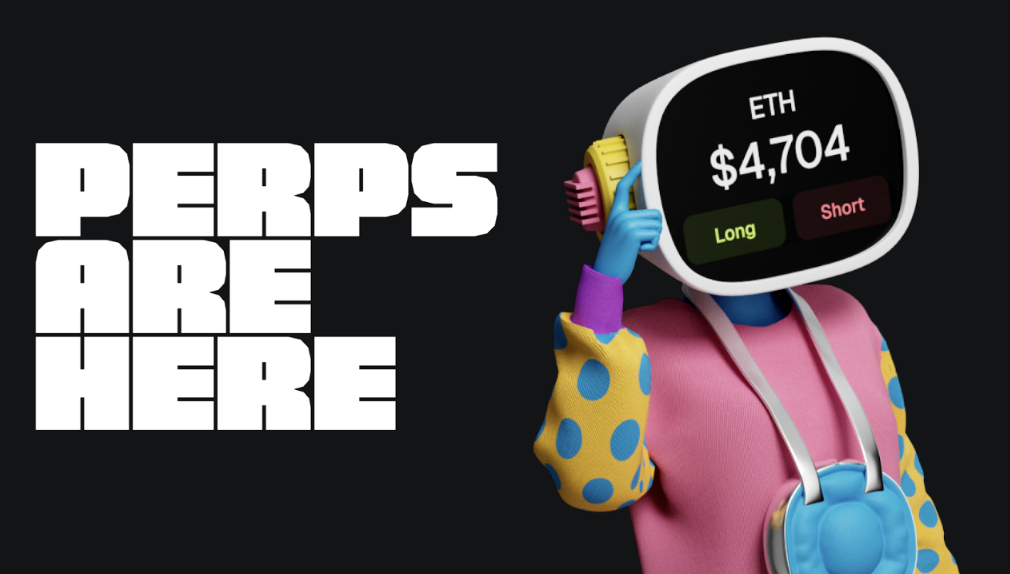
MetaMask Full Function: 40x Leverage on Sustainable Contracts
MetaMask officially introduces sustainable contract trading to the wallet, supporting over 150 tokens with up to 40x leverage through its Hyperliquid infrastructure and launching a rewards program covering trading, referrals, card payments and stablecoin holdings with a reward pool of over $30 million. This not only moves MetaMask away from a "wallet-only" position, but also towards a comprehensive DeFi platform. In the future, Polymarket will be integrated to forecast the market and issue MASK tokens to further strengthen the ecosystem. These features mean that users no longer need to rely on centralized exchanges to perform leveraged hedging operations on the chain. In other words, even if the market enters a bear market, investors will be able to profit from shorting directly through MetaMask. This trend is not only in line with the logic of decentralized finance, but also reveals that the Web3 ecosystem is gradually evolving from a single-entry wallet to a self-contained system with a full set of financial tools.
Hundreds of billions of dollars of capital whirlwind, replicating the Web3 narrative of 2015
ICM (Internet Capital Market) is gradually becoming the centerpiece of the current cottage season. Its formula "Ideas + Attention = Capital" has completely lowered the threshold of financing, and pushed the market from a pure mystery game to an institutionalized experiment in startup financing. According to the data, Pump.fun, with a market capitalization of about US$6.5 billion, almost monopolizes the "attention-based" coin-issuing, while Believe Ecology, which is positioned in the Silicon Valley, has a market capitalization of only US$110 million, but gradually accumulates stickiness based on its actual business model. This segment differentiation reflects the market's transition from a "junk-coin bonanza" to "on-chain venture capital". The ICM boom can be seen as a replica of the Web3 narrative of 2015: decentralized apps were the vision, now on-chain funding is becoming the reality, and Solana's embrace of ICM has accelerated the market's perception that its competition with ethereum is no longer about TPS, but rather about the redefinition of the ecological narrative. However, sector rotation means that while ICM is a new tier of narrative, it's also the perfect time for big players to get out of the market at a profit. If the historical frenzy of betting on AI and fanaticism is still of value, investors may want to lay out their positions in advance of the formal influx of capital, and decisively reduce their positions before the frenzy reaches its threshold, in order to avoid a repeat of the cyclical liquidation of the capital ebb and flow.

Litecoin, HBAR ETFs to be Approved: Major Catalyst for Second-Line Currencies
Canary Capital has filed its final paperwork and expects to launch spot ETFs for Litecoin (LTC) and HBAR once the U.S. government shutdown is over, with the two funds coded LTCC and HBR, respectively, charging fees as high as 0.95%, much higher than the average Bitcoin ETF's rate of 0.15%-0.25%. According to Bloomberg analyst Eric Balchunas, the move signals that the process is in its final stages and suggests that it is only a matter of time before the ETF is approved. Historical experience shows that the approval of ETFs is often seen as a sign of "regularization" and "capital inflow", which has a short-term lifting effect on second-tier currencies. However, this kind of catalytic event often becomes an opportunity for big investors to get out of the market. Take the approval of the Bitcoin ETF as an example, the price rose briefly after the news was announced, but then retreated significantly. LTC and HBAR are second-tier assets with limited liquidity and investor base, and are more prone to quick reversals after sentiment has been pushed up. For retail investors, although ETF news may bring short-term market, the effect is likely to be short-lived if not supported by continuous capital inflows. Investors are advised to carefully consider taking profits before the positive news is realized, so as to avoid becoming an outlet for liquidity after the market sentiment has peaked.
DePIN Narrative Continues to Evolve as Grass Secures Another $10 Million in Funding
Grass, the DePIN project of Solana Ecosystem, has recently completed a $10 million bridge round with Polychain and Tribe Capital, demonstrating that its business model has moved beyond validation and into scale. Grass uses a decentralized network architecture to allow users to sell idle bandwidth and accumulate unprecedented data access capacity. Grass' decentralized network architecture allows users to sell their idle bandwidth, allowing them to accumulate unprecedented data access capacity. Currently, Grass has 8.5 million monthly active users and partners with more than 20 organizations, including AI labs, non-profit organizations, and universities. According to the official statement, all customer revenues will go directly to the Grass Foundation, and GRASS tokens will be the main value-carrying tool, providing a clear value return link for investors. Grass' strategic shift is not limited to training data, but to gradually enter the inference market, with plans to complete an "Internet-grade web crawler" and establish real-time contextual retrieval, which will dramatically enhance the commercialization of AI models. This is equivalent to upgrading DePIN from "resource supply" to "AI infrastructure," making it a potential focus for capital flows in 2025. For investors, Grass Season 2 is not just short-term speculation, but a gradually expanding application ecosystem. At a time of market volatility and capital divergence, installing and participating in the network may be a solid medium-term option to capture the growth dividends from the cross-over of DePIN and AI.
Macro News

100-day trade war reignites: $20 billion liquidation triggers market panic
President Trump's announcement on October 10th, before the deadline, that he would impose 100% tariffs on Chinese goods starting in November, as well as proposed export controls on critical software, sent global markets into an instant and violent shockwave. Total crypto market capitalization plummeted from $4.25 trillion to $4.05 trillion in a matter of hours, evaporating over $200 billion. Bitcoin fell 10% to $107,000, while Ether, BNB, XRP and other major currencies fell more than 15%, and the largest 24-hour liquidation of $20 billion in history occurred during the week, with most of the fake currencies chopped to pieces, and the XPL dropped 46% in a single day, suspected to be caused by the collapse of liquidity of the over-the-counter (OTC) trading and market maker. Global risk aversion surged, and the market shifted to a full "risk-off" mode, with the sentiment index rapidly falling into the fear zone. The crash, though violent, is a natural part of the market's healthy correction process, which has stabilized the structure by cleansing it of over-leveraged and short-term speculators. From a cyclical perspective, the crypto market is still in a high volatility, high risk appetite growth phase, and has yet to experience the "irrational exuberance" of the end of the bull market - retail FOMO, full-blown cryptocurrency eruption, and mainstream media campaigns have yet to surface. This means that the bull market is not yet over, but the end is near, and when liquidity returns to risky assets, the rebound may be fast and furious. For investors, the key at this point is not to panic and flee, but to be disciplined and rational in adding to their positions. If anxiety leads to unbalanced decision-making, you should take the initiative to reduce your position and control your risk, as the primary principle of investing is not to let emotions lead your behavior. We at Monsterblockhk suggested in our last weekly report to "take profits at high levels and wait for pullbacks". If you have already taken your positions, this is the best time to reposition your position and use caution to control the movement. This is not the end of the market, but the baptism before the mad cow - only by calming down in fear can we stay on top of the next wave.

Gold Price Breaks $4,000, Precious Metals Becomes a Protective Factor
With the price of gold surging to $4,000 per ounce this week, and major investors like Ray Dalio and Jeffrey Gundlach suggesting that gold should be included in their allocations, Dalio suggesting up to 15%, and Gundlach mentioning as much as 25%, the price and the big names point to one thing: capital is rapidly moving away from risky assets or downsizing in search of vehicles that can preserve value in the face of currency depreciation. capital is rapidly moving away from risky assets or downsizing in favor of vehicles that can preserve value in the face of currency depreciation. The current extreme uptrend in gold prices is not just about short-term risk aversion, but also reflects the market's reevaluation of liquidity and real assets. From the perspective of sentiment and capital rotation, gold's strength is often a leading signal of the end of a boom or the rise of systemic risk. When stocks and crypto assets experience profit-taking or liquidity reversals, precious metals often become the main safe haven. In the author's judgment, if the stock market and crypto assets retrace sharply in the next few months, gold and silver will overperform. Therefore, in the face of the current overheated market, it is recommended to transfer part of the realized profits into precious metals or related underlying assets in a batch and disciplined manner, so as to retain the possibility of participating in the subsequent upward movement and to establish an effective downside protection. In conclusion, the gold price breakout and the change in capital appetite are not isolated phenomena, but should be seen as a clear signal to adjust asset allocation and risk management.

The tech bubble is approaching its tipping point, and the capital frenzy will eventually return to equilibrium.
Recently, Orlando Bravo, founder of Thoma Bravo, stated that AI company valuations are in "bubble territory," even comparing them to the dot-com bubble. He pointed out that some startups with annual revenues of just $50 million are valued at $10 billion, making it nearly impossible for investors to realize a reasonable return on their current cash flow. Although unlike the dot-com bubble, the current round of funding has been backed by large, financially healthy companies, the valuation detachment from fundamentals is a clear indication that the market is in the overheated phase of the boom cycle. From an economic point of view, capital market operation always revolves around a cycle - boom, overheat, recession and recovery - and the current situation of AI stocks corresponds to a typical "overheat" period, with capital frenzy, valuation imbalance, and both risks and opportunities. For the cryptocurrency market, once the AI bubble cools, risk capital may shift to more liquid and cyclical crypto assets. This reminds investors that they should not try to be precise and accurate, but rather, they should adopt the core strategy of laying out their positions in batches and bagging on the high side, so that they can maintain discipline between the upcoming market frenzy and adjustments, and turn short-term volatility into a long-term advantage.
Related Post:
Best Cryptocurrency Trading Platform for Hong Kong Users?2025 Latest Bitcoin Tips for Beginners
2025 Coin Ring Newbie Guide Lazybones|Chained Ecology Entry Guide
2025 Must Read for Newbies! Use these six data indicators to learn how to judge buying opportunities.

Fed shift accelerates, funding environment to reshape again
U.S. Federal Reserve Governor Stephen Miran recently pointed out that the extraordinary calm in the U.S. bond market is itself a signal in favor of a more rapid rate-cutting process. Unlike the sharp volatility that has accompanied past policy adjustments, the muted reaction of the bond market to this rate cut suggests that the market is already anticipating further easing. Moreover, with inflation falling and economic fundamentals cooling, there is a strong case for the US authorities to push for at least one additional round of rate cuts before the end of the year. This is both a defense against a slowing economy and a policy option to bolster market confidence. If the rate cut does materialize, the global cost of capital will fall further, which will have a double impact on the cryptocurrency market. On the one hand, increased liquidity will drive a short-term frenzy in risky assets, providing strong support for Bitcoin and mainstream tokens; on the other hand, over-reliance on an easy market carries the risk of increased volatility and correction. This means that although the market is about to enter a new round of liquidity-driven frenzy, investors should not be delusional about precision, but should seize the liquidity window after the interest rate cut, and turn the policy dividend into long-term capital appreciation through batch profit lock-in and risk management.
Chained Data Analysis:

Greed Signals Emerge: Markets Turn from Fear to Fervor
The latest Crypto Market RSI Heatmap shows that the market structure has clearly changed. Compared to a few months ago when the market was generally weak or even oversold, more tokens are now in overheated territory, with BNB, ZEC, TWT and OG RSIs above 80, typically overbought, and PROM, B2, DASH and others approaching the strong 70-75 range. The citywide average RSI came in at 45.87, which is still in neutral territory, but compared to the previous general downturn, it already shows that capital risk appetite is gradually warming up. In fact, if you had placed your bets when the market was scared and the RSI fell into the weak zone or even the oversold zone, you would have gotten a substantial return today. This change highlights the iron law of buying when you are scared and selling when you are crazy, and the cyclical fluctuations in the RSI reflect the inverse of investor sentiment and capital flows: when prices are too low in fear, it is the right time to take a position; and when greed spreads and the RSI gets too hot, the risk of retraction rises. For the current market, it is advisable to avoid chasing high FOMO, instead, we should continue to review the positions we took a few weeks ago, and wait for the opportunity to lock in gains when market sentiment heats up further. Only with discipline can we turn emotional markets into systemic advantages and continue to accumulate excess returns during volatility.

Super Cycle Myths Difficult to Continue, Signs of a Top Emerging
Bitcoin retreated from the current cycle high of USD 124,000 to approximately USD 113,700, a decline of only about 8%, which is extremely modest compared to the average correction of 28% in the current cycle or the correction of 60% in the previous cycle. The chart shows that the volatility of the long Bitcoin cycle has been tapering off since 2011, reflecting the gradual maturation of the market structure, the deepening of liquidity and the rise of institutionalized trading. However, this apparent stabilization may also hide a buildup of market energy. The current price trend is similar to the mid-cycle phase of the 2015-2017 cycle, with a steady uptrend but no explosive "blow-off", suggesting that the market is in the midst of a potential consolidation phase at a higher level. Declining volatility, while conducive to market stability, is also symbolic of a potential late-stage feature. History shows that Bitcoin tends to undergo a long period of low volatility before entering the top zone, followed by a quick burst and reversal. If the current "calm" continues for too long, the market may mistakenly believe that the "supercycle" is still in progress and ignore the return of natural cyclical patterns. From a macro perspective, the current structure is closer to the end of the cycle than the beginning of a long-term bull market. Investors should remain vigilant and be wary of the rapid release of compressed volatility, as true tops often emerge at the least dramatic moments.

Retailers need to be wary of overheating cycles as the bull market clock draws to a close.
As seen in Glassnode's Bitcoin price cycle chart, the current cycle is highly overlapping with the past two cycles. Assuming that $124,000 has been the global high, the current cycle has lasted about 1,030 days, which is close to the length of the 2015-2018 and 2018-2022 cycles, which lasted about 1,060 days. The data suggests that historical peak returns are tapering off: the 2011-2015 red line shows over 200x upside, the 2015-2018 blue line about 100x, and the 2018-2022 green line only about 20x. The current black line is much more modest, with positive growth, but the slope has slowed considerably, a far cry from past spikes. The fact that MicroStrategy has not added to its holdings of Bitcoin for several weeks now also reflects that the momentum of institutional capital to push the market up further is starting to weaken. This phenomenon emphasizes a brutal fact: bull markets do not extend indefinitely, but follow the iron law of cycles and capital flows. With just a few weeks left before the end of the cycle, it is very easy for retail investors with limited capital to blindly chase the highs and fall into a trap at the end of the cycle. In contrast, a rational strategy would be to remain disciplined during periods of high volatility, gradually adjusting positions to take advantage of prior period gains, and allocating surplus capital in batches to undervalued targets, rather than falling into a greedy FOMO at the end of the period. the cyclical nature of the market reminds us that it is not the size of the position that really cuts through the bulls and the bears, but rather, it is the ability to retain the flexibility to harvest the cycle into a long-term accumulation of capital before the turn of the tide in sentiment.

Profit Ratios Peak: Market at a Frenzy Point
Bitcoin's Realized Profit/Loss Ratio data shows that the localized peaks of each cycle occurred when the realized rate of profitability was near the extreme end of the range. As can be seen in the chart, the current bull market is not a single extended wave, but rather three multi-month profit-taking waves. Whenever more than 90% of the outstanding coins are in profit-taking realization, the market enters high-risk territory, marking the peak of the cycle. Now that we have just emerged from the third extreme profit zone, the historical pattern suggests that the probability of a subsequent cooling or correction has increased dramatically. This means that the market is in a classic "frenzy eve" phase: prices may not reverse immediately, but the short-term period will be extremely frenzied and accompanied by rapid oscillations. Pursuing "precise top selling" at this point in time is tantamount to gambling, and it is very easy to miss opportunities due to emotional miscalculation. On the contrary, locking in gains in tranches and maintaining cash flexibility is a rational strategy. The data reminds us that an investor who has truly traversed the bulls and the bears is not one who has done a perfect job at the top, but one who has been able to discipline himself to harvest before the madness sets in, turning uncontrollable cyclical fluctuations into certainty in long-term capital accumulation.

Bitcoin at Critical Defense, Bulls and Bears May Be Divided
The STH Cost Basis has once again become the centerpiece of Bitcoin's price structure. According to Glassnode data, BTC's post-FOMC rebound failed, falling below the average short-term cost of ownership of $111.6K, hitting a low of $109K, before triggering a strong buying counterattack, which quickly brought the price back up to $118.8K. This support zone has been tested five times since May 2025, but has been held repeatedly, demonstrating the high sensitivity of short-term capital to this level. The repeated defense of this area is a sign of investor confidence and reveals the current divergence of momentum in the market amidst the high level of the oscillator. However, this cost zone is also the demarcation point for bulls and bears. If the price stabilizes above 111.6K for an extended period of time, it will help maintain the medium-term uptrend structure and attract incremental capital back into the market. On the contrary, if the price effectively breaks below it, it may trigger a chain of profit taking and deleveraging, which will in turn trigger a cyclical pullback. Combined with the historical rhythm of Bitcoin's four-year halving cycle, the current position may be at the "end of bull market oscillator" stage, where market sentiment and capital flows will be more sensitive. For investors, it is important to maintain discipline and risk management. Only by staying rational between support confirmation and loss of support can we stay in the strong volatility to come.
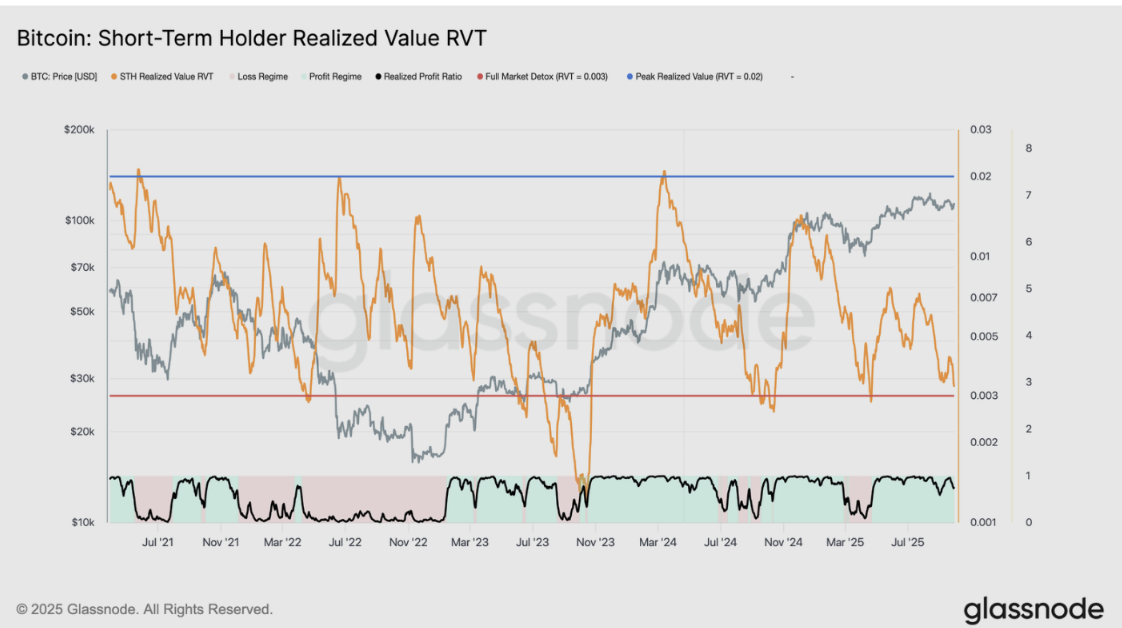
Short-term profit-taking momentum cools, correction may welcome a new round of capital buildup
Bitcoin's Short-Term Holder Realized Value RVT has been declining since May, indicating a significant weakening in the profit-taking strength of short-term capital. The indicator measures the ratio of short-term holders' realized gains to the overall trading value of the network. When the RVT is high, it tends to reflect an overheated market and a wave of profit-taking; on the other hand, when the index shrinks to the "Full Market Detox" range (around 0.003), it means the market is entering a speculative retreat. As seen in the chart, RVT has dropped significantly from the previous highs and is well below the 0.02 overvaluation zone, implying that short-term investors have generally lowered their selling pressure and profit-taking behavior, and the market has entered a structural cooling. This trend is a short-term drag on price performance, but from a cyclical perspective, it is building momentum for the next phase of the uptrend. The current low level of RVT reflects a gradual shift to a period of wait-and-see and re-accumulation. Combined with the previous short-term cost basis of multiple supports at $111.6K, the pullback may be creating a better risk-reward ratio for the subsequent rebound. Historically, when the RVT touches the bottom area and sentiment recovers, it often signals the incubation of a new round of bullish momentum. If Bitcoin maintains a healthy consolidation at this stage, a stronger short-term rebound could emerge in the coming weeks as speculative capital re-enters the market.
Conclusion
Most Popular Cryptocurrency Trading Platforms
Hong Kong People's Top Choice for Bitcoin and Ether Trading 》 【2025 Introduction】OSL Registration Benefits, Security, Deposit and Withdrawal, Special Features
Suitable for traditional Hong Kong investors to buy and sell stocks and currencies at the same time. [2025 Introduction] What is Victory Securities? Security, Deposit and Withdrawal, Features
More choices of contract currencies, suitable for buying fake coins in cash. Trade on MEXC and enjoy 500x leverage and many other benefits!
Related Post:
Best Cryptocurrency Trading Platform for Hong Kong Users?2025 Latest Bitcoin Tips for Beginners
2025 Coin Ring Newbie Guide Lazybones|Chained Ecology Entry Guide
2025 Must Read for Newbies! Use these six data indicators to learn how to judge buying opportunities.

Disclaimer
The content of this article is for reference only, investors should exercise independent judgment, invest prudently and at their own risk, this article does not provide or attempt to persuade the audience to do trading or investment basis, the content is for sharing purposes only, and should not be regarded as investment advice.It does not represent the views and position of Monsterblockhk.All information and opinions are current as of the date of the judgment. In addition, if a judgment is rendered on aIn this siteAny content related to virtual asset trading platforms that have not yet obtained a license to operate virtual asset trading platforms in Hong Kong, including but not limited to text introductions, pictures, offers, events, etc., are only available to users outside the Hong Kong Special Administrative Region.
According to the Hong Kong Anti-Money Laundering and Counter-Terrorist Financing (Amendment) Ordinance 2022, after June 1, 2023, all centralized virtual asset trading platforms operating in Hong Kong or actively promoting their services to Hong Kong investors will be licensed and regulated by the SFC, and any related unlicensed activities will be a criminal offence. For more information and details of the legislation, users may refer to the SFC website.