


Real World Asset (RWA) tokenization refers to the use of blockchain technology to convert various types of real world assets into digital tokens for circulation and trading on the chain. The types of assets to be tokenized are very broad, covering both homogenized and non-homogenized assets.
For example, a homogenized asset may be a bond, an equity, a share of real estate, a commodity, etc., whose tokens tend to be of equal value and interchangeable, while a non-homogenized asset, such as a work of art, a single object of real estate, a luxury item, etc., each token of which represents a unique interest.
In short, RWA represents the rights to physical assets as tokens on a blockchain, enabling them to be securely held, transferred and split for trading. This innovation allows traditional assets to connect to the global digital marketplace, dramatically increasing liquidity and transaction efficiency.
With the maturity of technology and regulatory clarity, more and more financial institutions have begun to test various RWA applications, ranging from public bonds, structured notes, funds to tokenization of physical assets. For example, Hong Kong brokerage firms have implemented tokenization of Hong Kong dollar-linked exchange rate bonds, and the Mainland and Hong Kong have cooperated in issuing cross-border tokens for new energy assets.
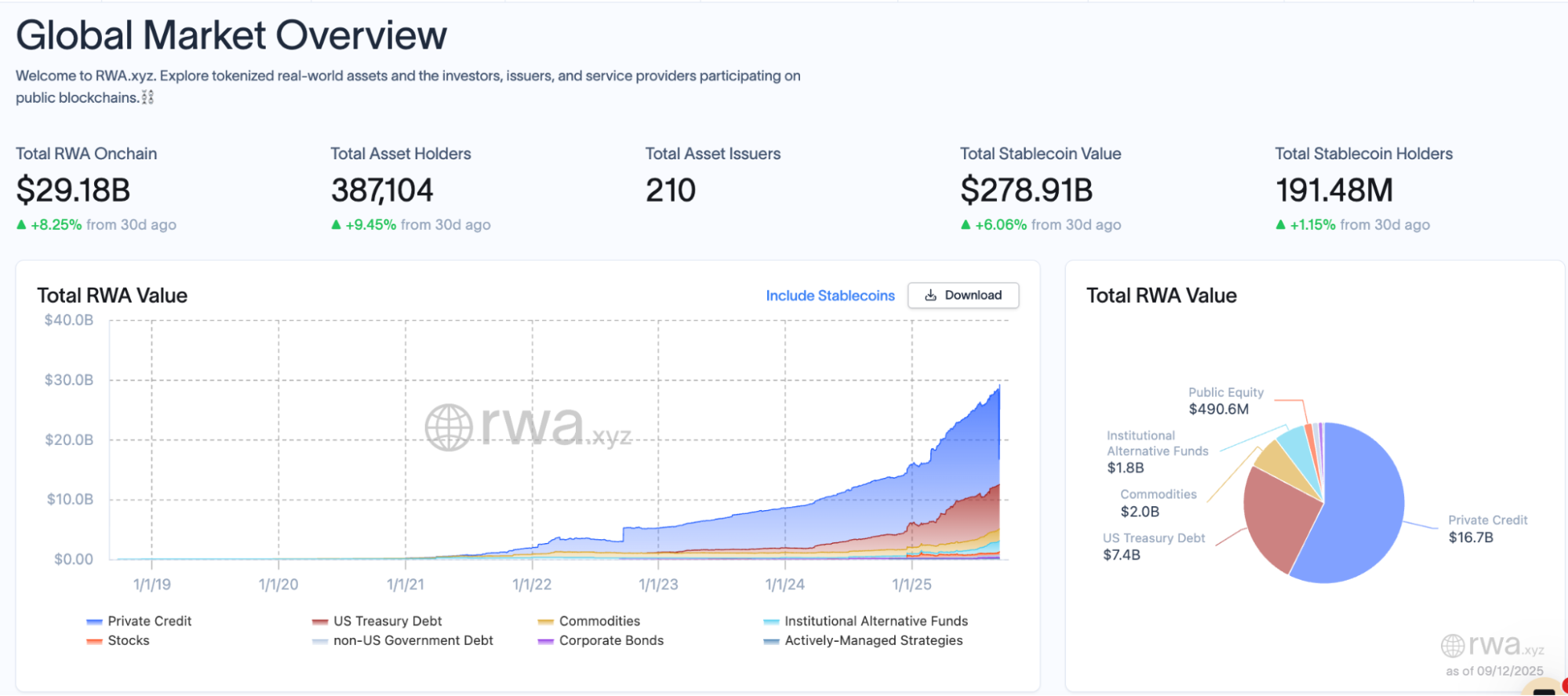
According to rwa.xyz Statistically, excluding stable currencies, the overall RWA market still represents a very small percentage of global financial assets, but the growth curve is quite steep, indicating a strong demand for a digital transformation of assets.
However, there are still many challenges to the large-scale implementation of RWA:
- Compliance and legal framework: The various assets are subject to different jurisdictions, and there is a need for clear safeguards as to how the interests of token holders will be legally recognized. As a result, many RWA projects use Special Purpose Vehicles (SPVs) to hold physical assets to isolate risk and comply with local regulatory requirements.
- Information Bridging and Trust Issues: A prediction machine or third-party audit must be used to ensure that on-chain tokens are synchronized with off-chain asset values, and that data is transparent and up-to-date in real time.
- Technology and Ecological Integration: RWA tokens need to be integrated into blockchain ecosystems such as DeFi to provide liquidity and application scenarios, otherwise it is difficult to fully realize the value of tokens alone without a trading market.
The Unique Value of Gold as an RWA: Historical Status and Tokenization Advantages
Among the many real assets that can be monetized, gold is one of the most iconic. From the medium of exchange of ancient civilizations to the gold standard of the U.S. dollar under the Bretton Woods system, gold has always been regarded as a true "hard currency". Even though the modern fiat currency system has long since moved away from the gold standard, gold is still an important component of central banks' reserve assets, and it is also the market's first choice for hedging.
Hedging attributesThis is the greatest value of gold: when geopolitical turmoil or economic uncertainty rises, capital tends to flock to gold for stability. Statistics show that global central bank purchases of gold have risen significantly in recent years, with net central bank gold purchases nearly doubling in 2023 compared to two years earlier, and accounting for 231 TP3T of global gold demand, up from 111 TP3T in 2021. gold has one of the largest and most liquid markets of any asset, with a daily trading volume and a total global holdings value that is second only to that of the U.S. S&P500 index. Gold's market size and liquidity are among the highest of all assets. This underscores the stability and international recognition of gold as an asset and provides a solid foundation for its monetization.
Physical gold vs. digital gold vs. gold tokens
Traditionally, there are two ways for investors to hold gold:
- Holding physical gold (e.g. gold bars, coins)The first is to provide a physical touch and direct control of ownership, but there are also problems such as inconvenient storage and safekeeping, and poor liquidity (realization needs to go through a pawnshop or a trading house).
- Holding Digital GoldDigital gold products reduce the hassle of holding and trading physical gold by eliminating the need for investors to physically hold gold, such as buying a gold ETF or a paper gold account at a bank. Investors can buy and sell their gold through a securities account or at a bank at a price that closely matches the price of spot gold.
However, traditional digital gold often has limited trading hours - for example, ETFs can only be traded when the stock market is open - high thresholds, as ETFs usually represent about 0.1 ounces of gold per share, no freedom to physically withdraw the shares, and a lack of decentralization (investors have to trust the issuer).
Here's the point of this article.Gold tokenizationIn fact, in this case, the advantages of both have been perfectly combined: each token is backed 1:1 by physical gold, can be traded on the blockchain at any time, 7×24 hours a day, and has a high degree of divisibility.
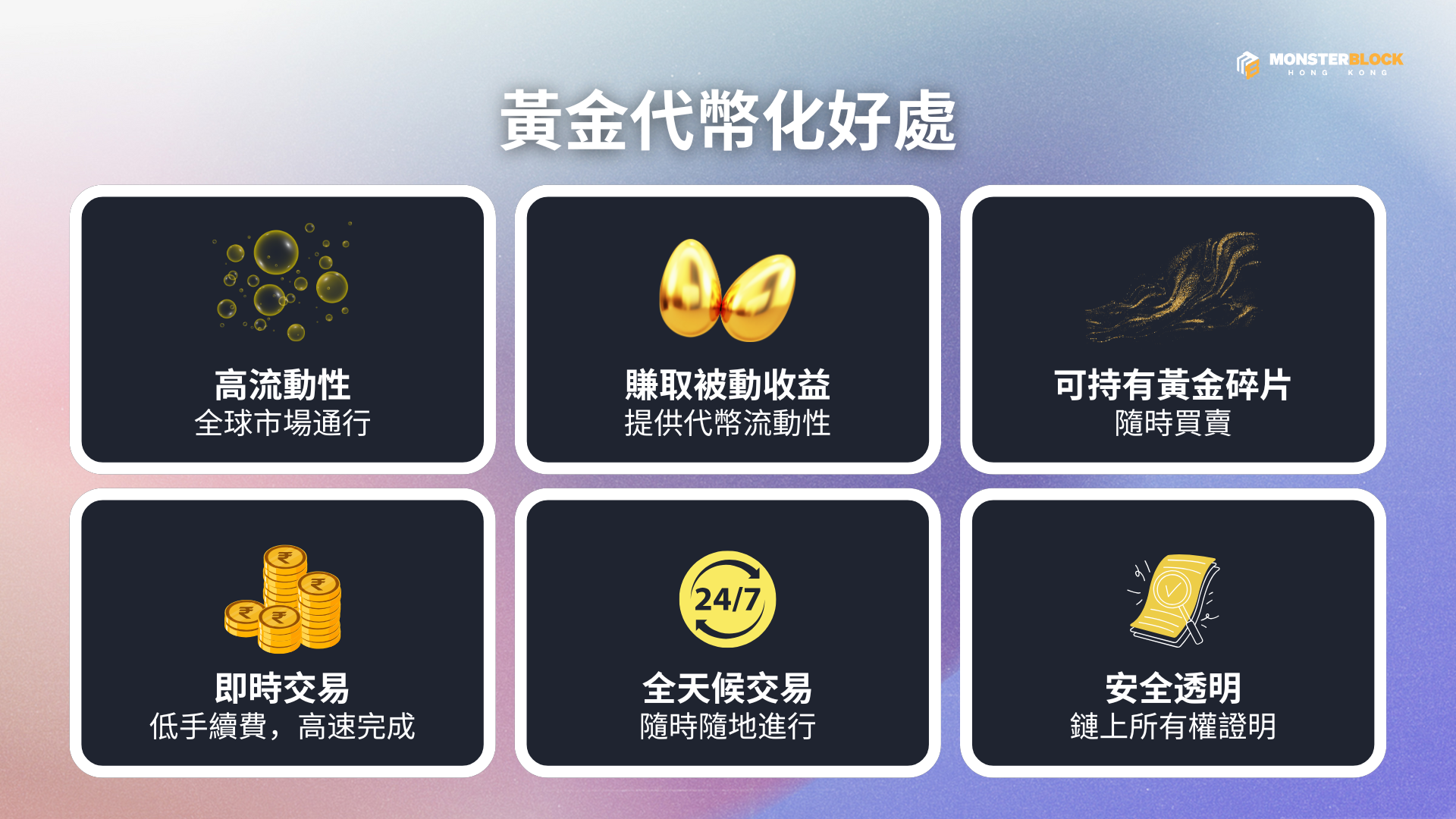
For example, the traditional gold market uses the ounce as the base unit, but through monetization, investors can even buy 1 gram or lessGold. The peer-to-peer transfer nature of blockchain allows gold tokens to be transferred globally as quickly as cryptocurrencies, reducing geographic and intermediary constraints.
Gold tokens can also be integrated into the DeFi ecosystem for collateralized lending, liquidity mining, etc., further unlocking the financial properties of gold. Compared to gold ETFs, tokenized gold has better trading time and flexibility, and the holders are able to trade gold when they meet the conditions.Convertible Physical GoldTo ensure that the value is anchored to the physical value.
Of course, gold tokens are also facing challenges in terms of regulatory recognition and market acceptance, but there have been a number of mature products launched in recent years, such as Paxos Gold and Tether Gold, which prove that there is a demand for this model in the market.
That's why gold tokenization is considered to be one of the most important issues in the RWA space.Most PotentialOn the one hand, gold's own value stability can provide a credit endorsement to the digital asset world, and on the other hand, blockchain technology brings a young investment base and globalized liquidity to the traditional gold market.
Can the Hong Kong market run on the RWA circuit?
Hong Kong's gold market wasn't built in a day. The Chinese Gold and Silver Exchange Society, established in 1910, was Asia's leading precious metals exchange at the time, and has maintained its credibility and influence in the trading of physical gold and silver for more than 110 years. You may wonder: can such a "century-old company" still have a role to play in the Web3 world? In fact, it can, because it relies not on gimmicks, but on a system of self-regulation and self-execution, and has built up a whole set of reliable spot gold trading system over a long period of time.
The biggest fear of gold tokenization is whether or not there is real gold bullion behind it. This is where the Hong Kong Precious Metals Assay Center (HKPMAC) comes in. It is wholly owned by the Chinese Gold & Silver Exchange Society and follows the international ISO/IEC 17025 standard to provide gold purity testing services for clients, and is also an authorized laboratory accredited by the Hong Kong Accreditation Service.
In other words, the purity of the gold bars or gold jewellery in your hand can be tested by it, and this level of certification is also tantamount to endorsing the monetization of gold. In terms of policy environment, the Hong Kong government's attitude towards virtual assets in recent years can be described as positive but cautious. Starting from 2023, they have called for the creation of an international virtual asset center, and have introduced a licensing system for exchanges and a stable currency regulatory ordinance under planning. Regulators have even explicitly pointed out that tokenized assets are an important direction for Web3's development.
This is not just a slogan because in the area of gold, it is stated in the policy address that it is necessary to consolidate Hong Kong's position as an international gold trading center.
Of course, there is a hard side to regulation, as the Regulatory Regime for Dealers in Precious Metals and Gemstones, which came into force in April 2023, requires all dealers in precious metals to register with the Customs and Excise Department (C&ED) and fulfill their anti-money laundering obligations. Although this is troublesome, it also provides a compliance framework for future gold tokens to prevent them from being used for money laundering. What about virtual assets? The Hong Kong Securities and Futures Commission (SFC) and the Hong Kong Monetary Authority (HKMA) have issued guidelines on tokenized securities and stablecoins, emphasizing that they must comply with the definitions of the Securities Act or obtain the appropriate licenses before they can be issued to the public. Although the legal position of gold tokens is still being explored, the official attitude is at least open to observation rather than sweeping. What does this mean? It means there is room for experimentation!
A number of local licensed brokerages and banks in Hong Kong have already ventured into tokenized gold pilots. HSBC launched the HSBC Gold Token in March 2024 (for Hong Kong clients only), which allows retail investors to hold gold held in the bank's custody through tokens; and the Hong Kong Gold Exchange (HKGX) of the Chinese Gold and Silver Exchange Society (CGSE) has seized the opportunity to develop digital gold products.
To sum up, Hong Kong's advantages in gold tokenization are as follows
- The credibility of the traditional gold market
- Government policy support and infrastructure investment
- Progressively clearer framework for compliance
GoldZip: An Innovative Practice of Gold Tokenization in Hong Kong
Hong Kong gold market has a hundred years of history, but the traditional investment in gold is either buying physical gold bars through gold shops or buying gold ETFs - both of which are subject to thresholds, trading hours and low liquidity. goldZip wants to solve the problem by allowing gold to be traded anytime, anywhere, 24 hours a day, with a low threshold for entry and liquidity at any time, just like cryptocurrencies. GoldZip
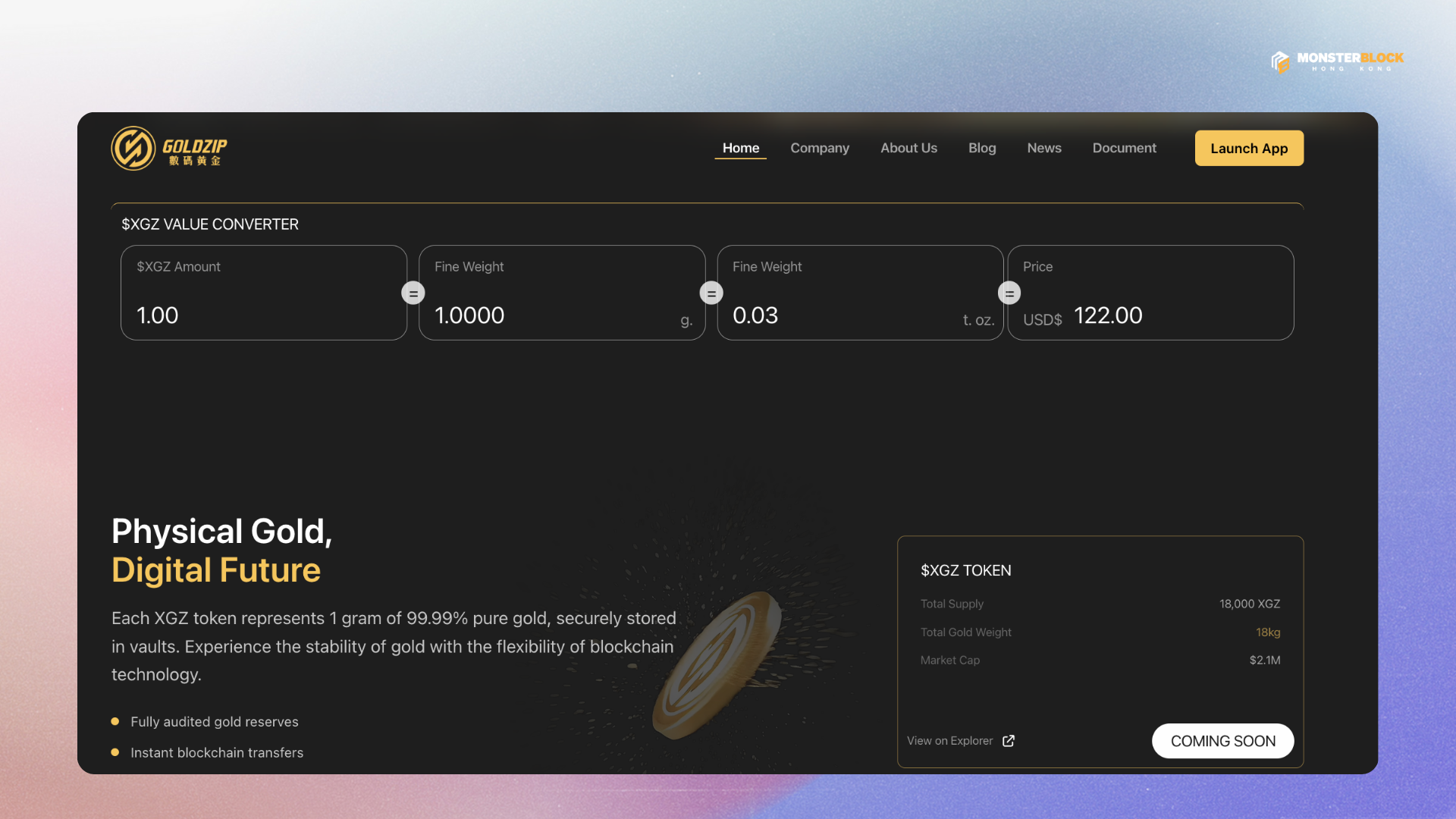
GoldZip is issued by HKGX through its Singapore subsidiary, GoldZip Pte. Ltd. and is regulated under the laws of Singapore (as a "precious metals dealer").
Behind each XGZ token is 1 gram of 99.99% pure gold. The gold reserve is held in 1 kg LBMA-accredited bars in a third-party vault managed by an internationally recognized custodian. GoldZip's gold is inspected by the Hong Kong Precious Metals Assaying Center (HKPMAC) to ensure that it is of the required fineness before it is placed in storage. GoldZip is also regularly audited, so an investor's holding of XGZ is effectively the same as holding the equivalent weight of physical gold, which is a fundamental guarantee of its value stability.
The smart contracts for the tokens will also undergo stringent auditing and security testing, and multi-signature wallets will be used to protect the underlying vault private key to prevent single point of failure leading to indiscriminate issuance or misappropriation of assets, and the project party will also publish regular reports on the gold holdings for public scrutiny.
This is tantamount to telling the users that their security is not just an empty promise, but is really backed up by gold bullion. Traditionally, gold is traded either through banks or gold dealers, and not only is the unit of measurement in ounces or tael, the amount of money can start from tens of thousands of Hong Kong dollars, and the transaction time is limited.
One of the innovations of GoldZip is that it significantly lowers the threshold of gold investment and improves the convenience of trading, allowing investors to trade gold tokens at any time through the mobile app or web interface, just like trading cryptocurrencies such as Bitcoin.
In addition to the Gas fee of the blockchain network, the platform only charges 0.01% transaction fee for each transaction, and the total cost of transferring 1 kilogram of gold tokens is less than 10 US dollars at the current price.
GoldZip has also refined the unit of gold trading to 1 gram. Based on the recent gold price of around HK$300+ per gram, a few hundred Hong Kong dollars is enough to enter the market, which is very suitable for young or small investors. Of course, for large investors, this group of investors can also quickly process large gold transactions at Goldzip without the need to move physical gold bars, thus improving efficiency and security.
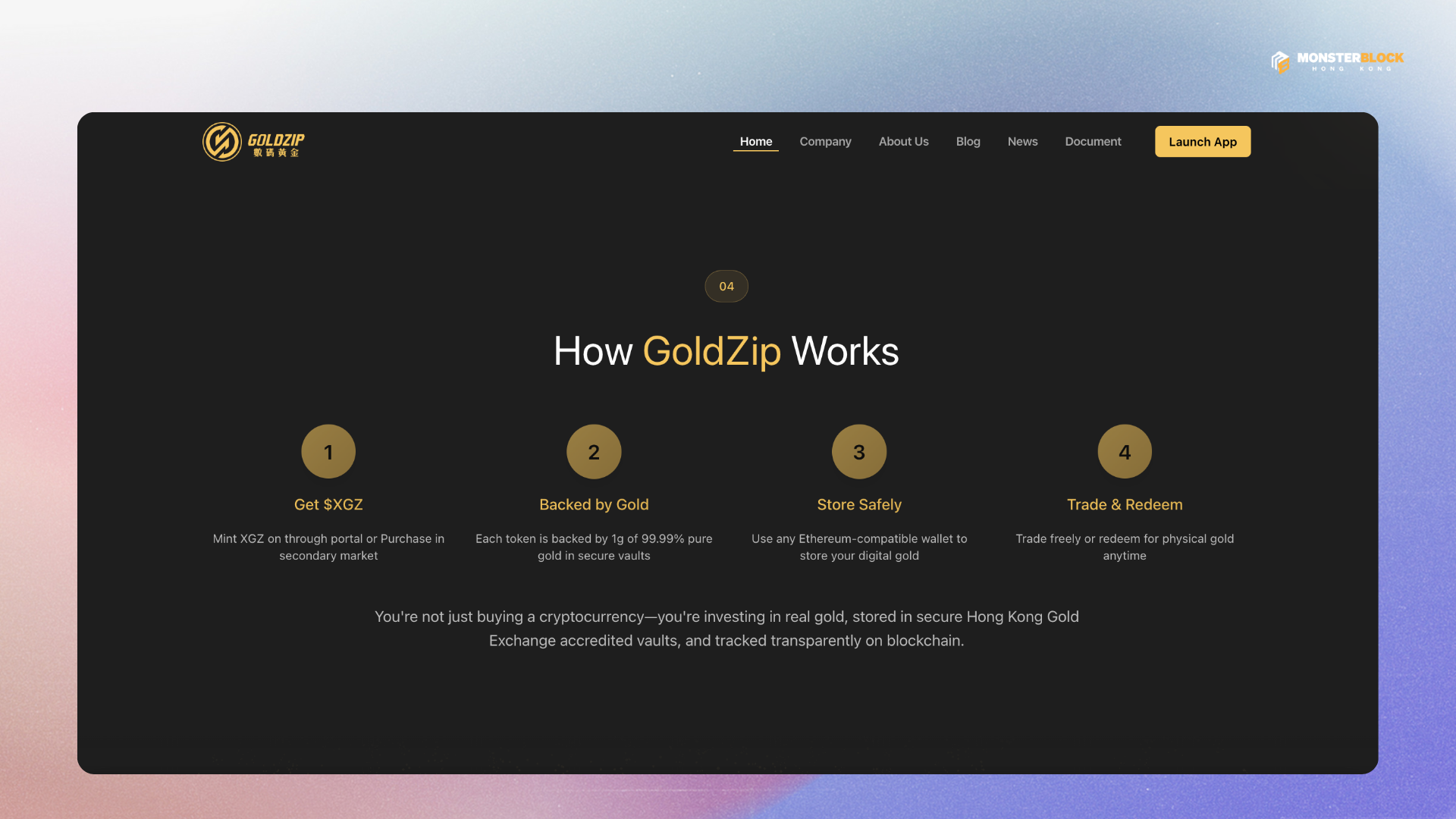
In terms of usage scenarios, GoldZip highlights its potential in the DeFi ecosystem, in addition to its investment and trading capabilities. As the XGZ token follows the ERC-20 standard (currently deployed on Arbitrum, Ether's second-tier network), it is able to easily access various decentralized financial protocols.
For example, in the future, users can use XGZ as collateral to lend stablecoins on other DeFi platforms, realizing the effect of "taking out a loan with gold", or offering XGZ mobility on decentralized exchanges to earn handling fees and token rewards.
Some of the more well-known gold tokens in the world include Paxos Gold (PAXG) issued by Paxos Trust in the United States and Tether Gold (XAUt) launched by Tether.
Each PAXG token represents one ounce of gold from the London Treasury and is regulated by the New York Financial Supervisory Authority (NYDFS) in the U.S., which is a high level of compliance, but the exchange threshold is skewed towards institutional investors, which makes it difficult for general retail users to participate.
XAUt, launched by Tether, the world's best-known stablecoin issuer, is also denominated in one ounce of gold and deposited in Swiss vaults, but conversion must be over 430 grams, which is a cumbersome process and limits flexibility for retail investors.
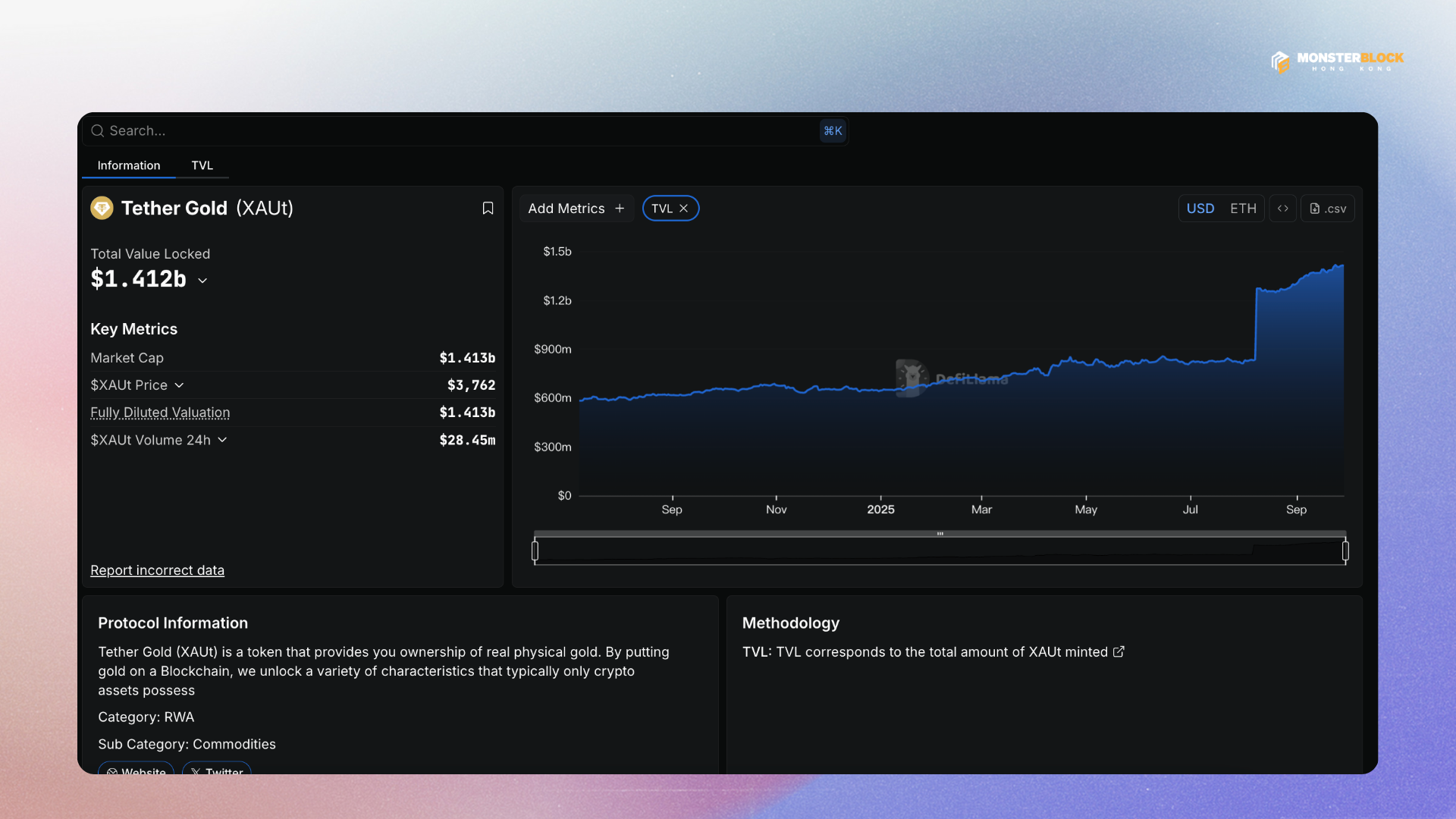
In contrast, GoldZip is backed by only 1 gram of gold per XGZ, which not only lowers the investment barrier, but also combines the 100-year history and compliance foundation of the Hong Kong Gold Exchange with a design specifically tailored to the needs of the Asian market. Deployed in Arbitrum, GoldZip's low transaction fees, speed and ability to expand into DeFi lending and income scenarios make gold not just a static safe-haven asset, but a truly flexible and liquid Web3 financial instrument.
GoldZip, as a newcomer, focuses on the Asian market and has the opportunity to link up the physical gold market in Hong Kong with the demand in the Mainland, thus forming a regional advantage; while international investors' perception of GoldZip will depend on whether its future liquidity and disclosure standards can be on par with those of PAXG and the like. It is foreseeable that as Hong Kong's local compliant crypto trading platforms continue to add GoldZip to their shelves for trading, and as the DeFi sector connects to the GoldZip liquidity pool, the token's market depth and price discovery functions will be gradually perfected.
Conclusion: Gold Tokenization Brings New Opportunities for Hong Kong's Financial Web3
Gold tokenization, as an important part of the RWA sector, is showing great potential for development. Through innovative projects such as GoldZip, we see that the combination of the traditional gold market and blockchain technology can create tremendous synergies: on the one hand, physical gold provides solid value and credit backing for digital tokens; on the other hand, blockchain gives gold a new vitality for 24/7 trading, global mobility, and programmatic finance.
For investors, gold tokenization lowers the threshold and cost of holding gold, provides more diversified asset allocation choices, and enriches the asset classes in the DeFi ecosystem, which is expected to bring in stable and high-value assets to participate in the market and improve overall liquidity. In particular, against the backdrop of rising uncertainty in the current macro environment, gold tokens are expected to become a stabilizing anchor in the digital asset market, bringing traditional hedge funds into the blockchain world.
If there is still something unclear after reading this, please join in! Telegram Community Ask questions and communicate together!
Recent Articles:
OKX Boost Airdrop Tutorial: Newbie to Advanced stroking Strategy
2025 Beginner's Guide|How to transfer USDT? From bank deposit to wallet receipt of coins complete instruction
Best Cryptocurrency Trading Platform for Hong Kong Users?2025 Latest Bitcoin Tips for Beginners
2025 Coin Ring Newbie Guide Lazybones|Chained Ecology Entry Guide

Disclaimer
The content of this article is for reference only, investors should exercise independent judgment, invest prudently and at their own risk, this article does not provide or attempt to persuade the audience to do trading or investment basis, the content is for sharing purposes only, and should not be regarded as investment advice.It does not represent the views and position of Monsterblockhk.All information and opinions are current as of the date of the judgment. In addition, if a judgment is rendered on aIn this siteAny content related to virtual asset trading platforms that have not yet obtained a license to operate virtual asset trading platforms in Hong Kong, including but not limited to text introductions, pictures, offers, events, etc., are only available to users outside the Hong Kong Special Administrative Region.
According to the Hong Kong Anti-Money Laundering and Counter-Terrorist Financing (Amendment) Ordinance 2022, after June 1, 2023, all centralized virtual asset trading platforms operating in Hong Kong or actively promoting their services to Hong Kong investors will be licensed and regulated by the SFC, and any related unlicensed activities will be a criminal offence. For more information and details of the legislation, users may refer to the SFC website.