

The Hong Kong Securities and Futures Commission (SFC) has issued a "Transitional Arrangements" notification letter in relation to the Virtual Asset Service Provider (VASP) licensing regime, which comes into effect today (6/1), offering a one-year transitional period (1 June 2023 to 31 May 2024) for digital asset platforms interested in applying for a license and already operating in Hong Kong with a substantive business in Hong Kong prior to 1 June to do so. The following is an in-depth look at the new VASP regime.
In response to the October 2022 Policy Declaration on the Development of Virtual Assets in Hong Kong, which aims to promote Hong Kong as an international virtual asset center, the Legislative Council of Hong Kong passed the latest amendments to the Anti-Money Laundering and Counter-Terrorist Financing Ordinance 2022 ("AMLO") on 7 December 2022, which means that Hong Kong's brand new Virtual Asset Service Providers licensing regime ("VASP regime") will come into effect on 1 June 2023 and will be implemented in Hong Kong. This means that Hong Kong's new Virtual Asset Service Provider licensing regime ("VASP regime") will come into effect from June 1, 2023 onwards.
On February 20, 2023, the Securities and Futures Commission (SFC) of Hong Kong released the VASP Consultation Paper and on May 23, 2023, it released the VASP Consultation Conclusions, which confirmed that the Guidelines Applicable to Operators of Virtual Asset Trading Platforms (the VASP Guidelines) will come into effect on June 1, 2023. This signifies that the Hong Kong Government, through more than half a year's planning, will actively welcome the new VASP regime with an open attitude towards the virtual asset market by then:
- All centralized virtual asset exchanges operating in Hong Kong or actively promoting their services to Hong Kong investors, whether or not they provide securities-based token trading services, must be licensed and regulated by the SFC.
- The SFC will finalize allowing licensed virtual asset exchanges to offer services to retail investors in the second half of the year, but only tokens that are not securities and are highly liquid in one of the traditional financial indices may be offered to retail investors.
- For stablecoins, the regulatory arrangements for stablecoins will be finalized in 2023/24 and a licensing and permitting system for stablecoin-related activities will be established. Until stable money is regulated, the SFC considers that stable money should not be included for retail trading.
i. background of the revision of the vasp system
In the VASP Consultation Paper, the SFC set out a clear background to the revisions that have been made to the establishment of the new VASP regime: in the ongoing crypto winter, a spate of crashes has exacerbated the risks in the virtual asset markets, and in particular, the collapse of the FTX, which has resulted in significant losses for tens of millions of investors.
The risks associated with the increasing proximity of virtual asset markets to traditional financial markets highlight the importance and need for effective regulation of the virtual asset industry. Major jurisdictions around the world are shifting their regulatory approach from lax (i.e., regulating from an anti-money laundering and payments perspective) to more relaxed (i.e., regulating from an anti-money laundering and payments perspective).Transformation into a more comprehensive(i.e. regulation from the perspective of investor protection).
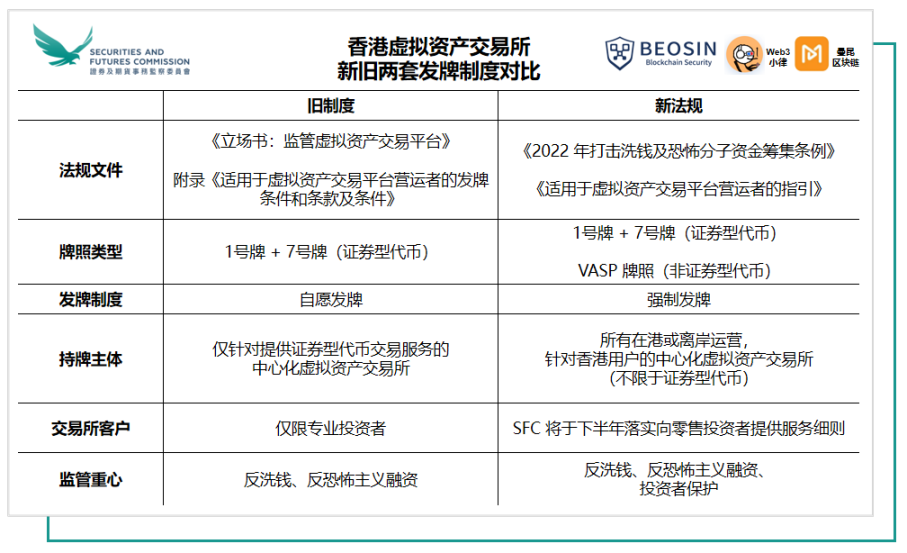
The SFC has led other jurisdictions in phasing in a "voluntary licensing" regime for securities-based token virtual assets as early as 2018. Explicitly provide that the SFC does not have the authority to regulate platforms that only trade in non-securities-based virtual assets or tokensThe VTBs are not required to be licensed under the "voluntary licensing" regime. Under the "voluntary licensing" regime, a license is not required for virtual asset trading platforms that are engaged in non-securities-based tokens. Only two virtual asset exchanges have been licensed to conduct exchange business under the "voluntary licensing" regime: OSL Digital Securities Limited, a subsidiary of the BC Technology Group, and Hash Blockchain Limited, a subsidiary of the HashKey Group, have been issued with License 1 (for securities trading) and License 7 (for providing automated trading services). (providing automated trading services).
Nowadays, the virtual asset industry has undergone tremendous changes and the original "voluntary licensing" regime can no longer cover today's market, which is dominated by retail investors and where non-security-based tokens are the main trading objects. In order to comprehensively regulate all centralized virtual asset trading platforms in Hong Kong and to implement the latest standards of the Financial Action Task Force on Money Laundering (FATF), the Hong Kong Government has amended the Anti-Money Laundering Ordinance and established a new "mandatory licensing" regime for VASPs, with a view to achieving a better balance between investor protection and market development. The Government has amended the AMLO and established a new VASP "mandatory licensing" regime with a view to striking a better balance between investor protection and market development.
Upon the formal implementation of the VASP regime, all centralized virtual asset exchanges operating in Hong Kong or actively promoting their services to Hong Kong investors, irrespective of whether or not they provide securities-based token trading services, will need to be licensed and regulated by the SFC.
Virtual Assets and Virtual Asset Services
The definition of VA under the AMLO will cover most of the virtual currencies in the market, including BTC, ETH, Stablecoin, Utility Token and Governance Token. For Stablecoin, the SFC also stated clearly in the Consultation Conclusions: The HKMA has released the "Consultation Conclusions on the Discussion Paper on Crypto Assets and Stablecoins" in January 2023, stating that the regulatory arrangements for stablecoins will be finalized in 2023/24, and that there will be a licensing and permitting regime for stablecoin-related activities. Pending the regulation of stablecoins, the SFC is of the view that stablecoins should not be included for retail trading.
The attributes of NFTs are linked to the attributes of the assets behind them, and there is no clear definition of this under the VASP regime yet. when the SFC issued a reminder to investors about the risks of NFTs on June 6, 2022, it stated that if the NFT is a true digital representation of a collectible (art, music or film), the activities associated with it are not regulated by the SFC. However, some NFTs cross the line between collectibles and financial assets and may have the attributes of "securities" regulated under the SFO and will therefore be subject to regulation.
Under Schedule 3 B of the AMLO and the VASP Guidelines, activities related to virtual asset services (VA Services) are defined as: operating a virtual asset exchange, i.e:
(a) Provide, through electronic facilities, services that meet the following descriptions:
(1) The service:
A. offers to buy or sell virtual assets are routinely made or accepted in such a manner that the making or acceptance of such offers creates a binding transaction or results in a binding transaction; or
B. persons routinely introduce or identify each other with a view to negotiating or completing a sale or purchase of virtual assets, or routinely introduce or identify each other with a reasonable expectation that they will negotiate or complete a sale or purchase of virtual assets in a manner that creates a binding transaction or results in a binding transaction; and
(2) in the case of the service, client money or client virtual assets are taken possession of, directly or indirectly, by the person providing the service; and
(b) any virtual asset trading activities and incidental services provided by the Platform Operator to its customers that are conducted outside the Platform, and any activities conducted in connection with virtual asset trading activities conducted outside the Platform.
Therefore, for (1) centralized virtual asset exchanges operating in Hong Kong, and (2) centralized virtual asset exchanges operating offshore that actively promote their services to Hong Kong investors, engaging in the relevant activities described above would fall within the scope of VASP. Under the AMLO53 ZRD, any entity operating a virtual asset service must obtain a VASP license from the SFC.
At present, apart from the above virtual asset services, other businesses such as market making, proprietary trading, futures contracts and derivatives are not allowed, but we do not rule out the possibility that the Hong Kong Financial Services and the Treasury Bureau will incorporate other virtual asset services by way of a notice published in the Gazette in the future.

III. Application for VASP License
Under the brand new VASP regime, applicants are licensed and regulated by the SFC in accordance with the AMLO and the VASP guidelines. Application for a VASP license imposes very high requirements on the company and its personnel:
A. Corporations: 1. have a company incorporated in Hong Kong with a fixed office location; 2. need to have a registered capital of not less than HK$5 million and a liquidity of HK$3 million or more; 3. subsidiaries or associated companies must have a Hong Kong Trust TCSP license for virtual asset custody.
B. Personnel: 1. the applicants, ROs, licensed representatives, directors and ultimate owners of the VASP must meet the SFC's fit and proper test; 2. at least two Responsible Officers (ROs) with experience in VASPs must be appointed, and the following conditions must be met: at least one RO must be an executive director of the VASP, at least one RO must be permanently resident in Hong Kong, and there must always be at least one RO overseeing the business; 3 . At least one RO must be a licensed representative of the VASP; 4. An auditor with experience in virtual asset business is required.
C. Compliance Requirements: In addition to the qualification and staffing requirements, there are a number of compliance systems that need to be met, such as VASP's Business Assessment Report, AML/CTF, and client asset management. According to the VASP Guidelines, the detailed requirements for these applications also include: fit and proper requirements, competency requirements, continuous training requirements, principles of business conduct, financial soundness, operation of virtual assets on the platform, prevention of market manipulation and non-compliance, trading with clients, protection of client assets, management, supervision and internal controls, network security, avoidance of conflicts of interest, record keeping, auditing, continuous reporting and auditing. Audit, continuous reporting and notification obligations.
IV. Compliance Requirements of the Exchange
A. Safekeeping of Client Assets
The Platform Operator shall hold Customer Money and Customer Virtual Assets in trust (TCSP Trust License) through a wholly owned subsidiary (i.e., a "Contacted Entity"). The Platform Operator should ensure that no more than 2% of Customer Virtual Assets are stored in the Online Wallet. In addition, since access to the Virtual Assets is enabled through the use of a private key, safekeeping of the Virtual Assets is essentially a matter of managing the private key. Platform operators should establish and implement written internal policies and governance procedures for private key management to ensure that all cryptographic seeds and keys are securely generated, stored, and backed up. In addition, the Platform Operator shall not deposit, transfer, lend, pledge, repledge or otherwise deal in, or incur any encumbrances on, Customer Virtual Assets. It shall also be required to maintain insurance coverage which shall cover the risks involved in the safekeeping of the Client's Virtual Assets.
B. Know Your Customer (KYC)
The Platform Operator shall take all reasonable steps to establish the true and full identity, financial situation, investment experience and investment objectives of each of its customers. In addition, the Platform Operator shall ensure that its customers are fully aware of virtual assets (including awareness of the risks involved) before providing any services to them.
C. Anti-Money Laundering / Terrorist Financing
Platform operators should establish and implement adequate and appropriate AML/CFT policies, procedures and controls. Platform operators may utilize virtual asset tracking tools to trace the records of specific virtual assets on the blockchain.
D. Prevention of conflicts of interest
Platform operators should not engage in proprietary trading or proprietary market-making activities and should have policies in place to manage internal employee trading on virtual assets to eliminate, avoid, manage or disclose actual or potential conflicts of interest.
E. Inclusion of virtual assets for trading purposes
The Platform Operator shall establish a function responsible for establishing, implementing and enforcing the criteria for the inclusion of Virtual Assets, the criteria for suspending, suspending and withdrawing Virtual Assets from trading, together with the options available to Customers. In addition, the Platform Operator shall conduct reasonable due diligence on any Virtual Assets before including them for trading and shall ensure that the Virtual Assets continue to meet all the criteria.
F. Preventing Market Manipulation and Illegal Activities
Platform operators should establish and implement written policies and controls to identify, prevent and report any market manipulation or illegal trading activities on their platforms. Such controls should include restricting or suspending trading upon detection of manipulative or irregular activities. The platform operator shall use an effective market surveillance system provided by a reputable independent vendor to identify, monitor, detect and prevent such manipulative or non-compliant trading activities and provide access to this system to the SFC.
G. Accounting and Auditing
Platform operators should select auditors with appropriate skill, care and diligence, taking into account their experience, track record and ability to conduct audits of virtual asset related businesses and platform operators. In addition, platform operators should submit an auditor's report for each financial year, which should include a declaration as to whether there has been a breach of applicable regulatory requirements. In addition, the SFC requires the Platform Operator to provide the SFC with a monthly report on its business activities within two weeks of the end of each calendar month and upon request.
H. Risk Management
Platform operators should put in place a robust risk management framework that enables them to identify, measure, monitor and manage all risks arising from their business and operations. Platform operators should also require customers to pre-fund their accounts and should not provide customers with any financial facilities to purchase virtual assets.
V. Transitional arrangements
The AMLO provides transitional arrangements for "pre-existing virtual asset exchanges", with a transitional period before June 1, 2024, for exchanges that are already operating in Hong Kong and have a meaningful and substantial business before June 1, 2023, including (1) exchanges that have or are applying for a license under the SFO. Exchanges that are already operating in Hong Kong and have a meaningful and substantial business before 1 June 2023, including (1) exchanges that have or are applying for a license under the SFO, and (2) unlicensed exchanges that carry on business in relation to non-safety tokens under the SFO, will be eligible to participate in the transitional arrangements.
Exchanges eligible to participate in the transitional arrangements must meet the conditions set out in Schedule 3G of the AMLO in order to continue to operate in Hong Kong from June 1, 2023 to May 31, 2024 and will be subject to the VASP licensing regime from June 1, 2024 onwards.
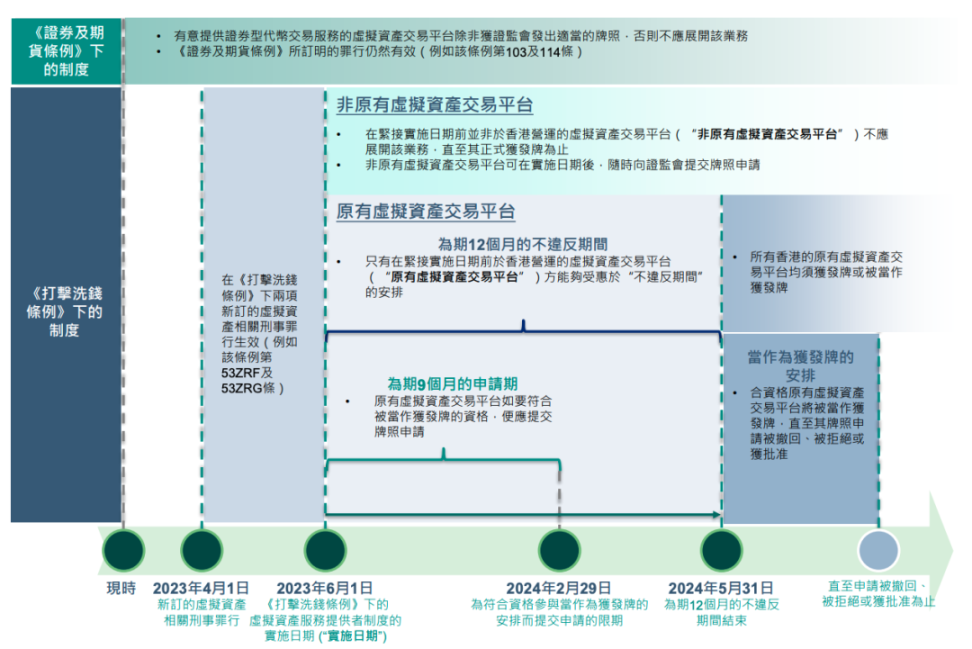
If the operator applies to the SFC within nine months of June 1, 2023 and confirms that it will comply with the regulatory requirements established by the SFC, the operator may be deemed to be licensed until the SFC makes a decision on its application for a license, during which time it will be able to continue to provide its services until the earlier of (i) the end of the first twelve months, (ii) withdrawal of the application, (iii) rejection of the application by the SFC, the and (iv) the SFC grants the license, whichever is earlier.
If its application for a VSP license is rejected by the SFC, it must terminate the business of its virtual asset service within 3 months of the notification of rejection or by June 1, 2024, whichever is later. During this period, the Operator may only take actions that are solely for the purpose of shutting down its services. The Operator may apply to the SFC for an extension of the closure period for such period as the SFC may deem appropriate having regard to the Operator's business and activities.
For "non-original virtual asset exchanges" that plan to provide virtual asset services in Hong Kong after June 1, 2023, they must apply to the SFC in advance and be issued a VASP license.
Conclusion
With the impending implementation of the VASP regime, applicants for VASP licenses should prepare in advance for the business compliance and the associated license applications, irrespective of whether they are: (1) virtual asset exchanges already operating in Hong Kong; (2) virtual asset exchanges operating offshore that are actively marketing their services to investors in Hong Kong; (3) intending to operate virtual asset exchanges in Hong Kong; or (4) traditional financial institutions intending to engage in virtual asset exchanges. Applicants for VASP licenses should prepare for the business compliance and related license applications in advance.
The VASP regime is being "channelled" through licensed exchanges, and in this context KYC and anti-money laundering (AML) compliance is a key priority. After this first step, we will see a series of rules and regulations on opening up investments to retail investors and how to protect them in the second half of the year. Only when the regulatory requirements are met can exchanges participate in the distribution of this huge cake and promote the long-term development of the market.
We can foresee that the "rise of the east and fall of the west" has become inevitable. With the fall of FTX, the tightening of regulation in the US, and the political games, Hong Kong will definitely regain its glory as a "crypto center" by relying on its own traditional financial foundation and perfect rule of law system, as well as the solid resources of the Mainland backed up by the front store and the back factory.