

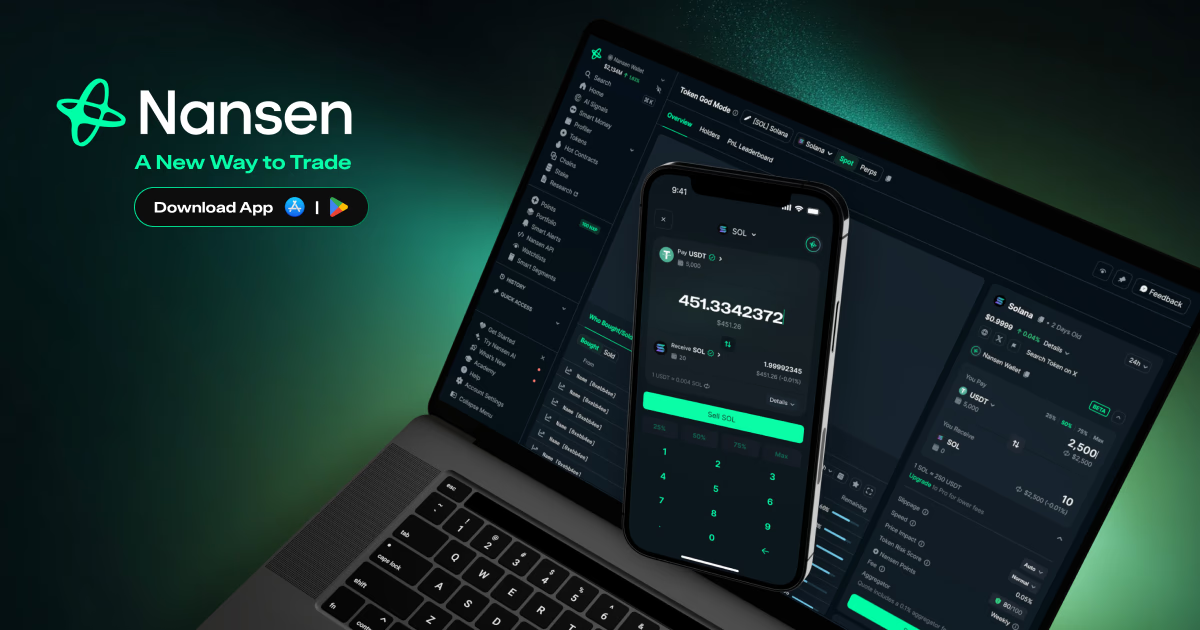
Whenever a new currency is launched on an exchange, there is always a group of people who have already laid out their plans. They don't rely on insider information or special talents, but rather on a simple fact: all transactions on the blockchain are public. This is the core logic of Nansen's on-chain analytics platform. It translates a string of hard-to-decipher hexadecimal addresses into comprehensible intelligence, allowing the average investor to track institutional wallets, VC capital flows, and even the position changes of top traders. In this article, we'll take a closer look at Nansen's operating mechanism, hands-on instruction, and whether the Pro version is worth subscribing to.
What is the core logic of Nansen?
From a String of Addresses to Readable Intelligence: What Nansen Did
The transparency of blockchains is often misunderstood. Many people think that since all transactions are on the chain, anyone should be able to see the same information. This is not the case. A 40-character wallet address means nothing to the average user unless you know who's behind it, what their past transactions have been, and what assets they currently hold. This is where Nansen's Chain Analytics platform steps in.
Nansen is an AI-driven blockchain analytics platform whose core value is the reorganization and tagging of information. The platform collects data on on-chain activity across more than 30 blockchain networks, and uses machine learning algorithms to transform this data into actionable intelligence. Rather than "mining" data, Nansen "translates" data - translating machine language into a decision-making framework that humans can understand.
According to official informationNansen Over 5 million wallet addresses have been tagged. These tags are not simply categorized, but are based on actual behavioral identification. The platform identifies which addresses belong to institutional investors, VC funds, exchanges, DeFi contracts, and even specific top traders, and this granular categorization makes subsequent data analysis meaningful.
The Meaning Behind 5 Million Wallet Labels
The value of wallet labeling lies in breaking the information asymmetry. In traditional financial markets, institutional investors have an informational advantage that comes from specialized analytical teams, market research capabilities, and policy channels. In the crypto market, this advantage should have disappeared because all transactions are on the public chain. But in reality, most retail investors have no way of extracting useful information from millions of transactions on the chain.
Nansen's labeling system reimagines information visibility. When you know that a wallet belongs to "Polychain Capital" or "Pantera Capital," you can track the investment movements of these top-tier organizations. When you see that an address labeled "Whale" has been buying tokens for the past 30 days, you no longer get a meaningless transaction history, but a verified signal of behavior.
These 5 million tags cover different dimensions of categorization. Some are identity tags (who is this address), some are behavioral tags (the past profit and loss history of this address), and some are risk tags (whether this address has been hacked before). It is this multi-dimensional tagging system that gives Nansen its unique tracking capabilities compared to other chain analytics tools.
Nansen in 2026: AI Agent Transaction Integration
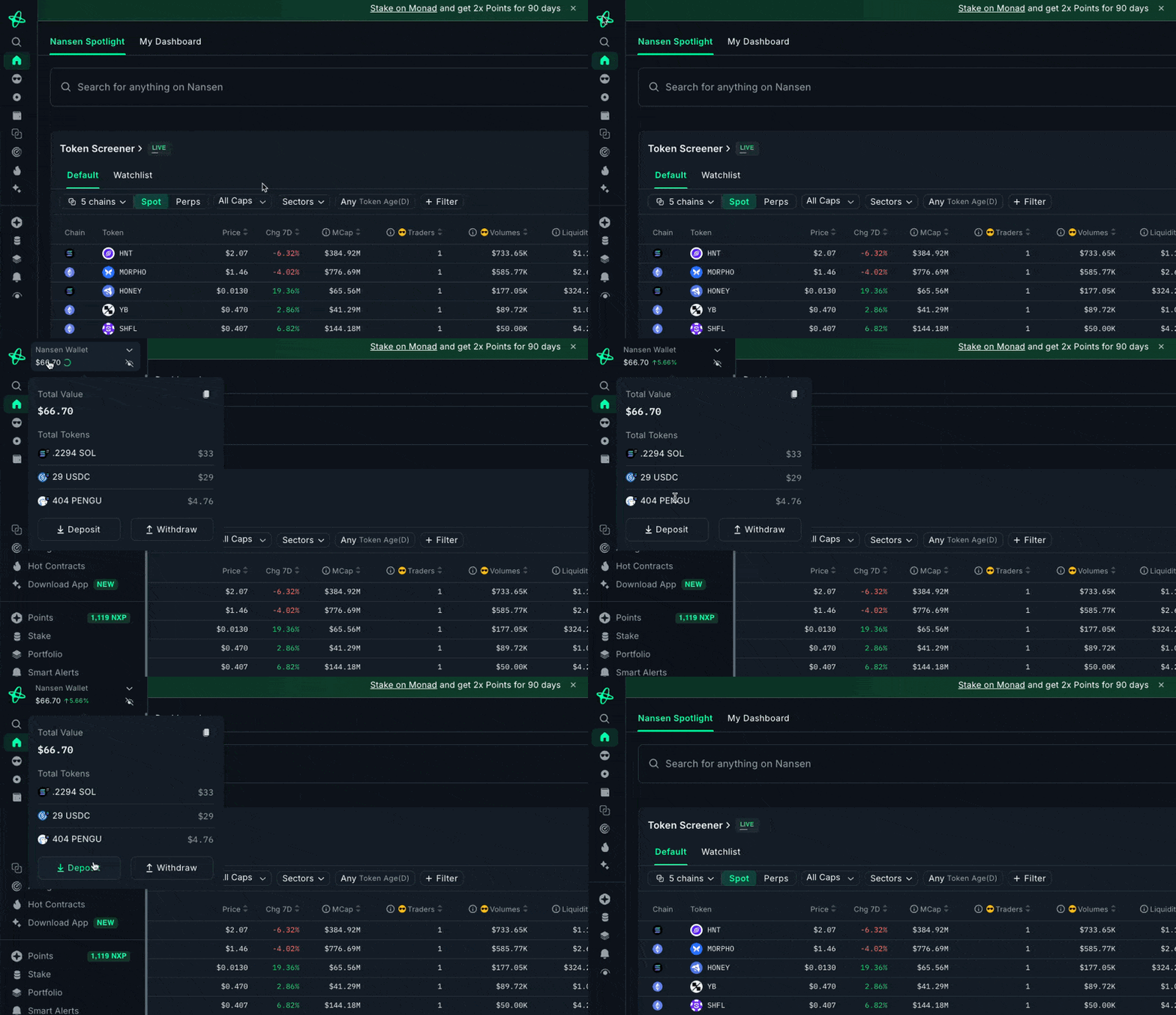
In 2026, Nansen's feature set expands once again. The platform's new Agentic Trading feature marks the leap from chain analysis to trade execution. Traditional analytics tools remain at the "signal finding" stage, where users need to manually evaluate, make decisions, and execute. Nansen's new feature integrates with major trading platforms such as Jupiter, OKX, LI.FI, etc., allowing users to execute trades directly after discovering a signal, without the need to jump to a third-party platform.
This improvement may seem simple, but it actually changes the positioning of the tool; Nansen has evolved from a simple "intelligence platform" to a "decision execution platform". For users with high trading frequency and high mobility requirements, this significantly reduces operational costs and risk exposure time.
In-depth analysis of Nansen's main features (free version)
Smart Money Tracker: It's not luck you're following, it's history!

Smart Money tracking is Nansen's core and most talked about feature among investors. In the daily crypto market discussion, "follow the smart money" has become a high-frequency term. Nansen's definition of smart money is not based on someone's guess or market rumors, but on historical performance.
Nansen's Smart Money tab identifies wallets that have consistently realized net profits in the past. The algorithm tracks a wallet's complete trading history, calculating its weighted average bid price, realized profit/loss, and unrealized profit/loss to determine the trading power of the address. An address is labeled as Smart Money only when it has experienced a sufficiently long time span (usually more than 6 months) and a sufficiently large trading volume.
This means that the "Smart Money" you see on the Nansen platform is not a subjective opinion, but a verifiable fact. Behind an address labeled as Smart Money is an accumulation of hundreds or even thousands of successful transactions. This is fundamentally different from following a community vlogger or listening to the grapevine.
On a practical level, the value of Smart Money tracking is realized in two ways. First, when multiple Smart Money addresses enter a particular token at the same time, it often indicates that a new narrative is forming at the institutional level of the market. Second, observing Smart Money position changes (additions, subtractions, liquidations) can provide a signal of a trend reversal. For example, if a Smart Money that has been making money in a bull market is reducing its position sharply as the price of tokens reaches new highs, this is usually a sign that the address is anticipating a possible correction in the near term.
Token God Mode: Who is holding this token?
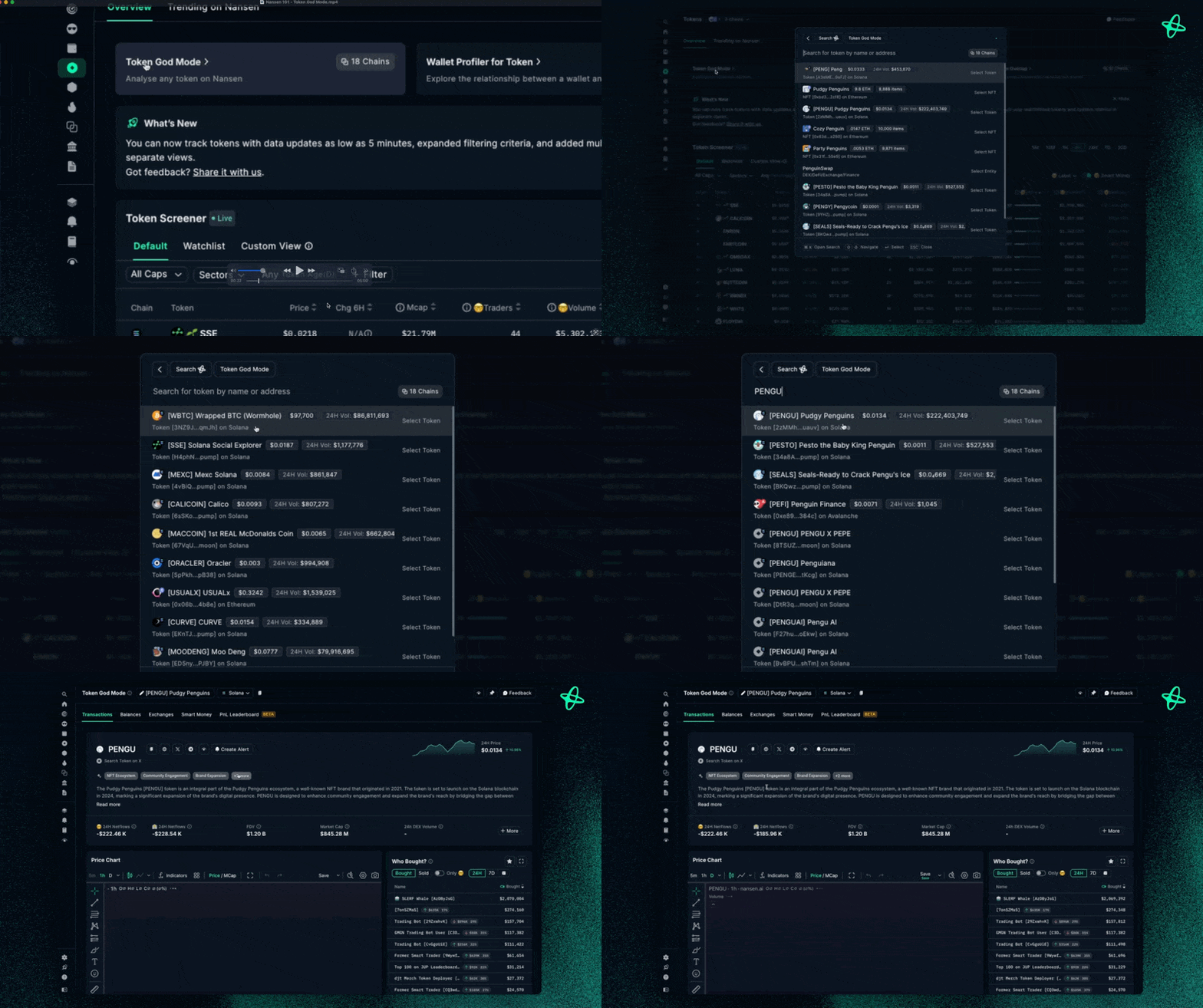
If Smart Money tracking answers the question "who is making money", then Token God Mode answers the question "who is holding". This feature allows users to drill down into any token to see its holder structure, money flow and concentration.
In Token God Mode, users can see which wallets hold a particular token, the percentage of positions held by each type of holder (institutional, trader, retail), the net inflows and outflows over the last 7 days, and the cost of trading for each wallet. This multi-dimensional view allows investors to quickly assess the liquidity structure and quality of holders of a token.
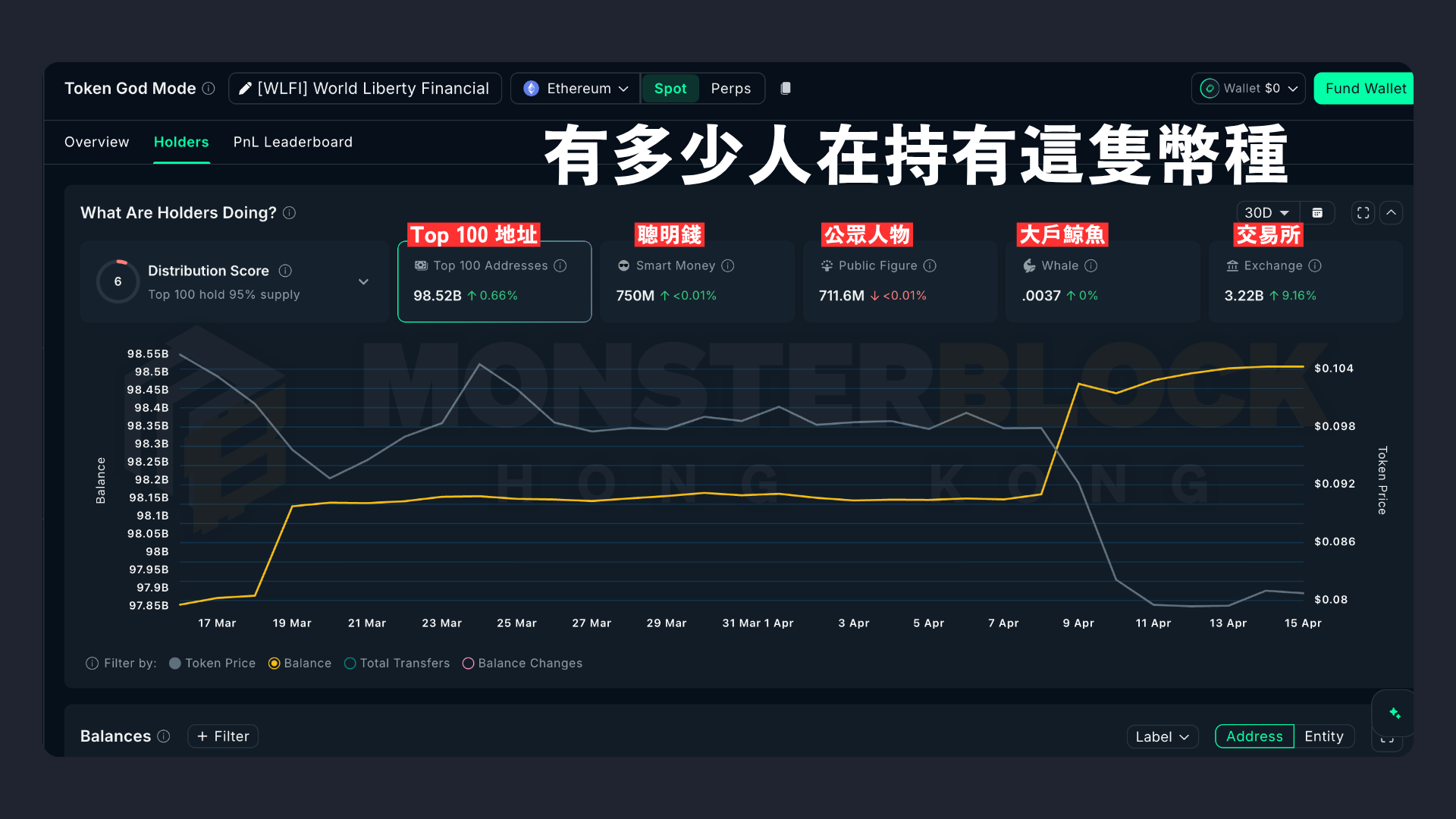
In particular, Token God Mode has built in an important risk indicator called "Whale Concentration". If the top 10 holders of a token have more than 70% in circulation, the risk of price fluctuation of that token is flagged as high. This is an intuitive warning to investors who are concerned about the security of their tokens.
From a market structure perspective, the Token God Mode also reveals an often overlooked phenomenon: different types of holders tend to have different behavioral patterns during the same period. Institutional investors tend to build their positions gradually when fundamentals change, while traders may follow quickly when price signals appear. By looking at the net flows of these different types of holders, you can infer which type of force is currently dominating the market.

Wallet Profiler: Turn a wallet inside out!
Wallet Profiler is an in-depth diagnostic tool that allows you to completely reconstruct the investment history and strategy preferences of any wallet address. Enter a wallet address and Nansen instantly displays a complete transaction history for that address for the past 12 months (or longer), the purchase cost of all tokens already held, the current unrealized profit/loss, and the DeFi agreement interactions involved.
The value of this tool is in "visualizing complex behavior. An institutional investor's wallet often involves hundreds or even thousands of transactions, making it nearly impossible to read the chain directly. But Wallet Profiler aggregates this data into a few clear indicators: total invested capital, current asset value, realized profit/loss, average holding period, preferred token type (e.g. Layer 1, DeFi, NFT), etc. The tool also provides a clear picture of an institutional investor's wallet, which can be used as a tool to visualize the complexity of a transaction.

More critically, the Wallet Profiler reveals "when this address is in and when it is out". This is critical for tracking an organization's investment cycle. A VC fund's investment wallet typically comes in early in a project, and the holding period can be as long as 2-3 years. When you see a VC fund take a small position in a project after 18 months, it's often a sign that the fund's confidence in the project is changing.

Smart Alerts: Let the Machine Keep Watch for You
The Smart Alerts feature allows the user to set up customized alert rules to monitor unusual chain activity on specific wallets, tokens or protocols. This is a time management tool, but it is essential for active traders.
Configurable alert rules include, but are not limited to: trading activity at a Smart Money address, large transfers of specific tokens, liquidity changes in the DeFi protocol, and collective buy/sell behavior at certain types of addresses. For example, you can set a rule that says "Send a notification when any address labeled 'Tier 1 VCs' has cumulatively bought more than $100K Solana tokens in the last 24 hours."
The Smart Alerts mechanism is continuous and requires no human intervention. Once setup, Nansen's backend system continuously scans the data in the chain to match your rule conditions. For investors who can't watch the market 24/7, this feature dramatically reduces the risk of missing important signals.
Hands-on Tutorial: How to track Smart Money with Nansen?

Step 1: Filter Potential Early Tokens in Token Screener
The Token Screener is Nansen's core tool for token discovery. Unlike other screening tools, Nansen's screening dimension is a mix of fundamentals and chain upticks. Open Nansen Official WebsiteIf you are a member of the Token Screener module, enter the Token Screener module.
You will see a filter panel that includes the following commonly used criteria: Coin Age (when the token was launched), Liquidity (the size of the pair's USD liquidity), Smart Money Inflows (the net inflow of Smart Money over the last 7 days), Holder Concentration, and Price Volatility.
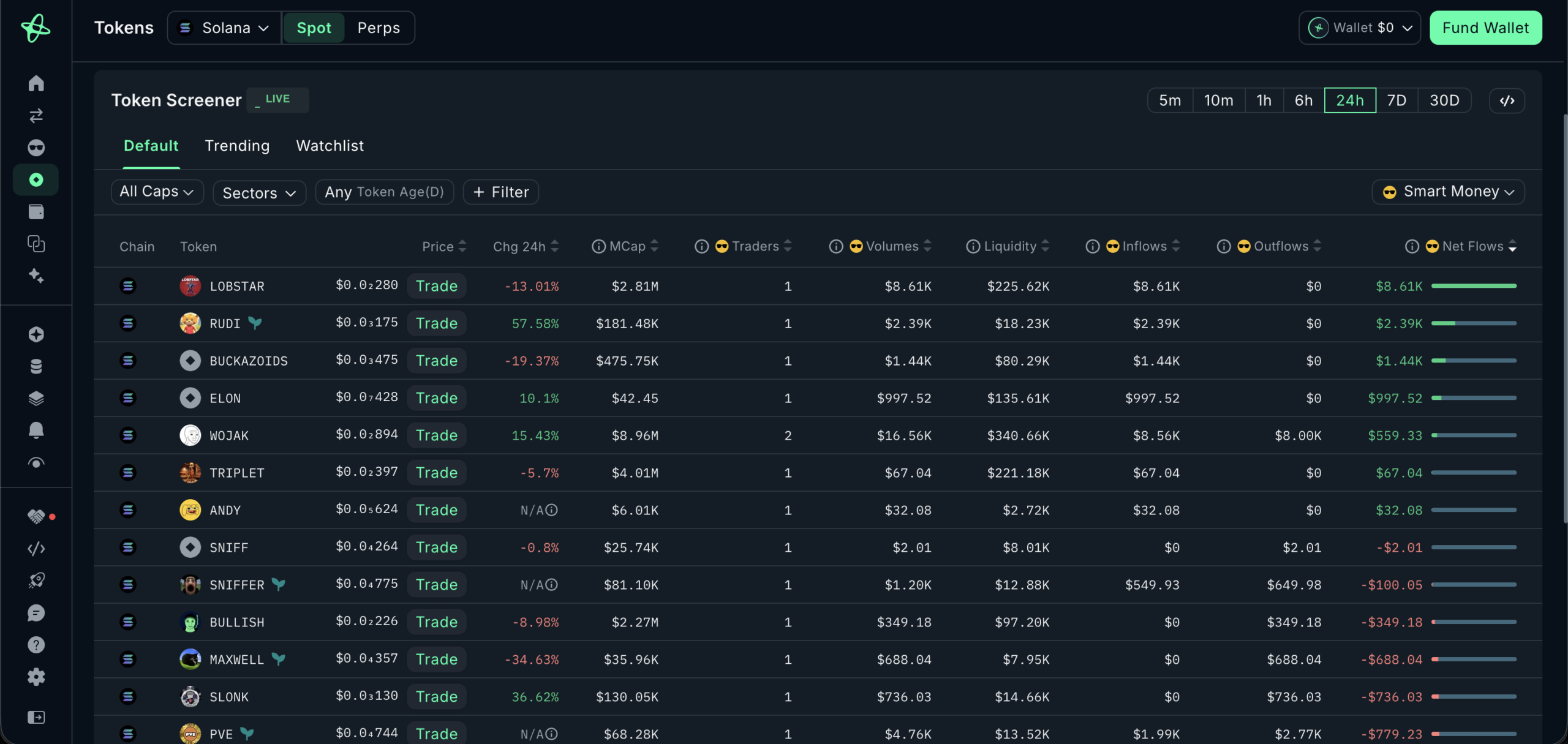
A common filtering strategy is: Coin age $100K, Smart Money 7-day net inflow > 0 (indicating that the organization is consistently buying rather than selling), and Top 10 holders < 60% (to avoid the risk of over-concentration). After setting these conditions, you will get a list of eligible tokens.
But the heart of this step is not blindly tracking the results of filters, but understanding "what combination of filters represents what market conditions". When you see an influx of new tokens on Smart Money's buy list, it tends to indicate that the market is entering a cycle of rising risk appetite. Conversely, if even liquid tokens are not attracting Smart Money buying, the market may be going through a cautionary cycle.
Step 2: Verify specific wallet behavior with Wallet Profiler
After filtering out the tokens of interest, the next step is to verify "which organizations are actually buying". At this point, you need to switch to Wallet Profiler.
On the Nansen platform, when you see a token labeled as a "Smart Money holding", click on the label to expand a list of holders. Select one of the addresses of interest (e.g. the wallet of a top VC fund) and go to the Wallet Profiler.
The Wallet Profiler page displays an overall overview of the wallet: historical total return, average holding period, and current portfolio structure. Scroll down and you'll see all of the wallet's transactions for the past 12 months, in reverse chronological order. Key information to look at includes: when the address bought in the target token (how long ago), the size of the purchase relative to the address' overall capitalization, and the address' past historical performance on similar tokens.
For example, if you find that a VC fund's buy size on a new token is only 0.2% of the fund's capital, this suggests that the fund has limited confidence in the project, or that the fund is still in the evaluation phase.
Conversely, if a trader who made a 100x return on an earlier Solana project invests a relatively large amount of money in a new project, this may warrant further attention. For more information on Smart Money tracking strategies, see Nansen Official Teaching Guide。
Step 3: Set up Smart Alerts for continuous monitoring of key signals
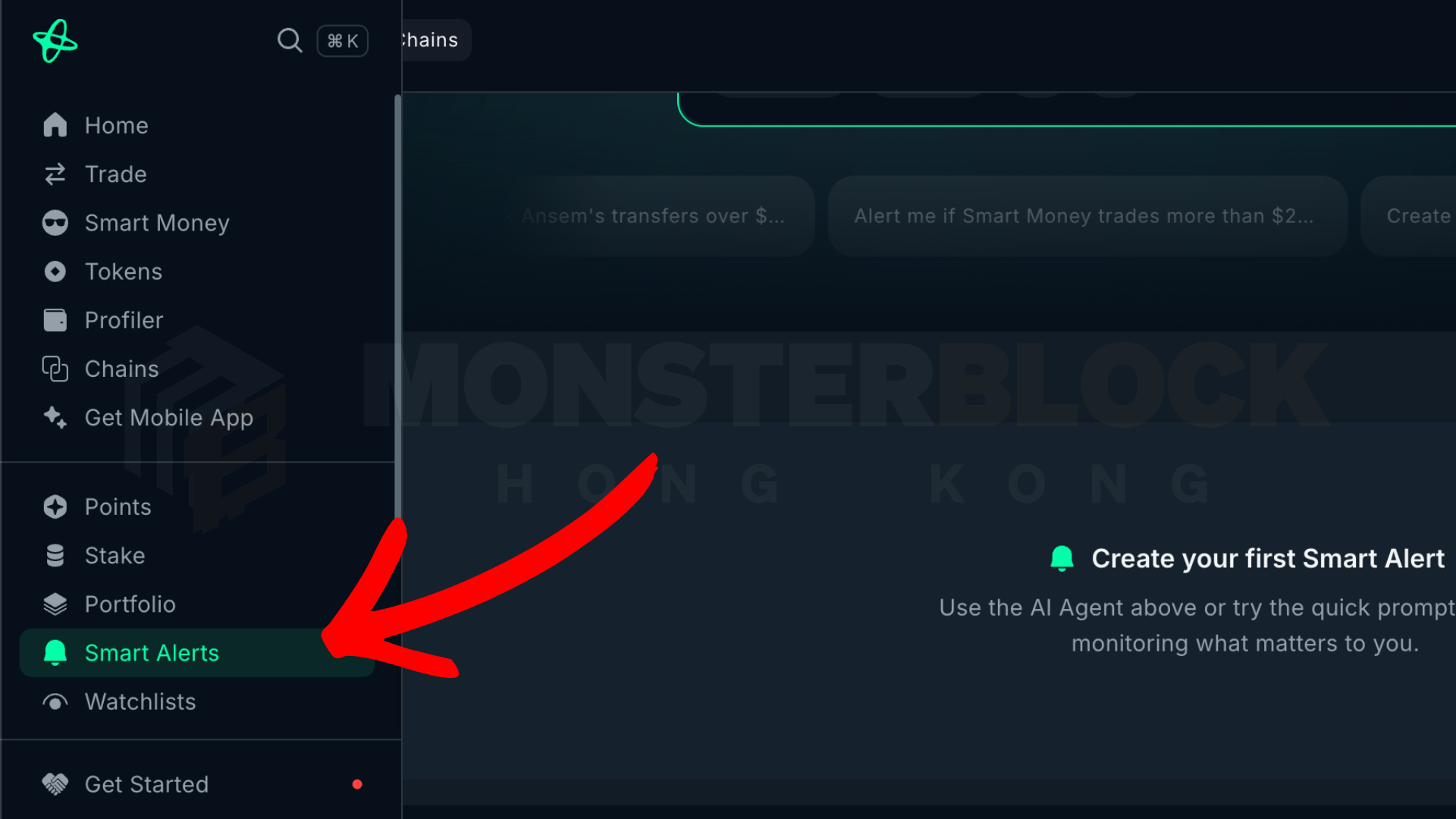
After completing the first two steps, if you decide to track a specific address or token, setting up Smart Alerts will allow you to be notified as soon as the event occurs.
In the Alerts module of the Nansen platform, click "Create Alert". You can choose who to monitor (a wallet address, a token, or collective behavior for a certain type of address), as well as the triggering conditions (buy/sell size, trade frequency, percentage change in position, etc.).
An example of a useful setup would be to monitor an address labeled "Tiger Global" and send a notification when that address makes a transaction of more than $500K in the last 24 hours. This way, instead of manually checking the movement of the address every day, you are automatically alerted when an important transaction occurs.
Nansen vs Glassnode: Which tool should I use?
Glassnode is one of the most recognized on-chain analytics tools in the crypto market, with industry-standard positions in macro-analysis of Bitcoin and Ether in particular. However, Glassnode has a completely different core positioning than Nansen!
Glassnode specializes in macro indicators of market cycles. On Glassnode you can see indicators such as "Number of Active Bitcoin Addresses", "Net Outflows from Miners", "Net Inflows from Exchanges", etc., which allow you to infer where the market is in the cycle. These indicators are useful for determining whether it's a good time to enter the market.
Nansen focuses on the movement of capital at the micro level, it focuses on who is buying rather than the macro sentiment of the market. If Glassnode is a thermometer of market sentiment, Nansen is a tracker of capital flows.
In terms of pricing, Glassnode's Pro version is about $833/month, much higher than Nansen's $69/month.
Glassnode's high pricing reflects its professional institutional investor client base, while Nansen's price reduction strategy (formerly up to $1,299/month, now down to $69/month) suggests that it is aiming toExpanding the retail investor market!
What is the difference between the free version and the paid Pro version? (Comparison chart attached)
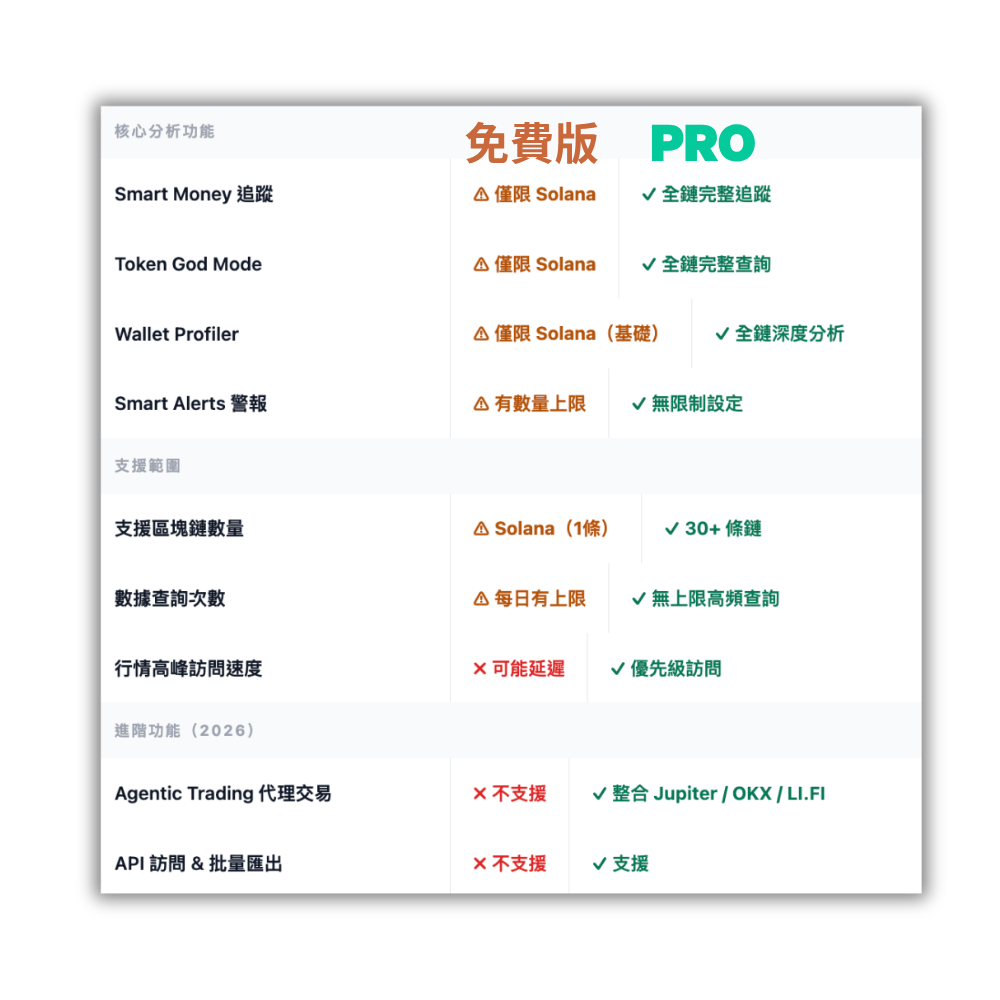
The free version of Nansen provides full feature support on the Solana ecosystem. If you are primarily interested in the Solana project, the free version is sufficient for Smart Money tracking, Token God Mode queries and basic Wallet Profiler analysis. This allows Solana users to enjoy most of the core features at virtually no cost.
However, once you get involved with other mainstream chains (e.g. Ether, Arbitrum, Optimism, Polygon, etc.) or need to use advanced features, the limitations of the free version become apparent. Specifically, the features added to the Pro version versus the free version include:
Full Cross-Chain Access: While the free version restricts access to Ether and other non-Solana chains, the Pro version opens up full data for all 30+ supported chains. This is critical when a VC fund is deployed on multiple chains at the same time.
Unlimited Settings for Smart AlertsThe Pro version allows unlimited creation of customized monitoring rules: while the free version has an upper limit on alert settings, the Pro version allows unlimited creation of customized monitoring rules. This is a must for professional traders who track multiple addresses and tokens.
Higher data query limits: While the free version has a limit on the number of queries per day, the Pro version removes the limit and allows users to perform high-frequency analysis queries.
Priority Visits: The Pro version gets priority access during peak traffic periods (e.g. when the market fluctuates dramatically) to ensure the platform's response speed.
AI Proxy Trading Functionality (2026 New): This is Nansen's newest feature, which allows users to execute trades directly after spotting a signal, without having to jump to a third-party platform.
Is the cost of the $69 monthly fee a good value for money?
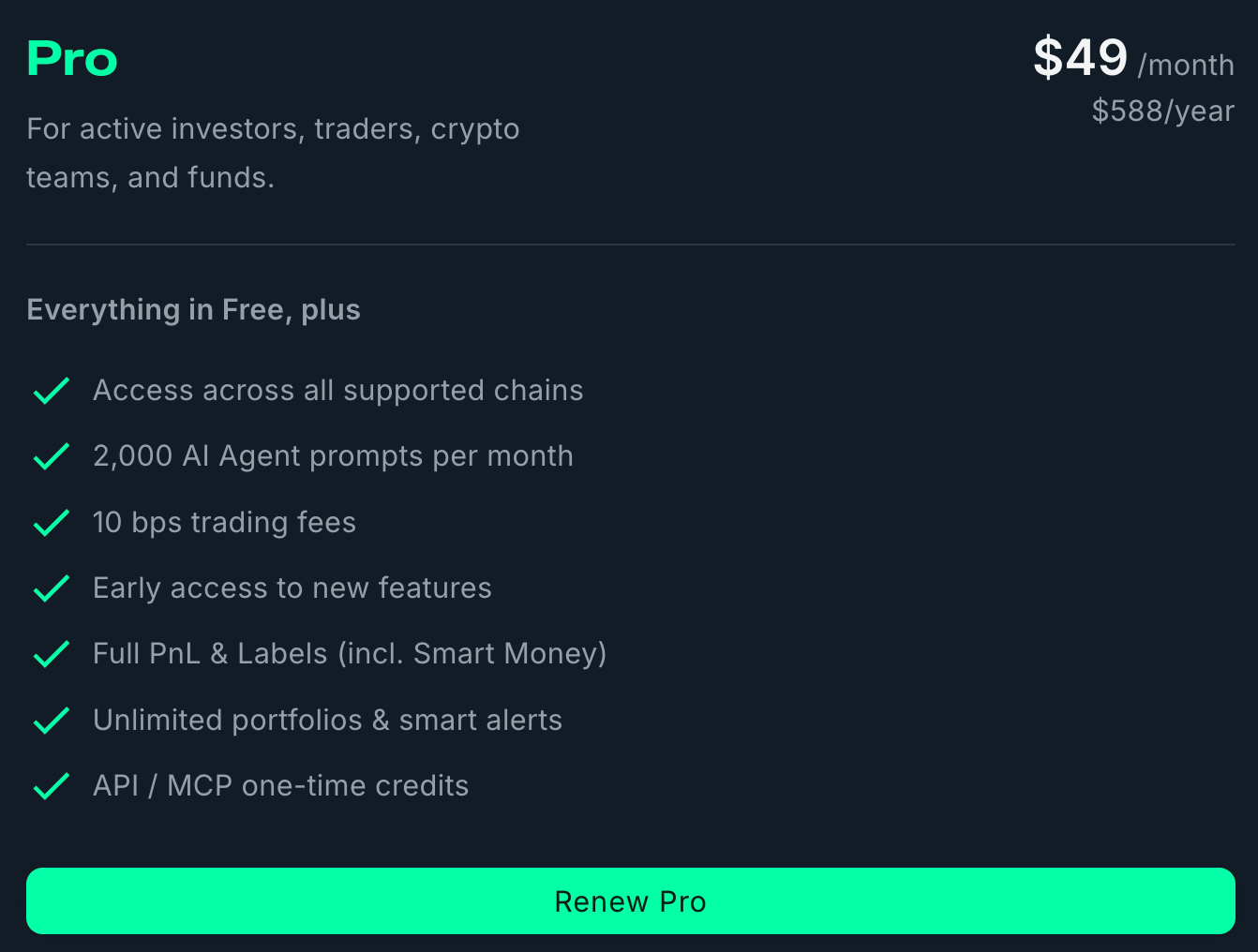
The monthly cost of #Nansen Pro is $69, while the annualized version is about $49/month (i.e., $588/year, which is a savings of about 30% over the monthly payment). From a cost perspective, the annualized monthly payment is $828. Compared to the cost of a traditional financial research subscription, which is often in the thousands of dollars/year, the annualized cost of $828 is very low.
It's worth noting that Nansen has dramatically adjusted its pricing strategy over the past few years! While the previous Professional plan was priced at $1,299/month, the current Pro pricing represents a drop of over 95%. This change reflects Nansen's shift from an institutional tool to a mass-market tool.
For detailed function comparison, please refer to CryptoAdventure's 2026 Nansen Depth Review。
In a bull market environment, Nansen's value is fully realized when Smart Money's buy signals are in line with the market's uptrend. However, in a bear market or an oscillator, the validity of the signal decreases significantly. Therefore, the cost-effectiveness of Nansen Pro is cyclical.
Should I subscribe to the Pro version? How do I know if I'm a good candidate?
Active investors who trade frequently: With more than 20 transactions per year and high information timing requirements, the annual cost of $828 is negligible relative to its transaction frequency and potential revenue.
Multi-Chain Portfolio Manager: If your portfolio spans multiple chains such as Ether, Arbitrum, Polygon, etc., cross-chain access in Pro is a must.
Professional Cryptography Researcher: Whether you work for a fund company or independently, if your job involves writing investment reports or conducting market analysis, Nansen Pro's data support can boost your productivity.
Users who want to use AI for proxy trading: If you want to use the latest Agentic Trading features, the Pro version is a must.
On the contrary, the following people do not need Pro:
Investors focusing on Solana's ecology: Since the free version provides full functionality on Solana, the additional cost of the Pro version does not yield enough marginal value.
Long-term position holdersIf your investment strategy is "buy and hold for 12 months", high-frequency data queries and real-time alerts are not necessary for you.
Very small retail investorsIf your annual investment is less than $5,000, it is recommended that you dive into the free version first, and then evaluate whether to upgrade when your capital grows.
Now through Monsterblockhk Recommended Links(Promotion Code MBHK10) First time subscriber enjoys 10% discount, which is equivalent to a reduction in monthly fee from $69 to $62.1.Annual cumulative savings of about $60-$80 are enough to offset some of the costs for many months!
Conclusion
The real answer to "why the smart money knows it first every time" is not that they have insider knowledge or superhuman abilities, but rather that they have the tools and understanding of the market structure. The transparency of the blockchain is inherently public, and the value of Nansen's on-chain analytics tools is in translating this public information from a disorganized on-chain record into an actionable decision-making framework.
If you are willing to invest the time to deeply understand the nature of on-chain analytics, and you are active enough to generate marginal value, then the cost of $69/month is reasonable. But if you're expecting Nansen to become a "moneymaker", then that expectation can only be dashed by disappointment.
In a crypto market where information asymmetry is gradually being eliminated, the real value of Nansen is to help you think and act more clearly as information asymmetry is eliminated. If you are ready to learn about chain analysis, start with the free version and explore each module in depth. When you start to feel limited by the number of queries or cross-chain access, it's the perfect time to upgrade to Pro!
Recent Recent Posts:
2026 Latest 6 Free Coin Ring Tools Inventory|Where to find the data on the chain?
2025 Latest OKX Web3 Wallet Tutorial: Does it work? How to create it? A Guide to Safe Operation, Multi-Link Support, and Time-Limited Airdrops
2026 Latest Polymarket Tutorial|How to find out the insiders and realize the high win rate!
2025 New DeFi Beginner's Guide|Teaching you to earn stable money passive income! Introducing 3 popular programs, DeFiLlama tool tutorial!
Disclaimer
The content of this article is for reference only, investors should exercise independent judgment, invest prudently and at their own risk, this article does not provide or attempt to persuade the audience to do trading or investment basis, the content is for sharing purposes only, and should not be regarded as investment advice.It does not represent the views and position of Monsterblockhk.All information and opinions are current as of the date of the judgment. In addition, if a judgment is rendered on aIn this siteAny content related to virtual asset trading platforms that have not yet obtained a license to operate virtual asset trading platforms in Hong Kong, including but not limited to text introductions, pictures, offers, events, etc., are only available to users outside the Hong Kong Special Administrative Region.
According to the Hong Kong Anti-Money Laundering and Counter-Terrorist Financing (Amendment) Ordinance 2022, after June 1, 2023, all centralized virtual asset trading platforms operating in Hong Kong or actively promoting their services to Hong Kong investors will be licensed and regulated by the SFC, and any related unlicensed activities will be a criminal offence. For more information and details of the legislation, users may refer to the SFC website.