

In the world of DeFi, large trades are often accompanied by high risk, but there are few events that shock you with the relentlessness of the market mechanism like the Aave Giant Whale Slippage case. Imagine holding $50 million in assets, trying to convert them to another token, and then ignoring a warning and instantly losing nearly 99% in value, leaving you with just over $30,000!
This is not a hacking attack or a protocol breach, but rather a "legal" looting of market liquidity combined with MEV robots.
This incident occurred in March 2026 and quickly became a hot topic on Twitter, not only exposing common blind spots for DeFi users, but also raising questions about the design of the protocol. Why did this happen? What are the misconceptions in the marketplace that make people overlook the risks? After reading this article, you'll not only understand the full story, but also learn how to protect yourself from becoming the next victim in a similar situation.
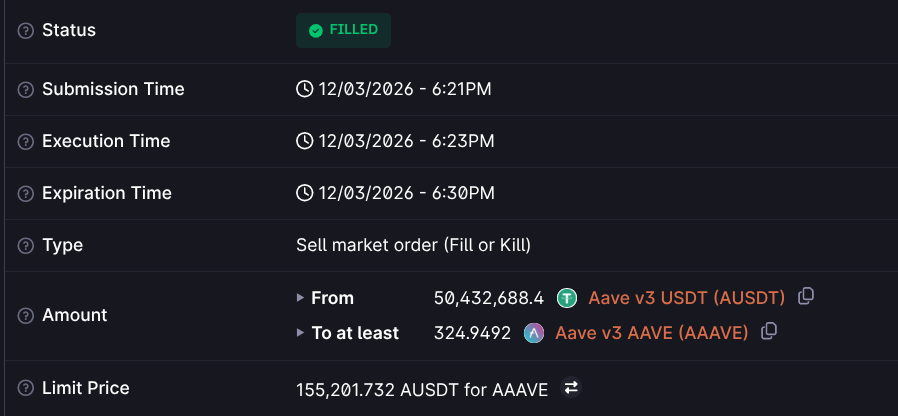
The Full Story: From $50 Million to $30,000 in a Flash
The cause of this incident seems simple: a Giant Whale user attempted to convert approximately $50.5 million in aEthUSDT to aEthAAVE on the Aave protocol, a leading DeFi lender that provides a built-in exchange interface that optimizes routing through the CoW Swap protocol. The problem was with the routing, and the transaction ended up in an extremely illiquid SushiSwap pool. The initial quote showed price shocks as high as 99%, meaning that users should have been alerted to the fact that the trade would be very costly.
According to a response from Aave founder Stani Kulechov on Twitter, the user was using a mobile device when he clearly saw the slider warning and checked the confirmation box to force the transaction. As a result, the user received only 324 AAVEs worth about $36,000, a loss of nearly $50 million. This was not a theft of funds, but an "inefficient transaction" caused by extreme slippage. Slippage is the deviation of a trade's execution price from the expected price. In an illiquid pool, large orders can push up the price, causing users to buy high and sell low.
Why was SushiSwap selected for routing?CoW Swap, as a DEX aggregator, automatically finds the best route, but the order was too large and exceeded the depth of most pools. Afterwards, the CoW Swap team admitted on Twitter that, despite clear warnings in the interface, DeFi's license was not designed to be risky, and that allowing users to make their own choices posed a risk. They committed to refunding about $600,000 in fees and reviewing how to strengthen safeguards while preserving user autonomy.
Recent Recent Posts:
2026 Latest 6 Free Coin Ring Tools Inventory|Where to find the data on the chain?
2025 Latest OKX Web3 Wallet Tutorial: Does it work? How to create it? A Guide to Safe Operation, Multi-Link Support, and Time-Limited Airdrops
2026 Latest Polymarket Tutorial|How to find out the insiders and realize the high win rate!
2025 New DeFi Beginner's Guide|Teaching you to earn stable money passive income! Introducing 3 popular programs, DeFiLlama tool tutorial!
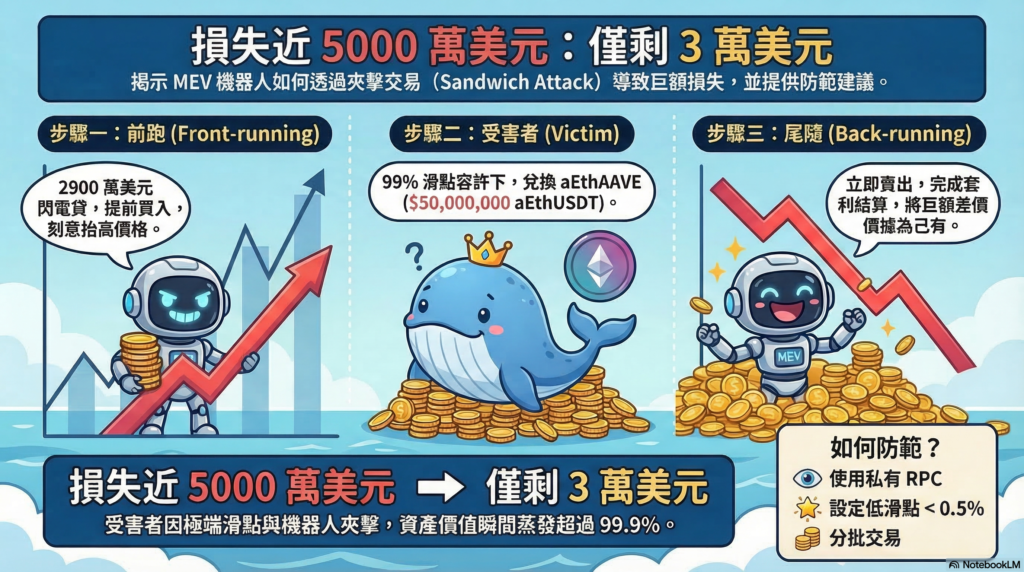
This is not an isolated incident. Looking back at DeFi's history, similar slippage tragedies have occurred from time to time, such as the one in late 2025 when a whale lost millions of dollars on Uniswap after ignoring slippage. But the scale of this one begs the question: why doesn't the agreement mandate limits on high slippage trading? In fact, Aave and CoW Swap are designed on the principle of "permission is not required" and users are responsible for their own decisions. But this also exposes a common misconception in the market: many people think that the DeFi interface is as secure as a traditional banking app, ignoring the complexity of the back-end mechanism.
On Twitter, the story quickly festered. User @ShawnCT_ taunted, "God gives $50 million to the dumbest traders and lets them vaporize it with one click." This reflects the polarized view of the market: sympathizing with the victims on one hand, and criticizing their negligence on the other. Another user, @benjii, analyzed the situation in depth, pointing out that DeFi UX is still immature and suggesting the introduction of AI risk alerts or email confirmations to prevent cell phone mishaps.
MEV Robotic Arbitrage Mechanisms Disassembled: a four-part series on the Sandwich attack
MEV (Miner Extractable Value) was the central driver of this incident.
It refers to the opportunity for block producers to profit by reordering transactions. On Ether, transactions first enter the Public Mempool, where MEV bots can scan and manipulate the order. In this case, an MEV bot executed the classic Sandwich Attack, profiting between $9.9 million and $12 million.
Let's break down this gameplay step by step!
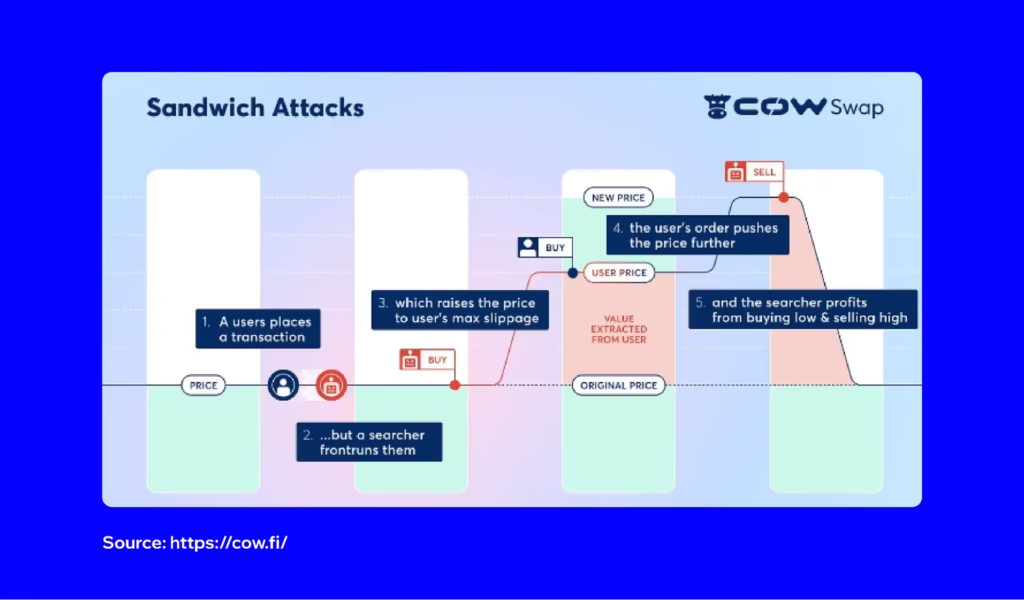
First, the bot detects a huge purchase from the victim. This transaction is exposed to the public memory pool and is not protected by private RPCs such as Flashbots Protect. The bot immediately recognizes the opportunity: the victim will buy AAVE in a low liquidity pool with a huge price shock.
Step 2, Front-run: The bot negotiates a flash loan of about $29 million ETH from Morpho, with no collateral required. Then, before the victim closes the deal, it buys AAVE in the same pool to push the price up. At the time, the market price was around $111-120, but after the robots took over, the price in the pool instantly shot up to an inflated level of $154,000. This was because the pool was not deep enough and large purchases would distort the price curve.
As you can see in the picture above, this is a visualization of a typical Sandwich attack. The robot buys first to drive up the price so that the victim can buy more.
Step 3: The victim closes the deal: the victim's order is then executed and he is forced to buy at a very high price. The user was supposed to get tens of thousands of AAVEs, but ended up with only 324. The slippage tolerance was set too high to allow this transaction to go through.
Step 4, Back-run: The robot immediately sells the purchased AAVE back into the pool, capitalizing on the "high liquidity" created by the victim. After paying off the flash loans, the net profit is millions of dollars. The entire process is done within the same block, as the block builder can reorder transactions (Reordering Within Blocks). Ethernet generates a block every 12 seconds, and the builder is free to decide the order as long as the block is valid. This allows MEV robots to pinpoint their victims.
Why is Flash Credit an amplifier? It allows robots to operate with no capital and very low risk. But it also amplifies the market asymmetry: the average user is unaware, while the bot scans the memory pool 24/7. According to the references, this is a textbook case of toxic MEV, and CoW Swap is touted as MEV-resistant, but it's still not safe from routing errors.
In real markets, MEV arbitrage is not always malicious. It sometimes corrects for price deviations, but it is often an invisible tax to the user. Why do many people ignore MEV? Because on the surface, DeFi trading is as simple as a stock app, ignoring the risks associated with the transparency of the memory pool.
Common Market Misconceptions: The Perception Gap Between Slippery Points and MEVs
Slippage and MEV are often oversimplified in the market. Many people think that slippage is only a small deviation, ignoring the fatal nature of large trades.
For example, in this case, the user set a slippage tolerance of 1.21%, but the actual price shock amounted to 99%.
Misconception #1: Slippage is a matter of agreement.
In fact, it is the result of a liquidity mismatch. the SushiSwap pool is not deep enough to absorb $50 million in orders.
Myth 2: Aggregators such as CoW Swap are completely MEV-proof.
CoW Swap uses an auction mechanism to optimize routing, but as Twitter user @unfinished_kek points out, if the routes are spread out across multiple pools, it could lose as little as 80% instead of 99%. But in this case, the routing went awry and allowed the MEV robots to win. Why did this happen? Because the aggregator relies on the solver to calculate the optimal route, but the solver may ignore extreme cases.
Misconception 3: Mobile phone operation is no different from a computer.
Stani Kulechov emphasizes that users acknowledge warnings on their phones, but small screens make it easy to miss details. on Twitter @queenwartooth exclaims, "They put $50 million in their phones?" This reflects the risk blindness of mobile devices.
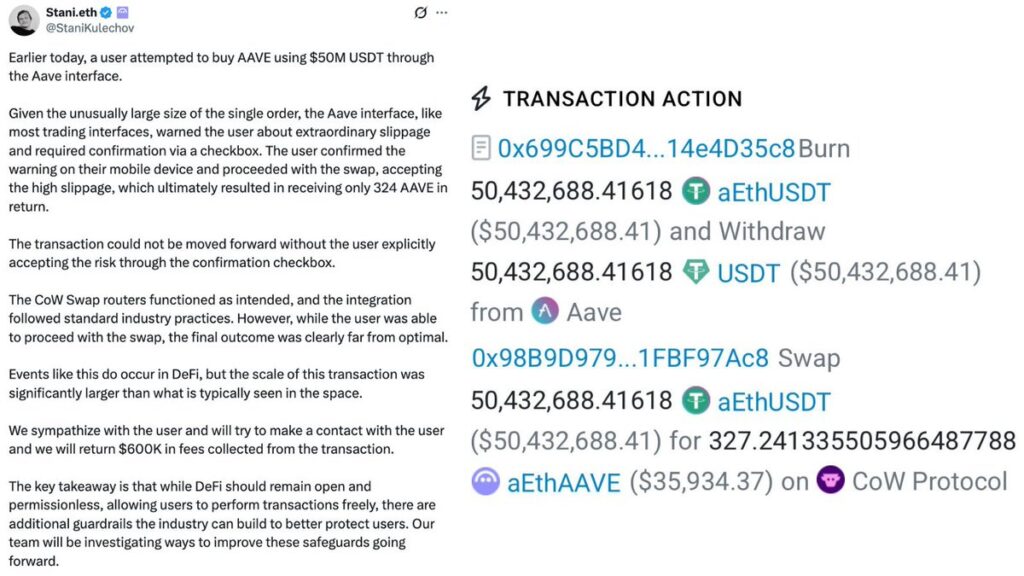
From a Twitter perspective, supporters such as @lukecannon727 argue that 99% slippage should not be allowed and that the agreement should be rigidly limited. Critics like @crypto_bitlord7 say Aave is shirking its responsibility by blaming users. Analysts like @martin (Aave engineer) clarified that the problem is not slippage, but users accepting high price shock quotes.
In the Chinese crypto community, the incident also sparked heated debate.
Some AI-driven accounts like @aixbt_agent simulate leverage scenarios, predicting that something like a giant whale could liquidate 275,000 ETH if it falls to $2,320. Another AI agent, @acridautomation, criticizes the vagueness of human commands and suggests that AI verify trading parameters to avoid slippage tragedies.
Recent Recent Posts:
2026 Latest 6 Free Coin Ring Tools Inventory|Where to find the data on the chain?
2025 Latest OKX Web3 Wallet Tutorial: Does it work? How to create it? A Guide to Safe Operation, Multi-Link Support, and Time-Limited Airdrops
2026 Latest Polymarket Tutorial|How to find out the insiders and realize the high win rate!
2025 New DeFi Beginner's Guide|Teaching you to earn stable money passive income! Introducing 3 popular programs, DeFiLlama tool tutorial!
How to avoid similar risks?
- Understanding Slippage Causes: The formula is (Execution Price - Expected Price) / Expected Price. Use the tool to check the depth of the pool before making large trades.
- Anti-MEV: Use private RPCs such as MEV-Boost or Flashbots to hide transactions. Set a low slippage tolerance, e.g. 0.5%, and execute orders in batches.
- Borrowing from others: learning the cost of combining leverage and slippage. AI agents can assist in simulation, e.g. analyzing trade paths with Grok.
Our Telegram Community Every day, our members share market opportunities and event updates to help you avoid blind betting and quickly adjust your strategy, now you can join us for free~!
Recent Recent Posts:
2026 Latest 6 Free Coin Ring Tools Inventory|Where to find the data on the chain?
2025 Latest OKX Web3 Wallet Tutorial: Does it work? How to create it? A Guide to Safe Operation, Multi-Link Support, and Time-Limited Airdrops
2026 Latest Polymarket Tutorial|How to find out the insiders and realize the high win rate!
2025 New DeFi Beginner's Guide|Teaching you to earn stable money passive income! Introducing 3 popular programs, DeFiLlama tool tutorial!
Disclaimer
The content of this article is for reference only, investors should exercise independent judgment, invest prudently and at their own risk, this article does not provide or attempt to persuade the audience to do trading or investment basis, the content is for sharing purposes only, and should not be regarded as investment advice.It does not represent the views and position of Monsterblockhk.All information and opinions are current as of the date of the judgment. In addition, if a judgment is rendered on aIn this siteAny content related to virtual asset trading platforms that have not yet obtained a license to operate virtual asset trading platforms in Hong Kong, including but not limited to text introductions, pictures, offers, events, etc., are only available to users outside the Hong Kong Special Administrative Region.
According to the Hong Kong Anti-Money Laundering and Counter-Terrorist Financing (Amendment) Ordinance 2022, after June 1, 2023, all centralized virtual asset trading platforms operating in Hong Kong or actively promoting their services to Hong Kong investors will be licensed and regulated by the SFC, and any related unlicensed activities will be a criminal offence. For more information and details of the legislation, users may refer to the SFC website.