


In early 2026, Taiwanese artist and crypto giant whale Machibigbrother Huang Li-Cheng (黃立成) became one of the most sought-after "reverse guides" in the cryptocurrency world with his on-chain data on Hyperliquid. According to Arkham's chain monitoring, he went from a peak account of $50 million in September 2025 to a 25x leveraged long position in ETH, and after more than 241 bursts, his account assets eventually shrunk to less than $10,000 USD. The cryptocurrency community has been laughing for a long time, and some people have even done some calculations: this loss (more than $74 million) could have been used to make more than seven Taiwanese movies of the same scale.
This led many to believe that the "Brainless Reverse MJB" was a stable trading strategy that could be executed. However, in April 2026, this assumption was met with its most brutal counterexample: Big Brother Mahjong suddenly went on a 13-game winning streak, posting a weekly profit of $1.14 million. All those who followed the opposite direction either lost money or closed their positions that week.
The purpose of this guide is not to ask you to continue to reverse with him or to chase him down and buy from him. Rather, it is to help you truly understand:The concept of counter-indicators, how they work, what makes them effective, and the misuse traps you're most likely to step into.
What is an anti-indicator? Where does its logic come from?
Definition of counter-indicators and the psychological basis of the market
Contrarian Indicator literally means "a signal or figure that is consistently moving in the opposite direction from the correct direction". In traditional financial markets, the concept of a contrarian indicator originated in finance - when market sentiment collectively goes to extremes, it often means that the trend is about to reverse, because excessive optimism or pessimism means that the majority of market participants have completed their positions in the same direction, and that the power to push prices up or down is about to be exhausted.
The logic itself is not complicated, and is even backed up by rigorous statistics. The problem is that many people apply this logic of reversal of mood to specific individuals and call it "character counter-indicators". There is a fundamental difference between these two applications.
The Essential Difference Between Emotional and Character Counterindicators
Emotional counter-indicators are based on the marketOverall Group Behavior StatisticsFear Greed Index. When the Fear and Greed Index falls into the extreme fear zone (0-25), historical data has repeatedly shown that this tends to be highly correlated with intermediate-term market lows. Conversely, when the index breaks below 75 and enters extreme greed, it is often the first sign of a top. This correlation is not due to the behavior of any particular individual, but rather to the collective irrationality of the market's overall sentiment reaching extreme levels, with inherent mean reversion pressures naturally building.
The character counter-indicator is completely different. Its logic is: "This person has been wrong many times in the past, so whatever he does, I'll do in reverse". This inference has a fatal premise assumption - the person's mistakes must beSustainable and predictable, not by accident.
Have you ever wondered why so few people in the market have been able to consistently profit from "mindlessly reversing someone" for so long?
In-depth analysis of the case of Brother Magee: how the counterpointer was formed and how it collapsed
From NFT Whale to Hyperliquid
Huang Lixing first came to the cryptocurrency world as an NFT giant whale. In his early years, he had large holdings in blue-chip NFTs such as Bored Ape Yacht Club, and amassed a sizable book of assets during the NFT bull market of 2021-2022. Since May 2025, however, he has shifted his focus to Hyperliquid, a decentralized sustainable contract platform known for its transparency on the chain, and has gradually built up an operating model based on a 25x leveraged long position in ETH.
According to Arkham and Coinglass's on-chain monitoring data, Huang Lixing built up a 25x leveraged long Ether position on Hyperliquid since September 2025, when the price of ETH was around $4,700 USD. The market then took a sharp turn for the worse, with ETH dropping by more than 50%, and the rate of loss expanding geometrically under the amplification effect of the 25x leverage.
Mechanisms for the formation of counter-indicator effects
Hyperliquid's on-chain transparency is key to this story. Unlike centralized exchanges, all of Hyperliquid's positions, clearing records, and money flows are publicly available in real time. This makes every transaction made by Brother Magee publicly available for the market to track in real time. According to data from the chain's monitoring account, since October 2025, Wong Lap-shing has suffered more than 241 bursts on Hyperliquid, resulting in a cumulative loss of more than $71 million.
This scale of sustained losses has led to the direction of his positions gradually being recognized as a reverse signal in the cryptocurrency community. Once this consensus was formed, it even had a self-reinforcing effect: the more people took his position as a negative reference, the easier it was for his direction to become a rallying point for the market's rival orders, further increasing the frequency and scale of losses. In a sense, the community consensus itself changes the microstructure of the market.
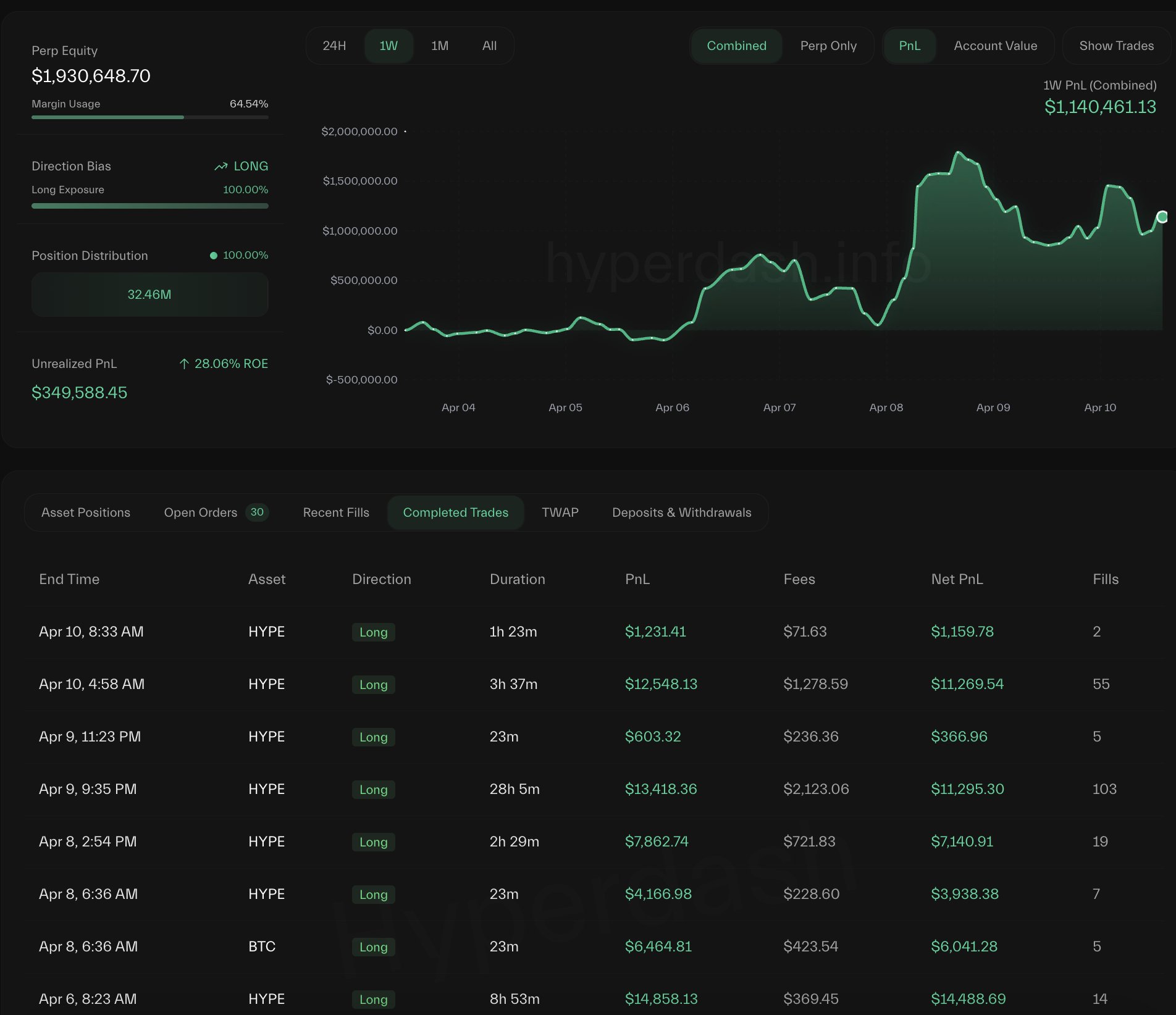
However, in April 2026, the market turned around. Brother Asakichi went on a winning streak of 13 consecutive victories, with a weekly profit of $1.14 million. This was a very painful lesson for traders who had gotten used to his "mindless reversals".
What does it say? It saysAn inverse indicator is not a stable signal source, but an auxiliary observation tool that can be invalidated by a variety of factors.The market conditions change, the parties adjust their strategies, or the direction itself is temporarily corrected. Once market conditions change, parties adjust their strategies, or there is a temporary correction in the direction itself, those relying on counter-indicators are left unprotected and exposed to risk.
You think you're doing it in reverse, when in fact you're just outsourcing the decision-making to another person's behavior entirely - just in the opposite direction.
Three Valid Conditions for Counter-Indicators: Not All "Frequently Wrong" People Are Counter-Indicators
A true counter-indicator must fulfill all three of the following conditions at the same time. If any one of them is missing, the reliability of the counter-indicator will be greatly reduced.
Condition 1: Consistency
A single or few directional errors do not constitute an inverse indicator. There must be a persistent deviation in direction over a sufficiently large sample of trades that is statistically significant and not randomly distributed.
There is a common misunderstanding that needs to be cleared up: a large number of closed positions does not mean that the direction is all wrong. A significant portion of the large number of burst positions of Brother Asakichi is due to the high leverage (25 times), even if the direction is correct, as long as the short-term fluctuation exceeds 4%, the system will close the position forcibly. In other words, under 25x leverage, it only takes 4% of inverse fluctuation to trigger a liquidation. When ETH falls below the psychological barrier, the system immediately forfeits the margin to repay the debt, and the value of the position goes to zero.
This means that the record of closed positions is a reflection of poor risk management, not necessarily a directional error. If you equate "a high number of closed positions" with "a total misdirection" and then use that as the basis for a reversal, your basis for judgment is inherently inaccurate.
Condition 2: Traceability
You need to be able to access the position information of the counter-indicator in real time. The key to why the Brother Asakichi case has become the talk of the cryptocurrency world is Hyperliquid's on-chain transparency - anyone can see his position direction, liquidation history, and funding dynamics in real time.
However, this real-time traceability does not exist in most cases. Many of the "contrarian indicators" that are discussed in the community have a significant information lag in their position information. By the time you see the news, the market has already reacted in advance. To operate on the basis of lagged information is not only to reverse, but to enter the market after the opponent has already left the market.
Condition 3: Non-self-awareness
This is the core reason why counterpointers are most likely to fail. Once a person realizes that he is being used as a counter-indicator, he has a powerful tool at his disposal: he can either deliberately make a move that will cause the counter-indicator to lose money, or he can simply change his trading habits so that the counter-indicator effect disappears. Whether or not the 13 consecutive victories of Brother Asakichi are partly due to strategy adjustments cannot be fully determined from the data in the chain at this point in time. But the possibility itself speaks volumes about the intrinsic fragility of the counter-indicator: it relies on the opponent's "persistent non-change", and no one in the market stays in the same place forever.
Three ways to use counter-indicators: which one should you choose?
Approach A: Pure reverse operation (most common and dangerous)
The logic is very simple: he goes long, you go short; he goes up, you go down. The attraction of this approach is that the operation is clear and does not require much independent judgment. But the problem is equally fatal: all your decisions are based on the behavior of another person, without any independent risk assessment system. Once the counter-indicator fails - as in the case of Big Brother Mahjong's 13 consecutive victories - you have no defense. Your judgmental framework collapses at that moment, because the whole framework is not your own analysis from the beginning, but just a mirror image of someone else's behavior. This approach can be used for sentiment counter-indicators (e.g., fear and greed indices) because sentiment counter-indicators are backed by statistical history and do not rely on the persistence of individual behavior. However, this approach has very low long-term reliability for person counter-indicators.
Mode B: Confirmation filter (more rational application)
Instead of a direct reversal, the counterpointer is used as an additional layer of "counter-confirmation". The logic is that when you have arrived at a judgment in a certain direction through your own analysis, but at the same time discover that the counter-indicator is operating in the same direction, this is not a confirmation signal, but rather a warning to pause and re-examine. The core of this approach is that you still retain the subjectivity of active judgment. Counter-indicators are here only an external input to your analytical system, not a source of decision-making. This requires a certain amount of market analysis on your part, but its logic is far more sound than that of pure counter-indicators. You retain the ability to understand the market independently while protecting yourself from the failure of counter-indicators.
Approach C: Using counter-indicators as analytical material (most valuable in the long term)
This is the most time-consuming but also the most compounding of the three approaches. The core question is not "should I reverse his position", but "why does he keep making the same mistake? What's worth digging deeper into in the case of Brother Asakichi is not how many times he blew up his position, but what common cognitive biases his behavioral pattern reveals. Behavioral finance calls this kind of continuous betting the "gambler's fallacy" - trying to catch a rebound before the price has stabilized, hoping to make up for losses in one go. However, Hyperliquid's mechanism is not forgiving, and with its high leverage and low maintenance margin, the algorithm is ruthless when the market doesn't turn out as expected.
This cycle of "blowing up - raising - blowing up again" reveals a combination of Sunk Cost Fallacy and Overconfidence Bias. The Sunk Cost Fallacy prevents him from accepting losses and stopping losses because admitting losses is tantamount to denying past judgments, while Overconfidence allows him to believe that he will be able to "pull it off this time" even after he has blown each position. These two cognitive biases are very common among retail traders in the cryptocurrency world. The real way to benefit from the case of Brother Asakichi is not to reverse his positions, but to use his behavioral pattern as a mirror to examine whether you have a similar trading mentality.
Sentiment counter-indicator tool: a more stable market reference system than character counter-indicators
If you want to apply counter-indicator logic to real-world judgments, sentiment counter-indicators are a far more reliable choice of tool than character counter-indicators. Below are the main sentiment indicators and the logic of using them.
Fear & Greed Index
The historical data clearly illustrates the statistical significance of sentiment as a backward-looking reference, as the Fear and Greed Index reached 84 on November 9, 2021, the day before Bitcoin hit an all-time high of $69,044, and 29 a year later when BTC fell to $15,922.
Historically, markets tend to approach turning points when fear reaches extreme levels - usually after the weakest chip holders have left the market. The same reverse pattern occurs in times of extreme greed, where overconfidence often precedes a correction. Of course, there is no tool that can predict the future with certainty; indices simply illuminate where sentiment is at the moment.
It is important to note that during the March 2026 market decline, the Fear and Greed Index fell into single digits at one point, hitting one of the all-time lows since the launch of the index in 2018. in March 2026, with Bitcoin trading near $71,000 and Ether near $2,170, the Sentiment Index readings were at 14, in the zone of deep fear. Cryptsy Such historic lows have tended to correspond to intermediate-term opportunity zones in past cycles - but that doesn't mean it's possible to pinpoint a time to enter the market, as sentiment indicators lag, not lead.
You can do this by alternative.me/crypto/fear-and-greed-index Check out the daily updated Fear and Greed Index readings for free.
Google Trends as a Macro Sentiment Thermometer
Google Trends doesn't provide precise entry and exit signals, but it does reflect the macro flow of retail attention. When the number of searches for "how to buy bitcoin" skyrockets in a short period of time, it often signals that a large number of new participants who have never been exposed to cryptocurrencies before are swarming into the market. This influx of new money has historically corresponded to a number of occasions near cycle tops.
It is important to note that Google Trends signals have a considerable lag and it is difficult to pinpoint the exact timing of the top. It is more suitable to be used as a warning of "overheated macro-sentiment" rather than a basis for short-term entries and exits.
Media Coverage and Mainstream Attention
The proliferation of cryptocurrency stories on the front pages of traditional media outlets has historically been a signal that the market is near the top of a cycle. One of the most classic examples of this was when Bitcoin was featured on the cover of Time magazine at the end of 2021, shortly after the market entered a bear market cycle that lasted more than a year. The logic behind this phenomenon is similar to the Google trend: when cryptocurrencies begin to attract the widest mainstream attention, it often means that the incremental capital available to enter the market is largely gone.
Again, this is a macro reference, not an operational signal. There may be weeks or even months between when the mainstream media starts to report and when the market actually tops out.
Recent Recent Posts:
2026 Latest 6 Free Coin Ring Tools Inventory|Where to find the data on the chain?
2025 Latest OKX Web3 Wallet Tutorial: Does it work? How to create it? A Guide to Safe Operation, Multi-Link Support, and Time-Limited Airdrops
2026 Latest Polymarket Tutorial|How to find out the insiders and realize the high win rate!
2025 New DeFi Beginner's Guide|Teaching you to earn stable money passive income! Introducing 3 popular programs, DeFiLlama tool tutorial!
The Core Misuse of Counter-Indicators: Aids as Trading Systems
The most common misuse of counter-indicators in the currency world is to treat them as a complete trading system rather than an auxiliary tool. The difference between the two determines whether or not your risk exposure is within your control.
A complete trading system consists of entry logic, position management, stop-loss mechanisms and exit strategies. The counter-indicator itself, at best, can only provide a directional bias input and cannot replace any of these components. When you use counter-indicators as a system, you are in effect assuming complete market risk on an extremely simplified framework whose core assumption - the continued validity of the counter-indicator - can be invalidated at any point in time.
There are three questions that pure contrarians often fail to answer: First, under what circumstances should you stop contrarian trading? Second, how should you adjust your position if the counter-indicator starts a winning streak? Third, where do you set your stop loss?
If you don't have clear answers to the three questions above, then your use of counter-indicators isn't inherently that different from the one you reverse - both are betting against the market without complete risk management.
Where does real judgment come from?
The Brother Asagi case provides one of the most educational cases in the cryptocurrency world, but not because his losses make it easy to make money, but because his behavior clearly demonstrates a few of the most common trading psychology traps.
True market judgment does not come from finding a signal that can be replicated, it comes fromUnderstanding the "Why"Why does the market turn around at a certain point? Why does the market reverse at some point? Why is it almost impossible to maintain high leverage in a volatile market? Why do traders continue to increase their positions even when they know they are losing money? The answers to these questions constitute a trader's true cognitive advantage.
Counter-indicators can be a useful lens to look through, but they can never replace a deeper understanding of market mechanisms. When you are able to extract transferable insights from "why he keeps making the same mistakes", rather than just following the counter-indicator, the real value you gain from this case is just beginning.
Recent Recent Posts:
2026 Latest 6 Free Coin Ring Tools Inventory|Where to find the data on the chain?
2025 Latest OKX Web3 Wallet Tutorial: Does it work? How to create it? A Guide to Safe Operation, Multi-Link Support, and Time-Limited Airdrops
2026 Latest Polymarket Tutorial|How to find out the insiders and realize the high win rate!
2025 New DeFi Beginner's Guide|Teaching you to earn stable money passive income! Introducing 3 popular programs, DeFiLlama tool tutorial!
Conclusion
Counter-indicators are a real market phenomenon in the cryptocurrency world, but their validity is far more conditional and prone to failure than what is discussed in the community. Sentiment counter-indicators (e.g. fear and greed indices) are supported by statistical history and are suitable for macro reference, whereas character counter-indicators rely on the persistence of individual behavior and may disappear overnight once the person concerned adjusts his strategy or the market environment changes.
The case of Brother Asakichi illustrates that even a person with a track record of hundreds of blown positions can be continuously profitable at a given point in time. This is not an exception, but an intrinsic property of counter-indicators. The most logical way to use a counter-indicator is to use it as a confirmation filter or analytical material, not as a stand-alone operating system.
The way to truly learn from the market on a continuous basis is to understand the reasons behind other people's mistakes, rather than copying their negative maneuvers. This understanding is the core asset for long-term survival in volatile markets.
If you want to keep track of more whale movement analysis and market interpretations, our Telegram Community Join us as our members share daily updates on market opportunities and events to help you avoid market pitfalls and quickly adjust your strategy!
Disclaimer
The content of this article is for reference only, investors should exercise independent judgment, invest prudently and at their own risk, this article does not provide or attempt to persuade the audience to do trading or investment basis, the content is for sharing purposes only, and should not be regarded as investment advice.It does not represent the views and position of Monsterblockhk.All information and opinions are current as of the date of the judgment. In addition, if a judgment is rendered on aIn this siteAny content related to virtual asset trading platforms that have not yet obtained a license to operate virtual asset trading platforms in Hong Kong, including but not limited to text introductions, pictures, offers, events, etc., are only available to users outside the Hong Kong Special Administrative Region.
According to the Hong Kong Anti-Money Laundering and Counter-Terrorist Financing (Amendment) Ordinance 2022, after June 1, 2023, all centralized virtual asset trading platforms operating in Hong Kong or actively promoting their services to Hong Kong investors will be licensed and regulated by the SFC, and any related unlicensed activities will be a criminal offence. For more information and details of the legislation, users may refer to the SFC website.