


In the world of cryptocurrencies, U.S. stock contracts are becoming the focus of more and more investors. They offer a unique opportunity to participate in the fluctuations of the U.S. stock market without the need for a traditional securities account.
Imagine sitting at home and being able to buy, sell, and short popular stocks like Tesla or Apple, even when the stock market is closed. Sounds appealing, right?
But it's definitely not a shortcut to overnight riches, but a tool that requires a careful strategy. In this article, we'll take a closer look at the core mechanics of cryptocurrency U.S. contracts, tips on how to use them, and the potential risks, so you can enter this fast-changing market in a smarter way.
Whether you're new to crypto or a stock market veteran, this article will help you avoid the common pitfalls of U.S. stock contracts!
What is a cryptocurrency U.S. stock contract? How is it different from traditional U.S. stocks?
Cryptocurrency U.S. stock contracts are essentially derivative instruments that allow investors to track price fluctuations of U.S. stocks on a crypto platform, rather than directly owning the stocks themselves. In the case of Coin's USDT perpetual contracts, for example, these products allow you to go long or short on a specific U.S. stock, such as Tesla, but you're only buying and selling a contract, not actual shares. This means you don't become a shareholder of the company, and you don't get dividends or voting rights.
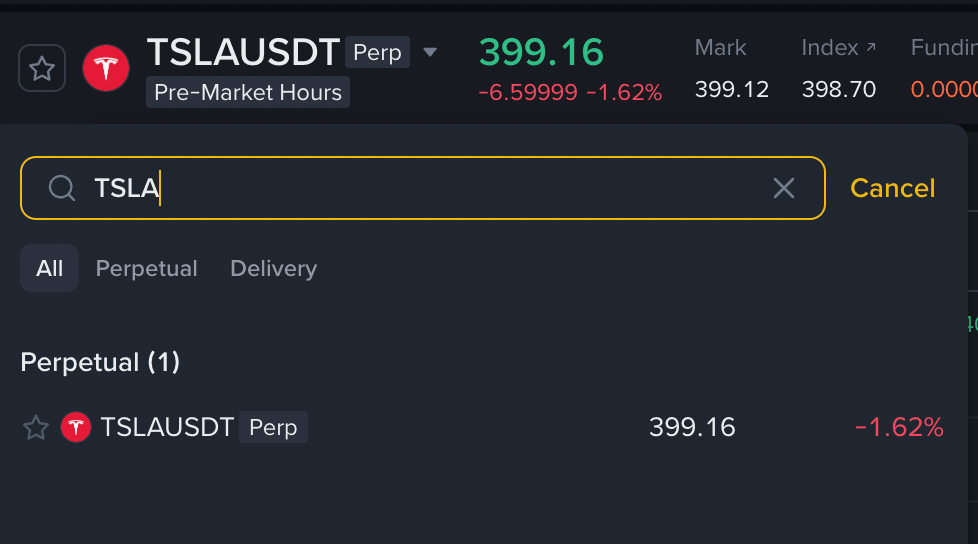
Instead, it's more like a bet on the price to go up or down, and is suitable for traders who are looking for short-term profits. Traditional U.S. stock investing is completely different: when you buy a stock through a brokerage firm like Interactive Securities, your holdings are recorded in the official books and represent real ownership. Even if the stock price goes down, you're not at risk of losing your position because it's a long-term asset.
Crypto U.S. stock contracts introduce an element of leverage, usually up to 5x, which magnifies potential gains as well as losses. For example, if you're predicting an increase in Tesla's stock price, you could open a long position; conversely, you could open a short position.
But remember, these contracts can't be held for the long term because they're designed for quick market entry and exit. If you're looking to invest in the growth of tech giants like Warren Buffett over the long term, this isn't the place to do it. Instead, it provides a flexible platform to capture short-term opportunities in U.S. stocks in the global crypto ecosystem.
Encrypting U.S. Stock Contracts: Leverage, Funding Rates, and Price Tracking
To get a handle on the CryptoUS contract, you first have to figure out its core parameters, theDon't just look at the latest price in the middle of the market, that's only the price of the order book of Currency Security, which is easily manipulated.
The three prices that really matter:
- Index Price:Reference prices from outside the real U.S. stock market. Normal hours are official NASDAQ quotes; before/after hours are ECN data. This is the "real" price, and it's what you look at to determine if you're making money or not.
- Mark Price:Coin's own "fair price" is used to calculate unrealized profit/loss and risk of position blowout. During normal trading hours, the mark-to-market price is ≈ the index price; however, during pre/post/night trading hours, when liquidity is poor and U.S. stock prices are jumping around, CurrencySecure will purposely delay + smooth the mark-to-market price to avoid position blow-ups or sharp gains. Imagine an EKG: the index price jumps up and down, while the marker price tracks slowly.
- Last Price:The price of the real transaction in the Coin's disk. On weekends and holidays, when the index prices stop, CoinSafe will be delinked, no longer completely refer to external sources, but more to the latest price of their own, but will be smoothed to avoid the bad guys pulling the order to burst the position of the user. Marked prices will have a limited range to prevent extreme volatility.
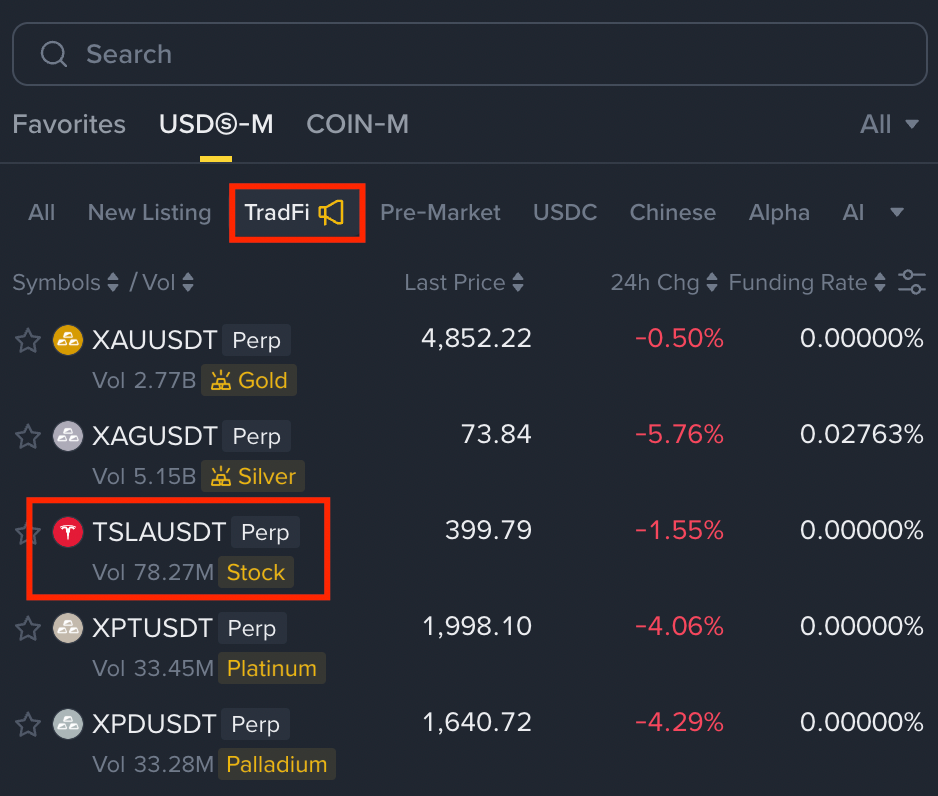
Take Coin's TSLA contracts for example, which support up to 5x leverage, allowing smaller funds to control larger positions. But leverage is a double-edged sword: it can turn your $1,000 position into a $5,000 exposure, but it also means that small price fluctuations can trigger a blowout. Traditional stocks don't blow up because you have physical assets.
However, in a contract, if the market moves in the opposite direction, your margin could be zeroed out instantly.
Another key element isFunding RatesThis is a mechanism to keep the contract price in sync with the real stock price. It is usually capped at ±2% and is settled every 4 to 8 hours. This is much higher than the 0.375% limit for the Bitcoin perpetual contract, meaning that the cost of holding a position can build up quickly.
For example, if you have a long position and the market frenzy causes the price on the platform to deviate from the true stock price, the platform will charge a positive capital rate to balance it out, forcing the long position to close out. This is not only a cost, but also prevents the price from becoming seriously distorted. But on weekends or holidays, when the US stock market is closed, this rate can cost you a lot, and multiple settlements a day can eat up more than 10% of your capital.
Trading Hours and Liquidity: 7x24 Advantages and Hidden Risks
One of the biggest selling points of crypto U.S. stock contracts is that they are traded around the clock, 24 hours a day, 7 days a week. This is in stark contrast to traditional US stocks, which have strict opening hours: 10:30pm to 5:00am Hong Kong/Taiwan time during Winter Time (9:30pm to 4:00am during Daylight Saving Time), followed by less liquid pre- and post-openings, and even thinner night trades, which are completely closed on weekends and holidays.
In the case of Cryptocurrency, these contracts allow you to continue to operate when the U.S. stock market is closed, capturing real-time opportunities brought about by global news. But this convenience comes with a risk: during non-opening hours, the platform's trading volume plummets, creating troughs that can distort prices.
A Tesla contract that is $350 one second can jump to $370 the next because of the lack of market makers to keep it stable. During normal hours, liquidity is high, with a mix of institutional and retail traders, but at night or on weekends, there are only a few profit seekers left, so the market is easily manipulated.
Platforms usually have "overnight" or "closed" warnings, but impulsive traders or retail traders often ignore them! If you open a position and then try to close it, the poor liquidity may allow you to trade at an unfavorable price and even magnify your losses.

Price distortion, bursts and funding rates?
Although crypto U.S. stock contracts are full of opportunities, they are full of potholes! We can see that price distortion is a common problem. Unlike the Bitcoin market, where the platform price is not prone to deviation due to the 24/7 nature of the market, in the case of U.S. stocks, when the platforms are forced to open during a closed period, the internal price may be out of sync with the real index.
At this point, an aggressive market maker may enter the market and drive the price up or down, causing injury to retail investors. Mark-to-market smoothing provides protection by slowing down the tracking of changes, but it does not completely eliminate the risk.
Another big threat is the bursting of positions: while traditional stocks can be held indefinitely, contracts can't, and small fluctuations in high leverage can wipe out your account. Funding rates are more like an invisible tax: up to ±2%, based on position size, not margin.
If you open a 5x long order for $1000 and have a $5000 position, the 2% rate will be deducted $100 at a time. With multiple settlements over the weekend, the cumulative loss is staggering. But on the other hand, if you are short, the negative rate may allow you to make extra money.
So it's proven.U.S. stock contracts are more suitable for short termIgnore these positions and you could be excited to open a position on good news only to blow it on a Monday jump higher. Ignore these positions and you could open a position in the excitement of good news, only to blow it on Monday when it jumps higher. Understanding historical funding rates allows you to anticipate costs and turn risk into a strategic advantage!
Recent Recent Posts:
2026 Latest 6 Free Coin Ring Tools Inventory|Where to find the data on the chain?
2025 Latest OKX Web3 Wallet Tutorial: Does it work? How to create it? A Guide to Safe Operation, Multi-Link Support, and Time-Limited Airdrops
2026 Latest Polymarket Tutorial|How to find out the insiders and realize the high win rate!
2025 New DeFi Beginner's Guide|Teaching you to earn stable money passive income! Introducing 3 popular programs, DeFiLlama tool tutorial!
How can I securely participate in encrypted U.S. stock contracts?
Avoid opening positions on Friday or holding them through the weekend because of the high risk of a market break! Imagine having a positive Saturday and then a short Monday, your long or short position could collapse.
Therefore, it is better to control the leverage at a low level, 5 times is the upper limit, but newcomers from 1-2 times to start can reduce the chance of burst positions.
Remember to always set a stop loss, it's a safety net.Many aggressive market makers specialize in sweeping orders during low liquidity periods, and can easily be liquidated without a stop loss!
Monitor the three previously mentioned prices: the index price as a real basis, the marker price to determine the profit and loss, and the latest price to reflect the dynamics of the platform. Wait patiently for smooth tracking during non-normal hours!
Track the history of funding rates and consider closing out a position to hedge if rates are positively high.
Our Telegram Community Every day, our members share market opportunities and event updates to help you avoid blind betting and quickly adjust your strategy, now you can join us for free~!
Recent Recent Posts:
2026 Latest 6 Free Coin Ring Tools Inventory|Where to find the data on the chain?
2025 Latest OKX Web3 Wallet Tutorial: Does it work? How to create it? A Guide to Safe Operation, Multi-Link Support, and Time-Limited Airdrops
2026 Latest Polymarket Tutorial|How to find out the insiders and realize the high win rate!
2025 New DeFi Beginner's Guide|Teaching you to earn stable money passive income! Introducing 3 popular programs, DeFiLlama tool tutorial!
Disclaimer
The content of this article is for reference only, investors should exercise independent judgment, invest prudently and at their own risk, this article does not provide or attempt to persuade the audience to do trading or investment basis, the content is for sharing purposes only, and should not be regarded as investment advice.It does not represent the views and position of Monsterblockhk.All information and opinions are current as of the date of the judgment. In addition, if a judgment is rendered on aIn this siteAny content related to virtual asset trading platforms that have not yet obtained a license to operate virtual asset trading platforms in Hong Kong, including but not limited to text introductions, pictures, offers, events, etc., are only available to users outside the Hong Kong Special Administrative Region.
According to the Hong Kong Anti-Money Laundering and Counter-Terrorist Financing (Amendment) Ordinance 2022, after June 1, 2023, all centralized virtual asset trading platforms operating in Hong Kong or actively promoting their services to Hong Kong investors will be licensed and regulated by the SFC, and any related unlicensed activities will be a criminal offence. For more information and details of the legislation, users may refer to the SFC website.