

Many new traders mistakenly believe that increasing leverage will make them easy money, but in the end, leverage will only magnify losses. In fact, over-leveraging is often a result of greed and over-confidence - you may think, "This trade is going to go the way I want it to go," not realizing that the market can turn on you just as fast as it wants to. Another common mistake is not setting a stop loss or setting a stop loss too loose, Coinsutra once said: "not setting a stop loss is the biggest self-importance error"; professional traders have an ironclad rule: "no stop loss, no trade". Ignoring the stop-loss and taking a gamble with all of your capital is like driving a car without brakes, which can be disastrous if the situation turns out to be wrong. In short, avoiding full positions, setting strict stop-losses, and doing a good job of risk management are the only ways to minimize the chances of losing money.
Acceptance of Mistakes and Fault Tolerance
Always remember that trading is not a gamble, but a game of probability. Before placing an order, calculate "What is the maximum loss I can afford?" Then think "How much can I make?" Then think about "How much can I make? The first step a professional trader takes before entering the market is to think of the worst case scenario, not to immediately fantasize about a percentage gain. Strict adherence to a stop-loss program and treating losses as a tuition fee is the key to building a positive expectation system. Don't get upset when you make a mistake - the key is to review the cause, revise your strategy, and use each mistake as an opportunity to experiment and learn. Stay humble and patient in the trading process, don't be overwhelmed by a single win, and don't be scared off by a few small losses; the point is to live, and live longer in order to have a chance to win.
Steady Stop Loss:Consider stop-loss as part of your trading system. Set an acceptable loss point before entering a trade and exit the trade as soon as it is touched to avoid emotional behavior.
Fault-tolerant thinking:Every trade can be right or wrong, and the right thing to do is to tightly control each loss to be much smaller than the potential profit. Mistakes are not scary, what is scary is not learning from them.
Trading as a reality:Treat each trade as a validation of your strategy, not a last ditch attempt at destiny.Mindset calm, in order to rationally face the fluctuations, at any time to fine-tune the system. Remember: stop loss is not cowardice, but to protect the principal to continue on the road.
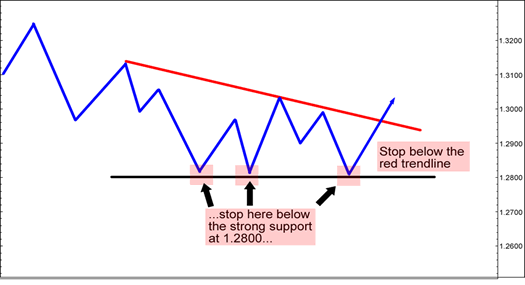
In technical analysis, stop-loss levels are usually set below key support/pressure points. If the price breaks below the trend line or support level, it means that the original long position is not valid and you should take a stop-loss to exit the market (after all, the market won't turn around just because you want it to). For example, the chart below shows the practice of placing a Stop Loss below a trend line: once the black support line is broken, it is time to admit the mistake and get out of the market. Stop Losses should be placed close to the market structure, not too close to be swept away by noise, and not too far away to allow losses to grow.
Order Logic and Positioning
Trend traders often do not have a high win rate, but a large profit/loss ratio per trade. Therefore, it is common for traders to take small positions to test the waters, and then gradually increase their positions once the market is moving in the right direction. On the other hand, short-term traders rely on a high winning percentage against a low profit/loss ratio, and need to manage their positions more closely with strict stop-losses. Regardless of the strategy, novice traders should avoid taking full positions at once. Pokies with too high a threshold are not only risky, but also stressful to the mind.
Profit/Loss Ratio vs Winning Ratio
Winning percentage and profit/loss ratio are complementary factors. If the strategy does not have a high win rate, you need to make sure that the profit is much larger than the loss; if the win rate is high, you can use a smaller profit/loss ratio to make a profit. In practice, you can follow the principle of "at least 1:2" risk-reward ratio, and limit the risk of a single trade to 1-2% of your total capital, so that even if you miss a few trades in a row, it will not be fatal.
Common Tools VRVP
The Volume Profile (also known as VRVP) shows the volume of trades at different prices, with the concentration of funds marked by horizontal bars.
The price level with the highest volume in the chart (the largest horizontal bar, called the "POC") is the area where the main institutional players are building or positioning their positions.
The green bar on the left side of the example below is the Volume Distribution, the thicker part is the heavyweight trading area (institutional price level), while the hollow area in the middle indicates thin trading. Simply put, VRVP/POC can help the novice to determine which price levels have a large amount of chips piling up, and are usually important support or pressure zones that are worth paying attention to.
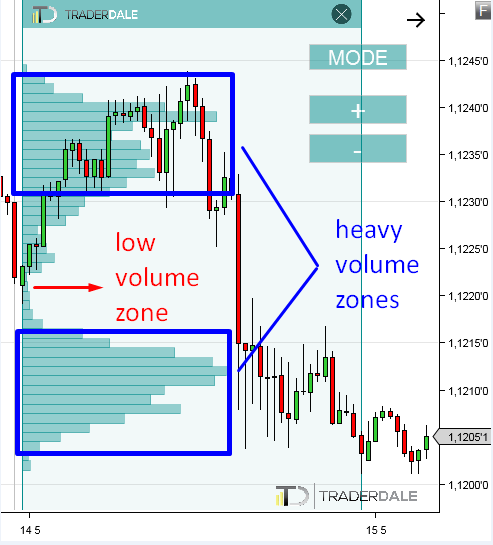
As you can see from the graph above, the Volume Profile forms wide bars in the high volume zones (labeled heavy volume zones), while the bars are relatively thin in the low volume zones (labeled low volume zones).
The location of the POC is usually attractive to the market and can be used as a reference point for take profit or stop loss.
The novice does not have to go into the various contour patterns, but at least understand that the concentration of volume is often a key price area.
What are the recommendations for newcomers to the operation?
Low leverage practice:Beginners should start practicing with low leverage (2-3 times). The advantage of using low leverage is that even if the direction is wrong, the losses will not explode as much as with high leverage. During the practicing stage, you can use demo accounts or small positions, and do not rush for big returns.
Choose a large currency:BTC, ETH and other major cryptocurrencies with high market capitalization and high liquidity are the first choice. High liquidity means that orders can be filled easily with little slippage, which is more suitable for newbies. Large market capitalization currencies are usually less volatile and have more obvious long-term trends, which can reduce the chance of being manipulated.
Strict stop-loss and hedging:Always place a stop-loss order on every trade. Do not leave losses to chance. If you have a spot position, you can hedge your position by shorting a perpetual contract of the same currency to minimize the loss caused by a price drop. For example, if you hold 1 BTC and are worried about a decline in the market, you can short an equal amount of BTC perpetual position in the contract market, and the gain or loss between the two can be partially offset.
Move to take profit:For positions that are already profitable in the general trend, you can use trailing take-profit or manually move up the take-profit point method to dynamically lock in gains. For example, when the price is rising, you can push the take-profit price up gradually; if the market continues to improve, you can capture more profits; if the market reverses, take-profit instructions to help you automatically exit. This can be profitable at the same time, reduce the pressure of having to watch the market all the time. Of course, novice traders can also set a fixed target level to lock in profits, but at higher risk, you should consider using the trailing stop function to avoid missing the protection when the trend reverses.
Mindset is the most important thing: Always treat every trade as an exercise, not a desperate attempt to turn the tide. A trader's first priority is to survive. As long as the capital continues to survive, there will always be a chance to reorganize the strategy and fight again. Don't expect to be surprised every time you enter the market. Adjust your expectations and stick to your stop-loss discipline in order to profit from the market in the long run. Last but not least, we recommend new traders to start practicing on exchanges that offer high liquidity and great rebates, such as Hyperliquid and MEXC, and we wish you the best of luck in your trading endeavors!
If there is still something unclear after reading this, please join in! Telegram Community Ask questions and communicate together!
Recent Articles:
OKX Boost Airdrop Tutorial: Newbie to Advanced stroking Strategy
2025 Beginner's Guide|How to transfer USDT? From bank deposit to wallet receipt of coins complete instruction
Best Cryptocurrency Trading Platform for Hong Kong Users?2025 Latest Bitcoin Tips for Beginners
2025 Coin Ring Newbie Guide Lazybones|Chained Ecology Entry Guide

Disclaimer
The content of this article is for reference only, investors should exercise independent judgment, invest prudently and at their own risk, this article does not provide or attempt to persuade the audience to do trading or investment basis, the content is for sharing purposes only, and should not be regarded as investment advice.It does not represent the views and position of Monsterblockhk.All information and opinions are current as of the date of the judgment. In addition, if a judgment is rendered on aIn this siteAny content related to virtual asset trading platforms that have not yet obtained a license to operate virtual asset trading platforms in Hong Kong, including but not limited to text introductions, pictures, offers, events, etc., are only available to users outside the Hong Kong Special Administrative Region.
According to the Hong Kong Anti-Money Laundering and Counter-Terrorist Financing (Amendment) Ordinance 2022, after June 1, 2023, all centralized virtual asset trading platforms operating in Hong Kong or actively promoting their services to Hong Kong investors will be licensed and regulated by the SFC, and any related unlicensed activities will be a criminal offence. For more information and details of the legislation, users may refer to the SFC website.