

Cryptocurrency wallets are tools for storing private keys, and are categorized into two main types: hot wallets (Internet-connected, easy to transact, such as MetaMask, OKX Web3 Wallet) and cold wallets (offline, with the highest level of security, such as Ledger, Trezor Hardware Wallet). The core trade-off between hot and cold wallets is the balance between convenience and security. The general principle is to use hot wallets for transaction funds (below HKD 50,000) and cold wallets for long term assets (above HKD 50,000).
If you're an advanced user, a mix of hot and cold wallets is fine!
This article will explain how hot and cold wallets work, the advantages and disadvantages of the four major types, recommended brands, and best practices for real-world use, in the hope of helping cryptocurrency newbies understand the practical differences between the two!
Want to know how to buy cryptocurrency on a licensed platform first? Check out 2026 Complete Comparison of Crypto Currency Trading Platforms in Hong Kong This article.

What is a cryptocurrency wallet?
Cryptocurrency wallets do not really store the cryptocurrency itself, but rather the "private key" that is used to prove ownership of the asset. Cryptocurrencies (e.g. Bitcoin, Ethereum) are always stored on the blockchain, and the wallet is just a key to control these assets.
When you send cryptocurrency, Wallet uses a private key to digitally sign the transaction, proving to the blockchain network that you are the rightful owner of the assets. If the private key is lost, no one (including yourself) will ever be able to access these assets.
How do private keys, public keys and auxiliary words work?
A cryptocurrency wallet consists of three core components:
Private KeyThe private key is a 256-bit random number that is the only proof of control over your wallet assets. The private key must be kept strictly confidential and anyone holding your private key is equivalent to controlling all your assets.
Public Key: Generated by a mathematical algorithm from a private key, it is used to generate your wallet address (similar to a bank account), which can be shared publicly to receive cryptocurrency. The public key cannot be deduced from the private key.
Aids (Mnemonic Phrase / Seed Phrase): A sequence of 12 to 24 English words derived from the private key to facilitate human-readable backup of the private key by the subscriber. Holding a token is the same as holding a private key - anyone who acquires your token has full control over your wallet assets.
Core Differences Between Escrowed and Self-Escrowed Wallets
Cryptocurrency wallets are categorized into two types based on control:
Custodial WalletPrivate keys are held by third-party platforms (e.g. OSL, Victory Securities, MEXC, etc.) and users log in with their account passwords. The advantage is that passwords can be reset if forgotten and the platform assumes responsibility for security; the disadvantage is that users do not have ”true control” ("not your keys, not your coins") - if the platform goes bankrupt, is hacked or is frozen by regulators, user assets could be jeopardized (FTX). If the platform goes bankrupt, is hacked or frozen by regulators, user assets could be compromised (FTX's bankruptcy in 2022 is a classic example of this, with millions of user assets frozen).
Self-custody WalletPrivate keys and tokens are kept by users themselves, including hot wallet (MetaMask, OKX Web3 Wallet) and cold wallet (Ledger, Trezor). Advantage is to have 100% asset control, no third party risk; disadvantage is that once the token is lost, the asset will be lost permanently, and all the responsibility is borne by the user.
Advanced Suggestions: Funds for day-to-day trading are held in the Exchange's custodial wallet (for convenience) and funds for long-term investment are held in the self-custodial cold wallet (for security).
Hot Wallet: An Internet wallet that facilitates easy transactions.
Hot wallets are cryptocurrency wallets that are continuously connected to the Internet, primarily in the form of browser extensions (e.g. MetaMask), mobile apps (e.g. OKX Web3 Wallet) and desktop applications. Because they are permanently online, hot wallets are readily available for transactions, connecting to the DeFi protocol and the NFT platform, but they carry a higher security risk than cold wallets.
How does a hot wallet work?
A hot wallet stores a private key in encrypted form on a device (computer or cell phone) and communicates with a blockchain node via a browser extension or app interface. When a user initiates a transaction, the wallet signs the private key locally on the device and broadcasts the signed transaction to the blockchain network. The private key remains on the user's device and is not uploaded to any server.
Pros and Cons of Hot Wallets
1. Security risk:Compared to cold wallets, hot wallets are less secure. Due to its connection to the Internet, hot wallets are vulnerable to hacking, malware, phishing and other security risks. However, there are already a lot of software on the market to prevent phishing attacks, such as Pocket Universe.
2. System vulnerabilities:Hot wallets run on devices connected to the Internet and may be affected by operating system vulnerabilities, software bugs, or hardware failures, which may result in the disclosure, loss, or damage of private keys.
For example, Metamask, OKX Web3 Wallet, Phantom Wallet, Trust Wallet, Coinbase Wallet are some of the more common and popular wallets in the cryptocurrency space. Below is the comparison chart:

Hot Wallet Recommendation: MetaMask and OKX Web3 Wallet
MetaMask (Little Fox Wallet): The world's most popular EVM-compatible hot wallet, with over 30 million monthly users in 2026. Supports 100+ EVM chains such as Ethereum, Arbitrum, Optimism, Base, Polygon, etc. Starting Dec 2025, native Bitcoin support will be added. Suitable for DeFi users and heavy EVM ecology users.
Detailed tutorial reference:MetaMask Small Fox Wallet 2026 Teaching
OKX Web3 Wallet: Multi-chain self-hosted hot wallet launched by OKX, supports more than 130 blockchains in 2026 (including non-EVM chains such as Solana, Bitcoin, Sui), with a built-in DEX aggregator, allowing one-click fund transfers to and from OKX centralized exchanges. Suitable for multi-chain users and existing OKX CEX users.
Detailed tutorial reference:OKX Web3 Wallet 2026 Complete Tutorials
Cold Wallet: The Highest Security Option for Offline Storage
Cold wallet is a cryptocurrency storage solution that is not connected to the Internet, and private keys are generated and stored in a completely offline environment. Since the private key never touches the Internet, hackers cannot steal it remotely, making it the preferred solution for long-term holding of large cryptocurrency assets. The main forms of cold wallets include Hardware Wallet and Paper Wallet.
How does cold wallet work?
Take hardware wallet as an example: the private key is generated in the Secure Element of the hardware device and never leaves the device. When a transaction is required, the user transmits the unsigned transaction data to the hardware device, which completes the private key signature in the offline environment and then returns the signed transaction to the computer for broadcasting to the blockchain. During the whole process, the private key is never exposed to the online environment.
Pros and cons of cold wallets
Advantages:
- Private key is completely offline, hackers can't invade it remotely.
- Secure Chip Prevents Physical Extraction of Private Keys
- Assets are safe even if your computer is infected with malware.
- The holding aid can be restored on any compatible device.
Disadvantages:
- Hardware purchase required (from USD 79)
- Transaction process is more complicated than Hot Wallet (requires device connection to confirm)
- Device damage is restored with the help of a dictionary (significant responsibility for management of the dictionary)
- Not suitable for frequent trading
Introducing Hardware Wallets: Ledger and Trezor
The hardware wallet market is dominated by two major brands, Ledger and Trezor, each with a different positioning.
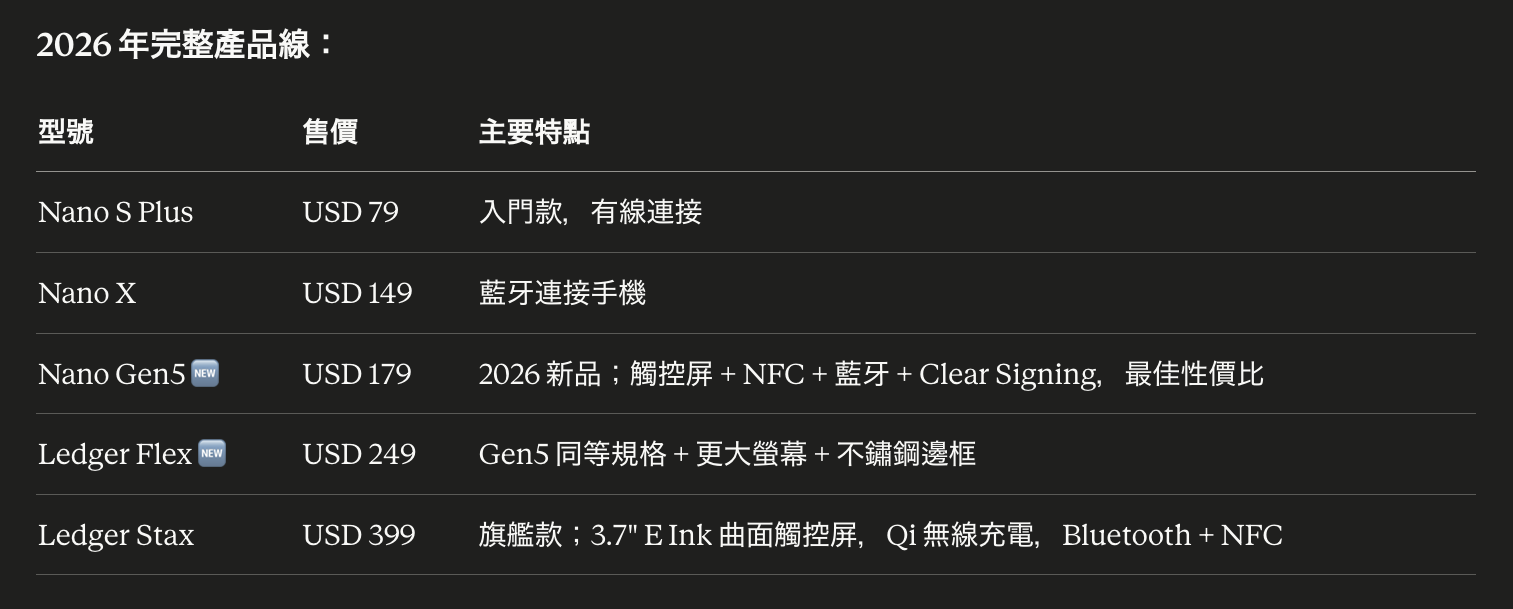
Ledger
French company founded in 2014, selling over 7 million hardware wallets worldwide. Built-in security chip (SE) and its own BOLOS operating system, supports more than 5,500 cryptocurrencies and NFTs. 2020 saw a breach of customer personal data, but the wallet private key itself was unaffected.
Trezor
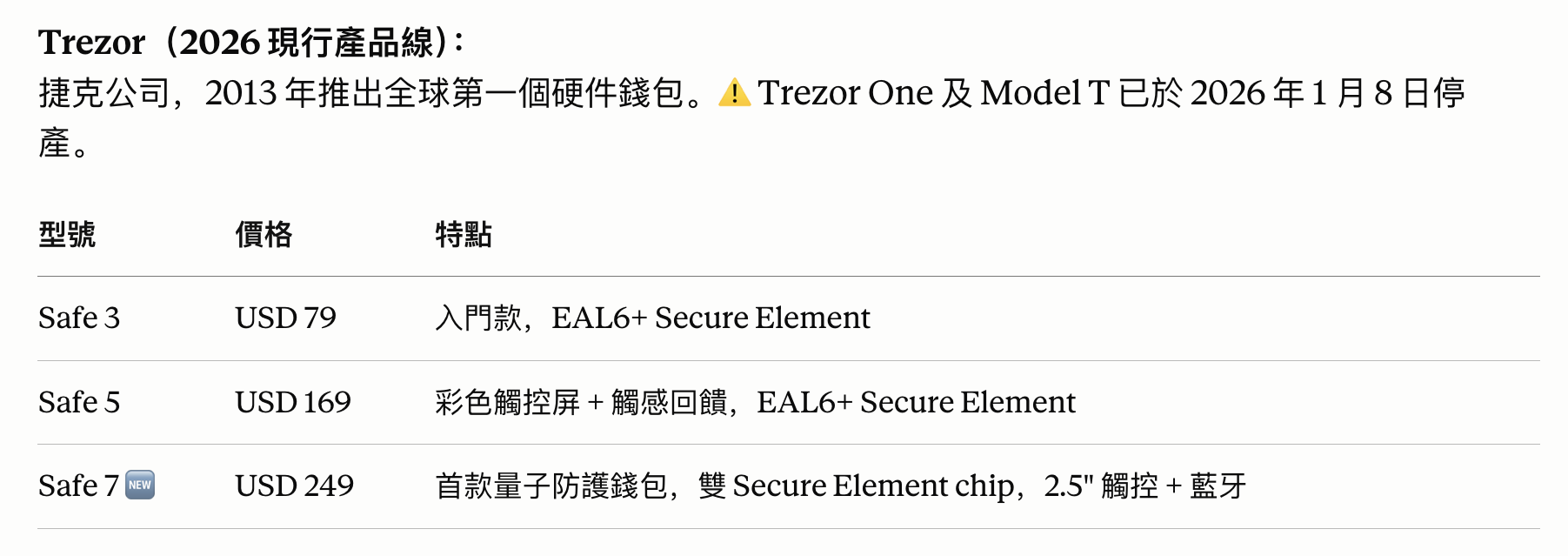
Czech company that launched the world's first hardware wallet in 2013. It uses open-source firmware (auditable by the community) and fully supports more than 7,000-9,000 cryptocurrencies.
IMPORTANT: The Trezor One and Trezor Model T were officially discontinued on January 8, 2026 and are no longer available for sale on the official website.
How does Ledger vs Trezor stack up?
When it comes to choosing a hardware wallet, Ledger and Trezor each have their own strengths that suit different needs.
For a budget of around USD 79, the Trezor Safe 3 or Ledger Nano S Plus are solid entry-level choices with enough features to meet your daily storage needs. For those looking for the best price/performance ratio in 2026, consider the Ledger Nano Gen 5 (USD 179), which features a touch screen, NFC and Bluetooth for a much improved hardware experience.
If transparency in the 100% open source is important to you, any Trezor model has a fully open source architecture for more transparency in security auditing. For advanced users with quantum protection needs, choose Trezor Safe 7 (USD 249). For those seeking a flagship touch experience, the Ledger Stax (USD 399) or the Trezor Safe 5 (USD 169) both offer high-quality, large-screen interfaces.
In terms of currency support, Trezor natively supports more than 7,000 to 9,000 currencies, which is significantly more than Ledger's 5,500+ currencies, a real advantage for users with long-tailed assets.
What is a Paper Wallet?
Paper wallets are a storage method that prints private and public keys on paper in the form of QR codes or text. The advantage is that the cost is extremely low and it is completely offline; the disadvantage is that the paper is easy to be damaged, faded, or destroyed by fire or flood, and it is inconvenient to operate, and it will be gradually replaced by the hardware wallet in 2026. If you still choose to use paper wallets, it is recommended that you switch to a metal cardboard (e.g. Cryptosteel) for physical backup to prevent physical damage.
Cold wallet vs hot wallet: how to choose?
The choice between a cold wallet and a hot wallet depends on the size of the assets held and how often they are used.
Holding amount below HKD 50,000: Hot wallet is sufficient
For small positions and everyday DeFi users, free hot wallets such as MetaMask or OKX Web3 Wallet are sufficient. It's easy to use, the cost is zero, and the security of mainstream hot wallets is already very reliable. The key lies in the fact that auxiliary words must be physically backed up, not stored in the cloud.
Holding amount above HKD 50,000: Hot/Cold Mixed Allocation is recommended.
Large long term assets are recommended to be transferred to a hardware cold wallet (Ledger or Trezor), which is connected only briefly for each transaction. The entry-level Trezor Safe 3 or Ledger Nano S Plus is priced at USD 79, which is a very low cost for the assets protected.
Advanced User Solutions: Hot and Cold Separation Configurations
Best practice is to have a clear tiering of assets: trading funds (daily swaps, DeFi interactions, short term operations) are held in the hot wallet; long term positions (core assets held for more than 6 months) are moved to the cold wallet. Different sets of auxiliaries are used so that even if one is compromised, the other set of assets remains intact.
Already hold USDT and want to know how to withdraw your assets from the exchange to your wallet in a compliant manner? Check out theHong Kong Compliance Tutorial: USDT from Exchange to Wallet》。
Cryptocurrency Wallet FAQ
Q: Do I always need to buy hardware for cryptocurrency wallets?
Not necessarily. For smaller holdings (under HKD 50,000), the free hot wallets (MetaMask, OKX Web3 Wallet) will suffice. Hardware wallets are suitable for large, long-term holders, with the 2026 entry-level models being the Trezor Safe 3 or the Ledger Nano S Plus at USD 79 each, and flagship models up to the Ledger Stax (USD 399).
Q: What is the difference between a private key, a helper and a password?
The private key is a 256-bit number that controls the wallet assets and is the lowest level certificate. A token (12 to 24 English words) is derived from the private key to facilitate human backup. Passwords are only used to unlock the Wallet App. Lost passwords can be reset with the helpers, but lost helpers will permanently lose the assets and cannot be recovered.
Q: Can a hardware wallet store multiple cryptocurrencies?
Yes. Both Ledger and Trezor support multi-chain storage (BTC, ETH, SOL, and various tokens), managing all assets on the same device and with the same set of tokens. Make sure you have installed the official app for your chain (e.g. Bitcoin App in Ledger Live) before using.
Q: What happens to my assets if my hardware wallet is damaged or lost?
Assets are stored on the blockchain, not in hardware devices. As long as you have the 12-24 character token, you can purchase any compatible device (same brand or other compatible hardware wallet) and re-import it and the assets will be restored automatically. It is recommended that you physically back up your memos on a metal cardboard and store them in a secure location, do not photograph them or upload them to the cloud or any digital device.
Q: Can I use a hot wallet and a cold wallet at the same time?
Yes, and this is the recommended allocation. The best solution is to use a hot wallet for trading funds (daily swaps, DeFi interactions) and a cold wallet for long term investment funds (held for more than 6 months). Each of them uses a different apostrophe and is isolated from the other to avoid a breach of one of them affecting all of your assets.