


STRC is a Nasdaq-listed perpetual preferred stock issued by Strategy (formerly MicroStrategy) under the symbol STRC, with a par value of $100, a monthly dividend in cash, and a current annualized interest rate of 11.51 TP3T. It is not a cryptocurrency, nor is it a stablecoin, but rather a fixed-income financial instrument that relies on the value-added logic of Bitcoin. It is not a cryptocurrency or a stablecoin, but a fixed income instrument that relies on the logic of Bitcoin appreciation. Over the past few weeks, STRC has been the subject of massive debate in both the crypto media and traditional financial circles, with only one issue at the heart of the debate: is it a cleverly designed Bitcoin derivative, or is it a high-risk bet wrapped up in a stabilization product?
This article will start from the basic definition of STRC, break down its flywheel mechanism, capital structure position, huge controversies, potential failure scenarios, and provide a practical framework for Hong Kong investors. Whether you know nothing about STRC now, or have heard of it but can't see the full picture, the goal of this article is to enable you to independently determine whether STRC fits your investment logic after reading it.
What is STRC? In the plainest possible language!
When most people first come across STRCs, their minds will categorize them as "fixed deposit-like" or "bond-like". This intuition is not entirely wrong, but if you stop at this understanding, you will seriously underestimate its risks.
STRC, known as Strategy Variable Rate Series A Perpetual Stretch Preferred Stock, is a type of perpetual preferred stock. The term "perpetual" means that it has no expiration date and can theoretically pay dividends indefinitely. The term "preferred stock" means that it has a preferential right to dividend distribution over common stock (MSTR), but also after all corporate bonds.
Ordinary bonds have a fixed maturity date and the principal must be repaid at maturity. STRCs do not have a maturity date and the company does not need to "pay back" the money, but only to continue to pay the dividend. The dividend can be unilaterally adjusted by the company, either up or down by 25 basis points per month, and the adjustment does not constitute any default. This will be explained in more detail later, as it is the most criticized design of the STRC.
What is the fundamental difference between STRC and buying Bitcoin directly?
This is the question most beginners ask. Holding Bitcoin outright, your returns come from the rise and fall of the BTC price itself, there is no cash flow, and all of the gains are realized by selling the asset. STRC is the opposite: you don't hold any BTC outright, but instead you lend the money to Strategy to buy BTC, and then you get back a monthly dividend of 11.5% in cash.
Why not just buy MSTR common stock instead of STRC?
These two products serve very different investor needs; MSTR common stock is a magnified long position in Bitcoin - when BTC goes up, MSTR tends to go up more because the market is willing to pay an additional premium for Strategy's "staying power", known as the mNAV premium. But when BTC goes down, MSTR's decline is magnified.
STRC is designed for a different group of people: institutional investors who need monthly cash flow, retirement funds, or income investors who don't want to be exposed to high volatility but still want to have exposure to the Bitcoin ecosystem. Saylor personally positioned STRC as "Digital Credit," the fixed income layer of the Bitcoin financial system, and MSTR as the equity layer. The two coexist, each serving different capital needs.
What kind of company is Strategy? How does it make money?
Formerly known as MicroStrategy, Strategy was originally an enterprise software analytics company, but in 2020, founder Michael Saylor began a massive conversion of the company's cash reserves to Bitcoin, which led to a fundamental shift in the business model.
Today Strategy is positioned as the world's first "Bitcoin Treasury Company". Its core logic is to continue to buy Bitcoin and bet on the long-term appreciation of BTC, financed by issuing equity and credit instruments in the capital markets. As of May 2026, Strategy held 818,869 BTC, with a market capitalization of approximately $65.7 billion, making it the largest Bitcoin position held by a single company in the world.
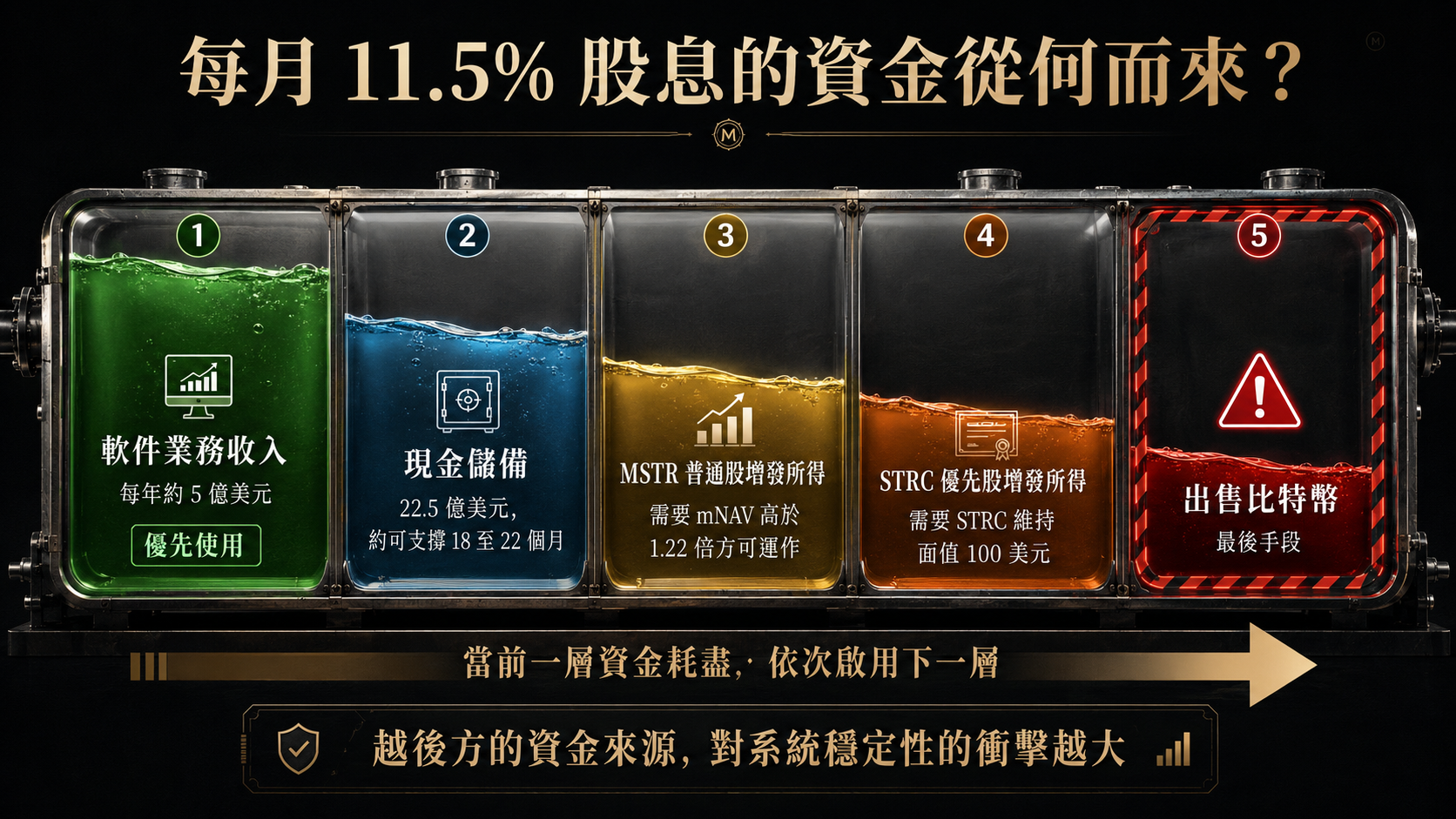
Where does Strategy's cash flow come from?This issue is critical because STRC's dividend must ultimately come from some real source of funding; Strategy currently has three main sources of funding, but the size disparity between them is alarming.
In the software business, Strategy's enterprise analytics software generated revenues of US$124.3 million in the first quarter of 2026, or approximately US$500 million on an annualized basis. However, Strategy's annualized preferred dividend payments total approximately US$1.5 billion, which is three times the amount of software revenue. The business alone cannot cover its dividend obligations.
The second source is the continued issuance of MSTR common stock (the ATM program), which has been Strategy's main engine in the past, getting more than a dollar of BTC value for every dollar of stock sold when the mNAV premium is high enough. The third source, and the most important engine for 2026, is STRC itself - issuing preferred stock and transferring the proceeds into BTC purchases.
There is a logic to this arrangement that needs to be confronted: STRC's dividends are paid, in part, from the funds raised by the continued issuance of STRC. This is at the heart of what critics have called the "reflexive structure".
How does the STRC flywheel mechanism work?
The logic of money flow in the whole system.
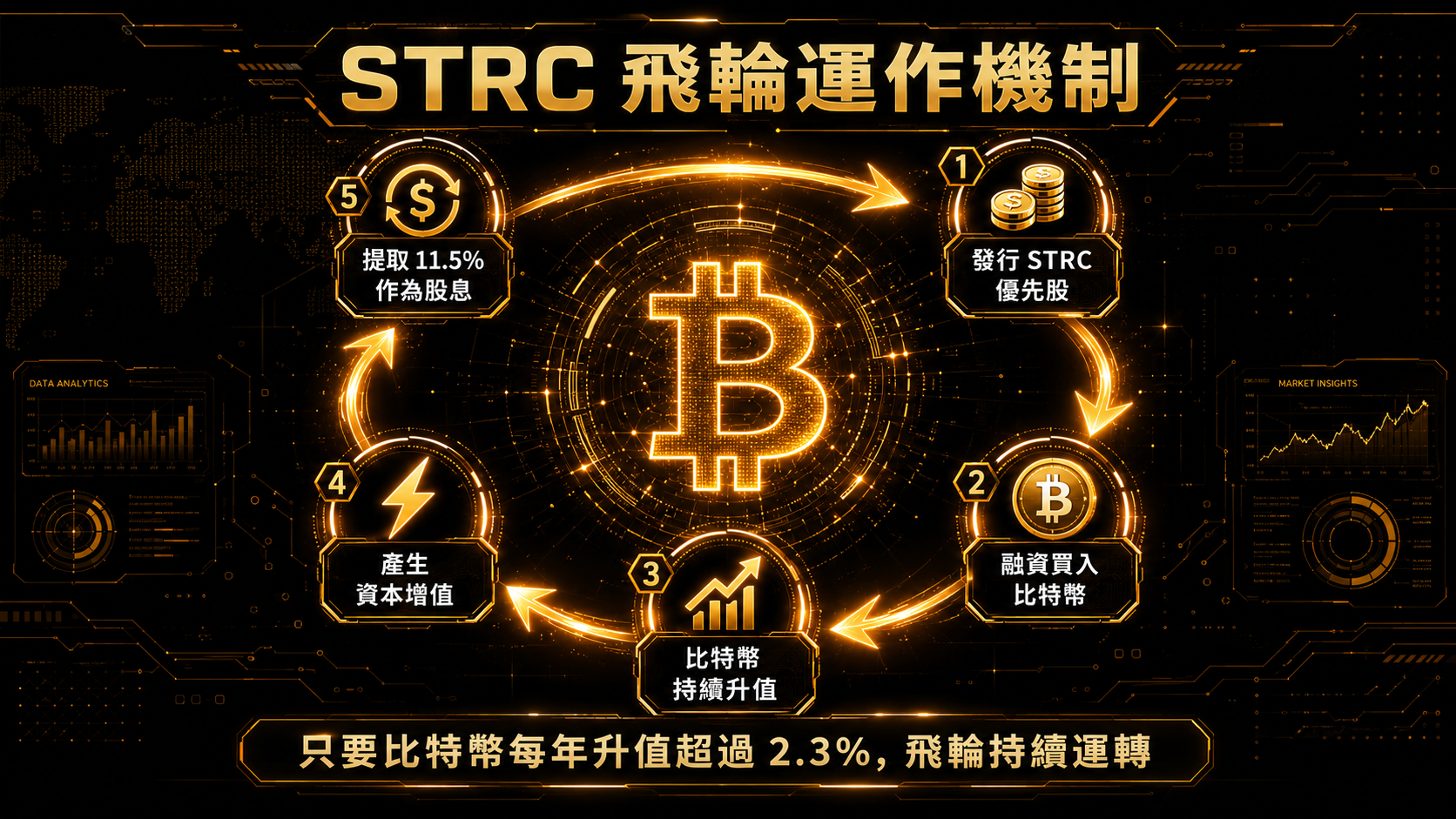
The clearest way to understand the mechanics of STRC is in the words of Michael Saylor himself. In a May 2026 interview with Bonnie Blockchain, he said, "We sold a million dollars of Stretch (STRC), and then we bought a million dollars of Bitcoin. We expect Bitcoin to appreciate by about 30% per year, and we took the first 11% of this capital appreciation and paid it out as a credit dividend."
This statement makes the whole mechanism very clear: the STRC dividend does not come out of thin air, it is Strategy's bet on the long-term appreciation of Bitcoin, and then withdraws a portion of the appreciation as a return to STRC holders. As long as the annualized appreciation of BTC is above 11.5%, the system is theoretically self-sustaining.
2.31 What is the mathematical logic of the TP3T breakeven point?
In the same interview, Saylor brought up a key number: 2.3%, which is the breakeven point for the entire system. As long as the total amount of STRC credits we issue doesn't exceed 2.3% of our BTC position, we'll still be a net buyer of BTC even if we sell BTC to pay dividends," he explained. Another way to look at it is this: as long as Bitcoin appreciates by 2.3% per year, we will always be able to pay dividends while continuing to accumulate BTC."
To illustrate with his specific figures for April: Strategy issued $3.2B in STRC in April and bought $3.2B in BTC with that money. the dividend payout for that month was around $80-90M. This means that while raising $3.2 billion, less than 3% was spent on dividends. The result is "buy 30 BTC, sell 1 BTC", and the net effect is still a massive accumulation of Bitcoin.
How does the $100 mechanism remain stable?
STRC has designed a self-adjusting mechanism: when STRC is trading above $100, Strategy can lower the dividend yield, making it less attractive to investors and bringing the price back down to near par; when STRC falls below $100, Strategy can raise the dividend yield, attracting more buyers and bringing the price back up to par.
The core purpose of this mechanism is to keep STRC's ATM program (i.e. Market Direct Issuance) operational. Only when STRC is trading near $100 can Strategy keep the wheel spinning by continually issuing new shares at par and raising money to buy BTC. Once STRC falls below $100 for an extended period of time, the ATM program stops and the funding engine dies.
mNAV is the speedometer for the entire system.
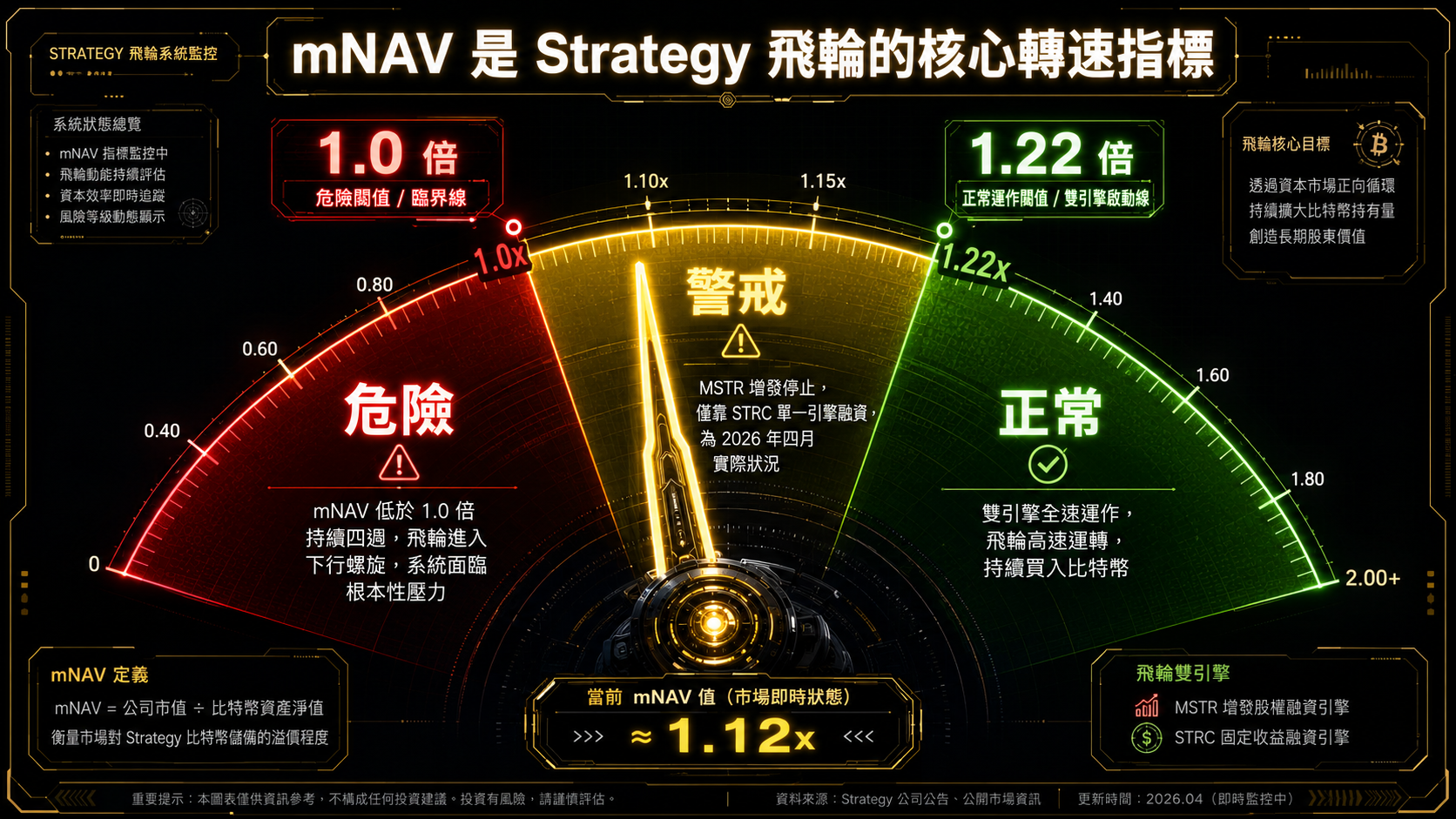
mNAV (market capitalization as a multiple of net asset value) is the most important metric for understanding the entire Strategy ecosystem. Simply put, mNAV measures how much extra premium the market is willing to pay for Strategy's "ability to hold BTC and keep buying".
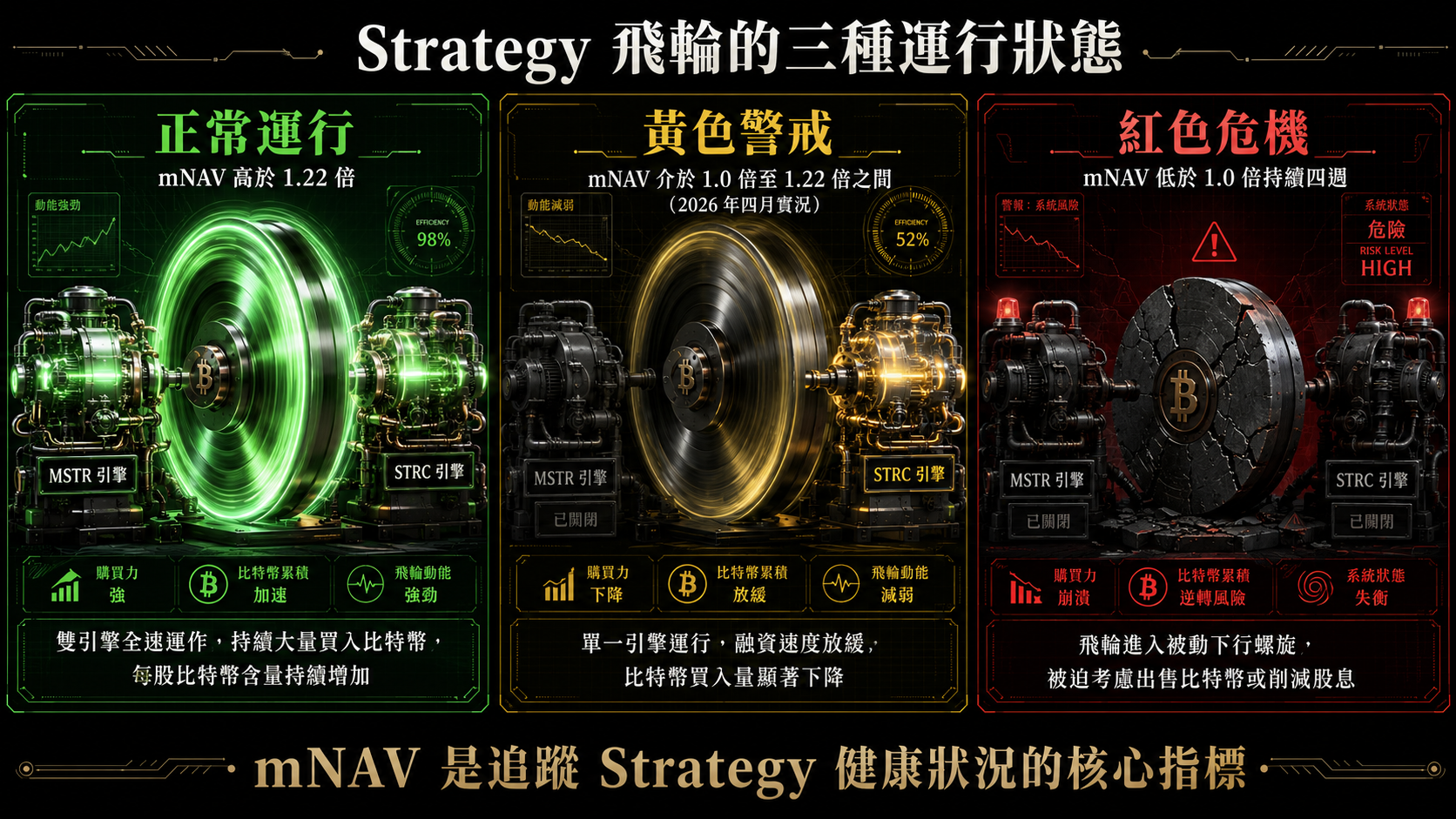
When mNAV is above 1.22x, Strategy can run two funding engines at the same time: the issuance of MSTR common stock and the issuance of STRC preferred stock. This is when the flywheel is running at its highest speed. When mNAV narrows to between 1.0 and 1.22x, issuing common stock is approaching the "selling equity at dirt-cheap prices" boundary, and Strategy relies heavily on the STRC engine - which is exactly what it was in April and May 2026, in fact. When mNAV falls below 1.0x for more than four weeks, analysts believe the entire Flyer will enter a passive downward spiral and the vulnerability of the system will be fully exposed.
Where does STRC fit into the capital structure? Where were you in the capital structure when things went wrong?
Understanding Subsidiarity with Building Levels
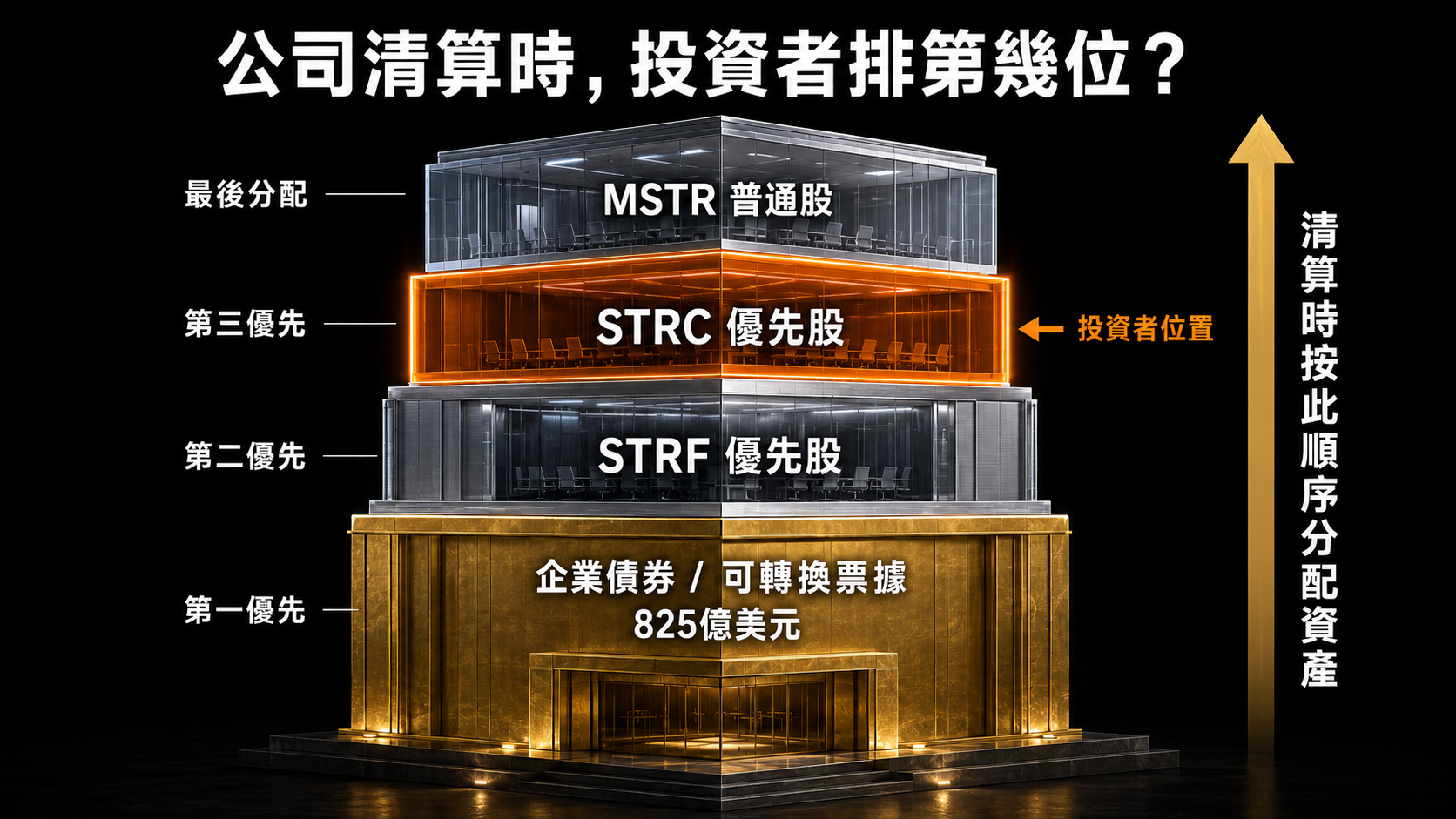
If Strategy were to fail tomorrow, its assets would be distributed to different creditors and investors in a particular order. Think of this order as a building: the lower the floors, the more people get paid first, and the higher the floors, the less people get paid, or even nothing at all.
The bottom tier (most senior) are the corporate bondholders, comprising approximately US$8.25 billion of convertible notes. They have the highest legal priority. The second tier consists of preferred shares (STRF), which are more senior than STRC. The third tier is the STRC holders. The top tier, and the last to be distributed, are MSTR common shareholders.
Importantly, Strategy's official disclosure document explicitly states that "the Company's preferred shares are not collateralized by the Company's bitcoin position and only have preferential claim to the remaining assets." This means that holding STRC does not give you a direct claim to any particular Bitcoin.
Understanding Subsidiarity with Building Levels
If Strategy were to fail tomorrow, its assets would be distributed to different creditors and investors in a particular order. Think of this order as a building: the lower the floors, the more people get paid first, and the higher the floors, the less people get paid, or even nothing at all.
The bottom tier (most senior) are the corporate bondholders, comprising approximately US$8.25 billion of convertible notes. They have the highest legal priority. The second tier consists of preferred shares (STRF), which are more senior than STRC. The third tier is the STRC holders. The top tier, and the last to be distributed, are MSTR common shareholders.
Importantly, Strategy's official disclosure document explicitly states that "the Company's preferred shares are not collateralized by the Company's bitcoin position and only have preferential claim to the remaining assets." This means that holding STRC does not give you a direct claim to any particular Bitcoin.
What are the risks of being "unsecured"?
Unsecured means that no specific asset is locked up exclusively for STRC holders. If Strategy decides to sell BTC to pay for other obligations, the STRC holder cannot prevent it. STRC holders must also be placed behind all corporate debt in the order in which BTC assets are distributed if the company is in financial distress.
This is quite different from a creditor who holds a secured loan, such as a mortgage. A secured creditor has the legal right to forfeit a particular collateral outright in the event of a borrower's default; STRC holders have no such right. Even if Strategy held $65.7 billion in BTC, STRC holders would have zero legal ability to directly claim those BTC.
Strategy can unilaterally cut the dividend, what does that mean?
This is the governance risk for which STRC is most often criticized, and why BitMEX Research calls it a "contract tailored to the company's interests". Under the terms of the STRC's design, Strategy can reduce the dividend yield by up to 25 basis points per month, a reduction that does not constitute a breach of contract and does not trigger any mandatory damages.
Theoretically, if Strategy were to consistently reduce the dividend yield for dozens of months in a row, the annualized dividend of 11.5% could be reduced to near-zero in three years, with absolutely no legal recourse available to STRC holders to stop it. The existence of this governance arrangement means that the effective yield on STRC is not fixed, but is unilaterally determined by Strategy's management based on market conditions.
Why is STRC just now showing up? What's the logic behind the timing?
The narrowing of the mNAV premium was the immediate trigger.
The fundamental reason for STRC's existence and rapid growth is that Strategy needed a funding pipeline that did not rely on mNAV premiums. At one point in late 2024, MSTR's mNAV premium was 2.6 to 2.8 times, meaning that for every dollar of MSTR stock sold, Strategy was able to trade well over a dollar of BTC appreciation. At that time, MSTR ATM was the most efficient financing tool.
But as the mNAV premium narrows, the benefits of continuing to issue MSTR common stock diminish, and the emergence of STRC allows Strategy to reach an entirely different group of investors - yield-sensitive institutional money that does not want to be exposed to equity volatility. This has allowed Strategy to continue to finance the purchase of BTC even in a bear market environment where mNAV premiums are low.
How STRC Became the Largest Preferred Stock in the U.S. in Just Eight Months
STRC went public in July 2025 at an initial interest rate of 9%. By the first quarter of 2026, Strategy had raised $5.6 billion through STRC, and with an additional $4.32 billion from April to early May, STRC grew from zero to approximately $8.5 billion in size in less than nine months.
At the Q1 2026 earnings release, Strategy CEO Phong Le revealed that STRC's average daily volume this year reached $375 million, with volatility controlled within 3%. Even more shocking to the market, Saylor directly stated in the Bonnie Blockchain interview, "We issued 60% of preferred stock across the U.S. this year, and we were the largest credit issuer in the U.S. last year and this year." This figure is a visual illustration of the systemic scale of STRC.
Extended Reading:
2026 FTSE BULLETINS Tutorials|Opening an Account, Depositing and Withdrawing Funds, Buying Coins
Fidelity Cryptocurrency Deposit and Withdrawal Tutorial 2026: Complete Guide on How to Add and Withdraw Coins to Hot and Cold Wallets
Recent Recent Posts:
2026 Latest 6 Free Coin Ring Tools Inventory|Where to find the data on the chain?
2025 Latest OKX Web3 Wallet Tutorial: Does it work? How to create it? A Guide to Safe Operation, Multi-Link Support, and Time-Limited Airdrops
2026 Latest Polymarket Tutorial|How to find out the insiders and realize the high win rate!
2025 New DeFi Beginner's Guide|Teaching you to earn stable money passive income! Introducing 3 popular programs, DeFiLlama tool tutorial!
Under what circumstances will the entire flywheel stop spinning?
How much does BTC need to go up per year to be enough?
The clearest way to understand the risks of STRC is to start with the necessary conditions. According to Saylor's own framework, BTC's annual appreciation of 2.3% is the minimum threshold below which the system can sustain itself. Below that, Strategy's BTC asset appreciation cannot cover the ongoing dividend obligation, and the system begins to deplete its cash reserves.
Strategy currently holds US$2.25 billion in cash reserves, which have been set aside specifically for the payment of preference share dividends. Based on an annual dividend obligation of about $1.5 billion, this reserve would last about 18 to 22 months. In other words, even if BTC were to stop rising altogether, the system would have a cushion of almost two years, rather than an immediate crash. The real stress test would be if BTC were in a prolonged downturn and funding channels were narrowing at the same time.
Three indicators that must be monitored simultaneously
The first indicator is the mNAV level. When the mNAV is above 1.22x, the system is running on both engines. When mNAV falls between 1.0 and 1.22x, the system relies heavily on the STRC single-engine operation (this was the actual situation in April 2026, when MSTR ATM had zero one-week issuance and was fully funded by the STRC). When mNAV remains below 1.0x for more than four weeks, analysts generally believe the system will enter a passive downward spiral.
The second indicator is STRC par stability. The ATM program can only operate if the STRC trades near $100. According to K33 Research's analysis, STRC goes ex-dividend on the 15th of every month, after which the price will briefly drop to $99.3-$99.4, and then gradually rise back to par within one to two weeks. Strategy can only restart ATM issuance and buy BTC after the STRC rises back to par, resulting in regular buying in the middle of every month.
The third indicator is whether the annualized appreciation of BTC consistently exceeds 2.3%, which is the fundamental underlying assumption. As long as this condition holds and the capital markets remain open, the system is mathematically self-sustaining.
STRC Issue Caps Approaching
According to Strategy's official disclosure, STRC's current ATM authorization limit is approximately US$28.3 billion. As of early May 2026, STRC had reached approximately US$8.5 billion, leaving room for approximately US$19.8 billion. At the current rate of growth, this cap could be reached between the second half of 2026 and early 2027. At that point, the STRC engine will also reach its ceiling unless shareholders vote to extend the authorization.
Another potential pressure that must be mentioned is the maturity of the convertible bonds; Strategy currently holds about $8.25 billion of convertible notes, which will enter a large maturity window starting from September 2027, with an even larger maturity in 2028, and if the BTC price is not strong enough by then, MSTR shares will not be strong enough to meet the maturity of the bonds. If the BTC price is not high enough and the MSTR stock price is not strong enough by then, Strategy will face the dual cash pressure of dividend obligations and debt maturity.
How can Hong Kong investors buy STRC or MSTR?
STRC, listed on Nasdaq under the symbol STRC.US, can be traded directly through FTNB without the need to open an additional offshore account or use a complicated cross-border platform. As a licensed broker in Hong Kong (SFC License CE No.: AZT137), FTNB offers a complete range of U.S. stock trading services, with a minimum transaction fee of US$1.99 per transaction, and supports direct deposit in Hong Kong dollars.
The steps to buy are very simple: after opening an account with Fortis, enter "STRC" in the search box to view real-time quotes and place an order. Currently, STRC is traded near the $100 par value, with an average daily turnover of hundreds of millions of dollars, so you don't have to worry about large bid-ask spreads.

If you don't have a Fortress account yet, we recommend you to use our exclusive invitation code first. MBHKFT Register to open an account and take away the HKD200 cash coupon first! Remember to register your account at Futura App Enter the Invitation Code at "My" > "Event Center" > "Redemption Center" and you will be rewarded after successfully opening an account!
Extended Reading:
2026 FTSE BULLETINS Tutorials|Opening an Account, Depositing and Withdrawing Funds, Buying Coins
Fidelity Cryptocurrency Deposit and Withdrawal Tutorial 2026: Complete Guide on How to Add and Withdraw Coins to Hot and Cold Wallets
If you need to know the complete account opening process of Futura, please refer to FTSE Bull Account Opening TutorialThe program includes step-by-step illustrated instructions.
MSTR can also be traded on FTNB. If after reading this article you decide that you prefer to hold MSTR ordinary shares (enjoying the amplification effect of BTC's rise, but at the same time bearing greater volatility), FTNB can also trade MSTR.US directly, with the exact same operation process!
Real-time price quotes, financial data and news information of the two stocks are fully presented on the FUTURE platform, making it convenient for investors to keep track of them.

Conclusion: STRC is, by its very nature, a structural bet on the long-term fate of BTC.
After understanding STRC, you will realize that all the questions ultimately lead to the same fundamental question: Do you believe that Bitcoin will continue to appreciate?
STRC exists as a way for Michael Saylor to take the belief that Bitcoin is the best quality capital and turn it into a financial infrastructure that generates monthly cash flow. It strips away much of the volatility of Bitcoin and extracts a fixed rate of return, allowing institutional capital that would otherwise not be able to withstand high volatility to participate in the Bitcoin ecosystem in an indirect way.
The design itself is ingenious, but ingenuity does not mean no risk. What STRC holders are really exposed to is three layers of overlapping risk: the fundamental risk of a Bitcoin downturn, the risk of unilateral adjustments to Strategy's governance structure, and the structural vulnerability of the entire inverted wheel in the face of shaky market confidence.
Those who understand these three layers of risk see in STRCs the birth of a new asset class. Those who do not understand these three layers of risk see in STRCs a stable dividend-paying income vehicle. The gap between these two understandings is precisely what makes STRCs the most interesting to understand in this market cycle.
If you don't have a Fortress account yet, we recommend you to use our exclusive invitation code first. MBHKFT Register to open an account and take away the HKD200 cash coupon first! Remember to register your account at Futura App Enter the Invitation Code at "My" > "Event Center" > "Redemption Center" and you will be rewarded after successfully opening an account!
Extended Reading:
2026 FTSE BULLETINS Tutorials|Opening an Account, Depositing and Withdrawing Funds, Buying Coins
Fidelity Cryptocurrency Deposit and Withdrawal Tutorial 2026: Complete Guide on How to Add and Withdraw Coins to Hot and Cold Wallets
Disclaimer
The content of this article is for reference only, investors should exercise independent judgment, invest with caution and at their own risk, this article does not provide or attempt to persuade viewers to trade or invest on the basis of the content of this article is for sharing purposes only, and should not be regarded as investment advice, and does not represent the Monsterblockhk viewpoints and positions, all information and views of the specific date of the judgment of the time-limited nature. In addition, if any content in this website involves virtual asset trading platforms that have not yet obtained a license to operate virtual asset trading platforms in Hong Kong, including but not limited to text introductions, pictures, promotions, events, etc., they are only available to users outside of the Hong Kong Special Administrative Region.
According to the Hong Kong Anti-Money Laundering and Counter-Terrorist Financing (Amendment) Ordinance 2022, after June 1, 2023, all centralized virtual asset trading platforms operating in Hong Kong or actively promoting their services to Hong Kong investors will be licensed and regulated by the SFC, and any related unlicensed activities will be a criminal offence. For more information and details of the legislation, users may refer to the SFC website.