

Currency Security Research has released a full-year report summarizing the characteristics that will define the cryptocurrency market in 2025 and outlining the themes for 2026. This article is a summary of the report's most practical decision points, highlighting structural signals: a clearer regulatory framework, expanding institutional participation, the scaling up of stablecoins as settlement infrastructure, the maturation of DeFi into a cash flow generator, and the transition of tokenization from a pilot program to a real-world operational process. Read the full report here.
Key Points
- Coin Security Research's 2025 review shows that cryptocurrencies are continuing to industrialize: regulation, stable coin settlement tracks, institutional participation, and cash flow generation are as important as price volatility.
- Bitcoin is becoming more and more of a macro-asset, with demand and liquidity flowing through regulated channels such as spot ETFs and corporate treasuries, even as underlying activity indicators weaken.
- The report's 2026 outlook is shaped by a more positive policy environment and maturing on-chain 'workhorses' - stable currencies, revenue-generating DeFi, tokenized real-world assets, and apps with user relationships.
2025: Structural Progress, Macro-Driven Markets
The year 2025 brought milestones and market ups and downs. For the first time, the total market capitalization of cryptocurrencies exceeded $4 trillion, and Bitcoin reached a new high of $126k. At the same time, macro uncertainty - monetary policy, trade tensions and geopolitical risks - dominated market behavior. Coin Research describes the year as one of "data fog," including the new U.S. administration, the tariff shock of Liberation Day, and government shutdowns that blurred economic signals. Cryptocurrencies traded in a wide range, with total market capitalization oscillating between approximately $2.4 trillion and $4.2 trillion, ending the year down approximately 7.9%.
The optimistic reading is that structural progress continues even if prices do not cooperate - this is the most obvious signal of maturity in the report. With participation paths, clearing tracks and regulatory advances, many of the areas of strong growth are related to actual use rather than speculation.
Cryptocurrency is being industrialized
A useful theme for 2025 is industrialization: markets increasingly reward infrastructure and reliable ways to participate. Regulatory clarity, particularly in relation to stable currencies, and the expansion of regulated investment products increase the ways in which institutional and sophisticated investors can participate. At the same time, the focus of the eco-economy continues to shift towards compliant and friendly building blocks: stablecoins for settlement, tokenized treasuries for on-chain cash management, and applications that make money from repeated flows rather than one-off speculative cycles.
This is one reason why 'activity' stands alone as a weaker signal. The report repeatedly distinguishes between raw usage indicators and economic relevance: what matters is whether the network or protocol captures repeated value, generates persistent fees or revenues, and supports reliable settlements and transactions.
Bitcoin as a Macro Asset
Bitcoin 2025 shows a divergence between market demand and base level activity. btc maintains market dominance of ~58% to 60%, with a market cap of nearly $1.8 trillion, while liquidity and demand increasingly flow through off-chain financial channels.
Two figures in the report anchor the change:
- The U.S. Spot BTC ETF accumulated more than $21 billion in net inflows.
- The business holds over 1.1 million BTC, which equates to a total supply of approximately 5.5%.
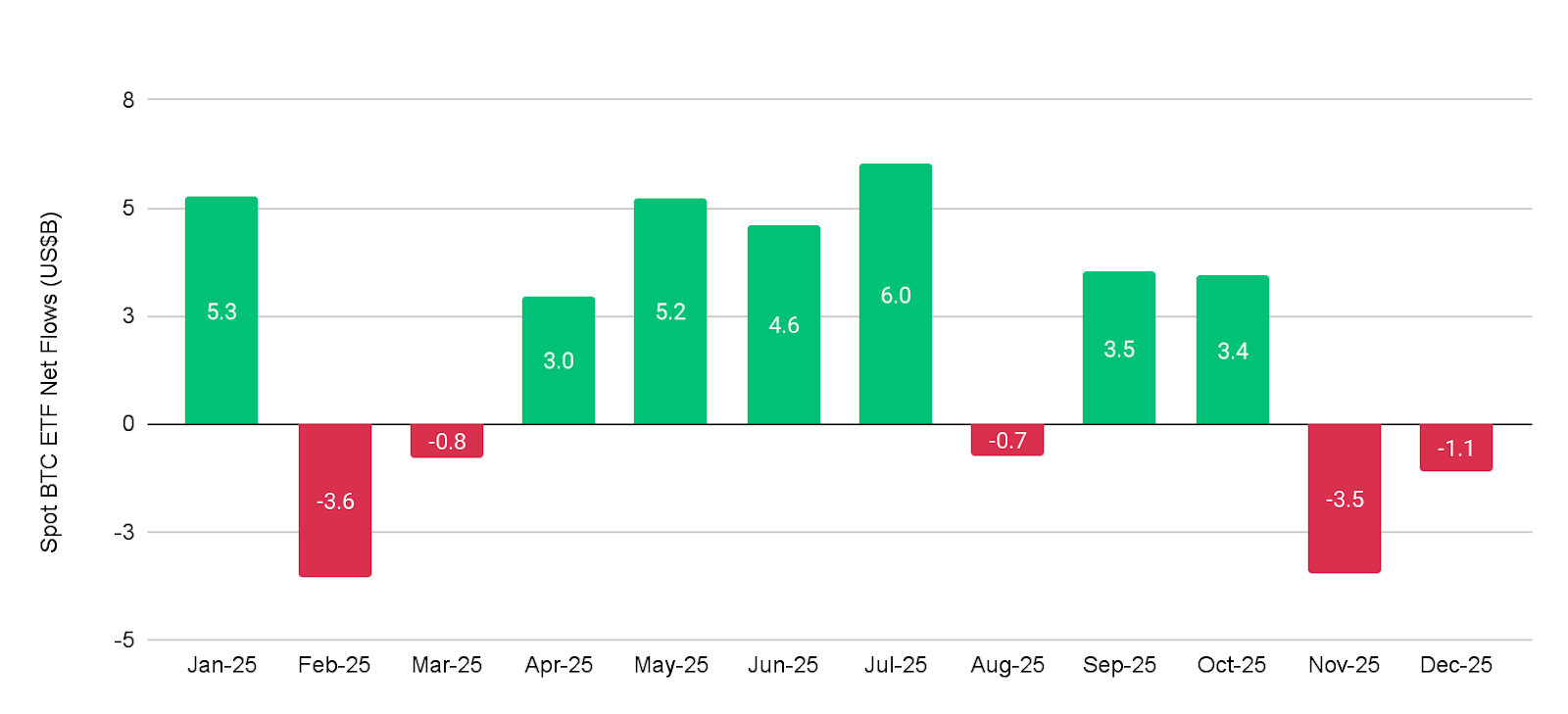
At the same time, active addresses declined by ~16% y/y, and the number of transactions remained below the pre-cycle peak. The point is not that the base layer is irrelevant, but that the role of the Bitcoin market is increasingly defined by its trading and holdings in macro portfolios and regulated channels. Cybersecurity continues to be strengthened - hash rate exceeds 1 zeta hash per second, mining difficulty rises by ~36% y/y - reinforcing the idea of continuing to invest in a secure budget for Bitcoin, even as usage metrics normalize.
In short, Bitcoin is moving towards a more liquid, institutional-grade macro asset rather than a purely transaction-oriented network.
Recent Recent Posts:
2026 Latest 6 Free Coin Ring Tools Inventory|Where to find the data on the chain?
2025 Latest OKX Web3 Wallet Tutorial: Does it work? How to create it? A Guide to Safe Operation, Multi-Link Support, and Time-Limited Airdrops
2026 Latest Polymarket Tutorial|How to find out the insiders and realize the high win rate!
2025 New DeFi Beginner's Guide|Teaching you to earn stable money passive income! Introducing 3 popular programs, DeFiLlama tool tutorial!
DeFi's "Blue Chip" Moment
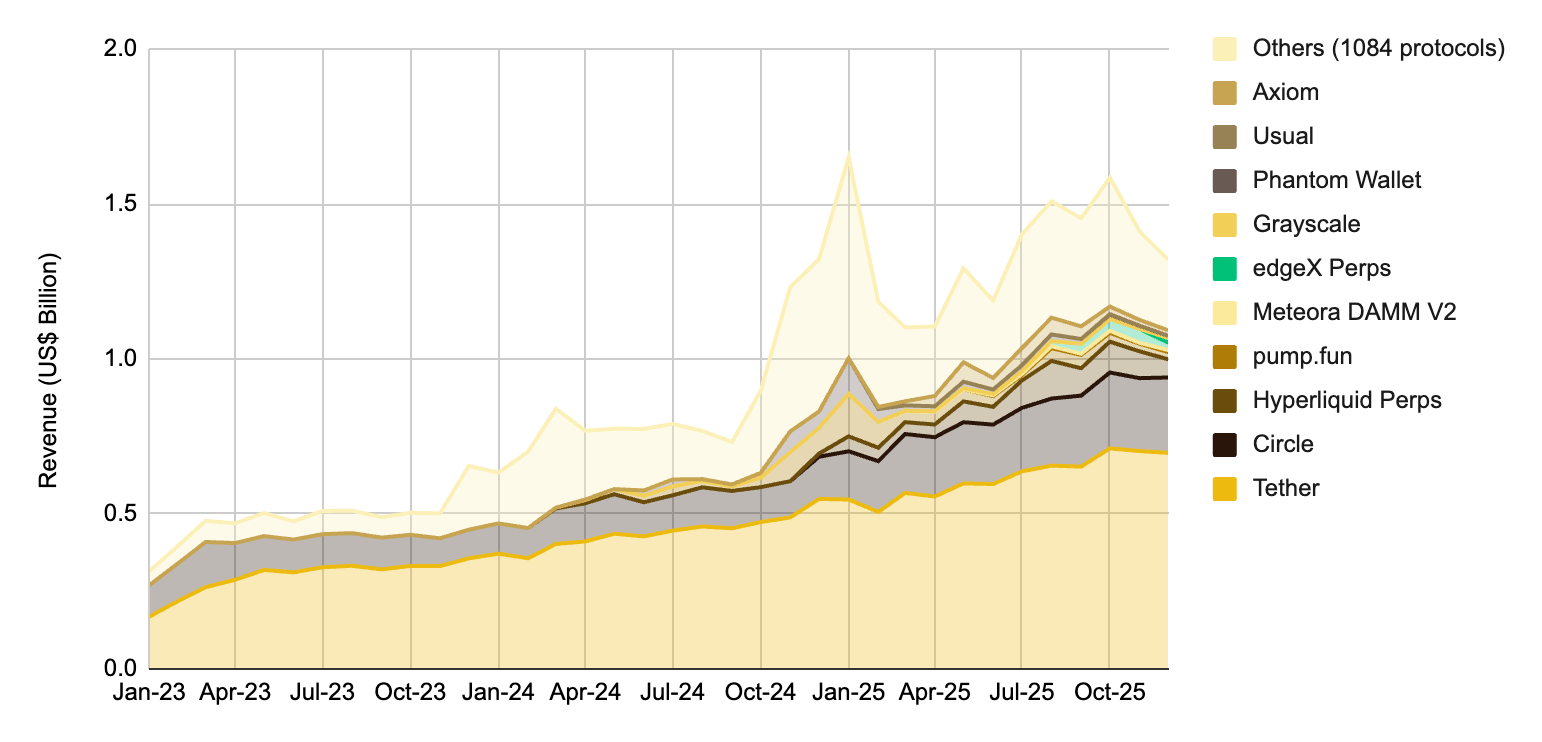
In 2025 DeFi moves further away from incentive prioritized growth and closer to capital efficiency and compliance. Total locked-in value stabilizes at ~$124.4bn, but capital composition is meaningfully shifted towards stable currencies and income-producing assets rather than inflation tokens. Parallel to this, DeFi's economic output has strengthened: agreed revenues reached $16.2bn, within a reporting framework comparable to that of major traditional financial institutions.
A major trend is the shift in tokenization from narratives to collateral. rwa's total locked-in value reached $17 billion, surpassing dex, driven by tokenized bonds and equities. This dynamic essentially changes what's behind the financials on the chain. When collateral is shifted to income-producing, real-world instruments, it makes DeFi more tied to repeatable financial demand.
The report also notes that on-chain execution continues to gain relevance, with DEX to CEX spot trading ratios peaking near 20%. While ratios fluctuate, the broader trend is for decentralized execution to become a meaningful venue for certain flows, especially as stable currencies grow and RWA collateral becomes more liquid and available.
Stabilized currency enters the era of "cyber fiat".
If there is one part of cryptocurrency that is clearly mainstreamed in 2025, it is the stablecoin, which has reliably become the clearing infrastructure.
Key points of the report on currency stabilization include:
- Total stablecoin market capitalization rose nearly 50% to over $305 billion.
- Daily trading volume averaged about $3.54 trillion.
- Annual transaction volume reached $33 trillion, about $16 trillion more than Visa.
- Regulatory clarity accelerated, led by the GENIUS Act.
- New Competition Expands Beyond Dual Monopolies: BUIDL, PYUSD, RLUSD, USD1, USDf, and USDtB each cross $1 billion in market cap.
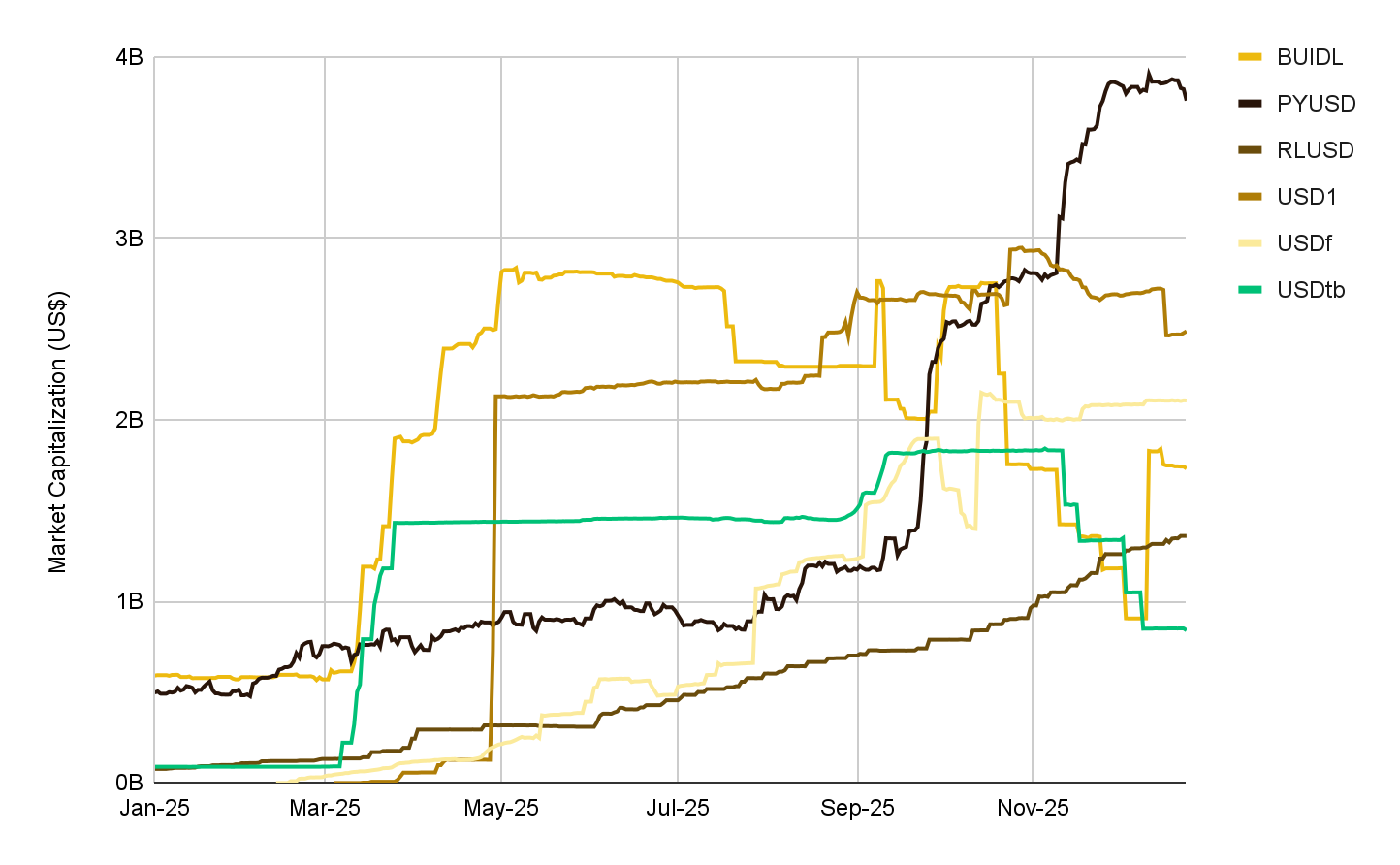
The optimistic narrative is simple: stablecoins are increasingly the default medium of exchange within the crypto market, as well as the de facto rail for cross-border settlements, payments, and fintech applications. In many cases, stablecoins allow users and businesses to access crypto tracks while abstracting away the volatility that makes newcomers hesitant.
Layer-1: Monetization as King
Across Layer-1 networks, there are not enough enhanced transactions in 2025. Many networks fail to convert activity into fees, value capture, or sustained token performance. At the same time, there is a growing fragmentation of repetitive monetizable flows such as transactions, payments and institutional clearing.
- Ether maintains developer activity, DeFi liquidity and total value dominance, but rollup execution fee compression affects ETH performance vs. BTC.
- Solana maintains high utilization, expands stablecoin supply, generates meaningful agreement revenue even as speculative wave subsides, and receives approval from U.S. spot ETFs to enhance institutional accessibility.
- BNB Chain Benefits from Strong Retail Transaction Demand and Market Narrative to Support Large Stable Currency Settlement Mobility and RWA Deployments. The report also frames BNB as the best performing major crypto asset in 2025.
Layer-2 networks account for over 90% of Ethernet-related execution in 2025, supported by upgrades to reduce data availability costs. Activity and fees are concentrated in a few rollups such as Base and Arbitrum, while many others have faded due to declining incentives. Slicing and uneven sorter decentralization of over 100 rollups remains a limitation, reinforcing another 2026 theme: value capture may move "upstream" to the application layer that owns the user relationship, rather than remaining at the blockspace layer.
Outlook 2026: Risk Reactivation and Adoption-Oriented Growth
The report's 2026 outlook frames a more proactive policy environment and a shift towards adoption-led growth.
At the macro level, a 'policy triumvirate' may support a reset of risk appetite: monetary easing, fiscal stimulus through cash and tax rebates, and deregulation. Risky assets often benefit when financial conditions are easy, and crypto has historically been highly sensitive to global liquidity impulses. The report also points to the potential of US strategic BTC reserves as a policy catalyst.
In the product and market structure, the theme is less about a single narrative and more about where durable use may be concentrated:
- PayFi: New Banking and Wallet Convergence to Generate Revenue Stabilized Currency to Support New Consumer Finance Applications.
- Institutionalization: on-chain money markets, treasury bonds and RWA settlements are embedded in the workflow.
- Value Capture: As block space becomes cheaper, applications such as wallets, aggregators, DEX and prediction markets may capture more value.
- Intelligence and AI Agent Finance: AI-driven execution, automated workflows, and trust tools.
- Prediction Market: information pricing as a proxy for opinion-oriented narratives.
In other words, 2026 may reward systems that are verifiable, compliant, and built around repeated utility.
final thoughts
In 2025, cryptocurrencies continue to progress even in the face of macro headwinds. Demand for Bitcoin increasingly flows through regulated channels, stablecoins expand into settlement infrastructure, DeFi matures into a revenue-generating industry, and tokenization moves closer to production-level finance. The 2026 outlook in the Coin Security Research report builds on these foundations: more institutional consolidation, more adoption at the application level, and the potential for macro settings to become less restrictive. For detailed charts, methodology and a complete list of 2026 topics, read the full report here.
Our Telegram Community Prediction Market is a special forum where members share daily updates on market opportunities and events to help you avoid blind betting and quickly adjust your strategy, join us now!
Recent Recent Posts:
2026 Latest 6 Free Coin Ring Tools Inventory|Where to find the data on the chain?
2025 Latest OKX Web3 Wallet Tutorial: Does it work? How to create it? A Guide to Safe Operation, Multi-Link Support, and Time-Limited Airdrops
2026 Latest Polymarket Tutorial|How to find out the insiders and realize the high win rate!
2025 New DeFi Beginner's Guide|Teaching you to earn stable money passive income! Introducing 3 popular programs, DeFiLlama tool tutorial!
Disclaimer
The content of this article is for reference only, investors should exercise independent judgment, invest prudently and at their own risk, this article does not provide or attempt to persuade the audience to do trading or investment basis, the content is for sharing purposes only, and should not be regarded as investment advice.It does not represent the views and position of Monsterblockhk.All information and opinions are current as of the date of the judgment. In addition, if a judgment is rendered on aIn this siteAny content related to virtual asset trading platforms that have not yet obtained a license to operate virtual asset trading platforms in Hong Kong, including but not limited to text introductions, pictures, offers, events, etc., are only available to users outside the Hong Kong Special Administrative Region.
According to the Hong Kong Anti-Money Laundering and Counter-Terrorist Financing (Amendment) Ordinance 2022, after June 1, 2023, all centralized virtual asset trading platforms operating in Hong Kong or actively promoting their services to Hong Kong investors will be licensed and regulated by the SFC, and any related unlicensed activities will be a criminal offence. For more information and details of the legislation, users may refer to the SFC website.